
What PSI Should Motorcycle Tires Be? A Rider’s Honest Guide to Getting It Right
 Jake Miller
5 min read
Jake Miller
5 min read
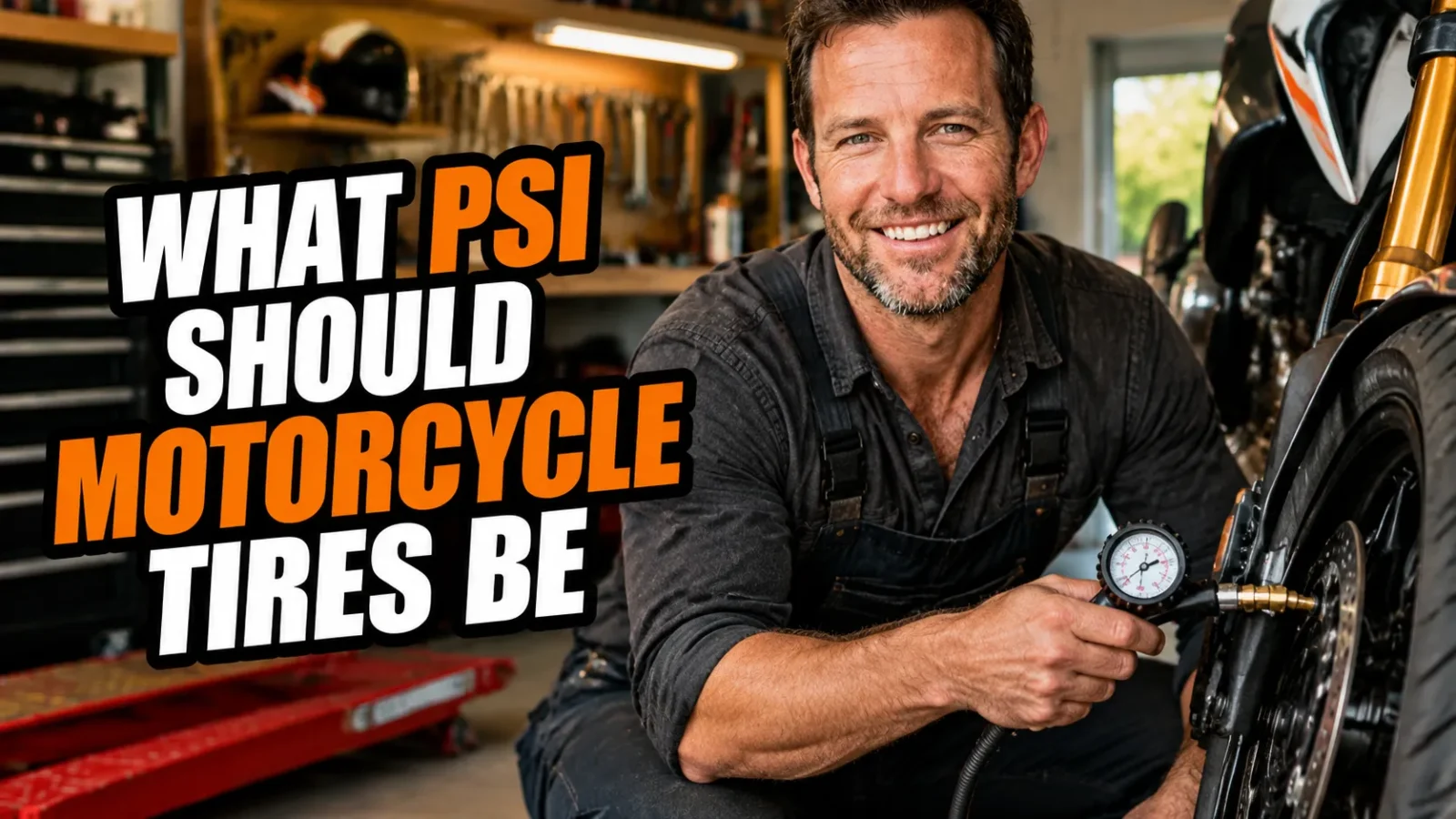
I still remember the first time I checked my tire pressure with a proper gauge instead of the “kick the tire and hope” method an older rider taught me. My front tire was sitting at 24 psi. I’d been riding it that way for weeks, convinced the bike was just naturally twitchy.
That single discovery changed how I think about motorcycle maintenance. Tire pressure is the most impactful adjustment you can make to how your bike handles, stops, and wears through rubber, and it costs you nothing but thirty seconds at a gas station.
So let me answer the question directly, then walk you through everything I’ve learned across sportbikes, cruisers, touring rigs, and a couple of dirt bikes that spent more time on their sides than upright.
- Most street bikes want 32-36 psi front and 36-42 psi rear, cold.
- The number on the sidewall is a maximum, never a target. Trust your owner’s manual.
- “Cold” means before you’ve ridden, or at least three hours after your last ride.
- Check pressure weekly and before every long trip. A few psi off is genuinely noticeable.
- Load, temperature, and terrain all shift the ideal number, sometimes by 5 psi or more.
Why Tire Pressure Matters More Than Most Riders Realize
Your tires are the only thing connecting you to the road. Every braking force, every cornering load, and every bit of acceleration passes through a contact patch roughly the size of a credit card.
Change the pressure inside that tire and you change the shape of that patch. Lower pressure means a bigger, flatter footprint. Higher pressure means a smaller, rounder one. Both have consequences.
I’ve ridden bikes that felt like completely different machines after adding six psi to the front tire. Steering sharpened up, the vague wandering disappeared, and the front stopped feeling like it was searching for grip. That’s how much this matters.
Grip, Wear, and Heat All Hang in the Balance
Underinflation lets the tire flex more than it was designed to. That flex generates heat, and heat is what kills tires. It also wears the shoulders of the tread faster and makes the bike feel sluggish to turn in.
Overinflation is the opposite problem. The tire runs cooler, but the contact patch shrinks, ride quality gets harsh, and you wear out the center of the tread long before the edges. On a wet road, that reduced footprint is genuinely unnerving.
Where Your PSI Should Actually Land
Here’s the honest answer: there is no single magic number. It depends on your bike, your tires, and how you’re riding. But I can give you realistic starting points based on what I’ve run and what manufacturers commonly recommend.
Cruisers and Touring Bikes
Cruisers are heavy and often carry luggage or a passenger, so they run higher rear pressures. I typically run 32-36 psi front and 36-42 psi rear on a big cruiser. When I’m loaded up for a multi-day trip, I push the rear toward the top of that range.
Touring bikes are similar but often spec slightly higher due to weight. If you’re two-up with full panniers, don’t be shy about running the maximum recommended pressure in the rear.
Sportbikes and Sport-Tourers
For spirited street riding, I run 34-36 psi front and 36-38 psi rear. That’s a sweet spot: enough pressure to keep the tire from squirming under hard braking, but not so much that I lose feel at the front.
Some manufacturers spec as low as 32 psi front on sportbikes. Try both. I promise you’ll feel the difference within the first mile.
Adventure and Dual-Sport Bikes
This is where things get fun, because the right number changes based on whether you’re on pavement or dirt. On the street, I run 30-34 psi front and 32-38 psi rear. The moment I hit gravel or sand, I drop to 22-26 psi for a much larger contact patch.
Just remember that low pressures on knobby tires and pavement will chew through your tread quickly. Air back up before you hit the highway.
Dirt Bikes and Track Machines
Pure dirt bikes typically run 12-15 psi, sometimes lower in sand or mud. Track bikes are a whole different discipline, usually 28-32 psi front and 26-30 psi rear depending on tire construction and whether you’re using warmers.
If you’re doing track days, get your pressures from the tire vendor at the track. They know their compound far better than any manual does.
A quick word about that number on the sidewall
That big “42 PSI” molded into your sidewall is the maximum cold inflation pressure the tire is rated to hold. It is not a recommendation. It has nothing to do with your specific bike’s weight distribution or suspension setup.
I’ve met riders who inflate to the sidewall number because “that’s what the tire says.” Please don’t. Your owner’s manual and the sticker on your swingarm are the real sources.
Cold Pressure vs. Hot Pressure: What “Cold” Really Means
Every manufacturer specification you’ll ever read is a cold pressure. Cold means the tire hasn’t been ridden in the last few hours, ideally overnight, and it’s sitting at ambient temperature.
Once you ride, friction heats the tire and pressure climbs. It’s completely normal to see a 3-5 psi increase after twenty minutes of hard riding. That’s the tire working as designed, not a problem to fix.
This is why you never bleed air out of a hot tire to hit a cold target. If you do, you’ll be riding around on an underinflated tire once it cools down. Set it cold, then leave it alone.
The Temperature Rule I Use
Pressure drops roughly 1 psi for every 10°F drop in ambient temperature. So if I set my tires perfectly
Frequently Asked Questions
What PSI should motorcycle tires be for normal street riding?
Most street bikes land between 32 and 36 psi in the front and 36 and 42 psi in the rear. Your owner’s manual is the final word, but that range covers cruisers, sportbikes, and touring bikes riding solo with light luggage.
Should I use the PSI printed on the tire sidewall?
No. That number is the maximum cold pressure the tire can safely hold, not a recommendation for your bike. It ignores your bike’s weight, suspension, and load. Always start with the owner’s manual figure.
Does tire pressure change with temperature?
Yes. Tire pressure drops roughly 1 psi for every 10°F (5.5°C) drop in ambient temperature. That’s why a tire that felt fine in August can feel vague on a cold October morning. Check pressure more often in spring and fall.
How often should I check my motorcycle tire pressure?
I check mine weekly and always before a long ride or a track day. Tires can lose 1 to 2 psi per month through normal permeation, and slow punctures are far more common than riders expect.

Related Articles

8 Best Cruiser Motorcycle Tires for Street Riding: My Real-World Picks
I rank the 8 best cruiser motorcycle tires for street riding, from Michelin to Pirelli, with real notes on grip,…
Jake Miller
9 min read

8 Best Michelin Motorcycle Tires for Every Riding Style (Tested Picks)
Looking for the best Michelin motorcycle tires? I break down my 8 favorite models for sport, touring, adventure, cruiser, and…
Jake Miller
9 min read

Yamaha Tire Pressure Guide: The Right PSI for Safer, Smoother Rides
Learn the right tire pressure for your Yamaha, from sportbikes to cruisers and dirt bikes. Check, adjust and maintain PSI…
Jake Miller
9 min read