
11 Best Footwear Options for Motorcycle Riding, Ranked by a Rider Who’s Worn Them All
 Jake Miller
10 min read
Jake Miller
10 min read
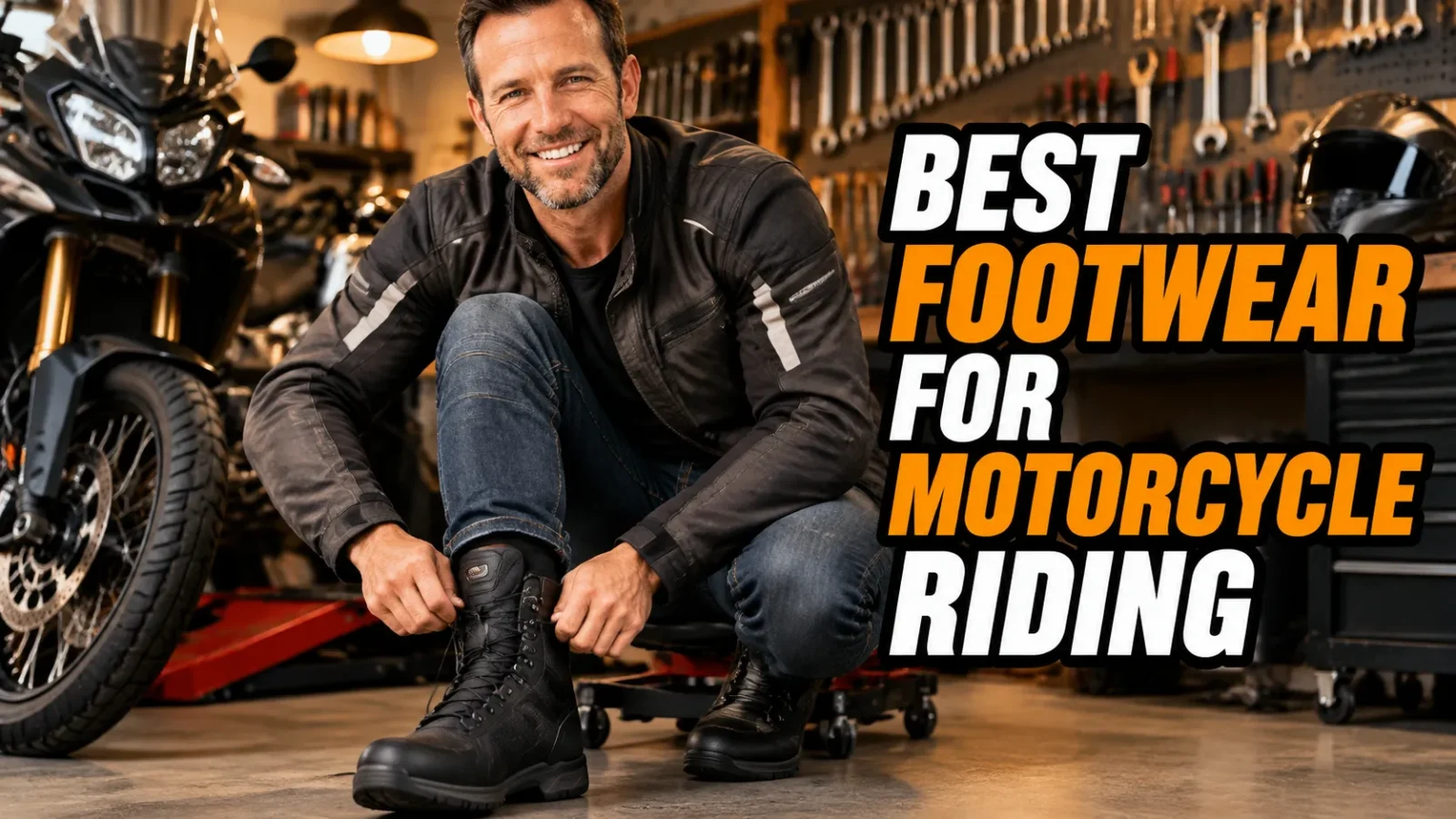
My gear closet looks like a boot museum. Race boots, adventure boots, a pair of oiled-leather retro boots I bought because they photographed well, and a scuffed set of work boots that have covered more miles than some of my bikes. Over the years I’ve learned that your feet are one of the first things to hit the ground in a crash, and one of the last things you think about when you’re shopping for gear.
So I put together this list the way I’d talk to a friend at a gas station. Every pick below is a real, currently available boot that I’ve either owned, borrowed for a few hundred miles, or spent enough time handling in a shop to form an opinion. If you want the deep technical background first, start with my Ultimate Guide to Motorcycle Boots and then come back here for the shortlist.
- My overall pick for street and sport riding is the Alpinestars SMX-6 V2 — CE certified, armored, and priced sanely.
- For gravel, dirt, and long-distance touring, the Sidi Adventure 2 Gore-Tex is worth every dollar.
- If you want one boot that looks normal off the bike, grab the TCX Street Ace WP.
- Skip anything without CE EN 13634 certification and real ankle coverage. Fashion boots are not riding boots.
- Budget about $180 to $260 for a solid first pair, and more if you want Gore-Tex and resolable construction.
What I Actually Look For Before I Spend Money
Before we get into the list, here’s the filter I run every boot through. It saves me from impulse buys, and it should save you too.
Certification and Armor
Look for CE EN 13634 certification. That standard tests abrasion resistance, impact cut resistance, and transverse rigidity, which is a fancy way of saying the sole won’t fold like a taco under your foot. Anything without it is a costume.
I also want a rigid heel cup, a reinforced toe box, and some kind of ankle disc or insert. That’s the stuff that matters when 400 pounds of motorcycle decides to lie down on your leg.
Waterproofing and Real-World Comfort
A Gore-Tex or similar membrane turns a miserable rainy commute into a non-event. It also keeps the boot from getting funky, because a soaked leather boot smells like a wet dog by Thursday.
Then there’s walkability. I ride to work, so I need to walk into a building without sounding like a tap dancer. That’s why my list has everything from full race boots to sneaker-style commuters.
1. Alpinestars SMX-6 V2 — Best Overall Street and Sport Boot
If I had to recommend one boot to a new rider who mostly rides paved roads, this is it. The Alpinestars SMX-6 V2 is the sweet spot between protection and price, and it’s been a staple of the best motorcycle riding boots conversation for years.
The upper is a microfiber and mesh blend, which is lighter than full leather but still abrasion resistant. You get a TPU shin plate, a TPU calf protector, a reinforced heel, and a replaceable heel slider. The ankle has dual-density protection on both sides.
What I like most is the fit. It’s snug without being a torture device, and the accordion flex zones let my ankle actually move when I’m walking around a parking lot. There’s also a Drystar waterproof version if you ride in the rain.
Price lands somewhere around $230 to $260 depending on the version and sales. Sizing runs from about EU 36 to 50, so most riders will find a fit.
Who It’s For
Commuters, canyon riders, and anyone doing their first track day. If you want one pair of boots to cover 80 percent of riding situations, this is the one I’d hand you.
2. Sidi Adventure 2 Gore-Tex — Best Adventure Boot
I’ve watched these things get submerged in creek crossings, kicked through rock gardens, and still look presentable at a gas station. The Sidi Adventure 2 Gore-Tex is the benchmark for Best Motorcycle Boots for Adventure Riding, and I don’t think that’s controversial.
The upper uses Sidi’s Technomicro microfiber with a Gore-Tex membrane underneath, so it’s fully waterproof but still breathes. There are four buckles plus a velcro closure at the top, which means you can cinch the calf down and keep grit out.
Protection-wise you get a PU shin plate, rigid ankle supports on both sides, a reinforced toe, and a nylon inner sole that stays stiff. The sole itself has a lugged tread pattern that actually bites into mud and gravel.
The catch is price. Expect to pay around $450 to $525, and they’re heavy. But these are the boots I’d trust on a multi-week trip through Utah or Patagonia.
3. Daytona Road Star GTX — Best Premium Touring Boot
Daytona is a German company that still hand-makes boots, and the Road Star GTX is the touring flagship. It costs more than most people’s first motorcycle, and I still think it’s worth mentioning because nothing else in this category lasts like it.
You get full-grain leather, a Gore-Tex membrane, and Daytona’s speed-lacing system with a zip on the side. There’s a rigid ankle protection system built into the shell, plus a reinforced gear-shift pad and a heat-resistant inner lining.
What really sets it apart is that Daytona will resole and rebuild them. I know riders who’ve had the same pair for over a decade, which changes the math on a $500 boot considerably.
4. TCX Street Ace WP — Best Casual Urban Boot
This is the boot I wear when I need to look like a normal human at the other end of the ride. The TCX Street Ace WP looks like a suede sneaker, but it’s got D3O ankle inserts, a reinforced toe and heel, and a T-Dry waterproof membrane.
Off the bike, it walks like a shoe. I’ve worn mine through airports, into restaurants, and around a grocery store without feeling like I’m clomping around in ski boots.
It runs roughly $180 to $200. That’s genuinely reasonable for a CE-certified boot with D3O inside it. If you commute and hate changing shoes at the office, this solves that problem.
5. REV’IT! Pioneer GTX — Best All-Weather Commuter Boot
REV’IT! makes gear that looks like it came out of a design studio, and the Pioneer GTX is no exception. It’s a mid-height boot with a suede and textile upper, a genuine Gore-Tex membrane, and a side zipper for quick on and off.
There’s a TPU heel and toe cap, plus a reinforced gear-shift zone. The sole is a rubber compound with a decent tread, so wet pavement doesn’t feel like ice.
At around $300 it’s not cheap, but the Gore-Tex liner is the real deal rather than a generic “water-resistant” coating that gives up after a season. I’ve ridden through multi-hour rain in these and stayed dry.
6. Sidi Canyon Gore-Tex — Best Mid-Range Touring and Adventure Hybrid
The Sidi Canyon Gore-Tex is what I recommend when someone wants adventure-boot durability without the full-height, four-buckle commitment. It’s a full-grain leather boot with a Gore-Tex membrane, two buckles, and a velcro strap across the instep.
You get a reinforced toe, a rigid heel, and ankle protection that’s a step above a casual boot. It’s also noticeably easier to walk in than the Adventure 2, which matters if your “adventure” involves a lot of sightseeing.
Expect to pay around $350 to $400. It’s the middle child of this list, and honestly it’s the one I’d buy if I could only own two pairs of boots.
7. Dainese Axial D1 — Best Track-Day Boot
When I did my first track day, I showed up in street boots and immediately understood why people spend real money on race boots. The Dainese Axial D1 is the one I’d buy if I were chasing lap times.
It uses Dainese’s D-Axial system, which is a structural ankle support that limits hyperextension in directions your ankle was never meant to go. The boot actually connects to compatible Dainese leathers via a zipper system, so the boot and suit move as one unit.
There are replaceable sliders on the toe, a magnesium slider on the heel, and an air-channel sole. It’s stiff, it squeaks when you walk, and it costs around $500. That’s the trade-off, and for track riding I’ll take it every time.
8. Forma Adventure Low — Best Short-Cut Adventure Boot
Not everyone wants a knee-high boot, and the Forma Adventure Low is my answer to that. It’s the low-cut version of Forma’s popular adventure boot, built from oiled full-grain leather with a waterproof DRYTEX membrane.
You get a reinforced toe and heel, an anti-slip rubber sole with a proper lug pattern, and CE certification. The fit is on the generous side, which is great news if you have wide feet like I do.
Price is usually around $220 to $250. I’d happily wear these on a weekend dual-sport ride or a long highway slog in the rain.
9. Stylmartin Rocket — Best Retro Leather Boot
Some of us ride bikes that deserve better than technical-looking plastic. The Stylmartin Rocket is an Italian-made full-grain leather boot with a genuinely vintage silhouette, and it doesn’t embarrass you in front of a cafe full of classic bikes.
Underneath the looks, there’s CE certification, a reinforced heel and toe, an anti-slip rubber sole, and a waterproof version if you want the membrane. Stitching quality is excellent, and the leather breaks in beautifully over a season or two.
Expect to pay around $250 to $300. It’s my pick for anyone riding a Bonneville, a Scrambler, or a classic UJM who still wants actual protection.
10. Red Wing Iron Ranger 8111 — Best Work-Boot Style Option
I’ll be upfront: this boot has no CE armor and no ankle disc. It is not a substitute for a proper riding boot, and I won’t pretend otherwise. But the Red Wing Iron Ranger 8111 is a genuinely excellent best work boots for motorcycle riding candidate for riders who refuse to wear technical gear.
You get amber harness full-grain leather, a Goodyear welt that can be resoled indefinitely, a cork midsole that molds to your foot, and a nitrile cork sole that grips pegs well. The leather is thick enough to shrug off serious abrasion.
The downsides are real: laces can catch on footpegs, there’s no rigid ankle protection, and the break-in period is measured in weeks, not days. If you’re set on this style, it’s also worth reading about best combat boots for motorcycle riding, since lace-up tactical boots share the same strengths and the same weaknesses.
11. Alpinestars Stella SMX-6 V2 Drystar — Best Women’s Riding Boot
Here’s a pet peeve of mine: a lot of “women’s” riding boots are just men’s boots in smaller sizes with a pink stripe. The Alpinestars Stella SMX-6 V2 Drystar isn’t that. The Stella line uses a women’s-specific last, so the calf, instep, and heel are shaped differently rather than just scaled down.
Tech-wise it mirrors the men’s SMX-6 V2: microfiber and mesh upper, TPU shin and calf plates, dual-density ankle protection, a replaceable heel slider, and a Drystar waterproof membrane. It’s the same protection in a fit that actually works.
Price is roughly $260 to $280. If you’re shopping this category, I’ve got a longer breakdown of best motorcycle riding boots for women worth reading before you commit.
Final Thoughts From Someone With Too Many Boots
If you take one thing away from this list, make it this: buy the boot that matches the riding you actually do, not the riding you daydream about. A track boot is miserable on a 400-mile highway day, and a retro leather boot won’t save your ankle at a track day.
My honest recommendation for most people is the Alpinestars SMX-6 V2 for street riding and the TCX Street Ace WP if you need to look normal off the bike. If you ride dirt, gravel, or long tours, stretch for the Sidi Adventure 2 Gore-Tex and never think about it again.
Whatever you choose, make sure it’s CE certified, make sure the ankle is covered, and make sure it fits snugly without cutting off circulation. Your feet will thank you the first time something goes wrong.
Frequently Asked Questions
Do I really need motorcycle-specific boots to ride?
Yes, ideally. Motorcycle boots are built to CE EN 13634 standards, which test abrasion resistance, impact cut resistance, and crush resistance. Regular sneakers or fashion boots can come off your foot in a slide or melt onto hot exhaust pipes. That said, a sturdy leather work boot is far better than flip flops.
Are motorcycle boots comfortable enough to walk in all day?
It depends on the boot. Track and race boots are stiff and awkward off the bike. Casual and urban models like the TCX Street Ace WP feel closer to a hiking shoe, so I can wear them at the office or walk a few blocks without wincing.
How much should I spend on riding footwear?
You can get a genuinely protective, CE-certified pair for around $180 to $260. Above that you are paying for Gore-Tex waterproofing, better armor, resolable construction, and handmade quality. My advice is to spend what it takes to get proper ankle coverage and a waterproof membrane.
Can I use work boots or combat boots for motorcycle riding?
Plenty of riders do, and oil-resistant soles and full-grain leather are real advantages. The trade-offs are laces that can snag on pegs, no ankle armor, and no CE certification. If that is your plan, read up on best work boots for motorcycle riding first.

Related Articles

10 Best Tennis Shoes for Motorcycle Riding: Honest Picks From a Rider Who Tried Them
I tested the best tennis shoes for motorcycle riding to find out what actually works behind the bars, plus the…
Jake Miller
10 min read

10 Best Non Riding Shoes That Actually Work on a Motorcycle
I have ridden thousands of miles in shoes that were never designed for a bike. Here are the best non…
Jake Miller
13 min read

8 Best Women’s Motorcycle Shoes for Cruisers: Rider-Tested Picks That Actually Fit
I've ridden cruisers for over a decade, and these are the best women's motorcycle shoes for a cruiser, with real…
Jake Miller
11 min read