
9 Best Work Boots for Motorcycle Riding That Won’t Kill Your Feet on Shift
 Jake Miller
12 min read
Jake Miller
12 min read
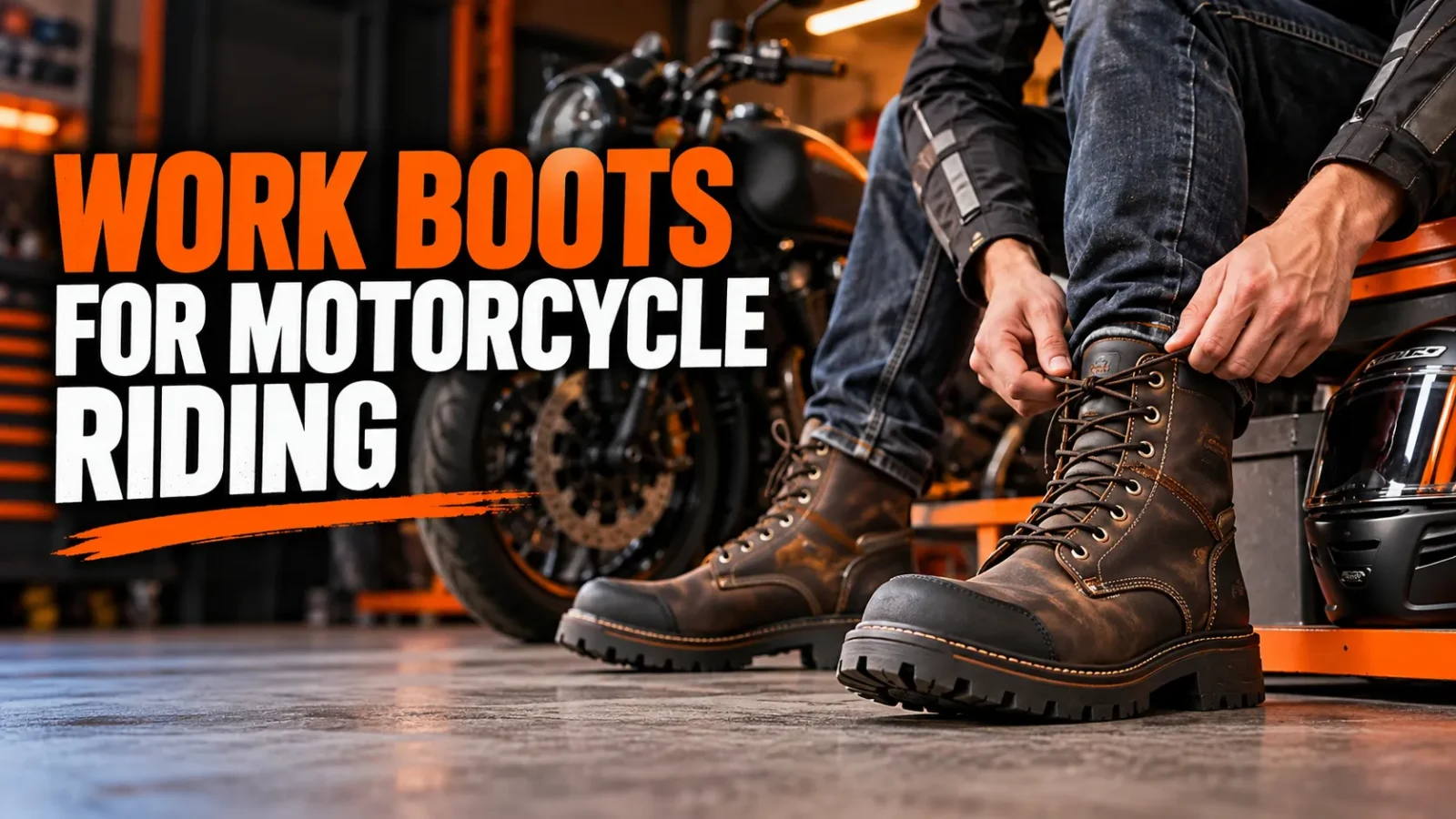
I’ve spent more mornings than I can count standing in my garage, one boot on, staring at my motorcycle and wondering if the same pair of boots that got me through a 10-hour shift on a job site could also get me home safely on two wheels. Short answer: sometimes, yes. But it took me years of trial and error (and one embarrassingly sore ankle after a low-speed tip-over) to figure out which work boots actually hold up on a bike.
This isn’t a generic “any steel toe will do” list. I’ve worn, ridden in, and beaten up every category of boot below, either on my own commute or through buddies who ride to the shop every day. If you want the deep-dive on what separates a true riding boot from a work boot, I’d also point you to my Ultimate Guide to Motorcycle Boots before you buy anything — it’ll save you money.
- My top all-around pick is the Thorogood 1957 Series Wedge Sole — it shifts smoother than almost any work boot I’ve tried.
- If you want heritage style with real ankle support, the Red Wing Iron Ranger 8111 is worth the splurge.
- For wet climates, the Timberland PRO Boondock HD and its waterproof membrane are hard to beat.
- Steel toes can be great for the job site but aren’t always ideal for shifting feel — I explain why below.
- None of these fully replace a dedicated motorcycle boot for serious protection, so weigh your priorities before buying.
1. Thorogood 1957 Series Wedge Sole — Best Overall for Riding to Work
The Thorogood 1957 Series Wedge Sole is the boot I recommend first to anyone who rides a bike to a job site. The wedge sole (instead of a traditional heeled sole) means there’s no lip to catch on your peg, and shifting feels almost natural compared to most work boots.
It’s built with full-grain leather, a Goodyear welt construction, and a moc toe that gives your foot room to flex. Mine have lasted over three years of daily wear, including plenty of miles on my Sportster.
At around $190–$220, it’s not the cheapest option here, but the comfort-to-durability ratio is genuinely excellent. If you’re deciding between a work boot and a purpose-built riding boot, this is the closest bridge I’ve found — and it’s a good jumping-off point if you want to read my full motorcycle boots vs work boots comparison.
Why it works on a bike
The low heel and rounded wedge sole let you find the shift lever by feel, not by guessing. I also appreciate that it doesn’t feel like I’m dragging bricks around when I’m walking a job site all day, then riding home.
2. Red Wing Iron Ranger 8111 — Best Heritage Boot with Real Ankle Support
The Red Wing Iron Ranger 8111 is a classic for a reason. It’s got a six-inch shaft that actually covers your ankle bone, which matters a lot more on a bike than most people realize.
Made from Red Wing’s Amber Harness leather with a nitrile cork sole, this boot is stiff when new but molds to your foot over a few weeks. That stiffness, once broken in, gives you noticeably more lateral support than a soft-sided work boot.
Expect to pay $300–$330, which is steep, but Red Wing boots are resoleable, so the investment stretches over a decade of wear if you take care of them. I’ve had mine resoled once already after two years of near-daily riding and work use.
Where it falls short
It’s not waterproof out of the box, so budget for a leather conditioner or wax treatment if you’re riding in the rain often. It’s also on the heavier side, which some riders love for the planted feel and others find fatiguing on long days.
3. Danner Bull Run Moc Toe — Best for Safety-Toe Requirements
If your job site actually mandates a safety toe, the Danner Bull Run Moc Toe is my go-to recommendation. It comes in both soft-toe and safety-toe (ASTM-rated) versions, so you’re not stuck choosing between compliance and comfort.
The full-grain leather upper and Danner Dry waterproofing hold up well against rain and slop, and the Vibram outsole grips pavement better than most work boots I’ve tested on a wet parking lot.
Pricing sits around $200–$230. The moc toe design keeps the front end from feeling bulky, which helps a lot when you’re trying to slide your foot cleanly onto a peg or find neutral at a stoplight.
A quick note on toe protection
Safety-toe boots protect your foot from crush injuries on the job, but the added bulk can occasionally make precise gear shifts trickier. I’d rather have the protection and adapt my shifting technique slightly than skip it — but it’s worth test-riding in the parking lot before committing to daily use.
4. Harley-Davidson Men’s Bonham Motorcycle Boot — Best Purpose-Built Hybrid
This one’s a bit of a cheat because Harley-Davidson designed the Bonham specifically to straddle the line between work boot and riding boot. It’s got the rugged leather look of a work boot with reinforced ankle support built in for bike use.
The oil-resistant rubber outsole handles job-site spills fine, and the leather upper is thick enough to survive exhaust heat exposure, something a lot of standard work boots fail at within a season.
Priced around $150–$180, it’s more affordable than the heritage brands on this list, and it doesn’t pretend to be a work boot that happens to ride well — it’s genuinely built for both from day one.
5. Wolverine 1000 Mile Boot — Best Classic Leather Boot for Style and Comfort
The Wolverine 1000 Mile Boot has been around since 1914, and it’s stayed relevant because the construction just works. It uses a Goodyear welt, full-grain leather, and a leather midsole that breaks in beautifully over time.
I like this boot for riders who split time between an office, a garage, and a bike. It looks sharp enough for casual work environments but still has enough structure to protect your ankle in a minor spill.
At $350–$400, it’s the priciest boot on my list, but the resoling program and lifetime of use make the cost per wear pretty reasonable if you’re in it for the long haul.
Comfort over time
The leather midsole takes longer to break in than rubber-soled alternatives, so give it two or three weeks of regular wear before judging it. Once broken in, mine felt custom-molded to my foot.
6. Timberland PRO Boondock HD — Best Waterproof Option
Rain is the one thing that will ruin a good ride and a good workday simultaneously, which is why I keep a pair of Timberland PRO Boondock HD boots in my garage year-round. The waterproof membrane genuinely keeps water out, even after standing in ankle-deep puddles.
It’s got a composite safety toe, electrical hazard protection, and an aggressive rubber outsole that grips wet pavement and job-site gravel equally well. For riders in the Pacific Northwest or anywhere with unpredictable weather, this is the boot I recommend most.
Priced around $170–$190, it’s a strong value pick. The one tradeoff is weight — it’s chunkier than the leather options above, so it’s not my first choice for long highway rides.
7. Chippewa 1901 Highland 6-Inch Moc Toe — Best Balance of Style and Grip
The Chippewa 1901 Highland is one of the more underrated boots in this category. It uses a Vibram Sagola outsole that grips both wet metal shop floors and pegs equally well, which isn’t something I can say for every leather boot on this list.
The moc toe construction keeps the front flexible for shifting, and the six-inch height gives just enough ankle coverage without feeling restrictive. Full-grain leather means it ages nicely with a little conditioner and patience.
At roughly $220–$250, it sits in the middle of the pack price-wise. I’d call this the boot to buy if you want something that looks as good with jeans off the bike as it does with work pants.
8. Bates Men’s Tactical Sport 2 — Best Lightweight Tactical-Style Option
If you want something lighter and more athletic-feeling than traditional leather work boots, the Bates Tactical Sport 2 is worth a look. It’s technically marketed toward tactical and uniform use, but plenty of riders (myself included) have adopted it for daily wear because it’s genuinely comfortable for hours at a time.
The nylon and leather upper keeps weight down, while the rubber outsole still offers solid grip on pegs and wet pavement. It doesn’t have steel-toe protection, so it’s not for every job site, but for lighter-duty work paired with riding, it’s a great fit.
Expect to pay around $80–$100, making it one of the more budget-friendly picks here. If you’re curious how this style compares to more rugged options, my best combat boots for motorcycle riding guide covers similar tactical-style boots in more depth.
9. Rocky S2V Tactical Boot — Best for Riders Who Also Need Rugged Terrain Grip
The Rocky S2V was designed for military and tactical use, but I’ve found it holds up surprisingly well for riders who work outdoors in rough conditions, think construction, landscaping, or utility work, and then hop on a bike after the shift.
It’s got a low-profile lug outsole, waterproof breathable lining, and a lightweight build that doesn’t feel like you’re dragging around a brick, even after eight hours on your feet. The reduced heel height also translates well to finding the shift lever quickly.
Pricing runs about $150–$170. It’s not leather-forward like the heritage boots above, so if you want that classic look, this won’t be your pick — but for function over form, it delivers.
A word for female riders
Most of the boots above run in men’s sizing, but several brands, including Bates and Danner, offer women’s-specific lasts with narrower heels and better arch support. If none of these fit right, I’d steer you toward my dedicated best motorcycle riding boots for women guide for options built around a woman’s foot shape from the ground up.
What I look for before buying any work boot for riding
Heel height and shape
A tall, blocky heel is great for standing on concrete all day, but it’s terrible for finding your shift lever quickly. I always check for a low, rounded heel before anything else.
The boots on this list that shift the smoothest, the Thorogood 1957 and the Rocky S2V, both share this low-profile heel design. It’s the single biggest factor separating a “work boot that rides okay” from a “work boot that rides badly.”
Ankle coverage
Most OSHA-compliant work boots stop right at or just below the ankle bone, which offers almost no protection in a slide. I look for at least six inches of shaft height, ideally with some structure or reinforcement built in.
The Red Wing Iron Ranger and Chippewa Highland both do this well without feeling like you’re wearing a cast on your leg.
Sole material and grip
Job sites are often oily, wet, or covered in debris, and so are the roads I ride on most mornings. A Vibram or comparable rubber compound outsole handles both environments far better than a hard composite sole that was only designed for concrete.
Toe protection tradeoffs
Steel and composite toes protect your foot from impact and crush injuries, which matters on a job site and honestly matters on a bike too if something heavy lands on your foot. The tradeoff is reduced flexibility for shifting, so I always recommend trying a boot on and mimicking a shifting motion in the store before buying.
My honest take on work boots versus dedicated motorcycle boots
I’ll be straight with you: none of the boots above match a true motorcycle-specific boot for ankle armor, shift pads, or slide protection. Brands built purely for riding put reinforced TPU ankle cups and abrasion-resistant panels in places work boots simply don’t need them.
That said, if you’re commuting short distances at moderate speeds and need one boot to do double duty, the picks on this list are genuinely solid, tested compromises. I’ve ridden thousands of miles in several of them without issue.
If you ride longer distances, faster roads, or off-pavement, I’d strongly encourage checking out my what are the best boots for motorcycle riding guide, or my Best Motorcycle Boots for Adventure Riding roundup if your commute takes you off the beaten path.
Final thoughts before you buy
Every boot on this list has earned its spot through actual wear, not just a spec sheet. My honest recommendation is to start with the Thorogood 1957 if you want the smoothest all-around experience, or the Red Wing Iron Ranger if you’re willing to spend more for heritage build quality and ankle support.
Whatever you choose, try the shifting motion in-store if you can, break the boots in before a long ride, and remember that comfort on day one rarely predicts comfort on day one hundred. Your feet, and your gear shifts, will thank you.
Frequently Asked Questions
Are work boots actually safe for motorcycle riding?
Some are, but most steel-toe work boots weren’t designed with riding in mind. The best ones for motorcycle use have a stiff shank, low heel, and enough ankle coverage to offer real support — check out my motorcycle boots vs work boots breakdown for the full safety comparison.
Do I need a specific type of toe box for shifting gears?
Yes. Bulky steel toes can make shifting clumsy and numb your feel for the lever. I prefer boots with a moc toe or a slimmer composite toe, since they flex better and still protect your foot if a bike tips.
Should I just buy dedicated motorcycle boots instead?
If you don’t need work-site certification, dedicated moto boots usually win on ankle protection. I cover this in my what are the best boots for motorcycle riding guide, but for guys who need OSHA-rated boots for the job AND the commute, the picks below are genuinely solid.
Are these boots good for long adventure rides too?
Not really their strong suit. For multi-day trips or off-road riding, I’d point you toward my Best Motorcycle Boots for Adventure Riding list instead, since those are built for hours in the saddle.

Related Articles

9 Best Cowboy Boots for Motorcycle Riding You Can Actually Ride and Walk In
I break down the 9 best cowboy boots for motorcycle riding, covering heel height, shifter wear, ankle support, and comfort…
Jake Miller
11 min read

9 Best Motorcycle Boots for Hiking That Actually Work Off the Bike
I tested and researched the top hybrid motorcycle boots for hiking. Here are 9 real picks that protect on the…
Jake Miller
11 min read

9 Best Non-Motorcycle Boots for Cruisers That Still Ride Right
Not into moto-specific boots? I break down 9 real, non-motorcycle boots that hold up on cruisers—tough leather, good grip, and…
Jake Miller
13 min read