
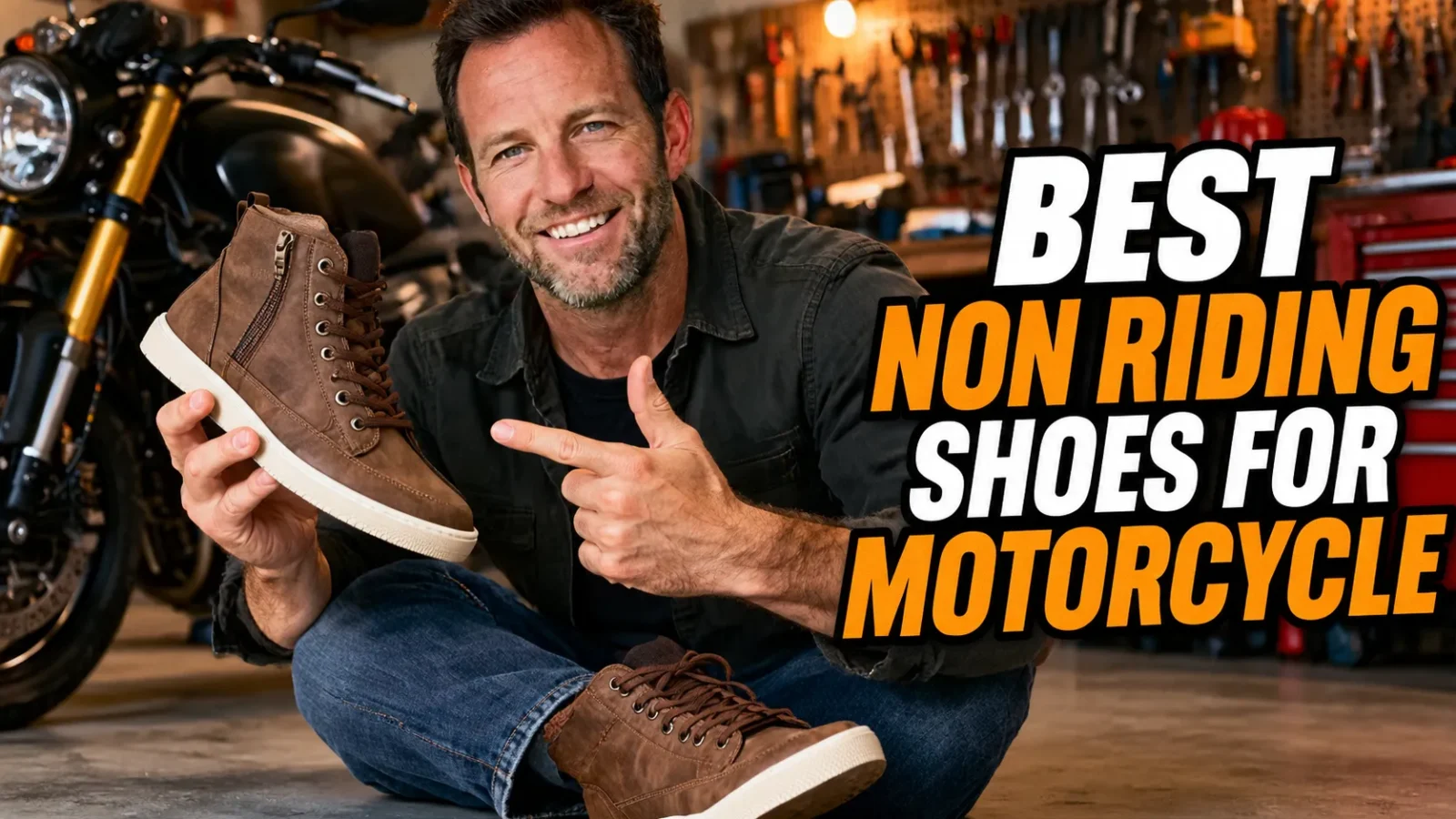
I have spent the better part of a decade commuting, touring, and running errands on two wheels, and I will admit something that probably gets me side-eye in gear forums: some of my favorite footwear on the bike was never designed for it.
There are real reasons for that. A dedicated pair of motorcycle boots is brilliant at exactly one thing, and if you ride to work, walk into a meeting, then walk three blocks for lunch, you end up either changing shoes in a parking lot or clomping around in something that looks like it belongs on a racetrack. That is why so many of us quietly reach for a tough leather boot or a rugged sneaker instead.
So I put together the list I wish someone had handed me years ago. These are all real, currently available shoes and boots that I have either ridden in myself or spent serious saddle time around. If you want the full breakdown of what purpose-built footwear does differently, my Ultimate Guide to Motorcycle Boots is the place to start, because understanding what you are giving up is the whole point here.
One honest caveat before the list: nothing below replaces proper armor. If protection is your priority, go read my picks for the best motorcycle riding boots and come back when you want something to wear to dinner.
- My overall pick is the Red Wing Heritage Iron Ranger 8111, thanks to its full-grain leather, six-inch collar and Vibram Mini-Lug sole.
- The Dr. Martens 1460 and Blundstone 500 Original are the two I reach for most on short urban rides.
- Sole stiffness matters more than brand. A soft, flat sneaker sole lets the peg bruise your arch and offers almost nothing against the shifter.
- Ankle coverage above the bone, oil-resistant rubber and tidy lace management are the three non-negotiables.
- None of these have ankle armor or a reinforced shifter pad, so treat them as a commuting compromise, not a touring solution.
1. Red Wing Heritage Iron Ranger 8111 — Best Overall Non-Riding Boot
If I could only own one pair of shoes that were not built for motorcycling, this would be it. The Iron Ranger is a six-inch, moc-toe work boot in Amber Harness full-grain leather, and it has been in Red Wing’s lineup for the better part of a century for good reason.
On the bike, the spec that matters most is the Vibram 430 Mini-Lug outsole. It is stiff enough that the footpeg does not press into my arch on a long day, and the mini-lug tread grips wet gas station pavement far better than the smooth leather soles on dressier boots. The Goodyear welt means it can be resoled, which is a big deal when you are spending this kind of money.
What I like about it on a motorcycle
The toe box is genuinely stiff. That sounds like a downside when you are walking, but it is a gift when you are upshifting, because the leather does not collapse under the shift lever. The collar sits well above my ankle bone, so a low-speed tip-over at least gives me some leather between my leg and the pavement.
Laces are the weak point. They are long, and long laces on a motorcycle are a genuine hazard. I run mine through a lace lock and tuck the tails inside the collar, and I have never had an issue since. If you want more work-boot options in this vein, I have written about the best work boots for motorcycle riding separately.
The catch
Break-in is brutal. I am talking two to three weeks of sore heels before the leather gives. Expect to pay somewhere in the $330 to $380 range, and expect to buy a half size down because they run large. But I have a pair that is five years old and still looks better than most boots I bought last season.
2. Dr. Martens 1460 — Best Combat-Style Shoe
This is the boot that made half of my generation start riding in the first place. The 1460 is the classic eight-eye silhouette in smooth leather, sitting on Dr. Martens’ air-cushioned AirWair sole, and it is Goodyear-welted and heat-sealed to the upper.
For motorcycling, the appeal is simple: it is a high-top boot with a thick, stiff sole, and it looks like nothing special when you walk into a bar. The air-cushioned sole gives me decent vibration damping on a naked bike, which is more than I can say for most fashion boots.
Where it falls short
The classic smooth leather is not waterproof, and the sole is genuinely slick on wet metal when it is new. That includes footpegs. I have had a boot slide off a wet peg in the rain, and it is a puckering experience. Scuff the soles up on dry pavement for a week before you trust them in weather.
The other thing I would flag is that the smooth leather takes a while to soften around the ankle. I have also tested a lot of stitched military-style boots and written up the best combat boots for motorcycle riding if you want something closer to that aesthetic but better suited to the saddle. Expect around $170 to $200.
3. Blundstone 500 Original — Best Slip-On Chelsea
Here is the boot I wear more than any other on short rides. The Blundstone 500 Original is a laceless Chelsea with a premium leather upper, twin elastic side panels, and a polyurethane outsole with a defined heel.
Laceless is the whole point. There is nothing to snag on a peg, nothing to catch in a chain, and nothing to tangle around the shifter. I can pull them on, ride to the store, walk around, and come home without ever thinking about my feet. For a five-minute urban errand, that convenience is unbeatable.
What you give up
The elastic gusset is the weak spot. Lay your leg against a hot exhaust once and you will learn that lesson permanently. I also find the sole a little soft for long highway days, and obviously there is zero ankle protection above the boot collar.
The 500 runs about $200 to $230, and Blundstone sizing is famously weird, so measure your foot properly rather than trusting your usual number. If you are shopping for a smaller foot, note that Blundstone’s women’s sizing is not identical to the unisex line, and my roundup of the best motorcycle riding boots for women is worth a look if you want a proper armored alternative in the same silhouette.
4. Timberland 6-Inch Premium Waterproof Boot — Best for Wet Weather
I rode through an entire Pacific Northwest winter in a pair of these, and they never once let water in. The 6-Inch Premium is built from seam-sealed waterproof nubuck, with a padded leather collar and a lugged rubber outsole.
The seam sealing is the real feature here. Most “waterproof” leather boots are just treated, and treatment wears off. The Timberland construction actually seals the seams, which is why it holds up to standing water and spray off a wet highway.
The riding reality
The sole is softer than a Red Wing or a Danner, so I would not want to do 400-mile days in them. But for a commute in the rain, the combination of waterproofing, ankle coverage, and a grippy lug pattern is genuinely good. They run about $190 to $220.
The laces are also easier to manage than most, since the boot uses a set of metal eyelets and hooks that let you cinch and tuck quickly. I keep the tails short and jam them down inside the collar.
5. Vans Sk8-Hi MTE-2 — Best Sneaker-Style Pick
I know, I know. A sneaker on a motorcycle. But hear me out, because the MTE-2 is not a normal Sk8-Hi.
The MTE line stands for Mountain Edition, and the MTE-2 build uses a water-repellent suede and textile upper, a warm fleece lining, and an outsole borrowed directly from Vans’ snowboard boot program. That outsole has actual lug depth and a rubber compound designed for cold, wet grip, which is a completely different animal from the flat waffle sole on a standard Sk8-Hi.
Why it works for short rides
It is the highest-cut sneaker Vans makes, so it covers my ankle bone, and the fleece lining means my feet stay warm on a 40-degree morning commute. At roughly $100 to $120, it is also the cheapest thing on this list by a wide margin.
Just be clear-eyed about the tradeoff. There is no shank, no armor, and the sole is thin compared to a real boot. I wear these for city riding and coffee runs, never for a highway commute, and never in heavy rain where I need to plant a foot on an oily intersection.
6. Danner Mountain 600 — Best Hiking Crossover
This is the boot I recommend to riders who want one pair that does everything. The Mountain 600 pairs a full-grain leather upper with a Danner Dry waterproof liner, a Vibram SPE midsole, and a Vibram Fuga outsole.
The Fuga outsole is the star. It has a self-cleaning lug pattern that sheds mud instead of packing it, which matters if you ever put a foot down on a gravel shoulder or a dirt driveway. And because it is a hiking boot at heart, it is genuinely comfortable to walk in all day.
On the bike
Ankle support is excellent, and the midsole is stiff enough that pegs do not bother me. The height is around 4.5 inches, so coverage is solid without feeling like a full touring boot. Expect to pay $200 to $230.
The lace hooks are the one annoyance. They sit high and can catch on a peg when you are swinging your leg over. I lace mine so the top hooks are loose and tuck the tails. If you are leaning toward this style, my picks for the Best Motorcycle Boots for Adventure Riding cover the purpose-built versions of exactly this idea.
7. Salomon Quest 4 GTX — Best for Dual-Sport and Light Off-Road
When I started mixing pavement with fire roads, the Quest 4 GTX became my go-to. It is a GORE-TEX hiking boot with a nubuck and textile upper, Salomon’s 4D Advanced Chassis underfoot, and a Contagrip TD outsole.
The GORE-TEX membrane is the real selling point for dual-sport riding. You will get soaked crossing a creek or standing in wet gravel, and a genuine GORE-TEX boot is the difference between a dry foot and a miserable afternoon.
What I would change
It is a hiking boot, not a motorcycle boot, so the sole is designed for traction on rock rather than abrasion resistance on pavement. The laces and speed hooks are also the single biggest snag risk on this entire list. I have had a lace loop catch a peg while dismounting, and it is exactly as awkward as it sounds.
At around $220 to $250, it is a serious investment for something that is not actually a riding boot. But if you are a dual-sport rider who hikes at the destination, nothing else on this list comes close.
8. Wolverine 1000 Mile — Best Heritage Leather Boot
This is the prettiest boot on the list, and I say that as someone who normally does not care. The 1000 Mile uses Horween Chromexcel leather, a Goodyear welt, and a classic leather outsole with a rubber heel.
Chromexcel is legendary stuff. It takes a shine, it develops a patina, and it is thick enough to shrug off abrasion that would destroy a normal shoe. On a motorcycle, the leather upper is genuinely protective.
The serious caveat
The outsole is leather. Leather soles are slippery when wet, and they are borderline dangerous on a painted crosswalk or a metal grate. I have ridden in mine on dry days only, and I am careful about putting a foot down on anything shiny. If you buy these, budget for a cobbler to add a rubber half-sole or a topy.
They run $380 to $420, they need real break-in, and they are not a wet-weather boot. But for dry-day commuting in a pair of jeans, nothing looks better.
9. Nike SFB Field 2 8″ — Best Lightweight Tactical Option
I picked these up out of curiosity and ended up wearing them for a full summer of short city rides. The SFB Field 2 is an eight-inch tactical boot with a leather and textile upper and a sticky rubber outsole, weighing in around a pound per boot.
That weight is the whole story. If you walk a lot on either end of your ride, a light boot changes your day. The eight-inch collar gives you more ankle coverage than almost anything else here, and the price lands around $140 to $170.
Where I draw the line
The sole is thin and there is no shank, so long highway days leave my arches aching from the pegs. The textile panels also do not love radiant heat from an engine or an exhaust. I wear these for city riding only, and I would not tour in them.
10. Thursday Boot Company Captain — Best Value Leather Boot
If the Red Wing is out of your budget but you still want a proper leather boot, this is where I point people. The Thursday Captain is a full-grain leather boot with a Goodyear welt and a clean, slightly dressy profile that works with chinos as easily as jeans.
Thursday offers the Captain in a Rugged and Resilient leather build with a lugged outsole, and that is the version I would buy for riding. The lug gives you wet-weather grip that the standard model’s smoother sole lacks.
Riding notes
It is lighter and less stiff than the Iron Ranger, which makes it more comfortable to walk in but slightly less protective against the shifter. The ankle collar is moderate. At roughly $200, though, the value is hard to argue with.
Thursday also makes women’s sizes in the same silhouette, which is more than most heritage brands can say. If that is what you are after, my women’s-specific roundup covers the armored alternatives.
How I Judge a Non-Riding Shoe for Motorcycle Use
After enough miles, the criteria boil down to a short list, and none of them have anything to do with how the boot looks in a mirror.
Sole stiffness and oil resistance
A soft sole lets the footpeg press into your arch, which turns a two-hour ride into a two-hour ache. I also want a rubber compound that does not turn greasy when it touches fuel or oil at a gas station. Leather soles fail this test outright.
Ankle coverage
I want the collar to sit above the ankle bone. That is the single biggest difference between a shoe and a boot in a low-speed drop. Anything below the malleolus is a fashion choice, not a safety one.
Lace and strap management
Loose laces near a chain or a spinning wheel are a genuine hazard. I use lace locks, I tuck tails inside the collar, and I avoid boots with protruding speed hooks when I can.
Heat and abrasion resistance
Full-grain leather handles both. Synthetics and elastic panels do not love a hot exhaust. If your boot has an elastic gusset, keep that side away from the pipe when you stop.
None of these ten will protect you the way a proper riding boot will. I still keep a dedicated pair for touring, and I would not cross a state line in anything on this list. But for the commute, the coffee run, and the errand, they are a genuinely smart compromise, and I would rather you ride in a good leather boot than skip the ride entirely.
Frequently Asked Questions
Are regular shoes safe to ride a motorcycle in?
They are a compromise, not a substitute. A good pair of non riding shoes gives you ankle coverage, a stiff sole and a full leather upper, which covers the basics. What they lack is rigid ankle armor, a reinforced shifter pad and a purpose-built crush-resistant sole. For short urban hops and commuting I think they are fine, but for highway miles and touring I still reach for proper motorcycle boots.
What should I look for in non-riding shoes for motorcycling?
Four things matter to me: a stiff, oil-resistant sole so the peg does not dig into my arch, ankle coverage above the malleolus, full leather or heavy textile uppers that resist abrasion, and lace or strap management so nothing dangles into the chain or wraps a peg. Grip on wet pavement is the fifth, and it is the one people forget.
Are Red Wing Iron Rangers good for motorcycle riding?
Yes, they are my top overall pick. The Amber Harness full-grain leather, six-inch collar, Goodyear welt and Vibram 430 Mini-Lug outsole make them genuinely capable on a bike. Just budget two to three weeks of break-in, and tuck or lace-lock the long laces so they cannot snag.
Can I shift a motorcycle in sneakers?
You can, and plenty of riders do, but I would not recommend thin-soled sneakers. A stiff midsole protects the top of your foot from the shifter and stops the peg from bruising your arch. If you want a sneaker look, go for something built up like the Vans Sk8-Hi MTE-2 rather than a flat canvas shoe.

Related Articles

10 Best Tennis Shoes for Motorcycle Riding: Honest Picks From a Rider Who Tried Them
I tested the best tennis shoes for motorcycle riding to find out what actually works behind the bars, plus the…
 Jake Miller
10 min read
Jake Miller
10 min read

11 Best Footwear Options for Motorcycle Riding, Ranked by a Rider Who’s Worn Them All
I've put thousands of miles on moto boots. Here are the 11 best footwear options for motorcycle riding, from track-ready…
Jake Miller
10 min read

8 Best Women’s Motorcycle Shoes for Cruisers: Rider-Tested Picks That Actually Fit
I've ridden cruisers for over a decade, and these are the best women's motorcycle shoes for a cruiser, with real…
Jake Miller
11 min read