
8 Best 4-Inch Speakers for Motorcycle Fairings That Actually Deliver Loud, Clear Sound
 Jake Miller
11 min read
Jake Miller
11 min read
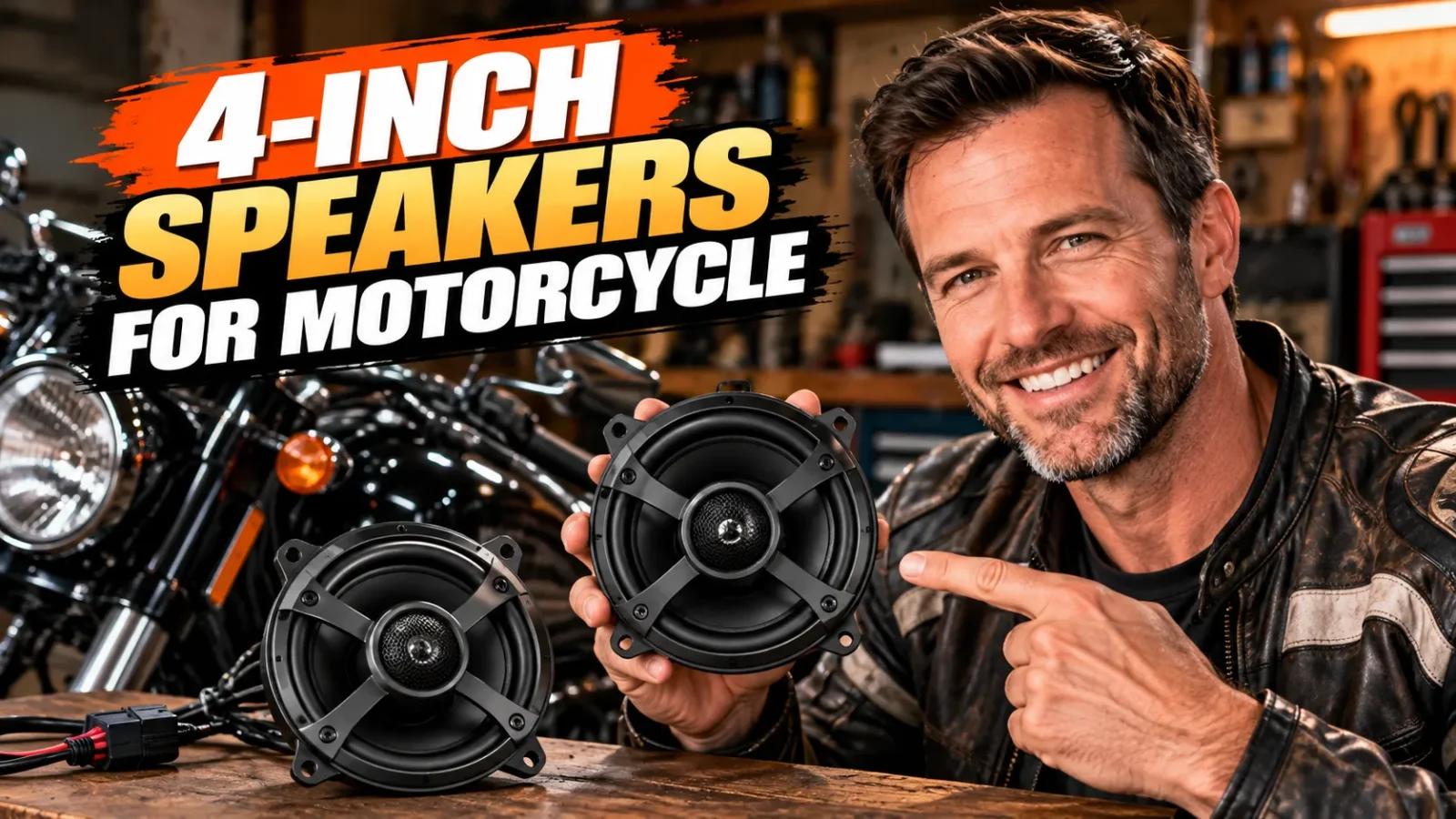
I’ve burned through more sets of fairing speakers than I care to admit. Some sounded great in my garage and turned to mush the second I hit 65 mph on the interstate. Others died within a season because they weren’t actually built for rain and vibration, no matter what the box claimed.
After years of swapping speakers on my own batwing fairing and helping buddies upgrade their Road Glides and Gold Wings, I’ve narrowed it down to the 4-inch speakers that consistently deliver clear, loud sound without falling apart. This list is built from real riding experience, not spec-sheet guessing.
- My overall top pick is the Rockford Fosgate TMS4 for balanced power handling and weatherproofing at a fair price.
- If you ride a Harley Touring model, Hogtunes Rebel and J&M Performance Series speakers are near-perfect factory-fit swaps.
- Budget riders should look at the BOSS Audio MCBK420B or Pyle PLMRB43W for solid performance under $60.
- Speakers alone won’t beat wind noise at 80 mph — pair them with an amp, and consider helmet speakers for personal, weatherproof audio too.
- Always match impedance (4-ohm vs 2-ohm) to your amp or head unit before buying, or you’ll blow a speaker fast.
1. Rockford Fosgate TMS4 — Best Overall 4-Inch Motorcycle Speaker
The Rockford Fosgate TMS4 is the pair I keep coming back to, and it’s what I recommend first to anyone asking me where to start. These are full-range 4-inch speakers rated at 40 watts RMS (80 watts peak), with a polypropylene cone and rubber surround that’s held up through two full Colorado winters on my own bike.
What sold me is the mid-bass punch. A lot of small motorcycle speakers sound tinny and thin, but the TMS4 has enough low-end presence that music doesn’t feel hollow at parking-lot volume, and it doesn’t fall apart when you crank it on the highway.
They’re built with a marine-grade rating (UV-resistant cone, moisture-sealed basket), so they shrug off rain and sun exposure without warping. At around $90-110 for the pair, I think it’s the smartest all-around buy in this whole list.
Why I rate it so highly
Rockford Fosgate has been making powersports audio for decades, and it shows in the fit and finish. The mounting depth and bolt pattern match most factory batwing fairings, so installation took me under 20 minutes with basic hand tools.
2. Hogtunes Rebel Series — Best for Harley-Davidson Batwing Fairings
If you ride a Street Glide, Road Glide, or Electra Glide, Hogtunes is basically the industry standard, and the Rebel Series 4-inch speakers are their flagship offering. Hogtunes builds almost exclusively for Harley fitments, so fitment issues are a non-issue here.
The Rebel speakers are rated at 60 watts RMS per speaker, which is noticeably more headroom than most stock options. I swapped a set into a friend’s 2019 Road Glide, and the difference in clarity at highway speed was immediate — vocals stopped disappearing into wind noise around 70 mph.
They run around $150-180 for the pair, which is pricier than some competitors, but the 4-ohm design pairs cleanly with most factory Harman Kardon and Rockford Fosgate amp setups already found on newer Harleys.
A note on installation
These are genuinely plug-and-play on most Harley Touring models from 2014 and up. I didn’t need to modify any wiring or brackets, which isn’t something I can say about every “universal fit” speaker on the market.
3. J&M Performance Series 4-Inch Speakers — Best Factory-Match Replacement
J&M has been building motorcycle audio components since the late 1970s, and their Performance Series 4-inch speakers are one of the most trusted direct-replacement options for Harley fairings. I installed these on my own Ultra Limited a couple of years back.
These speakers use a woven composite cone with a rubber surround, rated around 50 watts RMS. What impressed me was how balanced the sound was — not bass-heavy, not tinny, just clean reproduction across the frequency range, which matters a lot when you’re listening to talk radio and music on the same ride.
Priced around $130-160, they sit right between the Rockford Fosgate and Hogtunes options. If you want a speaker built specifically with Harley wiring harnesses and grille clips in mind, J&M is hard to beat.
4. Kicker PS40 PowerSports Series — Best for Custom Builds and ATVs
The Kicker PS40 is part of Kicker’s dedicated PowerSports line, built for motorcycles, ATVs, UTVs, and marine applications. I used a set of these on a custom-fabricated fairing pod on a naked bike project, and they handled the irregular mounting without complaint.
Rated at 4 ohms with 45 watts RMS handling, the PS40 uses a UV-treated polypropylene cone and a foam surround that Kicker says is designed to resist moisture intrusion. In my experience, they’ve held up fine through several rainy commutes.
At roughly $70-90 a pair, they’re a strong mid-range option, especially if you’re not restricted to a factory Harley or Gold Wing fairing shape and need something more flexible to mount.
5. Polk Audio DB402 — Best for Crisp Highs and Vocal Clarity
Polk Audio’s DB+ Series DB402 speakers were originally designed for marine use, but they’ve become a favorite among riders who want crisp, detailed sound rather than heavy bass. I run a set on my touring bike specifically because podcasts and talk-heavy content sound noticeably clearer.
These are rated at 75 watts RMS (225 watts peak) with a santoprene rubber surround and UV-stabilized polypropylene cone, so they’re rated for full outdoor exposure. Polk’s marine certification means they’re tested against saltwater corrosion, which is honestly overkill in a good way for motorcycle use.
At around $70-100 for the pair, the DB402 is a great value pick if your priority is voice and mid-range clarity over deep bass thump.
6. BOSS Audio MCBK420B — Best Budget Handlebar-Mount Speakers
Not every bike has a fairing to mount speakers into, which is where the BOSS Audio MCBK420B comes in. These are 4-inch weatherproof speakers that come with their own black handlebar mounting brackets, so cruisers and naked bikes without fairings can still get real sound.
Rated at 400 watts peak power (around 100 watts RMS combined), they’re louder on paper than most speakers on this list, though I’d take peak-power marketing numbers with a grain of salt. Real-world, they’re plenty loud for casual cruising volume.
At under $50 for the pair, this is the most budget-friendly option I’d actually recommend. Just don’t expect Rockford Fosgate-level fidelity — this is a “good enough and affordable” pick, not an audiophile one.
7. Pyle PLMRB43W — Best Ultra-Budget Weatherproof Option
The Pyle PLMRB43W is a marine-rated 4-inch speaker that’s become a go-to for riders building a custom sound setup on a tight budget. I’ve used Pyle speakers on a couple of project bikes where I wasn’t willing to spend big money before knowing if the mounting location would even work long-term.
Rated at 120 watts max (30 watts RMS), they’re not going to compete with the Rockford Fosgate TMS4 on power handling. But for the price — usually under $30 for the pair — they’re a genuinely usable speaker with a water-resistant polypropylene cone and foam surround.
I’d position these as a “try it first” option, or a backup pair for a garage project, rather than your final long-term upgrade.
8. GoHawk TN4-B — Best for LED-Lit Custom Installs
The GoHawk TN4-B has become popular in the custom motorcycle audio scene, mostly because it combines a 4-inch coaxial speaker with built-in multicolor LED lighting rings, controllable via remote. I’ll admit the light show is a gimmick, but the audio performance underneath is genuinely solid.
Rated at 400 watts peak (200 watts RMS for the pair) with a 4-ohm impedance, these speakers pack more raw power handling than almost anything else on this list. I paired a set with a small 4-channel amp on a bagger build, and they held up well without any audible breakup at high volume.
Pricing typically runs $80-120 depending on the kit configuration. If you want your sound system to double as a visual statement at bike nights, this is the pick.
How I actually chose these speakers
I didn’t just look at spec sheets for this list. I factored in real mounting compatibility, how these speakers held up to weather over multiple seasons, and whether the sound quality actually survives wind noise at highway speed — because that’s the real test on a bike.
Power handling and impedance matter more than you think
Before buying any 4-inch speaker, check whether your head unit or amp outputs at 2-ohm or 4-ohm stereo. Mismatching impedance is the single most common reason riders fry a brand-new set of speakers within the first month.
Most of the speakers on this list, including the Rockford Fosgate TMS4 and Hogtunes Rebel, run at 4 ohms, which is compatible with the vast majority of factory and aftermarket motorcycle amps.
Weatherproofing isn’t optional
A speaker rated for indoor car audio use will not survive a season of rain, road grime, and direct sun on a fairing. Every speaker I’ve recommended here uses a UV-treated cone and a sealed or moisture-resistant basket for exactly that reason.
Don’t underestimate wind noise
Even the best 4-inch speaker will get drowned out above 70 mph without amplification. If you’re serious about highway listening, budget for a small add-on amp alongside your new speakers — it makes a bigger difference than upgrading the speakers alone.
Fairing speakers versus helmet speakers
I get asked a lot whether fairing speakers or helmet speakers are the better upgrade, and honestly, it depends on how you ride. Fairing speakers like these give you shared, ambient sound that passengers and riders nearby can enjoy too.
But if you ride solo often or want personal audio that doesn’t broadcast to the whole parking lot, I’d point you toward the Best Helmet Speakers for Motorcycle guide instead. A lot of riders actually run both setups depending on the trip.
If you’re building out a full communication and audio setup, it’s also worth checking my breakdown of the Best Stereo Sound Systems for Motorcycle Helmets, since combining fairing speakers with helmet audio gives you the best of both worlds on long rides.
Don’t forget the rest of your audio setup
Great speakers are only half the equation. If you’re riding two-up or in a group, I’d strongly suggest pairing your new speakers with a solid intercom setup — my guide to the Best Motorcycle Intercom Systems for Rider and Passenger Communication covers exactly what to look for there.
And if you’re planning to take calls or record voice memos over your new sound system, it’s worth reading up on the Best Microphones for Motorcycle Helmets too, since a good mic makes a surprising difference in call clarity at speed.
Finally, if your current helmet setup feels clunky or outdated, my breakdown of the Best Headset for Motorcycle Helmet options is a good next stop after you’ve sorted your fairing speakers.
My final take
If I had to grab just one set for myself again today, I’d go straight for the Rockford Fosgate TMS4. It hits the sweet spot of power handling, durability, and price that most riders actually need.
But if you’re riding a Harley Touring model, don’t overthink it — grab the Hogtunes Rebel or J&M Performance Series speakers and enjoy the near-perfect factory fit. Either way, upgrading your 4-inch speakers is one of the most noticeable, cost-effective changes you can make to your ride this season.
Frequently Asked Questions
Are 4-inch speakers loud enough for highway speeds on a motorcycle?
Yes, if you pair them with a dedicated amplifier. Most stock fairing speakers struggle past 50 mph, but a set like the Rockford Fosgate TMS4 or Hogtunes Rebel speakers powered by even a small add-on amp will cut through wind noise at 80 mph without distorting.
Can I just swap my stock Harley-Davidson speakers for aftermarket 4-inch speakers?
In most cases, yes. Batwing and Road Glide fairings are built around a standard 4-inch mounting depth and bolt pattern, so brands like J&M and Hogtunes design their speakers as direct plug-and-play replacements for factory Harley speakers.
Do I need an amplifier for 4-inch motorcycle speakers, or will my stereo’s built-in power be enough?
A factory head unit typically outputs 20-25 watts per channel, which is fine around town but gets drowned out on the highway. I always recommend budgeting for a small amp if you want true concert-level clarity at speed.
What is the difference between motorcycle speakers and regular car or marine speakers?
Motorcycle-specific speakers are built with tougher UV and moisture-resistant cones, sealed basket designs, and voicing tuned to cut through wind and engine noise, whereas car speakers aren’t built to handle constant vibration and weather exposure the way these are.

Related Articles

9 Best Noise Cancelling Bluetooth Earbuds I’ve Actually Worn on the Road
I tested dozens of noise cancelling Bluetooth earbuds on rides, commutes, and long hauls. Here are the 9 that actually…
Jake Miller
12 min read

9 Best 6×9 Speakers for Motorcycle Saddlebags That Actually Survive the Ride
I tested and researched the best 6x9 speakers for motorcycle saddlebags. Here are my top picks for sound quality, weatherproofing,…
Jake Miller
12 min read

8 Best Motorcycle Intercoms for Multiple Riders in 2026
I tested the top mesh and Bluetooth intercoms for group rides. Here are my picks for the best motorcycle intercom…
Jake Miller
10 min read