
10 Best Camera and Mic Setups for Motorcycle Riders in 2026
 Jake Miller
12 min read
Jake Miller
12 min read
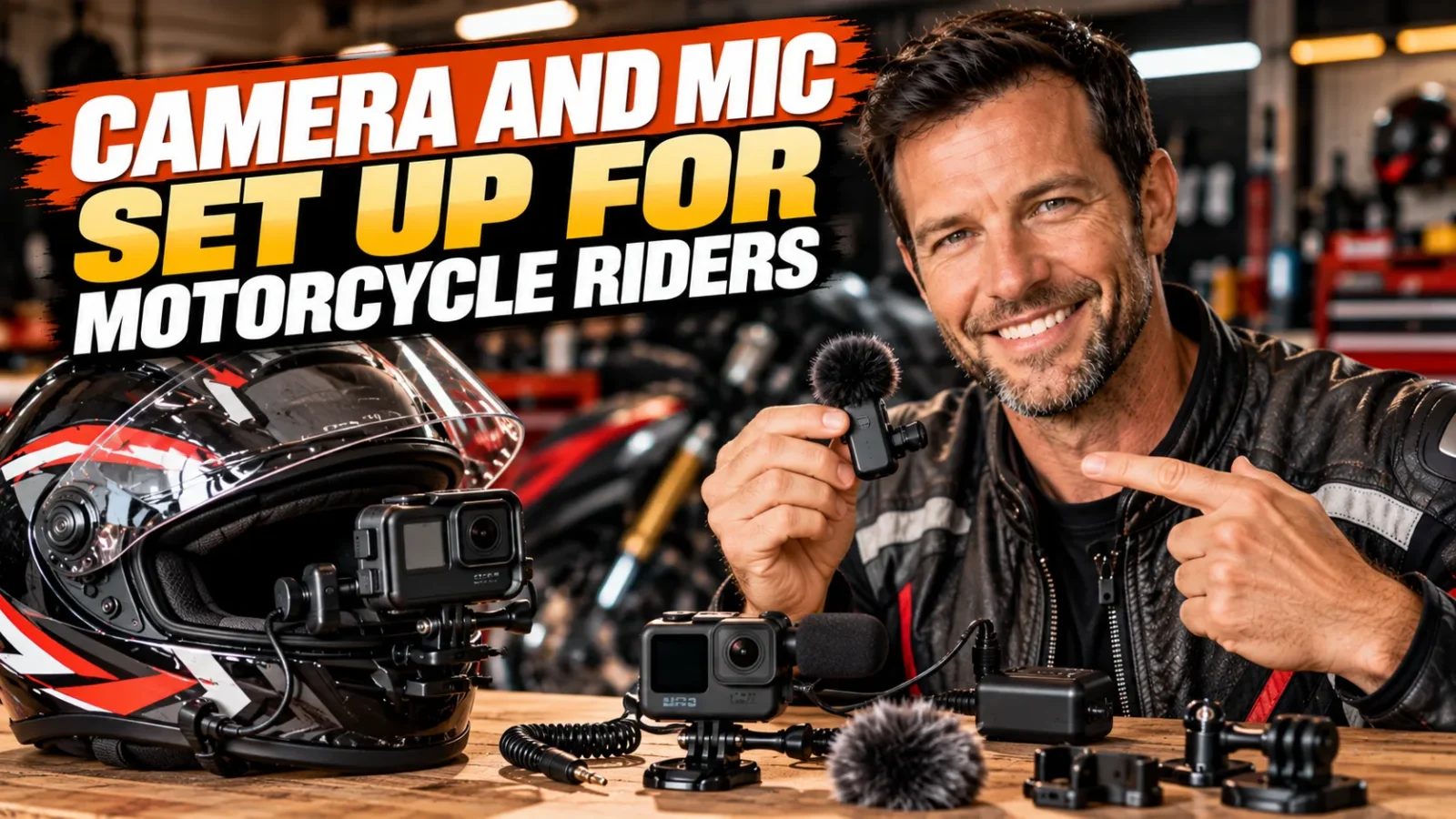
I’ve spent more hours than I’d like to admit fiddling with mounts, charging batteries at gas stations, and re-recording ride commentary because wind noise wrecked the first take. Over the years I’ve cycled through a genuinely embarrassing pile of cameras, mics, and intercoms trying to find combinations that actually hold up on two wheels.
This isn’t a theoretical list. Every product below is something I’ve either ridden with personally or researched deeply enough to trust putting my own money into. I’m going to walk you through the best camera and mic setup for motorcycle riders, whether you’re chasing cinematic canyon-carving footage, building a YouTube channel, or just want solid evidence footage if things go sideways.
- The GoPro HERO13 Black remains my go-to all-rounder for POV riding footage thanks to HyperSmooth stabilization and swappable lenses.
- If audio matters as much as video, pair your camera with a proper intercom like the Cardo Packtalk Edge or a combo unit like the Sena 10C Pro.
- For permanent, always-on protection footage, a hardwired dual-channel system like the Innovv K5 beats action cameras hands down.
- Mounting matters as much as the gear itself — I never skimp on RAM Mounts hardware after losing a camera to vibration once.
- Wind noise is the enemy of good audio, so don’t rely on your camera’s built-in mic for anything beyond casual clips.
1. GoPro HERO13 Black — Best Overall Action Camera for Riders
I keep coming back to the GoPro HERO13 Black as my default recommendation, and it’s not just brand loyalty talking. The 5.3K60 video resolution combined with HyperSmooth 6.0 stabilization makes handheld-shaky footage from rough pavement look surprisingly smooth.
What sold me on this generation is the new HB-series mounting system with interchangeable lenses, including an ultra-wide option that’s fantastic for chin-mount shots. It’s waterproof to 33 feet without a housing, which matters when you get caught in a sudden downpour on the highway.
At around $399 for the body, it’s not cheap, but the battery life improvements and the anti-fog design have genuinely fixed my two biggest complaints from older GoPro models. If you only buy one camera on this list, this is the safe, versatile choice.
Why It Works So Well on a Bike
The compact form factor means it disappears on a helmet mount without adding much drag or neck strain on longer rides. I’ve run mine on eight-hour touring days without any overheating issues, which used to be a real problem with earlier HERO models.
2. Insta360 X4 — Best 360° Camera for Reframing Every Angle Later
The Insta360 X4 solves a problem I didn’t know I had until I used one: never having to decide your camera angle before you ride. It shoots 8K360 footage, letting you reframe the shot after the fact in the Insta360 app.
Mounted on an invisible selfie stick off your tank or tail, it captures literally everything around you simultaneously. I’ve used this to catch both my hand signals and the scenery behind me in the same clip, something a fixed GoPro simply can’t do.
It retails around $499 and includes solid AI-powered stabilization that handles bumpy backroads well. The tradeoff is a steeper editing learning curve, but once you get the hang of reframing, it’s genuinely addictive.
Best For Content Creators
If you’re building a motovlog channel, the flexibility of choosing your “camera angle” in post is a huge time-saver. I no longer stress about mount placement before a ride since I know I can fix framing later.
3. DJI Osmo Action 5 Pro — Best for Low-Light and Night Riding
Night rides used to mean garbage, grainy footage until I tried the DJI Osmo Action 5 Pro. Its 1/1.3-inch sensor is noticeably larger than most action cameras in this price range, and it shows in dim conditions.
It shoots 4K at up to 120fps with 10-bit D-Log M color profiles, giving you real flexibility when color grading later. The magnetic quick-swap mounting system is also a nice touch — I can move it from helmet to chest mount in seconds without tools.
Priced around $349, it actually undercuts GoPro while matching or beating it on dynamic range. For anyone who rides dawn patrol or does a lot of dusk commuting, this is my top pick.
4. Sena 10C Pro — Best All-in-One Camera and Intercom Combo
The Sena 10C Pro was the first product that made me realize I didn’t need two separate devices bolted to my helmet. It combines a 4K30 camera with a full Bluetooth mesh intercom system in one compact unit.
The killer feature is that it can record your intercom conversations directly onto the video track, so rider banter syncs perfectly without any post-production audio work. Range on the mesh intercom hits up to 1.2 miles with compatible units.
At roughly $349, it’s priced competitively against buying a GoPro and intercom separately. If you’re curious how it stacks up against dedicated communication units, I’d point you to this breakdown of the best motorcycle intercom systems for rider and passenger communication.
Where It Falls Short
The camera quality, while solid, doesn’t quite match a dedicated GoPro or DJI unit in stabilization. I see this as the trade-off you accept for the convenience of an all-in-one setup.
5. Cardo Packtalk Edge — Best Intercom for Crystal-Clear Voice Audio
When audio quality is my top priority, I reach for the Cardo Packtalk Edge. It uses JBL-tuned speakers and a genuinely impressive noise-canceling mic setup that cuts through wind roar far better than I expected.
The Dynamic Mesh Communication (DMC) system supports group rides of up to 15 riders, and voice commands work reliably even at highway speeds. I’ve paired mine with a GoPro via Bluetooth to layer clean voice narration over my ride footage.
At about $329, it’s a premium buy, but the audio clarity alone justifies it if you’re recording commentary. I’d also recommend checking out this comparison of the best helmet speakers for motorcycle riders if speaker quality is your main concern.
Mic Placement Matters
I learned the hard way that mic boom positioning makes or breaks recorded audio quality. The Packtalk Edge’s flexible boom mic sits close enough to my mouth that wind interference stays minimal even in open-face setups.
6. Innovv K5 — Best Permanent Dual-Channel Dash Cam System
For riders who want continuous “always recording” protection, the Innovv K5 is in a different category entirely from action cameras. It’s a hardwired dual-channel system with a 1440p front camera and 1080p rear camera, permanently mounted on your fairing and tail.
Since it wires directly into your bike’s electrical system, there’s no charging or forgetting to hit record — it just runs whenever the ignition is on. GPS logging and WiFi footage retrieval round out the package nicely.
It runs about $429 for the full kit, which sounds steep until you consider it as insurance-grade documentation rather than a vlogging tool. I installed mine specifically for liability protection on my daily commute through heavy traffic.
7. Insta360 Ace Pro 2 — Best Flip-Screen Camera for Easy Framing
Co-engineered with Leica, the Insta360 Ace Pro 2 punches well above its weight for low-light performance and color science. The flip-up screen is genuinely useful for checking framing before you pull away from a gas stop.
It shoots 4K120 with a large 1/1.3-inch sensor and includes AI editing features that auto-highlight your best clips, saving me hours of scrubbing through footage after long trips. Battery swap design also means quick turnarounds on all-day rides.
Priced around $449, it competes directly with GoPro and DJI’s flagships. I keep this one in my kit specifically for solo trips where I want to double-check my shot without pulling out my phone.
8. Insta360 GO 3S — Best Ultra-Compact Chin-Mount Camera
The Insta360 GO 3S is genuinely tiny, about the size of a large gumball, and it’s become my favorite option for discreet chin-bar mounting on full-face helmets. It shoots 2.7K video and pairs with an Action Pod for a flip screen and extended battery.
Magnetic mounting means I can snap it onto my chin bar in seconds, and the low weight means I barely notice it’s there on long rides. Storage tops out around 64GB internal, which is plenty for a day’s worth of clips.
At roughly $399 for the full bundle, it’s not the cheapest option, but the sheer convenience factor makes it worth it for minimalist setups. This is the camera I grab when I don’t want to think about gear at all.
9. Rode Wireless GO II — Best External Mic for Roadside Vlogging
Every motovlogger I know eventually admits their camera’s built-in mic just isn’t good enough for talking-head segments at gas stops or scenic overlooks. The Rode Wireless GO II fixed this for me almost overnight.
It’s a dual-channel wireless clip-on mic system with a range up to 200 meters and built-in onboard recording as a backup. I clip the transmitter to my jacket collar when I hop off the bike to record commentary, and the audio difference compared to my helmet cam’s internal mic is night and day.
At around $299 for the dual-channel kit, it’s a smart add-on rather than a full replacement for your in-helmet audio setup. If you’re building out your full audio kit, it’s worth browsing this guide to the best microphones for motorcycle helmets to cover both in-helmet and off-bike recording needs.
10. RAM Mounts X-Grip and GoPro Curved Adhesive Mounts — Best Mounting Hardware
I’ll be honest, I underestimated mounting hardware for years until vibration loosened a cheap mount and I nearly lost a camera on the highway. Since then, I only trust RAM Mounts ball-and-socket hardware and genuine GoPro curved adhesive mounts for anything permanent.
The RAM X-Grip system is rock solid for handlebar-mounted phones or action cameras, with rubberized dampening that noticeably reduces micro-vibration blur in footage. The curved adhesive mounts, when properly prepped and cured for 24 hours, essentially never come loose.
Combined, you’re looking at $30 to $60 depending on configuration, which is a tiny investment compared to the camera it’s holding onto your helmet at 70 mph. I treat mounting hardware as non-negotiable, never the place to cut corners.
How I Actually Pick a Setup for a Given Ride
My honest process starts with what I’m trying to capture. For pure POV touring footage, I grab the GoPro HERO13 Black on a chin mount and call it done.
If I’m doing a group ride and want to document conversation along with the scenery, I switch to the Sena 10C Pro or pair a standalone camera with the Cardo Packtalk Edge. Audio quality genuinely transforms a ride video from amateur to watchable.
For my daily commute, the Innovv K5 just runs in the background, and I honestly forget it’s there most days until I need footage after a close call. It’s peace of mind more than content creation.
Don’t Overlook Your Helmet’s Audio Setup
A great camera means nothing if your recorded audio sounds like a wind tunnel. I’d genuinely recommend reading up on the best stereo sound systems for motorcycle helmets if you’re serious about both listening to music and recording clean commentary from inside your lid.
And if you’re still running an older or uncomfortable headset, it might be time for an upgrade. This roundup of the best headset for motorcycle helmet setups covers comfort, battery life, and mic quality side by side.
Final Thoughts on Building Your Kit
There’s no single perfect answer here, and honestly, that’s part of the fun of building a setup that fits how you actually ride. My own gear bag has evolved constantly over the years as new products solve old annoyances.
If I had to start completely from scratch today, I’d grab the GoPro HERO13 Black for footage and the Cardo Packtalk Edge for audio, then add the Innovv K5 once budget allows for permanent protection. That combination covers content creation and safety documentation without overcomplicating things.
Whatever you choose, spend the extra ten dollars on decent mounting hardware. I promise you’ll thank yourself the first time you hit an unexpected pothole at speed.
Frequently Asked Questions
Do I need both a camera and a separate microphone on my motorcycle?
Not always. Most modern action cameras like the GoPro HERO13 Black have decent built-in mics for casual clips, but wind noise at highway speeds is brutal. If you want clear voiceovers or rider commentary, pairing your camera with an intercom system or external mic makes a massive difference.
Where’s the best place to mount a camera on a motorcycle?
I get the most usable footage from a chin-mount or helmet-top mount for POV riding shots, paired with a chest or tank mount for a wider view. A dedicated system like the Innovv K5 mounted permanently on the fairing and tail is great for continuous evidence-style recording.
Can I use my motorcycle intercom’s microphone for video audio?
Some combo units like the Sena 10C Pro let you record intercom audio directly onto your video, which is fantastic for capturing rider-to-rider conversations. Otherwise, most riders sync separate audio in post-production.
How do I stop wind noise from ruining my motorcycle footage?
Foam wind covers help a little, but positioning your mic or camera out of direct airflow (like behind a windscreen or under a chin bar) makes the biggest difference. A dedicated lapel or intercom mic close to your mouth will always outperform a camera’s built-in mic at speed.

Related Articles

9 Best Noise Cancelling Bluetooth Earbuds I’ve Actually Worn on the Road
I tested dozens of noise cancelling Bluetooth earbuds on rides, commutes, and long hauls. Here are the 9 that actually…
Jake Miller
12 min read

9 Best 6×9 Speakers for Motorcycle Saddlebags That Actually Survive the Ride
I tested and researched the best 6x9 speakers for motorcycle saddlebags. Here are my top picks for sound quality, weatherproofing,…
Jake Miller
12 min read

8 Best Motorcycle Intercoms for Multiple Riders in 2026
I tested the top mesh and Bluetooth intercoms for group rides. Here are my picks for the best motorcycle intercom…
Jake Miller
10 min read