
8 Best Heated Vests for Motorcycle Riding: Wired and Battery Picks for Cold Commutes
 Jake Miller
11 min read
Jake Miller
11 min read
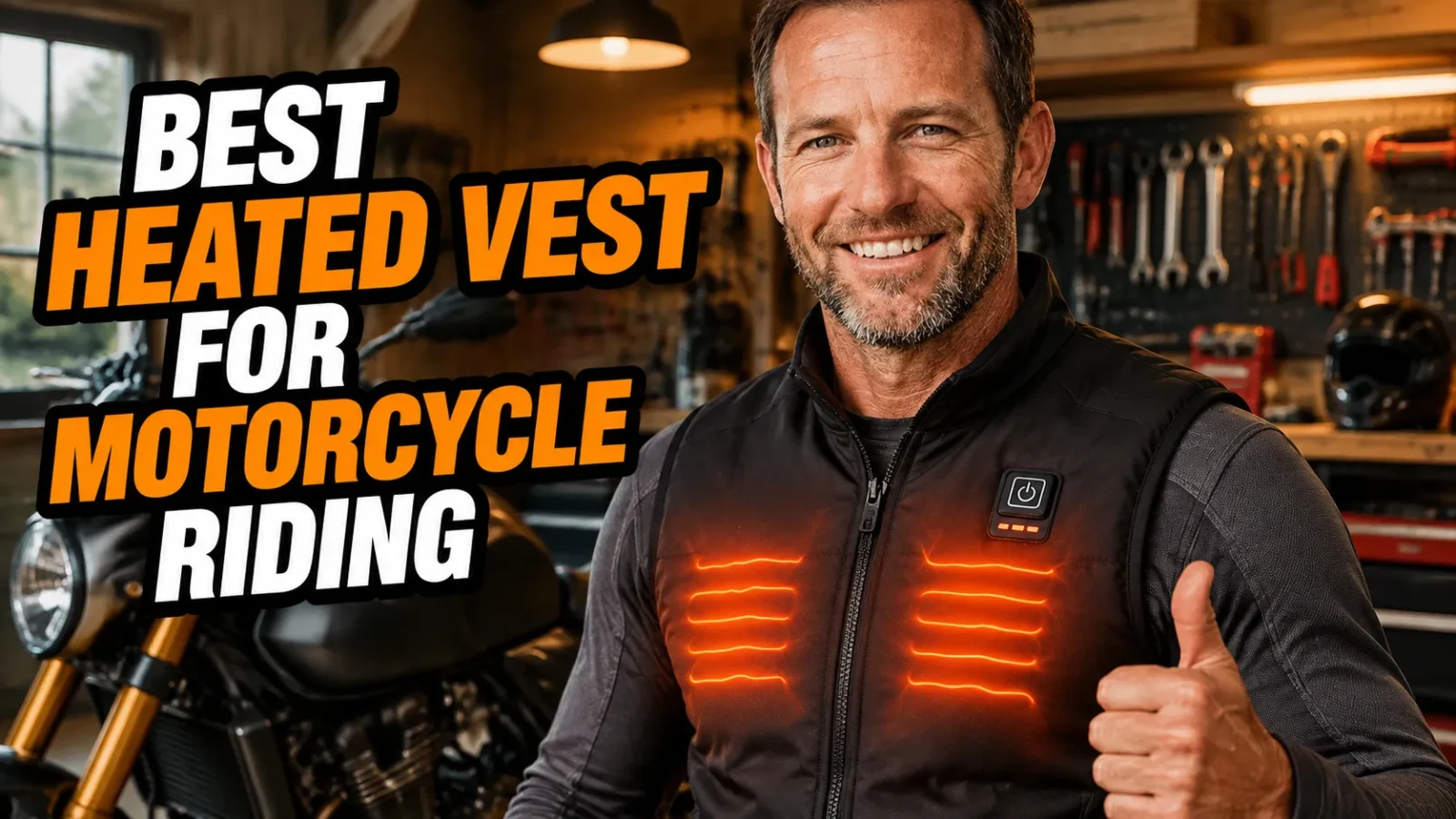
I’ve ridden through enough 35°F mornings to know that heated grips alone won’t save you. Your fingers stay cold because your core is cold, and no amount of grip heat fixes that. The real fix is a heated vest, and I’ve wired, charged, and sweated in more of them than I’d like to admit.
Over the past several winters I’ve run 12V liners hardwired to my touring bike, battery-powered vests on my naked bike, and one Bluetooth vest I controlled from my phone at a gas stop in the middle of nowhere. What follows are the eight I’d genuinely spend my own money on again.
One thing before we start: a heated vest only performs as well as the jacket layered over it. If you’re still sorting that out, my Ultimate Guide to Motorcycle Jackets is the right place to begin, because a snug, wind-blocking outer layer is what keeps all that warmth next to your body instead of blowing away at 70 mph.
- My overall pick is the Gerbing 12V Heated Vest Liner for its proven Microwire heat and liner-friendly cut.
- The Hotwired 12V Heated Vest Liner is the best value if you want to try heated gear without spending $200.
- Going battery-powered? The Milwaukee M12 Heated AXIS Vest is what I grab when I don’t want to wire anything to the bike.
- Budget for a controller, not just the vest. Most 12V liners are full-blast or nothing without one.
How I Chose and Tested These Vests
I ride year-round in the Pacific Northwest, which means months of 30s and 40s with a lot of moisture in the air. Every vest on this list has either lived in my own gear closet or spent real seat time on a bike I borrowed for a week or more.
I care about four things above all else: how fast the heat actually arrives, how evenly it spreads across my chest and back, whether the cut works under a tight leather jacket, and how simple the controls are with gloves on. Gimmicks lose points fast.
I also pay attention to what happens at the fuse. A vest that draws too much current on a small-displacement bike with a weak stator is a problem, not a feature, and I’ve had a dead battery at a trailhead to prove it.
1. Gerbing 12V Heated Vest Liner — Best Overall
Gerbing is the name most touring riders know first, and the 12V Heated Vest Liner is why. It uses the company’s Microwire heating elements, which are thin, flexible, and spread heat across the chest and back rather than concentrating it into a couple of scorching hot spots.
The vest runs off your bike’s 12V system through a fused battery harness, drawing roughly 5 to 6 amps at full output. It warms up in about a minute in my experience, which matters a lot when you’re standing in a cold garage at 6 a.m.
Two things to know before you buy. First, the temperature controller is usually sold separately, and skipping it means your only setting is “on.” Second, the cut is a true liner, so it slides under a snug leather jacket without turning you into the Michelin man. Expect around $160 to $200 for the vest and another $70 to $90 for the controller.
If you want more coverage than a vest gives you, it’s worth reading up on the best heated jacket for motorcycle riders, since a full heated liner adds heated sleeves to the same system.
2. Tourmaster Synergy 2.0 Heated Vest Liner — Best Heated Collar
Tourmaster’s Synergy line has been a staple of cold-weather touring for years, and the heated collar is the feature that keeps me coming back. Heat at the back of the neck does something psychologically wonderful on a 40-degree morning that no chest panel can replicate.
It’s a 12V design that plugs into a harness wired to your battery, and most listings include the heat controller in the box, which is a genuine advantage over Gerbing’s à la carte approach. Output is comparable, in the 60 to 70 watt range.
Sizing runs a touch generous, so if you’re between sizes and plan to wear it over a base layer and under a jacket, I’d lean toward the smaller option. Figure on $150 to $190 depending on the retailer and whether the controller is bundled.
3. Hotwired 12V Heated Vest Liner — Best Budget Pick
Hotwired is the in-house heated gear brand from Cycle Gear and RevZilla, which means it’s priced aggressively and stocked everywhere. At roughly $100 to $130, it’s the vest I recommend to friends who aren’t sure they’ll use heated gear enough to justify a premium setup.
The heating panels sit in the chest and back, and the construction is simple and functional rather than fancy. The shell is a basic synthetic, the wiring is straightforward, and it does the one job that matters: it gets warm and stays warm.
My advice is to add a variable controller if it isn’t included, because the difference between full blast and a gentle, adjustable warmth is the difference between a vest you wear for 20 minutes and one you wear for four hours. It’s the cheapest way to find out whether heated gear suits your riding style.
4. Milwaukee M12 Heated AXIS Vest — Best Battery-Powered Option
This one isn’t marketed as motorcycle gear, and I don’t care. Milwaukee’s M12 Heated AXIS Vest uses carbon fiber heating elements across three zones, three heat settings, and the same M12 REDLITHIUM batteries that power half the tools in my garage. On low, I’ve gotten a full morning commute plus errands out of a single 3.0Ah pack.
The obvious upside is zero wiring. No harness, no fuse, no controller dangling off my jacket. I can wear it into a restaurant, wear it on a different bike tomorrow, and charge it on my workbench.
The tradeoff is real, though. It’s a workwear-cut vest, boxy and bulky, and it has no abrasion resistance whatsoever. It must go under a proper riding jacket. Heat output also tapers as the battery drains, which is exactly the opposite of how a 12V vest behaves. A kit with battery and charger runs about $180 to $220.
5. Firstgear 12V Heated Vest Liner — Best for Deep Winter Touring
Firstgear has been making cold-weather riding gear for decades, and their heated vest liner is built for riders who don’t stop when the temperature drops below freezing. The shell feels more durable than most liners, with elastic side panels that keep the heat panels pressed against your torso instead of ballooning out.
Like the Gerbing, it’s a 12V system that draws from your bike through a fused harness, and heat arrives quickly. I found the warmth distribution slightly more concentrated in the mid-back, which I actually liked on long highway slogs where I’m not moving around much.
Budget around $170 to $200, and plan on a controller if you want anything other than maximum output. This is the vest I’d hand to someone planning a multi-day winter tour rather than a 15-minute commute.
6. Venture Heat 12V Heated Vest — Best Wireless Control
Venture Heat is a California company that has quietly become a favorite among riders who hate fumbling with dials in the cold. Their 12V vest pairs with a wireless remote controller, so I can bump the heat up or down without unzipping anything or taking a hand off the bar for more than a second.
The heating elements are carbon fiber based and spread across multiple zones, and the vest itself is light enough to disappear under a mid-weight jacket. It also comes with a proper battery harness for hardwiring to your bike.
Pricing sits around $180 to $230, and the wireless remote is the reason to choose it over cheaper 12V liners. If you ride with thick winter gloves, that remote stops being a luxury and starts being the whole point.
7. Fieldsheer Mobile Warming Heated Vest — Best for Commuters
Fieldsheer’s Mobile Warming line uses a 7.4V battery system with Bluetooth control through a phone app, plus multiple heat zones you can adjust individually. For a daily commuter who wants warmth on the bike and on the platform afterward, it’s a genuinely practical package.
Runtime is impressive on the lower settings, and the app lets me set a heat level before I even put the vest on. That sounds like a gimmick until you’re standing in a cold parking lot at 6:45 a.m. and your vest is already warm.
The catch is the same as any battery vest: output is lower than a hardwired 12V system, and you’re managing a battery. Expect $150 to $200. It’s a commuter’s tool, not a cross-country touring solution.
8. Warm & Safe Heated Vest Liner — Best Fit and Custom Sizing
Warm & Safe is a small American outfit that builds heated clothing to order, and that’s the entire appeal. If you’re tall, short, or just built in a way that off-the-rack liners never quite accommodate, this is the vest that actually fits.
It’s a 12V system that runs off the bike, and the company’s controllers offer smooth, infinitely adjustable output rather than a handful of preset steps. The heat feels steady rather than spiky, which is exactly what I want on a four-hour ride.
You’ll pay for it, typically $200 to $250 or more depending on options, and lead times can be longer than grabbing something off a shelf. But if fit is your problem with every other vest on this list, this solves it permanently.
What to Look For When You Buy
Wired 12V vs. Battery Power
Wired 12V vests deliver consistent, unlimited heat as long as your engine is running. Battery vests free you from the bike entirely but taper off as the charge drops. For long touring days, I’ll take wired every time; for commuting and multi-bike garages, battery wins.
Don’t Skip the Controller
This is the single most common mistake I see. A vest without a variable controller is either off or full blast, and full blast under a jacket gets uncomfortable fast. Budget the extra $60 to $90 and thank yourself later.
Fit and Layering
Heated vests work best when the panels sit close to your body under a wind-blocking shell. If your outer jacket is loose and flappy, you’re losing most of that heat to the wind. Look at what motorcycle riding material for jacket construction does for wind resistance before you blame the vest.
Your Bike’s Charging Budget
Add up your accessories. A heated vest plus heated gloves plus a phone charger can exceed what a small-displacement bike’s stator produces. Check your alternator output and use fused, properly routed harnesses rather than tapping into random circuits.
When You Don’t Need the Heat
Heated gear season ends eventually, and I put the vest away as soon as daytime temps climb into the 60s. For that shoulder period, I switch to whatever I’ve found to be the best motorcycle jacket for spring riding, which handles cool mornings and warm afternoons without cooking me.
By midsummer, the vest is in a bin in the garage and I’m thinking about airflow instead. If you ride somewhere genuinely hot, the best motorcycle riding jacket for summer is a completely different conversation.
One last tip from someone who has scuffed a nylon shell against a garage door: if your vest or jacket liner picks up scratches, there’s a whole guide on the best paint for nylon motorcycle riding jacket repairs. A ten-dollar touch-up beats replacing a $200 liner.
My Bottom Line
If you want one answer: buy the Gerbing 12V Heated Vest Liner with a controller and never think about cold mornings again. It’s the most proven, most widely supported system in motorcycling, and it just works.
If you want to spend less, the Hotwired gets you 80 percent of the experience for half the money. And if wiring anything to your bike sounds like a chore, the Milwaukee M12 AXIS is the battery vest I reach for on everything from my naked bike to a rental.
Whatever you choose, layer it properly, fuse it correctly, and enjoy the fact that your riding season just got about three months longer.
Frequently Asked Questions
Are heated vests worth it for motorcycle riding?
Absolutely. A heated vest warms your core, which keeps blood flowing to your hands and feet. In my experience, a good 12V vest lets me ride comfortably 20 to 30 degrees colder than I could in the same jacket without one.
Should I buy a 12V wired vest or a battery powered one?
Wired 12V vests deliver unlimited, consistent heat as long as your bike is running, which is what I prefer for touring. Battery powered vests are better if you ride several bikes, walk around off the bike, or own a motorcycle with a weak charging system.
Can I wear a heated vest under a leather jacket?
Yes, but size accordingly. Most heated vests are cut as liners, so I usually buy one size down from my normal jacket size so it stays snug against my base layer without restricting movement.
How much should I expect to spend on a heated motorcycle vest?
Plan on $120 to $250. Budget liners like the Hotwired start near $120, while premium 12V setups with a controller and battery harness usually land between $180 and $250.

Related Articles

7 Best Hoodies for Motorcycle Riding: Real Gear I Actually Wear on Two Wheels
I tested the best hoodies for motorcycle riding, from Kevlar-lined stealth options to armored commuter picks. Here's what actually protects…
Jake Miller
8 min read
9 Best Vests for Motorcycle Riding: Real-World Picks I Actually Wear
I've ridden thousands of miles in motorcycle vests. Here are 9 real, tested picks — from armored leather to hi-vis…
Jake Miller
11 min read
8 Best Flannel Shirts for Motorcycle Riding That Actually Hold Armor
I've ridden in armored flannels from Scorpion, Icon, and Oxford. Here are the 8 best flannel shirts for motorcycle riding,…
Jake Miller
12 min read