
7 Best 1-Person Tents for Motorcycle Adventures: Lightweight Shelters Tested for the Road
 Jake Miller
10 min read
Jake Miller
10 min read
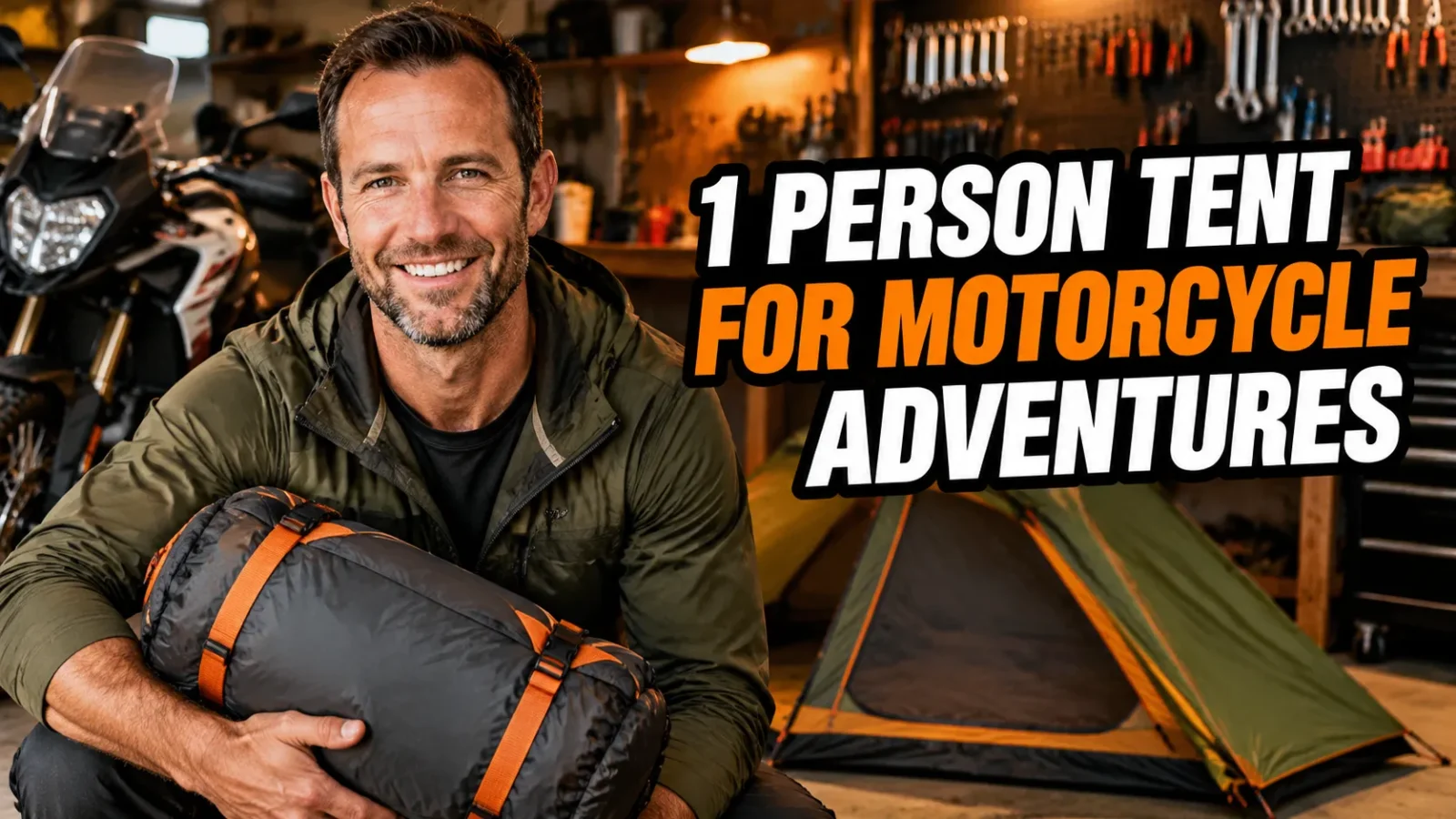
After eight seasons of strapping tents to everything from a Himalayan to a Gold Wing, I’ve learned one hard truth: the shelter you carry on a motorcycle is not the same shelter you’d carry on your back. On a bike, weight matters less but packed size, durability, and fast setup matter far more. You are pitching on gravel, hard-packed dirt, and campsite pads that laugh at ultralight stakes.
I’ve burned through cheap dome tents that shredded in a Wyoming hailstorm and premium shelters that survived three straight days of Scottish rain. Along the way I also learned that a blown battery or the wrong oil can end a trip faster than bad weather, so I keep my machine sorted with the help of this what are the different types of motorcycle batteries ultimate guide before I ever leave the driveway. This list is my honest, road-tested take on the best 1 person tent for motorcycle adventures.
- My overall pick is the Big Agnes Copper Spur HV UL1 for its rare mix of low weight and small pack size.
- Best budget option: the Naturehike Cloud Up 1, which punches way above its price.
- Best for storm-prone trips: the Hilleberg Akto, a genuine four-season fortress.
- Prioritize packed length under 20 inches so the tent fits real panniers, not just a duffel.
- A footprint and a set of beefy stakes matter more on a moto trip than saving 100 grams.
1. Big Agnes Copper Spur HV UL1 — My Overall Pick
If someone asked me to recommend just one tent for a lifetime of moto camping, I’d hand them the Big Agnes Copper Spur HV UL1 without hesitating. It weighs around 2 lb 7 oz on my scale, and the packed size is roughly 18 x 6 inches, which slides perfectly into a side pannier alongside my tool roll.
The “HV” stands for high volume, and it’s not marketing fluff. The vertical side walls and pre-bent poles give me genuine sit-up headroom, which matters when you’re changing out of riding gear in the rain. Two doors and two vestibules mean I can stash my helmet and boots under cover without dragging mud inside.
Real-world performance
I’ve had this tent up in 30 mph gusts on the Colorado plains, and the DAC Featherlite NFL poles barely flexed. The fly is silicone-treated ripstop nylon with a 1200mm hydrostatic head, and I’ve stayed dry through full nights of steady rain. The floor is the weak point, so I always run the matching footprint.
One thing I appreciate as a rider: setup takes me about three minutes in gloves, because the hub-and-pole system is nearly foolproof in the dark with a headlamp.
2. MSR Hubba Hubba NX 1 — The Most Trusted Name
The MSR Hubba Hubba NX 1 is the tent I see most often at motorcycle rallies, and there’s a reason. It’s been around forever, parts and footprints are easy to source, and MSR’s warranty support is genuinely good. Mine weighs about 2 lb 12 oz packed.
MSR lists the floor area at 17 square feet, and the 39-inch peak height is just enough for me to sit upright. The Xtreme Shield waterproof coating on the fly and floor is designed to last longer than standard polyurethane, which matters if you’re leaving the tent packed wet between riding days.
Where it shines and where it doesn’t
What I love is the color-coded pole set. I’ve pitched this thing in total darkness at a rest stop in Utah, and I still had it standing in under four minutes. The single door is a compromise, but for one rider and a small bag of gear, it works fine.
My gripe is that the stock stakes are too light for rocky ground. I swapped in MSR Groundhogs, and the tent stopped wandering in the wind.
3. Hilleberg Akto — The Bombproof Four-Season Option
If your adventures take you into serious weather or shoulder-season riding in the mountains, the Hilleberg Akto is in a different league. This is a tunnel-style solo tent with a Kerlon 1200 outer that Hilleberg rates to withstand extreme conditions. It weighs about 3 lb 8 oz with everything, which is heavy for a solo tent but light for what it does.
You need to stake this tent out properly. It is not freestanding. On hard campsite pads, that’s a real annoyance. But once it’s up, the Akto has shrugged off winds that flattened my friends’ dome tents next to me in Patagonia.
Is it worth the price?
At roughly $700 or more depending on configuration, it’s a serious investment. I only recommend it if you genuinely camp in bad weather or want one tent to last a decade. The interior is narrow, and the single entrance means you climb in head-first. You buy this tent for the storm, not for the comfort.
For most riders, the Akto is overkill. For the rider crossing mountain passes in October, it’s the best money you’ll spend.
4. Naturehike Cloud Up 1 — Best Budget Pick
I’ll be honest: I bought the Naturehike Cloud Up 1 expecting to be disappointed. Instead, it’s become the tent I lend to friends who are new to moto camping. At around $100 to $130, it weighs roughly 3 lb 8 oz and packs to about 17 x 6 inches, which is genuinely compact for the price.
The 20D silicone-coated nylon fly has a 4000mm hydrostatic head, and I stayed dry in a solid overnight rainstorm in Arkansas. The aluminum poles have held up through several seasons. It pitches fast, and the single vestibule is big enough for boots and a small dry bag.
Where it cuts corners
The zippers feel cheaper than on a Big Agnes, and the floor is thin enough that I’d never skip a footprint. The stakes are basically decorative. But here’s the thing: for a rider who camps a handful of times a year, this tent delivers 85 percent of the experience for 20 percent of the price.
If you’re still figuring out whether moto camping is for you, start here.
5. NEMO Dragonfly OSMO 1P — Best Ventilation
The NEMO Dragonfly OSMO 1P solves a problem I didn’t know I had until I camped in humid summer heat. The OSMO fabric is a proprietary blend that reportedly absorbs less water and dries faster than standard silnylon, and in practice, my tent stayed noticeably drier inside on muggy nights.
It weighs around 2 lb 8 oz and packs small. The standout feature for me is the high-cut fly and the large mesh panels, which create serious cross-ventilation. I stopped waking up in a puddle of my own condensation, which is a huge deal when you’re sharing a tent with damp riding gear.
Setup and durability notes
NEMO uses a hubbed pole design with color-coded clips, so pitching takes me about three minutes. The 2000mm fly and 1500mm floor are respectable for three-season camping. Two doors make it easy to get in and out without climbing over your luggage.
My only complaint is the price, which sits in premium territory. But if you ride in the Southeast or anywhere humid, the ventilation alone justifies it.
6. REI Co-op Quarter Dome SL 1 — Best Value From a Big Retailer
The REI Co-op Quarter Dome SL 1 is what I recommend to riders who want premium features without the premium risk of buying from a brand they’ve never heard of. At around 2 lb 10 oz, it’s competitive with tents costing significantly more.
The semi-freestanding design uses a single hubbed pole with a brow pole that lifts the ceiling, giving me about 40 inches of peak height. The fly has a 1500mm rating and the floor 1800mm, and REI’s return policy means you can genuinely test it and bring it back if it doesn’t work for you.
The rider-friendly details
Two vestibules give me a dry spot for my helmet on one side and my boots on the other. The packed length is about 18 inches. Setup is quick and intuitive, even in gloves.
If you’re a Co-op member, the dividend softens the price further. It’s not the lightest or the toughest, but it’s the safest all-around bet for a rider who wants one tent, bought once, from a store they trust.
7. Six Moon Designs Lunar Solo — Best Ultralight for Minimalists
If you’ve sorted your luggage and want the absolute minimum packed volume, the Six Moon Designs Lunar Solo is worth a look. It’s a single-wall, trekking-pole tent that weighs around 26 ounces, though with the optional aluminum pole it’s closer to 2 lb. Packed, it’s roughly the size of a loaf of bread.
Single-wall tents have a reputation for condensation, and the Lunar Solo is no exception in humid conditions. But the large mesh panel and the high venting design mitigate it reasonably well. I’ve used it on dry, high-desert trips and been perfectly comfortable.
Who should buy it
This tent requires stakes to pitch, so it’s a poor fit for hard campsite pads. It’s also a tight squeeze for taller riders, and I’m 5’10” and just fit with my sleeping bag. It is not the tent for everyone.
But if you’re an experienced camper chasing minimal pack size and you already carry a trekking pole or the optional support pole, the Lunar Solo delivers an astonishing amount of shelter for the volume it occupies on your bike.
How I Choose a Tent for Motorcycle Travel
Before you buy anything, think about how you actually ride. A rider crossing continents on a heavy tourer has different needs than someone doing weekend blasts on a sportbike. Here are the factors that have mattered most in my own experience.
Packed size beats weight
On a motorcycle, 8 ounces of extra fabric is irrelevant. What matters is whether the tent fits in your pannier, top box, or dry bag. I always check the packed length first. Anything over 20 inches becomes awkward to strap down.
Freestanding or staked?
I strongly prefer freestanding or semi-freestanding designs because campsites near roads are often hard-packed or gravelly. If you choose a staked tent, carry a set of long, sturdy stakes and practice pitching it before your trip.
Durability and spares
Motorcycle camping is hard on gear. I always carry a repair kit with pole splints and patch material. Buying from brands with good spare-parts support, like MSR or Big Agnes, has saved me more than once.
And speaking of keeping the bike reliable, the same trip-prep mindset applies to your engine. If you ride a smaller or older machine, check out the best motorcycle for short heavy person to make sure your platform suits your body and luggage load before you commit to a long tour.
Don’t forget the machine
Even the best tent won’t help if your bike lets you down 200 miles from camp. I keep my maintenance tight, and I’ve written about the best motor oil for 4 stroke motorcycle and the top engine oil for 4 stroke motorcycle to help other riders do the same. If you ride in India, the best engine oil for 4 stroke motorcycle in india guide is worth a read, and if you want the short version, this piece on what is the best engine oil for 4 stroke motorcycle covers the essentials.
Pitch it before you pack it
My golden rule: set the tent up in your yard at least twice before a trip. Learn how the poles seat, where the stakes go, and how the fly clips on. Doing this in daylight makes the dark, exhausted campsite pitch infinitely easier.
Final Thoughts
There’s no single perfect tent, but for most riders, the Big Agnes Copper Spur HV UL1 is the best 1 person tent for motorcycle adventures because it balances weight, pack size, weather protection, and liveability better than anything else I’ve used. If budget is tight, the Naturehike Cloud Up 1 is a legitimate performer. If storms are your reality, save for the Hilleberg Akto.
Whichever you choose, buy it early, pitch it in the yard, and pack it where you can reach it. Then get out there, because the best campsite is the one at the end of a good ride.
Frequently Asked Questions
What is the best 1 person tent for motorcycle adventures overall?
In my experience the Big Agnes Copper Spur HV UL1 is the best all-rounder. It packs small enough for a pannier, weighs around 2 pounds, and has held up through serious wind and rain on my trips.
How small does a motorcycle camping tent need to pack?
Look for a packed size under 20 inches long and about 5 inches in diameter. That fits inside most hard panniers, top boxes, or a 40L dry bag strapped to your seat.
Is a freestanding tent better than a trekking pole tent for moto camping?
For motorcycle adventures, yes. A freestanding or semi-freestanding tent pitches on rocky, hard, or gravel campsites where you cannot drive stakes. Pole-supported tents also set up faster after a long day in the saddle.
Do I need a footprint under my tent on motorcycle trips?
I always pack one. Campsites near roads and trails are often abrasive, and a footprint protects the tent floor from sharp rocks and extends its life. Many brands sell a matched footprint.

Related Articles

9 Best Budget Tents for Motorcycle Touring That Actually Survive the Road
I've slept in cheap tents across 30,000+ touring miles. Here are 9 genuinely good budget tents for motorcycle touring, with…
Jake Miller
10 min read

7 Best 2-Person Tents for Motorcycle Camping: Packable Shelters I Actually Trust
I've pitched these 7 two-person tents on real moto trips. From Big Agnes to MSR, here's what actually fits in…
Jake Miller
10 min read

7 Best 3 Man Tents for Motorcycle Camping: Real-World Picks From a Rider Who Actually Hauls Them
I've packed 3 man tents onto motorcycles for years. Here are 7 real picks that survive the road, from the…
Jake Miller
11 min read