
ABS and Wheelies: What Happens When Your Front Wheel Leaves the Ground?
 Jake Miller
9 min read
Jake Miller
9 min read
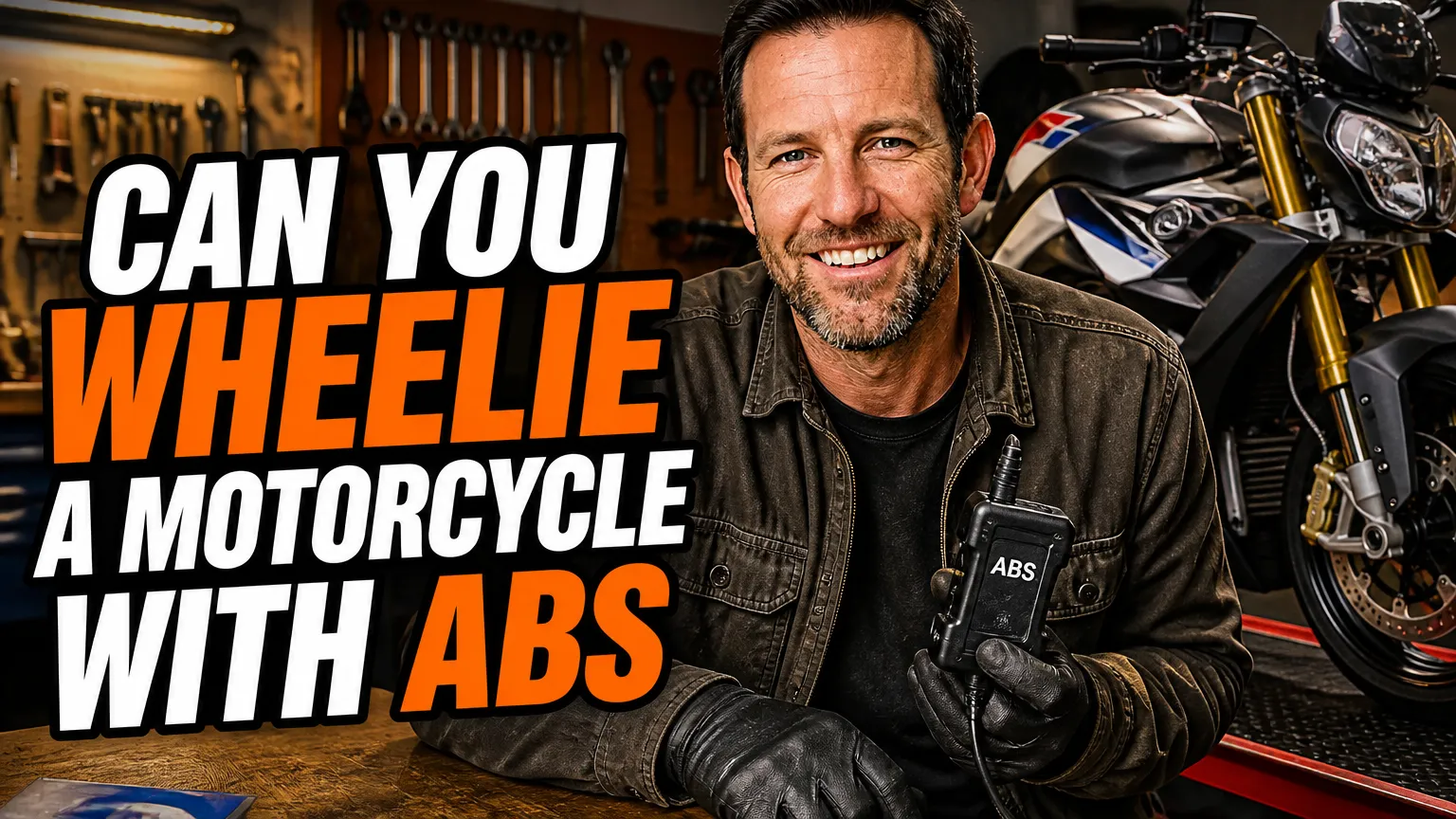
When I hear someone ask, “can you wheelie a motorcycle with ABS,” I think the useful answer is: often, yes, but ABS by itself usually is not what decides whether the front wheel comes up. Conventional ABS is designed to help prevent wheel lock during braking. It is not automatically a wheelie-prevention system.
That distinction matters, because modern bikes may combine ABS with traction control, an IMU, or a separate wheelie-control feature. I always look at the exact model and its settings before assuming how any electronic aid will behave. And whatever the electronics do, I never treat a wheelie as a safe or sensible experiment for a public road.
- Conventional ABS manages braking, so it usually does not prevent a power wheelie by itself.
- Wheelie control and integrated rider aids can reduce power or limit front-wheel lift.
- ABS is not a stunt safety net, and system behavior varies by motorcycle.
- I recommend learning advanced skills only with qualified instruction in a controlled setting.
What ABS does, and what it usually does not do
In my experience, people often use “ABS” as shorthand for every electronic safety feature on a motorcycle. That can cause confusion. ABS stands for anti-lock braking system, and its core job is to regulate brake pressure when a wheel is at risk of locking under braking.
If I brake hard on a bike with ABS, wheel-speed sensors provide information to the system. When the system detects a wheel-lock risk, it can adjust brake pressure to help that wheel keep turning. The goal is to support braking control, not to manage every movement the motorcycle makes.
A conventional ABS unit does not normally control engine power just because the front tire has lifted. A wheelie is generally linked to acceleration, weight transfer, and the bike’s geometry. Those are different conditions from a wheel locking under braking.
ABS is not the same as wheelie control
I separate braking aids from torque-management aids when I read a bike’s specification sheet. Wheelie control, when fitted, may use wheel-speed sensors and other inputs to recognize excessive front-wheel lift, then reduce engine torque or intervene in another way.
Some motorcycles package several features together, which is why the terms can sound interchangeable. A bike may have ABS, traction control, selectable riding modes, and wheelie mitigation, but those features do not all perform the same job. I check the owner’s manual rather than inferring a feature from a badge or a menu label.
Why the answer varies from bike to bike
Motorcycle electronics differ by model, year, market, and software settings. Even bikes from the same manufacturer can have very different systems. One model may offer basic ABS, while another may have an IMU-based package that can coordinate braking, traction control, and wheelie intervention.
So I would not promise that every ABS-equipped motorcycle will respond identically. I look for clear information in the manual about wheelie control, rear ABS settings, riding modes, and whether any feature can be adjusted. If the manual is unclear, I contact the manufacturer or a qualified dealer instead of guessing.
What may happen when a wheel lifts
On a motorcycle with conventional ABS, a front wheel lifting under acceleration does not automatically mean ABS will apply the brakes. ABS is primarily concerned with braking and wheel-lock risk. It does not usually act as an engine-power limiter simply because the front wheel is no longer firmly on the pavement.
With an integrated electronics package, the answer may be different. If the bike has wheelie control, or a system that uses data from an inertial measurement unit, it may detect a change in pitch or front-wheel speed and intervene. Depending on the design and settings, I might notice reduced power or a limit on how far the front end rises.
I avoid making assumptions based on what I have seen on another rider’s motorcycle. Some systems are more adjustable than others, and the same bike may behave differently in different modes. A wheel lifting can also be brief and unintentional, so I would never use a public-road ride as a test of what its electronics can handle.
Braking-related lift is a separate situation
When I discuss wheelies, I mean the front wheel rising during acceleration. A rear wheel lifting during very hard front braking is a different event. Some ABS systems include rear-wheel-lift mitigation intended to help manage that braking-related condition.
That feature should not be confused with a system that prevents a front wheel from lifting under power. The direction of the lift, the forces involved, and the control strategy are different. I find that distinction helpful when a manual describes “lift control” without making the context obvious.
How I check what my motorcycle can do
Before I rely on any electronic feature, I identify the exact motorcycle, model year, and equipment package. Online discussions can be useful for finding questions to ask, but they are not a substitute for the manufacturer’s instructions. A previous owner may also have changed settings or installed aftermarket parts.
- I read the owner’s manual. I look for ABS modes, wheelie-control descriptions, traction-control settings, and any warnings about changing those settings.
- I confirm which features are actually fitted. I do not assume a base model and a premium trim share the same rider aids.
- I note the operating conditions. Manuals may explain when a system is active, when it is unavailable, and whether a selected mode changes its behavior.
- I ask a qualified professional if I am unsure. A dealer or trained instructor can help me interpret model-specific information.
I also pay attention to tire condition, correct tire pressures, maintenance, and warning lights. A sensor or electrical fault can change how a system works or switch a feature off. If the bike displays an ABS warning, I treat it as a repair issue, not as an invitation to test the system’s limits.
Settings are not a substitute for skill
Riding modes can make a motorcycle feel different, but I do not assume a mode turns a risky maneuver into a controlled one. Electronic aids have limits, and they cannot remove hazards, correct every poor decision, or guarantee that a tire will maintain grip.
I would not switch off ABS or other aids just to see what happens during a stunt. Some motorcycles let riders change or disable certain functions, but that capability is not a recommendation. I follow the manual and keep safety systems operating for ordinary road use.
Why I keep stunt riding away from public roads
A wheelie can reduce the time and options I have to respond to a changing road. Traffic, gravel, potholes, road paint, a sudden turn, or a driver pulling out can turn a brief loss of control into a serious crash. ABS cannot steer around a hazard or protect me from every impact.
I also remind myself that many motorcycle risks come from the wider traffic environment, not just from the rider’s own decisions. I find it sobering to read about what percentage of motorcycle accidents are caused by cars and what percent of motorcycle accidents are caused by other drivers. A stunt leaves less margin when another road user makes an unexpected move.
For the same reason, I think about the consequences rather than treating a wheelie as a harmless clip for social media. Looking at how many fatal motorcycle accidents per day, along with what percent of motorcycle accidents result in death and what percent of motorcycle accidents are fatal, reinforces my view that risk deserves respect.
Those figures describe broader safety patterns; they do not predict the outcome of a particular ride or maneuver. But they do remind me that a crash on a motorcycle can have severe consequences. I would rather build skill in a structured environment than gamble on an empty-looking stretch of road.
If I want to learn advanced control
I would start by finding a reputable motorcycle school or closed-course training facility that offers instruction appropriate to my experience and machine. I would ask the instructor what the course covers, what protective equipment is required, and whether the facility permits the specific advanced skill I want to learn.
I would also use a suitable motorcycle in good mechanical condition and follow the instructor’s directions. I would not try to copy a short video, practice near traffic, or rely on ABS to catch a mistake. Professional coaching and a controlled environment are the responsible starting points for any high-risk skill.
Common misconceptions I hear about ABS and wheelies
“ABS will stop the front wheel from coming up”
That is not what conventional ABS is designed to do. It manages brake pressure when it detects a wheel-lock risk. A separate wheelie-control feature may limit lift, but I check the specific motorcycle’s documentation before assuming it has one.
“If the bike has ABS, a wheelie is safer”
I would not draw that conclusion. ABS can support braking control in certain conditions, but it cannot make a wheelie predictable or eliminate the risk of losing balance, traction, or control. The electronic package does not replace good judgment.
“All rider aids react the same way”
They do not. Systems can use different sensors and software, and manufacturers may give riders different levels of adjustment. I treat an online account of one motorcycle’s behavior as an anecdote, not as a reliable guide to mine.
“Turning everything off is the best way to find out”
I see that as an unsafe way to learn. Changing a setting does not explain the system’s limits, and experimenting in an uncontrolled location adds risk. I read the manual and ask a qualified instructor instead.
My practical bottom line
Yes, a motorcycle with ABS may be able to wheelie. Conventional ABS usually does not prevent a front wheel from lifting under acceleration because it is designed to manage braking and reduce the chance of wheel lock. But a bike with wheelie control or integrated rider aids may reduce power or limit lift.
Because equipment and settings vary, I would check the owner’s manual for my exact motorcycle rather than relying on a general rule. Most importantly, I would never mistake ABS for permission to take risks. For me, the sensible choice is to keep stunts off public roads and leave advanced practice to qualified instruction in a controlled setting.
Frequently Asked Questions
Does ABS stop a motorcycle from doing a wheelie?
Usually, no. Conventional ABS manages braking pressure to help prevent wheel lockup; it generally does not control engine torque. Integrated wheelie control may limit front-wheel lift.
Can a wheelie trigger motorcycle ABS?
A wheelie alone does not usually activate conventional ABS, because ABS responds to braking and wheel-lock risk. Some integrated rider-aid systems may react to wheel-speed or IMU data.
Should I turn off ABS to practice a wheelie?
I would not recommend disabling safety systems for a public-road stunt. Read the owner’s manual and seek qualified instruction at a suitable closed-course facility.
Is it safe to wheelie a motorcycle with ABS?
ABS does not make wheelies safe. A wheelie can still end in a crash, and electronic systems vary by model, so I would treat it as a high-risk maneuver requiring proper training and a controlled setting.

Related Articles

Smooth Motorcycle Downshifts: My Step-by-Step Guide to Rev Matching
Learn how I rev-match motorcycle downshifts smoothly, with clear steps, safe practice drills, common mistakes, and tips for different bikes…
Jake Miller
11 min read

Motorcycling in Early Pregnancy: Risks, Questions to Ask, and Safer Choices
Riding a motorcycle while pregnant in the first trimester raises safety questions. I cover crash risks, clinician advice, gear limits,…
Jake Miller
9 min read

How Road-Friction Tests Reveal What Happens When a Motorcycle Slides
I explain how motorcycle sliding-friction tests measure tire grip, what changes on wet or dirty roads, and how I use…
Jake Miller
10 min read