
How Road-Friction Tests Reveal What Happens When a Motorcycle Slides
 Jake Miller
10 min read
Jake Miller
10 min read
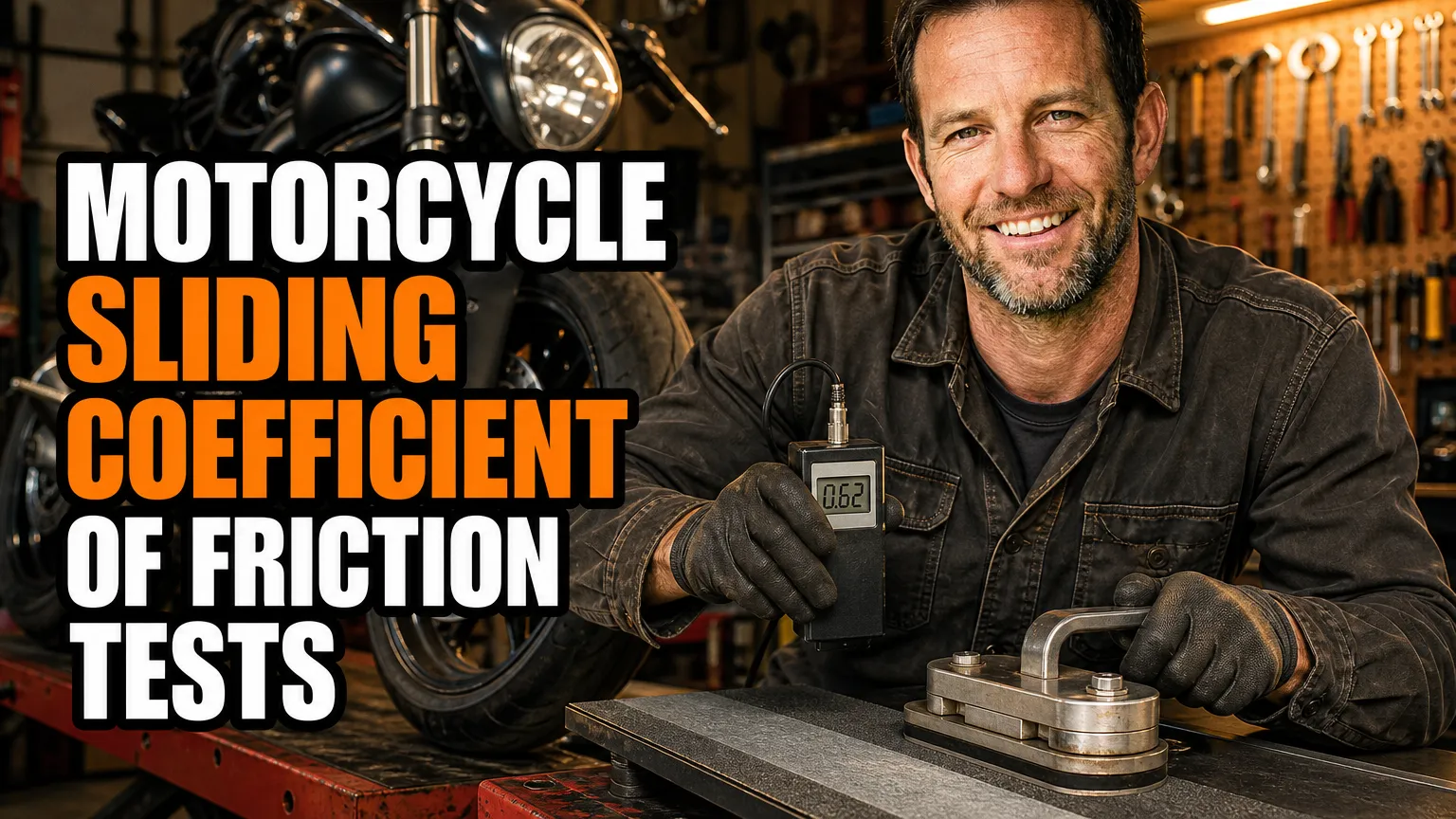
When I think about motorcycle grip, I don’t picture a single magic number printed on a chart. I picture a tire meeting a particular patch of pavement, under a particular load, in particular weather—and how quickly that relationship can change when the tire begins to slide.
That is why I find motorcycle sliding coefficient of friction tests useful, as long as I understand what they can and cannot tell me. These tests help measure resistance between a sliding tire and a road surface, but they are not a crystal ball for predicting every skid, corner, or crash.
- A sliding-friction coefficient describes resistance after a tire or test surface is already moving across another surface.
- Road material, water, contaminants, tire condition, load, speed, and temperature can all affect a test result.
- I treat test results as useful comparisons, not universal grip ratings or guarantees about real-world stopping and cornering.
- I never recommend deliberately testing a motorcycle slide on a public road.
What a sliding-friction number actually tells me
In simple terms, a coefficient of friction compares the force resisting movement with the force pressing two surfaces together. In a basic test, that relationship is often written as μ = F/N, where F is the measured friction force and N is the normal force pressing the surfaces together.
The coefficient itself is dimensionless, so it has no unit like miles per hour or pounds. A higher result generally means more resistance to sliding under the test conditions; a lower result means less. I always keep the phrase under the test conditions in mind, because the number does not describe every road, tire, or riding situation.
Sliding friction is not the same as cornering grip
One distinction I consider essential is the difference between a tire that is rolling and a tire that is sliding. A rolling tire can transmit forces through a changing contact patch, while a tire that is sliding has passed beyond the point where it rolls normally across the road.
That means a sliding-friction value cannot be used as a direct substitute for a motorcycle tire’s cornering or braking performance. During real riding, the tire may be rolling, deforming, slipping slightly, or losing grip progressively, and the front and rear tires may be doing different jobs at the same time.
I also avoid treating any test value as a simple stopping-distance prediction. Braking distance depends on more than friction alone, including speed, rider input, motorcycle setup, road slope, tire condition, and whether the wheel remains controlled.
How I think about the main types of friction tests
Different test methods answer different questions. When I read a result, I want to know what was tested, how it moved, and what the equipment actually measured before I decide what the number means for riding.
Controlled tire-on-surface tests
In a controlled setup, a tire or tire section can be pressed against a selected road sample and moved at a defined speed. Sensors record the force needed to keep it moving, while the test operator controls variables such as load, surface condition, and water application.
I find this approach helpful for comparing surfaces or conditions under repeatable laboratory settings. But a test sample is still a sample: it cannot capture every crack, patch, painted marking, oil trace, or change in texture that I might encounter over a full road journey.
Portable friction-measuring equipment
Some field devices measure friction by dragging or rotating a test element over a pavement surface. Depending on the equipment, the device may use a rubber slider, a small wheel, or another contact mechanism to produce a repeatable measurement.
These tools can help assess differences between sections of pavement, including changes associated with water or surface wear. I check the device type and operating procedure because two instruments can produce results that are not directly interchangeable, even when both report a friction-related value.
Skid trailers and larger test systems
A skid trailer can measure friction while a test wheel is pulled across a road at a controlled speed and load. This can be valuable for pavement evaluation, but the test wheel and its setup are not necessarily a complete stand-in for a full motorcycle with two tires, suspension, a rider, and changing lean angle.
For me, the important question is not whether a piece of equipment sounds sophisticated. It is whether its method is appropriate for the question being asked, and whether the report clearly states the conditions and limitations.
Why road conditions can change the result
When I look at friction test results, I start with the surface. Asphalt, concrete, aggregate, painted lines, metal covers, and repaired pavement can all behave differently, and even one road can vary from one stretch to the next.
Water matters too, but “wet” is not one uniform condition. A thin film, standing water, spray, and a damp surface with dust or residue create different contact conditions, so I want to know how much water was used and how it was applied.
Contamination, texture, and temperature
Oil, fuel, loose gravel, leaves, mud, and road markings can affect the contact between tire and pavement. A clean, dry test surface may be useful as a baseline, but it cannot tell me exactly how a contaminated corner will behave on a rainy evening.
Temperature is another factor I pay attention to. Rubber properties can change as a tire warms or cools, while the road and any water on it can also respond to temperature; the result is that a value measured in one condition may not carry over neatly to another.
Surface texture adds more complexity. A road’s tiny-scale texture and larger visible roughness can influence how a tire contacts it, so I don’t assume that a road that looks smooth or coarse will always produce a predictable friction result.
Tire condition, loading, and speed
A tire’s compound, tread depth, age, pressure, and wear pattern can influence its behavior. If a test report leaves out tire details, I treat the result as incomplete rather than assuming it applies equally to every motorcycle tire I have ridden on.
Load and speed matter because they affect how the tire and surface interact. I also consider whether the test measured a steady slide, a brief slip, or some other motion; those situations are not interchangeable, and the measurement may respond differently to each.
How I read a test report without overreading it
Before I compare two friction values, I look for the test method, equipment, test speed, tire or slider type, normal load, surface, temperature, and moisture conditions. I also check whether the report describes repeated measurements and how much the readings varied.
If those details are missing, I avoid making a confident ranking. A number without context can look precise while hiding important differences in how it was produced.
Comparisons are often more useful than a lone score
I usually find controlled comparisons more informative than an isolated number. For example, a test that evaluates one surface when dry and wet using the same equipment can show how that specific surface responded to that specific change in conditions.
Even then, I keep the conclusion narrow. I might say that one tested condition produced less measured resistance than another in that setup, but I would not claim that the result predicts every tire’s behavior or guarantees a particular stopping distance.
Questions I ask before trusting the data
- What exact surface and test device were used?
- Was the measurement taken under dry, wet, or contaminated conditions?
- What speed, load, and contact material did the test use?
- Were the same settings used for every comparison?
- Does the report explain uncertainty, repeatability, or test limitations?
What these tests mean for me as a rider
For my everyday riding, friction tests are most useful as a reminder that grip is conditional. They help explain why the same road can feel different after rain, why paint and metal deserve attention, and why I leave myself room to respond when the surface changes unexpectedly.
They do not give me permission to ride closer to my limits. A laboratory measurement does not account for a surprise obstacle, a mid-corner correction, a cold tire, or a patch of grit I did not see until I was on it.
I also separate friction testing from crash statistics. A friction measurement can describe a surface interaction; it cannot by itself explain why a crash happened or determine who caused it. For broader context, I look at research such as what percentage of motorcycle accidents are caused by cars and what percent of motorcycle accidents are caused by other drivers.
That distinction matters to me because a road surface is only one part of a crash scenario. When I want to understand the human consequences, I also review information about how many fatal motorcycle accidents per day, along with analyses of what percent of motorcycle accidents result in death and what percent of motorcycle accidents are fatal.
What a road-friction test cannot tell me
A test result cannot capture every feature of a complete motorcycle and rider. The machine’s geometry, suspension, tire profile, braking system, load distribution, and rider actions all influence how a real event develops.
It also cannot tell me exactly how a specific slide will feel or whether I could recover from it. A controlled test often focuses on one contact and one measurement, whereas a real incident can involve rapid changes in direction, load, lean, and surface conditions.
I’m especially cautious about treating a sliding coefficient as a universal “grip rating.” Different equipment, procedures, and surfaces can generate different values, so I compare results only when I understand how they were measured.
Why I leave deliberate sliding tests to professionals
I would never try to measure friction by deliberately sliding my motorcycle on a public road. Traffic, hidden contaminants, uneven pavement, and unexpected obstacles make that kind of experiment dangerous for me and for everyone nearby.
When a formal test is needed, I want it conducted in a controlled facility by people with suitable instrumentation, a defined procedure, and appropriate safety measures. That lets the test answer a technical question without turning a public road into an uncontrolled experiment.
For my own riding, I focus on practical habits rather than trying to recreate laboratory conditions. I scan for surface changes, ease my inputs when conditions deteriorate, keep a sensible margin, and make sure my tires are maintained according to the motorcycle and tire manufacturers’ guidance.
My takeaway on measuring a motorcycle slide
Motorcycle sliding-friction tests can provide useful evidence about how a tire or test material interacts with a road under specified conditions. I value them most when the method is transparent, the measurements are repeatable, and the conclusions stay within the limits of the experiment.
What I don’t do is turn one coefficient into a promise about real-world grip. I use test data to understand the variables, stay curious about the conditions behind a number, and ride with enough caution to account for the parts no test can predict.
Frequently Asked Questions
What does a sliding-friction test measure?
It measures the resistance between a sliding tire or test surface and the road, often expressed as a coefficient of friction.
Is the sliding coefficient the same as tire grip while cornering?
No. Sliding friction describes a tire that is already slipping, while cornering grip involves a more complex combination of forces and tire behavior.
Can one friction test predict exactly how a motorcycle will slide?
No. Results depend on the tire, road, speed, load, temperature, water, and test method, so a single value cannot predict every real-world slide.
Should I try a sliding-friction test on a public road?
No. I leave instrumented testing to controlled facilities and qualified professionals; deliberately sliding a motorcycle on public roads is dangerous.

Related Articles

Smooth Motorcycle Downshifts: My Step-by-Step Guide to Rev Matching
Learn how I rev-match motorcycle downshifts smoothly, with clear steps, safe practice drills, common mistakes, and tips for different bikes…
Jake Miller
11 min read

Motorcycling in Early Pregnancy: Risks, Questions to Ask, and Safer Choices
Riding a motorcycle while pregnant in the first trimester raises safety questions. I cover crash risks, clinician advice, gear limits,…
Jake Miller
9 min read

Why Your Motorcycle Wobbles at Low Speed: Causes I Check and Fixes That Work
Learn why a motorcycle wobbles at low speed, how I diagnose tire, steering, and setup problems, and the safe fixes…
Jake Miller
10 min read