
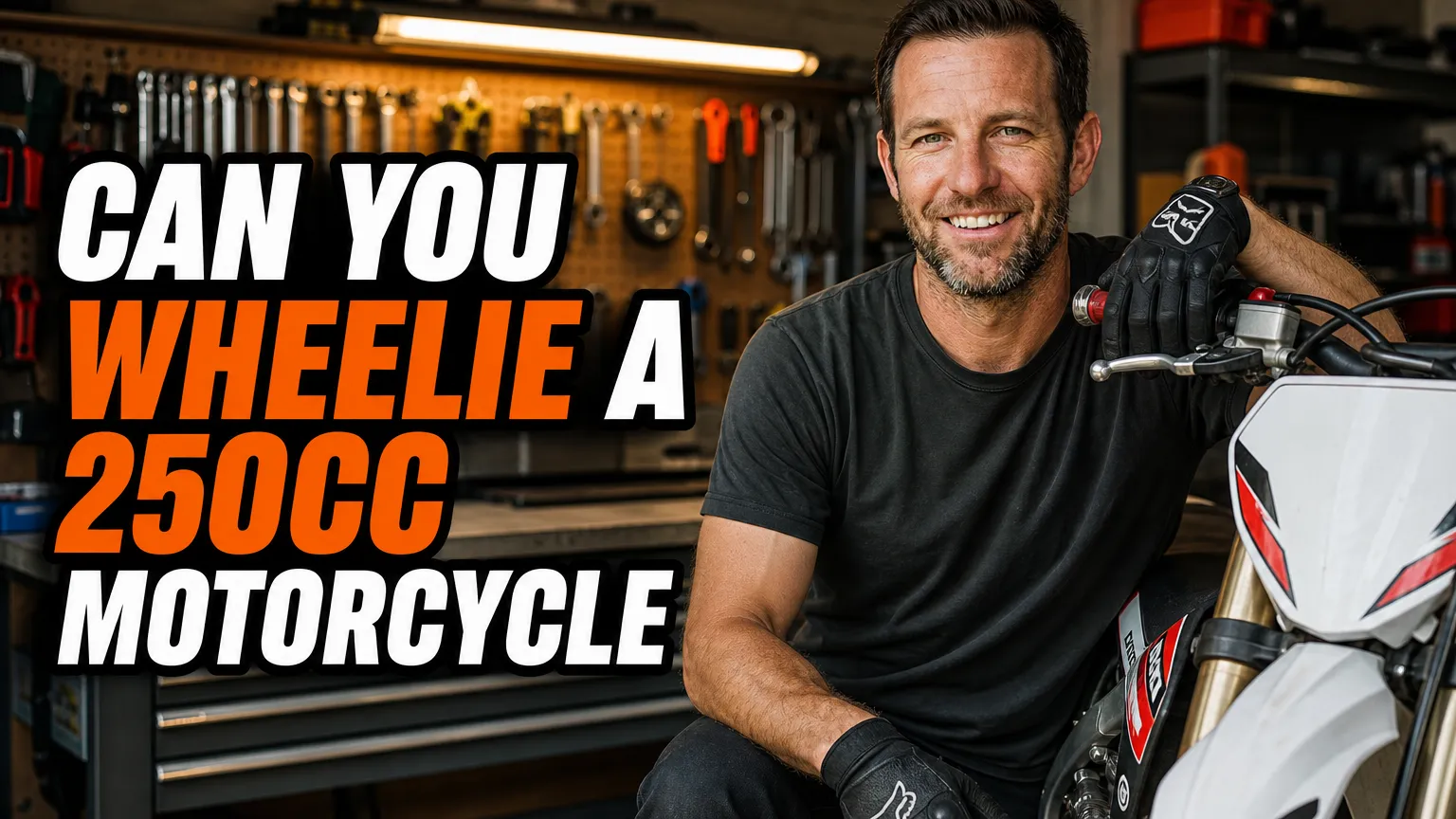
When someone asks me whether a 250cc motorcycle can wheelie, my short answer is yes, some can. But engine size alone won’t tell you how readily a particular bike can lift its front wheel, and being able to do it doesn’t mean it’s a good idea to try on the street.
I look at the whole picture: the motorcycle’s design, power delivery, weight, gearing, tires, and the rider’s experience. In this guide, I’ll explain what affects front-wheel lift, why different 250s behave so differently, and how I think about learning safely.
- Yes, a 250cc motorcycle can wheelie, but some models are much more capable than others.
- Bike type, power delivery, gearing, weight, traction, and rider skill all matter.
- I don’t recommend attempting wheelies on public roads or without proper training.
- Controlled practice and sound protective gear matter more than showing off.
My short answer: it depends on the 250
I wouldn’t treat “250cc” as a complete description of what a motorcycle can do. Displacement tells me the approximate volume swept by the engine’s cylinders; it doesn’t tell me the bike’s weight, power curve, gearing, or intended use. Two machines with the same engine capacity can feel remarkably different.
For example, a light off-road 250 may have a lively engine and gearing intended for trails. A street-oriented 250 may be heavier, tuned for smooth everyday riding, and designed to be approachable for newer riders. Those differences can affect how readily the front end gets light under acceleration.
In my experience, the useful question isn’t simply, “Is 250cc enough?” I’d ask, “What kind of 250 is it, what condition is it in, and can the rider control it safely?” The answer depends on that combination.
What makes one motorcycle lift its front wheel more easily?
When a motorcycle accelerates, weight shifts toward the rear. If the combination of engine force, traction, motorcycle geometry, and rider input is sufficient, the front wheel may become light or leave the ground. That’s a basic description of the physics, not a guarantee that any particular bike will lift.
I think of wheelie potential as the result of several factors working together. None of them should be considered in isolation, and a machine that lifts easily can be less forgiving if a rider makes a mistake.
Power delivery matters as much as peak power
A bike’s maximum horsepower figure doesn’t explain its entire personality. I pay attention to how the engine delivers power across the rev range: a smooth, predictable response can feel very different from a sudden surge. That distinction affects control as much as raw output does.
Engine design and tuning also matter. Two bikes with similar displacement can have different torque characteristics, throttle response, and usable power. I wouldn’t assume that a 250cc model with one kind of engine will behave like every other 250.
Weight, geometry, and gearing change the feel
A lighter motorcycle may respond to acceleration differently from a heavier one, but weight isn’t the only consideration. Wheelbase, suspension setup, center of gravity, and overall chassis design also influence how the bike behaves. I’m careful not to reduce a complex machine to a single number.
Gearing can change how quickly a motorcycle accelerates, too. The manufacturer’s intended setup is designed around the bike’s purpose, and modifications can affect handling, reliability, and how predictable the motorcycle feels. Before changing anything, I’d check the owner’s manual and talk with a qualified mechanic.
Traction and condition are part of the equation
Even a powerful motorcycle can’t behave predictably without suitable traction. Tire condition, tire pressure, road or ground surface, suspension condition, and weather all influence how a bike responds. A worn tire or uneven surface can turn a small mistake into a much bigger problem.
I also consider the bike’s general maintenance. Brakes, chain, controls, suspension, and tires need to be in sound condition for normal riding, let alone any demanding activity. If something feels off, I fix that before I even think about performance.
Why dirt 250s and street 250s feel so different
When I compare 250cc motorcycles, I start with what they were built to do. A motocross or enduro bike is designed for off-road use and often prioritizes low weight, ground clearance, and responsive performance. A small road bike may instead prioritize comfort, manageable power, fuel economy, and everyday reliability.
That doesn’t mean every dirt bike will wheelie easily or every street bike will stay planted. It means the design goals differ, and those goals shape how a motorcycle responds. I always judge the specific model rather than relying on a category label.
Off-road models
Some off-road 250s feel lively because they’re relatively light and designed to cope with changing terrain. That can make the front end feel more responsive, but it also demands respect. A trail or track has its own hazards, including loose surfaces, ruts, rocks, other riders, and limited room to recover.
I don’t mistake an off-road setting for a risk-free one. I’d ride within my ability, use appropriate protective equipment, and follow the rules of the land or facility. If I wanted to learn a new skill, I’d look for instruction and a designated practice area.
Street and beginner models
Many street-oriented 250s are deliberately easy to ride in traffic and at ordinary speeds. Their power delivery may be designed to feel accessible, which can make an unplanned front-wheel lift less likely than on a more specialized motorcycle. That’s a useful characteristic for everyday riding, not a shortcoming.
I also think about where the bike is being ridden. A public road has cars, intersections, driveways, changing pavement, and people who may not see a motorcycle. A stunt can leave almost no margin for those unpredictable conditions, even if the rider feels confident.
Is it a good idea for a beginner to try?
My honest view is that a beginner should focus on the fundamentals before attempting a wheelie. I’d build confidence with smooth starts and stops, steady braking, turning, hazard awareness, and low-speed control. Those skills help me stay safe in everyday situations and make me a more capable rider overall.
Wheelies can carry a meaningful risk of losing control, damaging a motorcycle, or injuring the rider and others. If the front end rises unexpectedly, the rider may not have the experience to respond calmly. A confident feeling isn’t the same as having the training and judgment to manage a high-risk maneuver.
I’m also mindful of the people sharing the road. Motorcycle crashes can involve driver errors and other traffic conditions, which is why I think it’s worth understanding what percentage of motorcycle accidents are caused by cars and what percent of motorcycle accidents are caused by other drivers. That context reinforces my preference for keeping public roads predictable rather than adding unnecessary stunts.
Where I’d learn, and what I’d do first
If I wanted to learn a specialized riding skill, I’d look for a qualified instructor and a facility that permits the activity. A structured environment gives me a chance to understand the risks, use suitable protective equipment, and get feedback from someone who knows how to teach. I wouldn’t use traffic, a parking lot without permission, or a busy public space as a practice ground.
I’d also check local laws and facility rules before doing anything. Regulations can vary, and what seems like an empty stretch of pavement may still be a public roadway or private property where stunts aren’t allowed. I’d rather take the time to find a proper setting than risk a ticket, a crash, or someone else’s safety.
My personal safety checklist
Before any demanding ride, I make sure I have a correctly fitted helmet and protective riding gear appropriate to the conditions. Gloves, boots, and abrasion-resistant clothing can reduce some injury risks, though no gear makes a stunt safe. I also inspect the motorcycle and avoid riding when I’m tired, distracted, or affected by alcohol or drugs.
I’d make sure the motorcycle is appropriate for my experience and in good mechanical condition. I’d read its manual, understand its controls, and ask a trained professional about concerns. I wouldn’t use a borrowed or unfamiliar bike for an activity that leaves little room for error.
Why I avoid practicing on public roads
Public roads are designed for transportation, not stunt practice. Drivers may turn, change lanes, pull out, or brake unexpectedly, and road surfaces can change without warning. Even when I believe a road is clear, I can’t control what another person does next.
I take crash risk seriously, rather than treating it as an abstract statistic. Looking into how many fatal motorcycle accidents per day, what percent of motorcycle accidents result in death, and what percent of motorcycle accidents are fatal is a sobering reminder that the consequences of a mistake can be severe. I don’t see a public-road wheelie as worth that risk.
Can wheelies damage a 250cc motorcycle?
They can, especially if the bike takes repeated hard impacts or the rider loses control. Depending on the motorcycle and how it’s used, hard landings and unusual loads may place stress on the suspension, steering components, wheels, drivetrain, and other parts. I wouldn’t assume a machine is built to withstand repeated stunts just because it can lift its front wheel.
Maintenance matters, too. After an incident or hard impact, I’d inspect the motorcycle and have a qualified mechanic check it if anything seems damaged or unusual. New noises, handling changes, leaks, or problems with the controls are reasons I would stop riding and get the bike checked.
I’d also read the warranty and manufacturer guidance before making modifications or using the motorcycle outside its intended purpose. Repairs can be expensive, and damage to a bike is only one concern; losing control can put the rider and other people at risk.
How I think about skill, confidence, and control
When I ride, I want my confidence to come from sound habits rather than bravado. That means looking ahead, leaving space, choosing a speed that suits conditions, and knowing when to back off. Those choices matter more to me than proving what my motorcycle can do.
I also separate “possible” from “wise.” A 250cc bike may have enough power to lift its front wheel in some circumstances, but that fact doesn’t make the maneuver appropriate for every model, rider, or setting. Good judgment includes knowing when not to try something.
If my goal is to become a more skilled rider, I’d put my time into formal training and practical road skills. Those lessons can help with emergency responses, braking, cornering, and awareness, which are useful on every ride. I see them as a better investment than copying a stunt without instruction.
My bottom line
So, can a 250cc motorcycle lift its front wheel? Yes, depending on the bike and the circumstances. A light, responsive off-road model may behave very differently from a heavier, smoothly tuned street bike, and rider skill plays a major role in how the motorcycle responds.
My advice is to treat wheelies as a specialized, high-risk skill, not a casual test of engine size. I’d avoid public roads, use a legal controlled setting if I pursued training, wear suitable protective gear, and get instruction from someone qualified. For most riders, learning to control a motorcycle smoothly and safely is far more rewarding than risking a crash to show that a 250 can lift.
Frequently Asked Questions
Can a 250cc motorcycle wheelie?
Yes. Some 250cc motorcycles can lift the front wheel, but the bike’s design, power, gearing, rider weight, and skill all affect how easily.
Is a 250cc motorcycle easy to wheelie?
Not always. A lightweight, powerful 250cc dirt bike may respond differently from a heavier commuter or beginner street bike.
Can I practice wheelies on a public road?
I don’t recommend it. Public roads bring traffic, obstacles, and legal risks; I’d seek qualified coaching in a controlled, permitted setting instead.
Does a wheelie damage a motorcycle?
It can. Repeated hard impacts or poor control may strain the drivetrain, suspension, steering, and other components, so I follow the manufacturer’s guidance.

Related Articles

Smooth Motorcycle Downshifts: My Step-by-Step Guide to Rev Matching
Learn how I rev-match motorcycle downshifts smoothly, with clear steps, safe practice drills, common mistakes, and tips for different bikes…
 Jake Miller
11 min read
Jake Miller
11 min read

Motorcycling in Early Pregnancy: Risks, Questions to Ask, and Safer Choices
Riding a motorcycle while pregnant in the first trimester raises safety questions. I cover crash risks, clinician advice, gear limits,…
Jake Miller
9 min read

How Road-Friction Tests Reveal What Happens When a Motorcycle Slides
I explain how motorcycle sliding-friction tests measure tire grip, what changes on wet or dirty roads, and how I use…
Jake Miller
10 min read