
9 Best GPS Units for Round-the-World Motorcycle Travel (Rider-Tested)
 Jake Miller
10 min read
Jake Miller
10 min read
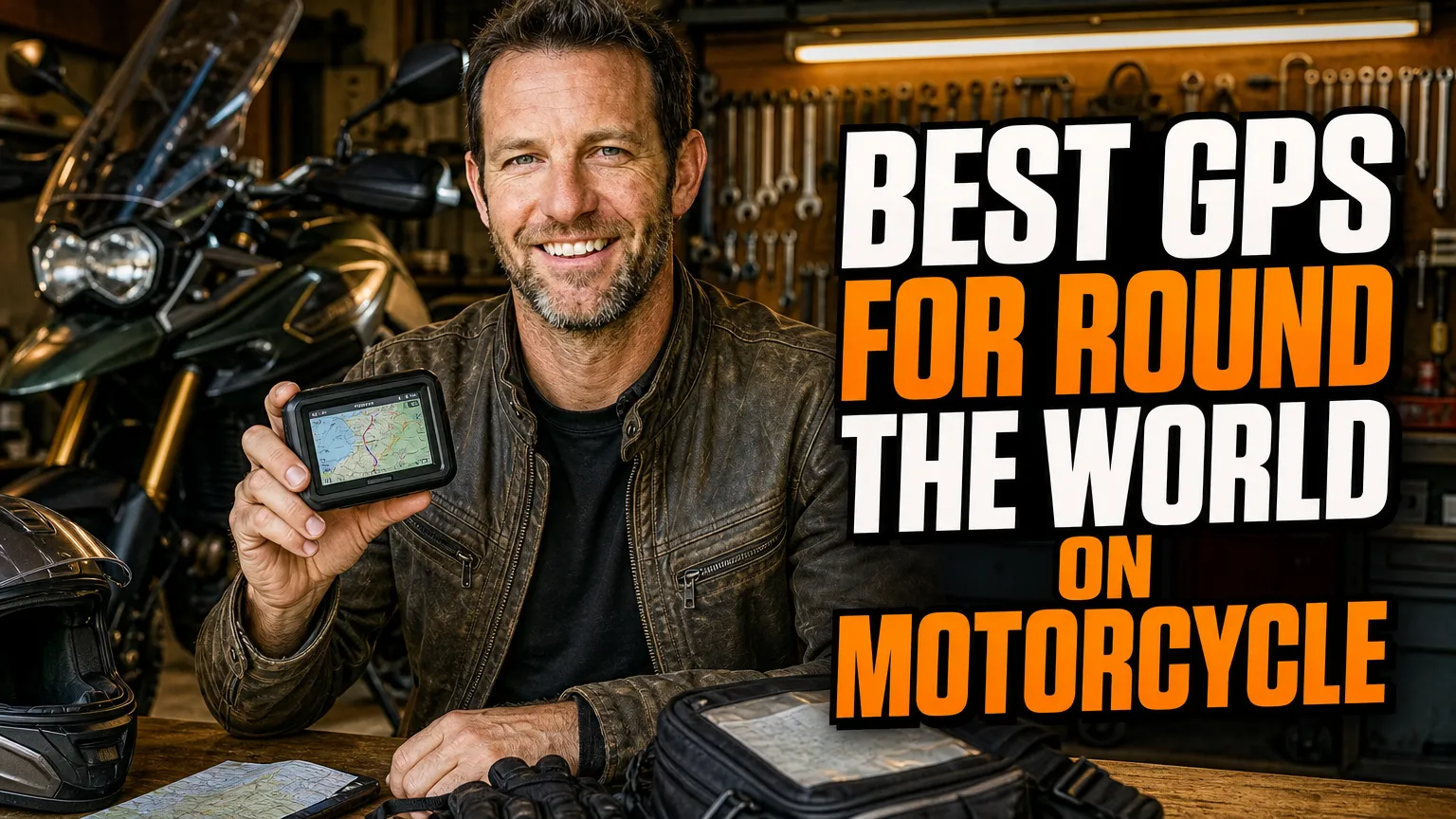
I have spent the last several years stringing together long-distance rides across Europe, the Balkans, Central Asia and the Americas, and the single piece of electronics that has caused me the most joy and the most swearing is my navigation setup. A phone in a cheap mount will get you across a country. It will not get you across a continent.
Over that time I have broken two phone screens, cooked one Android device in direct sun, and watched a riding buddy’s budget GPS lose its satellite lock in a Tajik valley with no signposts for 200 kilometres. That is how I ended up testing dedicated units seriously.
So this is my honest, rider-first list of the best GPS for round-the-world motorcycle travel. I have used or ridden alongside almost everything here, and I have been blunt about the compromises each one makes.
- The Garmin zūmo XT2 is my overall pick: big screen, IPX7, glove-friendly and genuinely rugged.
- The Garmin Montana 700i is the one I would take into the desert, because it has built-in inReach satellite SOS.
- Carry a second unit. The Garmin eTrex 32x runs on AA batteries and costs very little.
- Never rely on a phone alone. Heat, vibration and battery drain end more trips than bad roads do.
- Buy for the worst day, not the best one. Waterproofing and sunlight readability matter more than features.
What Actually Matters for RTW Navigation
Before I get into the units, here is the filter I apply to every device. If a GPS fails any of these on a long trip, it is dead weight in my tank bag.
Waterproofing and Heat Resistance
You will ride through rain for six hours straight, then park in 45°C sun. Anything rated below IPX7 is a gamble I am not willing to take with my only navigation source. Phones fail here constantly, because they throttle and shut down when they get hot.
Glove-Friendly Controls
I ride with thick winter gloves for months at a time. A capacitive screen that ignores gloves means pulling over every time I want to zoom out. Buttons and resistive or well-tuned capacitive screens win on a long tour.
Offline Maps and Track Recording
There is no data in the Pamir Mountains. Whatever I carry must have maps stored on the device, and it must record a breadcrumb track so I can reverse my route if a pass is snowed in.
1. Garmin zūmo XT2 — Best Overall Round-the-World Navigator
If you want one device and no drama, this is the one I recommend. The Garmin zūmo XT2 has a display that is noticeably bigger and brighter than the older XT’s 5.5-inch panel, and it stays readable in direct sunlight, which is the test that eliminates most rivals.
It is IPX7 waterproof, so torrential rain is a non-issue, and the touchscreen works with gloves on. Battery life is roughly 10 hours, and it charges over USB-C, which matters enormously when you are running off a bike’s 12V system with a dodgy regulator.
Why I Trust It
The zūmo XT2 has Adventure Mode with track recording, so I can build a route in a café, ride it, and keep the recorded line for next time. It also supports Group Ride Radio with the accessory, which is genuinely useful when you are riding with two or three others and keep losing each other at junctions.
It pairs with a phone over Bluetooth for calls and music, and it will update maps over Wi-Fi when you find good internet. Expect to pay around $600, which sounds steep until you compare it to a broken phone and a missed ferry.
Where It Falls Short
It is not a handheld. I would not take the zūmo XT2 hiking up to a viewpoint, and it does not have satellite messaging built in. For real off-grid safety you need to pair it with an inReach device.
2. Garmin zūmo XT — Best Proven Value
The zūmo XT is the unit I rode with for two full seasons before the XT2 existed, and I still think it is the smartest buy for most people. It has a 5.5-inch glove-friendly display at 1280×720, IPX7 sealing, and the same Adventure Mode track recording as its successor.
Battery life is again around 10 hours, and it charges via micro-USB, which is the one thing I dislike. I carry a short micro-USB cable specifically for it, and I have forgotten it exactly once, in Albania, which was memorable.
The zūmo XT can pair with a Garmin inReach for satellite messaging, so you can build a full RTW safety net around a cheaper head unit. Prices hover around $400 to $450, and second-hand examples are everywhere.
3. Garmin Montana 700i — Best Off-Road and Satellite SOS
If your round-the-world route involves more dirt than tarmac, this is my pick without hesitation. The Garmin Montana 700i is a 5-inch glove-friendly touchscreen device built to MIL-STD-810 and IPX7 standards, with a battery that runs up to around 18 hours.
The killer feature is that it has inReach satellite technology built in. That means two-way messaging and an SOS button that reaches a real emergency coordination centre, from anywhere on earth with a view of the sky.
Real-World Use
I have used a Montana as both a bike navigator and a hiking unit on the same trip, which is exactly what it is designed for. You can load City Navigator street maps and TopoActive topographical maps side by side, then switch between road routing and trail routing in seconds.
It takes a proper handlebar mount and it is heavy compared to a zūmo, but that weight is a clue about how tough it is. The 700i runs around $700, and the 750i adds an 8-megapixel camera for about $100 more.
4. Garmin GPSMAP 67i — Best Rugged Handheld Backup
This is the unit I strap to my bars when the terrain gets silly. The Garmin GPSMAP 67i has a smaller 3-inch display, but it is a proper handheld with buttons you can operate through thick gloves in the dark.
Battery life is the headline: up to 180 hours in expedition mode on two AA batteries, or roughly 35 hours in normal use. It supports multi-band GNSS, so it holds a lock in steep valleys where single-band receivers give up.
Like the Montana, the 67i includes inReach satellite messaging and SOS. It is IPX7 and built to MIL-STD-810, and it charges over USB-C. At around $600, it is the best compromise I know between a navigation device and a survival tool.
5. TomTom Rider 550 — Best for Winding Roads in Europe
I will be honest: I am a Garmin person. But the TomTom Rider 550 earned a permanent place in my kit for one reason, and that reason is the Winding Roads routing option. When I am crossing the Alps and I want the fun route rather than the fast route, TomTom just does it better.
It has a 4.3-inch glove-friendly touchscreen, IPX7 waterproofing, and lifetime map updates with world coverage available. The MyDrive app lets me plan a complicated route on my phone in a hotel room and push it to the device in one tap.
It also handles GPX imports cleanly, which matters if you are following routes shared by other riders. Expect around $400. The trade-off is no satellite messaging and a smaller screen than the zūmo XT2.
6. Garmin eTrex 32x — Best Budget AA-Battery Backup
Every long-distance rider I respect carries a second navigation device, and this is mine. The Garmin eTrex 32x costs around $280, runs on two AA batteries for up to 25 hours, and is IPX7 rated.
It has a tiny 2.2-inch screen, a three-axis compass, a barometric altimeter and a microSD slot for extra maps. It is button-operated, so gloves are irrelevant, and it survives being dropped on rocks repeatedly.
The eTrex 32x comes preloaded with TopoActive maps, which is remarkable at this price. I keep it loaded with the same regional maps as my main unit and buried in my luggage as insurance.
7. Beeline Moto — Best Minimalist Option
Not everyone wants a big screen on their bars. The Beeline Moto is a small circular device that shows a single arrow and a distance to the next turn, and nothing else. It is the closest thing to riding by instinct while still knowing where you are going.
It pairs with your phone over Bluetooth and uses the phone’s GPS and maps, with battery life of around 30 hours. It is waterproof and mounts with a neat twist-lock mechanism that I have never had vibrate loose.
At around $180 it is the cheapest real navigation device on this list. But be clear about the compromise: if your phone dies, the Beeline is a paperweight, so I only recommend it as a secondary unit on a world trip.
8. Samsung Galaxy Tab Active5 — Best Big-Screen Tablet Setup
Some riders, especially those doing rally-style navigation, want a proper tablet on the bars. The Samsung Galaxy Tab Active5 is the one I would choose: an 8-inch display, IP68 waterproofing, MIL-STD-810H toughness, and a user-replaceable battery.
Pair it with a vibration-damping mount and apps like OsmAnd, Calimoto or DMD2, and you get enormous maps, offline routing and a screen you can actually read at speed. The Tab Active4 Pro gives you a 10.1-inch option if you want even more real estate.
The catch is power and vibration. Tablets draw a lot of current and camera-based stabilisation does not exist on a screen, so I would never run one without a proper damped mount and a solid charging setup. Budget around $550 plus the mount.
9. Garmin inReach Mini 2 — Best Satellite Companion
This is not a full navigation device, and I am including it anyway because it belongs in the pocket of anyone riding around the world. The Garmin inReach Mini 2 weighs about 100 grams and delivers two-way satellite messaging plus an SOS button that reaches Garmin’s emergency response centre.
Battery life is up to 14 days with 10-minute tracking enabled, and it pairs with your phone through the Garmin Messenger app. It also offers basic waypoint navigation, so it can get you back to a known point in a genuine emergency.
You need an active satellite subscription, starting at around $15 per month, and the device itself is roughly $400. I consider that the cheapest insurance policy in motorcycling.
My Real-World Verdict
If I were leaving tomorrow on a genuine round-the-world ride, I would mount a Garmin zūmo XT2 on the bars, keep a Garmin eTrex 32x in my luggage as a backup, and carry a Garmin inReach Mini 2 on my jacket at all times.
If my route was heavily off-road, I would swap the zūmo for a Garmin Montana 700i and accept the extra weight and cost in exchange for a device that works as both a navigator and a lifeline.
The single biggest mistake I see riders make is trusting a phone. It works beautifully for the first three months and then it cooks itself on a hot day in a country where you cannot buy a replacement. Buy dedicated hardware, carry a spare, and ride further.
Frequently Asked Questions
Do I really need a dedicated GPS if I have a smartphone?
A phone is fine for weekend rides, but heat, vibration and battery drain kill them on long tours. A dedicated unit like the Garmin zūmo XT2 keeps navigating when your phone shuts down from overheating.
What is the best budget GPS for a round-the-world motorcycle trip?
The Garmin eTrex 32x runs on AA batteries, costs a fraction of a zūmo, and will still be working after your main unit dies.
Can a Garmin zūmo XT2 handle off-road riding?
Yes. Adventure Mode, track recording and optional TopoActive maps make it usable on gravel, though a Garmin Montana 700i is the tougher choice.
Do I need satellite SOS on a world trip?
I would not leave home without it. A Garmin inReach Mini 2 or a Montana 700i gives you two-way satellite messaging where there is no cell coverage at all.

Related Articles

6 Best Motorcycle Phone Mounts That Keep Your Phone Charged on the Road
Compare six dependable motorcycle phone mounts with wireless or USB charging, including fit, power wiring, vibration protection, weather resistance, and…
Jake Miller
10 min read

5 Best Motorcycle Phone Mounts for Naked Bikes and Open-Cockpit Riding
I compare secure, vibration-conscious phone mounts for naked and touring bikes, with fit notes, real trade-offs, and setup tips for…
Jake Miller
11 min read

7 Best Phone Mounts for Sport Bikes: Secure, Vibration-Smart Picks
Compare secure phone mounts for sport bikes, including clip-on fit, vibration control, case systems, prices, and my practical picks for…
Jake Miller
12 min read