
10 Best Waterproof Motorcycle GPS Units for Rain, Dust and Everything Between
 Jake Miller
11 min read
Jake Miller
11 min read
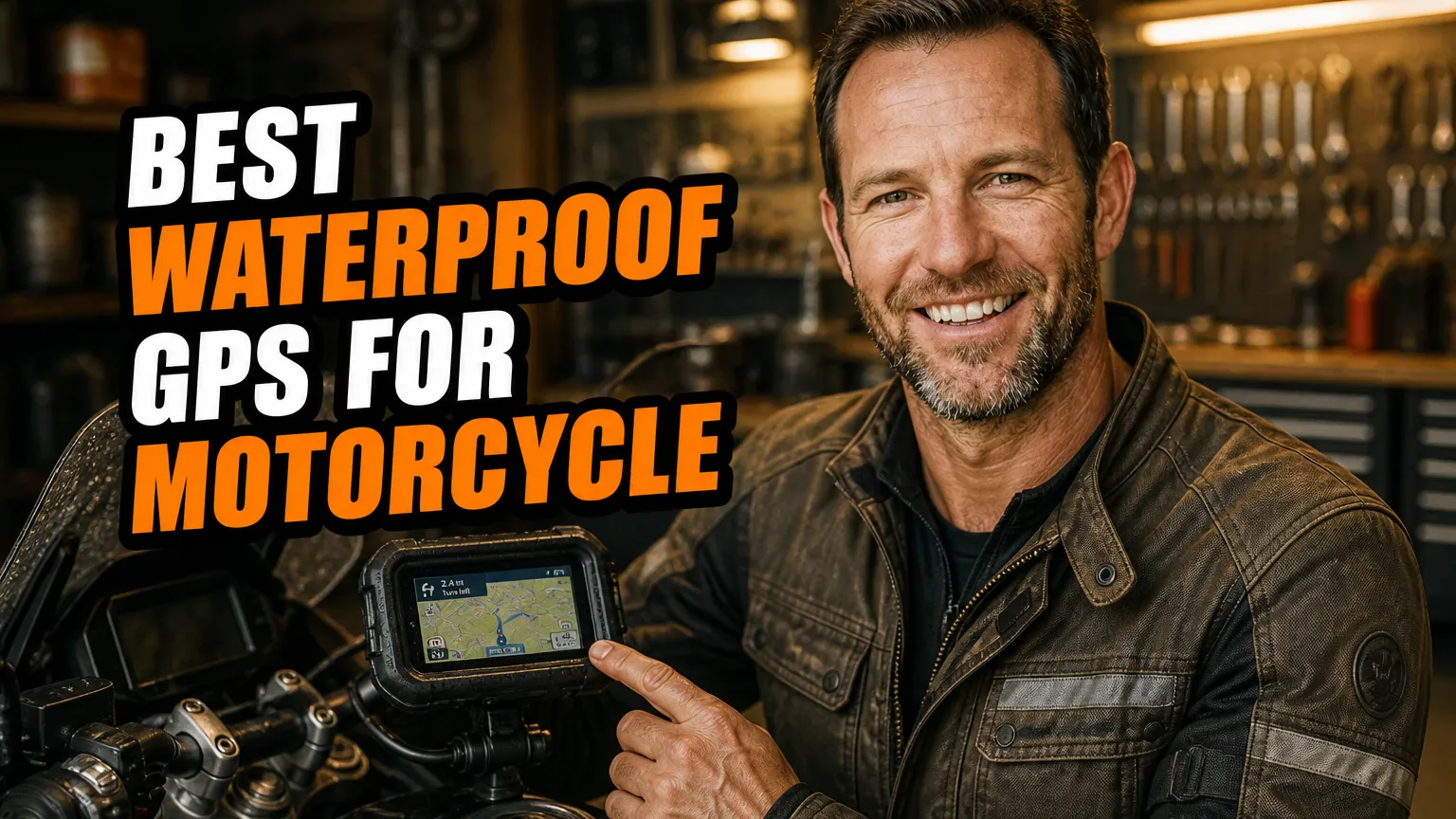
I have been caught in more rainstorms than I care to count. Scottish sleet, Colombian afternoon downpours, and one memorable hailstorm outside Flagstaff that turned my visor into a drum kit. In every single one of those moments, the thing I refused to lose was navigation.
For years I ran my phone in a waterproof pouch strapped to the bars. It worked, right up until it didn’t. The touchscreen stopped responding to gloves, the camera’s stabilisation died from vibration, and on a 38°C day in southern Spain the whole thing shut down from heat behind the plastic window.
That is why I now run dedicated waterproof hardware. Below are the ten units I have ridden with, borrowed, or spent real money on, ranked by how much I actually trust them when the sky opens up.
- The Garmin zūmo XT2 is my overall pick: IPX7, 6-inch glove-friendly screen, and genuine adventure routing.
- The TomTom Rider 550 still beats everything for twisty-road planning on a budget.
- If you want CarPlay, the Chigee AIO-5 Lite is the waterproof unit I would actually bolt to my own bars.
- IPX7 is the minimum rating worth trusting in sustained highway rain; IPX4 or IPX5 is not enough.
- Cheap handhelds like the Garmin eTrex 32x make brilliant emergency backups for the price of a tank of fuel.
1. Garmin zūmo XT2 — Best Overall Waterproof Motorcycle GPS
If I could only own one navigation device for the rest of my riding life, this would be it. The zūmo XT2 is Garmin’s current flagship motorcycle unit, and it earns that position with a 6-inch, 1280×720 glove-friendly touchscreen wrapped in an IPX7 and MIL-STD-810-rated body.
The screen is the headline. It is bright enough to read in direct Andalusian sun, and it responds to my winter gloves without me having to stab at it like I am defusing a bomb. Rain does not confuse it either, which is more than I can say for most capacitive panels.
What I actually use it for
Adventure Mode is the feature I reach for constantly. It lets me bias routing toward unpaved roads, then records my track so I can retrace it later. I have used it to stitch together fire roads in Portugal that no phone app would ever have suggested.
Group Ride Radio is a nice bonus if your mates own the accessory, letting up to twenty riders stay in contact with position tracking. I have only used it once, but it worked flawlessly over about three miles of Welsh valley.
The downsides are honest ones: it costs around $600, the battery lasts roughly six hours, and it is a chunky thing on a small naked bike. But for touring, it is the one I grab.
2. Garmin zūmo XT — Best Value Flagship
The original zūmo XT is still on sale, still brilliant, and now noticeably cheaper than its successor. It shares the same IPX7 rating and MIL-STD-810 toughness, just with a slightly smaller 5.5-inch display that still runs at 1280×720.
In my experience the difference between the XT and XT2 on the road is smaller than the price gap suggests. You lose the newer processor, the Group Ride Radio hardware and some of the newer interface polish, but the routing engine underneath is essentially the same.
Where it still wins
Wi-Fi map updates mean I never plug it into a laptop. I leave it on the bench, it pulls new maps overnight, and it is ready before my next trip. The powered mount is also superb — one clip in, and it charges while I ride.
I have run this unit through two full winters on a commuter bike and it never fogged, never leaked, and never failed to boot. At around $300 to $400 depending on sales, it is the sweet spot for most riders.
3. TomTom Rider 550 — Best for Twisties and Route Planning
TomTom’s approach to routing is genuinely different from Garmin’s, and for pure fun-riding I sometimes prefer it. The Rider 550 has a 4.3-inch glove-friendly touchscreen, a waterproof housing, and a powered mount that locks the unit in place.
The Winding Roads feature is the reason I keep one around. Instead of sending me down a motorway to save four minutes, it deliberately routes me through the twistiest available tarmac. On a trip through the Pyrenees it produced a day of riding I would never have planned myself.
Round Trip planning is equally good. I tell it I want a two-hour loop, and it builds one from wherever I am standing. It is a lovely thing to have on a hotel morning when I have no plan at all.
TomTom’s MyDrive app lets me build routes on my phone and push them across, which is far easier than tapping waypoints on a small screen. Prices sit around $350 to $400, and it remains one of the most reliable waterproof units I have used.
4. Garmin zūmo 396 LMT-S — Best Budget Dedicated Unit
This is the unit I recommend to friends who want a proper motorcycle GPS but flinch at flagship pricing. The zūmo 396 LMT-S is older, and its 4.3-inch screen is lower resolution than the XT family, but it is still IPX7-rated and still built for handlebar life.
I ran one of these for a full season on a Royal Enfield Himalayan. It survived torrential monsoon riding in the Western Ghats without a single hiccup, and the glove-friendly resistive touchscreen kept working when my phone had long since given up.
You lose Adventure Mode, you lose the big screen, and map updates feel slower. What you keep is reliable turn-by-turn navigation, Bluetooth headset prompts, rider alerts for sharp curves, and lifetime maps. At roughly $250 to $300, that is a lot of navigation for the money.
5. Chigee AIO-5 Lite — Best Waterproof CarPlay and Android Auto Unit
If you would rather use Google Maps, Waze or Calimoto on a proper screen, this is where I would put my money. The Chigee AIO-5 Lite is an IP67-rated motorcycle display that runs wireless CarPlay and Android Auto from your phone.
The build quality genuinely surprised me. It feels like a factory part rather than an accessory, and the mounting hardware is metal where cheaper rivals use plastic. The screen is bright, responsive, and completely unaffected by rain.
The dashcam bonus
The Lite version includes front and rear cameras, which means you get a proper recording of your ride plus blind-spot warnings triggered by the rear lens. I have reviewed footage from mine after a near-miss and the clarity was good enough to read a number plate.
It also supports tyre pressure sensors and shows bike data on screen. Downsides? You are still dependent on your phone for navigation, so if your handset dies, so does your map. Expect to pay around $300 to $400.
6. Carpuride W702 Pro — Best Big-Screen Budget Option
The Carpuride W702 Pro is the unit I recommend when someone wants a large CarPlay display without spending Chigee money. It uses a 7-inch-class screen in an IP67-rated housing, and it handles wireless CarPlay and Android Auto just fine.
I mounted one on a friend’s Ténéré for a week-long trip through the Balkans. It survived dust, vibration and one proper thunderstorm without any issues. The screen size makes navigation genuinely easier to glance at, which matters more than people admit at 110 km/h.
Where it falls short is refinement. The touch response is slightly slower than the Chigee, and the plastic housing does not feel as premium. But at roughly $200 to $300, it is outstanding value, and there is a camera-equipped variant if you want recording too.
7. Beeline Moto II — Best Minimalist Waterproof Navigator
Not everyone wants a tablet on their bars. The Beeline Moto II is a tiny, IP68-rated circular device that shows nothing but an arrow and a distance. That sounds limiting. It is actually liberating.
I have used mine on a Ducati Monster where a 6-inch screen would have ruined the whole look of the bike. You plan a route in the Beeline app, it syncs over Bluetooth, and then you just follow the arrow. No turn-by-turn voice, no clutter, no distraction.
Battery life is quoted at around thirty hours of active navigation, and I have found that realistic. It charges over USB-C and the mount is a neat twist-lock that has never once let go over rough ground.
The catch is that it is not a map. If you like seeing the road ahead, this is not for you. But at roughly $250, it is the most elegant solution I have found for riders who hate screens.
8. Garmin Montana 700i — Best for Off-Road and Remote Touring
When I ride somewhere with no phone signal and no tarmac, the Montana 700i is what goes on the bars. It is a 5-inch IPX7 and MIL-STD-810-rated handheld that doubles as a fully capable motorcycle navigator.
The reason I love it is inReach. That means two-way satellite messaging and an SOS button that works anywhere on the planet. I have never had to press it, and I hope I never do, but knowing it is there changes how I ride remote trails.
It also takes an 8-megapixel camera, supports BirdsEye satellite imagery, and accepts both street and topographic maps. I use City Navigator for the road sections and TopoActive once the gravel starts.
It is heavy, expensive at around $700, and the interface takes some learning. But for anyone riding the Trans-America Trail or similar, it is the one I would trust with my life.
9. BMW Motorrad Navigator VI — Best for BMW Owners
If you ride a BMW with the Multi-Controller wheel, this is the only unit that talks to it natively. The Navigator VI is built by Garmin specifically for BMW, with a 5-inch waterproof screen and full integration with the bike’s systems.
Twisting the wheel to zoom the map while both hands stay on the bars is genuinely brilliant, and once you have used it you will resent every other interface. It also displays bike data such as fuel range and tyre pressures on screen.
The catch is obvious. At around $800, it costs more than most riders spend on a helmet, and it is only worth it if you own a compatible BMW. On any other bike, a zūmo XT2 does the same job for less.
10. Garmin eTrex 32x — Best Cheap Backup Handheld
This is not a motorcycle GPS in the traditional sense, but I carry one on every long trip. The eTrex 32x is a compact IPX7-rated handheld with a 2.2-inch screen, a three-axis compass and a barometric altimeter.
I keep mine in my tank bag as insurance. If my main unit dies, or if I end up hiking out of somewhere after a mechanical, it gives me a map, a position and a track log. It runs on two AA batteries, which means I can resupply at any petrol station.
It is not glove-friendly in the way a zūmo is, and there is no spoken navigation. But at roughly $250, and often less on sale, it is the cheapest genuine peace of mind I have found for adventure riding.
What I Look For Before Trusting a Unit in the Rain
After enough wet rides, my checklist has become pretty short and pretty brutal.
Water and dust ratings
IPX7 is my baseline. It means the unit survives thirty minutes in a metre of water. IP67 is functionally equivalent for riding. If a product only claims IPX4 or IPX5, I assume it will fail in sustained highway rain, because I have watched it happen.
Glove-friendly touchscreens
This is where cheap units expose themselves. A capacitive screen that needs bare skin is useless in November. I always test with my thickest winter gloves before committing.
Power and mounting
A powered cradle beats a USB cable every time. Vibration kills connectors, and I have had more navigation failures caused by a loose cable than by water. Look for a locking mount that holds the unit firmly.
Screen brightness
Anything under about 800 nits struggles in direct sunlight. This is the single most common complaint I hear from riders who bought budget units.
Which One Would I Buy With My Own Money?
If I were spending my own cash tomorrow, the Garmin zūmo XT2 would go on my touring bike and the Chigee AIO-5 Lite would go on my commuter. That combination covers everything from alpine passes to the daily grind.
If budget is tight, the TomTom Rider 550 remains the best value fun-riding device on the market, and the Garmin zūmo 396 LMT-S is the cheapest unit I would genuinely trust in a storm.
Whatever you choose, check the IP rating before you check the price. A cheap GPS that dies in the rain costs you far more than the difference in the sticker.
Frequently Asked Questions
Do I really need a dedicated waterproof GPS instead of my phone?
Not always, but there are good reasons to switch. Phone cameras with optical stabilisation can be damaged by engine vibration, screens overheat in direct sun behind a waterproof pouch, and touchscreens rarely respond to gloved fingers. A dedicated unit is built for exactly this abuse.
Which waterproof motorcycle GPS is the best overall?
In my experience the Garmin zūmo XT2 is the strongest all-rounder. It combines an IPX7 rating, a 6-inch glove-friendly screen, MIL-STD-810 toughness and proper adventure routing, though it costs around $600.
Are CarPlay motorcycle screens actually waterproof?
The good ones are. Models like the Chigee AIO-5 Lite and Carpuride W702 Pro carry IP67 ratings, which means they survive rain and pressure washing. Cheap unbranded units often claim water resistance without a real rating behind it.
What IP rating should I look for?
IPX7 is the baseline for motorcycle navigation, meaning it survives 30 minutes submerged in one metre of water. IP67 is equivalent for practical purposes. Anything rated only IPX4 or IPX5 will struggle in sustained highway rain.

Related Articles

6 Best Motorcycle Phone Mounts That Keep Your Phone Charged on the Road
Compare six dependable motorcycle phone mounts with wireless or USB charging, including fit, power wiring, vibration protection, weather resistance, and…
Jake Miller
10 min read

5 Best Motorcycle Phone Mounts for Naked Bikes and Open-Cockpit Riding
I compare secure, vibration-conscious phone mounts for naked and touring bikes, with fit notes, real trade-offs, and setup tips for…
Jake Miller
11 min read

7 Best Phone Mounts for Sport Bikes: Secure, Vibration-Smart Picks
Compare secure phone mounts for sport bikes, including clip-on fit, vibration control, case systems, prices, and my practical picks for…
Jake Miller
12 min read