
 Jake Miller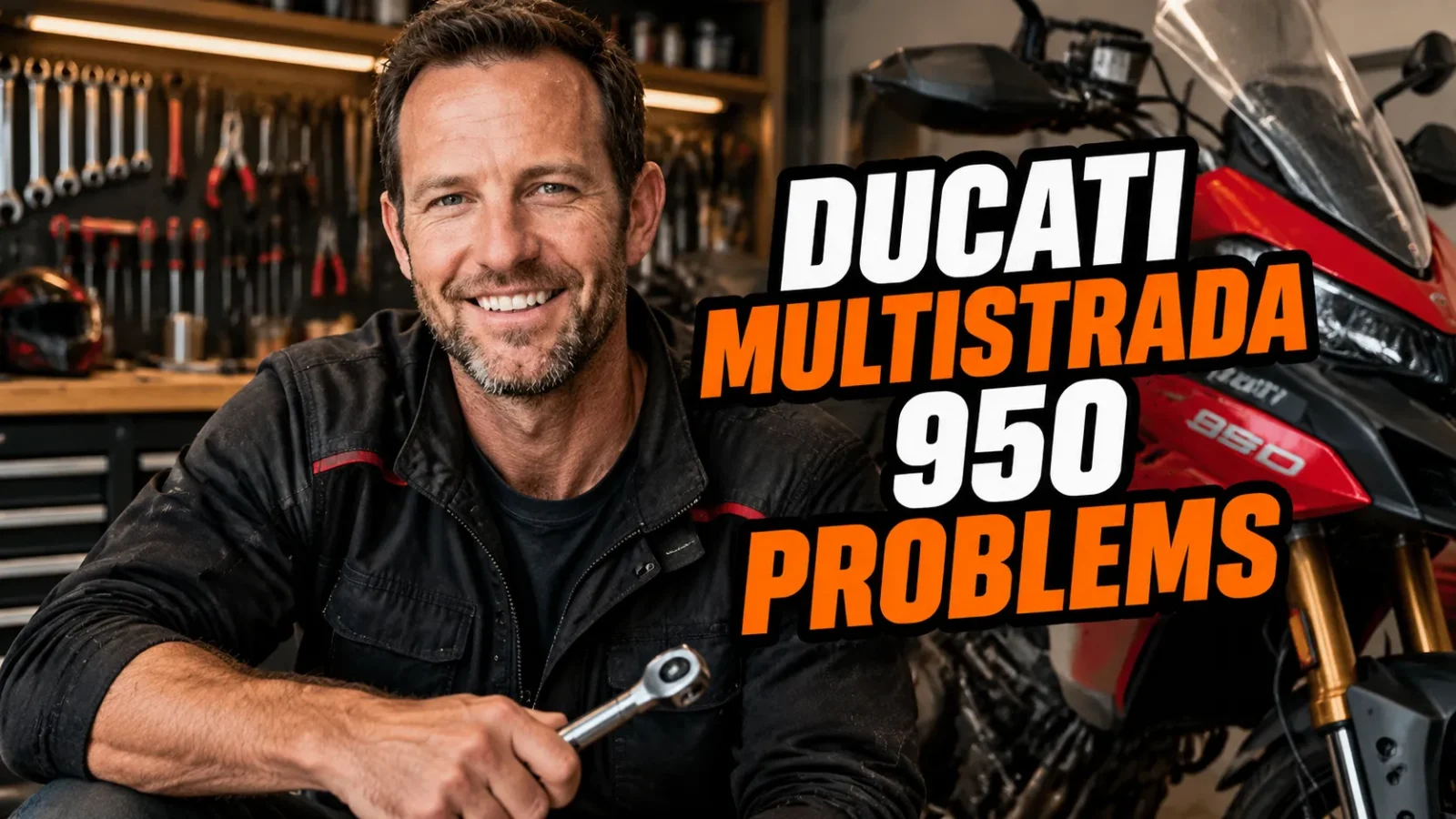
I bought my 2019 Ducati Multistrada 950 with 4,000 miles on the clock and a head full of romantic ideas about Italian adventure bikes. Three years and 22,000 miles later, I still own it. But that ownership came with a learning curve I wish someone had handed me on day one.
So this isn’t a hit piece. It’s the honest list of problems I actually ran into, the ones I read about and dismissed, and the fixes that finally worked. If you’re shopping for a used 950, or you already have one sitting in your garage, this is what I’d want you to know.
- Most Multistrada 950 problems are tuning and setup issues, not mechanical failures.
- Brake feel, throttle snatch, and handlebar buzz are the big three I dealt with.
- Valve service and desmo maintenance are the real cost of ownership.
- The 950 S fixes two of my biggest complaints with semi-active suspension.
- Buy one used, budget for a service, and you’ll get a genuinely brilliant all-rounder.
Why I Bought the 950 in the First Place
I wanted one bike that could commute all week, tour all summer, and still feel alive on a Sunday canyon run. The Multistrada 950 promised exactly that. Nineteen-inch front wheel, comfortable upright ergos, a torquey 937cc Testastretta engine, and that Ducati badge.
It delivered on most of that. What it didn’t deliver was Japanese-bike reliability out of the box. Nothing catastrophic ever happened to me, but there were plenty of small annoyances that added up.
If you’ve owned an American V-twin, you probably know the feeling of chasing down a list of small quirks rather than one big failure. That’s very much the vibe here, similar in spirit to the harley davidson switchback problems that owners talk about endlessly.
The difference is that the Ducati’s issues are mostly fixable with a laptop, a few clicks of suspension adjustment, and some patience.
The Front Brake Feel Problem
This was my first real complaint, and it showed up within the first month. The Brembo M4 calipers on the 950 should feel phenomenal. Instead the lever came back toward the bar with a soft, vague mushiness that made trail braking a guessing game.
I bled the system twice. I swapped fluid. I checked the master cylinder. Nothing changed meaningfully.
What Actually Fixed It
A brake pad upgrade and a careful, patient bleed with a vacuum tool did the trick for me. The stock pads just don’t have the initial bite I wanted, and trapped air in that convoluted ABS routing is a real culprit.
Many owners also report that the master cylinder’s piston seal can weep slightly over time, letting a tiny bit of air in. If your lever slowly sinks at a stop, that’s the clue.
I’d rate this a moderate problem. Not dangerous, but it steals confidence from a bike that should feel razor sharp. Fix it early and you’ll rediscover just how good that chassis is.
The Low-RPM Throttle Snatch
Here’s the one that drives me craziest. Below 4,000 RPM, in low gears, at constant throttle, my 950 hunts and surges. Around town it felt like the fuel mapping was fighting me.
This is an emissions-era problem, plain and simple. Ducati ran the 950 lean to pass regulations, and the result is a jerky, on-off feel at small throttle openings.
My Three-Step Fix
First, I had the dealer update the ECU to the latest map. That helped maybe 30 percent. Second, I dropped one tooth on the front sprocket, which let the engine sit higher in the rev range for the same road speed. Better.
Third, and this is the big one, I fitted a BoosterPlug style fueling module. The difference was night and day. Smooth, linear power right off idle, no more surging in traffic.
If you’re mechanically inclined at all, this is a weekend fix that transforms the bike. It’s the single mod I’d recommend above all others.
Handlebar Buzz and Vibration
The 950’s engine is a characterful thing, but that character comes with a high-frequency buzz through the bars between 4,500 and 5,500 RPM. On a long highway stint, my right hand went numb more than once.
I tried heavier bar-end weights first. Modest improvement. Then I switched to vibration-damping grips, which helped more than I expected.
The real answer, though, was a throttle body sync and a fresh set of spark plugs. Mine were original at 12,000 miles and clearly tired. After the sync, that buzzing band narrowed considerably.
Why This Matters for Touring
The 950 is marketed as an adventure tourer, so buzz matters. If you’re planning multi-day rides, address this before you leave. Numb hands ruin a 500-mile day.
Speaking of long-distance comfort and wrenching on your own bikes, I’ve spent plenty of time around other brands too. The attention to detail on something like a set of Shovelhead years to avoid tells you how much era-specific knowledge matters when you buy old metal. Same principle applies to used Ducatis.
Clutch Pull and Neutral Hunting
The hydraulic clutch on my 950 has a heavy, long pull. In stop-and-go traffic, my left forearm starts complaining after about 20 minutes. Finding neutral when hot is also fiddly, which is a classic Ducati trait.
I switched to an aftermarket slave cylinder with a larger bore. That reduced lever effort noticeably. Finding neutral got easier once I adjusted the clutch free play properly and stopped using the cheapest fluid I could find.
Small fixes, real quality-of-life gains.
Suspension Setup From the Factory
Out of the crate, my 950’s fork and shock felt stiff and harsh over broken pavement. Ducati ships these bikes with settings that suit a 180-pound rider on smooth Italian tarmac, not a 210-pound rider on frost-heaved backroads.
I spent a full afternoon with a sag gauge and a notebook. Setting rider sag to roughly 35mm front and 30mm rear transformed the ride. Spending a little time here is free and it matters more than any farkle.
If you want a deeper look at how much setup and upgrade work costs on a big twin, my writeup on harley stage 4 upgrade cost gives you a sense of how quickly performance spending adds up.
Valve Cover Seepage and Oil Weeps
At around 15,000 miles, I noticed a light oil mist around the horizontal cylinder’s valve cover. Not a leak, a weep. Common on these Testastretta engines, especially if the gasket has been reused.
I had it resealed at my next service. Cost me about $120 in parts and labor on top of the service. Annoying, but minor in the grand scheme.
What to Check When Buying Used
Look at the front cylinder’s valve cover and the oil cooler lines. Any dark, sticky residue is a sign of seepage. It’s not a dealbreaker, just negotiate accordingly.
Electrical and Dashboard Quirks
The TFT dash on my bike has been mostly reliable, but I did have one episode where the fuel gauge read empty with a full tank. A battery disconnect and reconnect fixed it.
Other owners report occasional CAN bus gremlins, usually traced to a weak battery or a loose ground. These bikes are sensitive to voltage. Keep your battery on a tender in winter.
Regular Maintenance Costs
This is the problem nobody warns you about loudly enough. Desmo valve service on a 950 runs every 18,000 miles, and it isn’t cheap. I budgeted around $900 to $1,200 per major interval at my local dealer.
Add tires, chain and sprockets, brake fluid, and the usual wear items, and the annual running cost is meaningfully higher than a comparable Japanese ADV bike.
That’s the trade. You get character, sound, and a chassis that punches way above its class. You pay for it in maintenance.
If you’re weighing whether a brand’s long-term health matters before you commit, it’s worth asking is harley davidson in trouble as a comparison point. Ducati’s dealer network is smaller than it looks, and that affects service convenience.
The 950 S Difference
If I were buying again today, I’d spring for the 950 S. The semi-active Skyhook suspension and cornering ABS directly address the two things I complained about most: stiff, harsh setup and brake confidence.
The base 950 is a great bike. The S is the one I’d actually recommend to most riders.
Was It Worth It?
Yes, and I’d buy it again. Every problem I hit was solvable, and none left me stranded. The 950 rewards an owner who’s willing to learn the bike, adjust it, and keep up with maintenance.
If you want a hands-off appliance, buy Japanese. If you want an adventure bike with real soul and you’re willing to do a little fettling, the Multistrada 950 is one of the best all-rounders out there.
Just do your homework first. Check the brakes, test the throttle below 4,000 RPM, look for oil weeps, and set your suspension before you fall in love. And if you enjoy working on your own machines, that willingness to tinker is half the fun, much like the owners who wrestle with a harley pushrod adjustment chart on a Sunday afternoon.
The 950 isn’t perfect. But it’s mine, and after three years, I still grin every time I fire it up.
Frequently Asked Questions
What are the most common Ducati Multistrada 950 problems?
The most reported issues are vague front brake feel, a snatchy low-rpm throttle, buzzing handlebars, a stiff clutch pull, valve cover seepage, and a stiff fork and shock from the factory.
Is the Multistrada 950 expensive to maintain?
Yes, more than a Japanese adventure bike. Expect roughly $900 to $1,200 per major service interval at a dealer once desmo valve service is due.
How often does the Multistrada 950 need a valve check?
Ducati calls for a valve clearance inspection every 18,000 miles or 30,000 kilometers, though I’d check earlier if the bike sounds noisy.
Should I buy a Multistrada 950 or a Multistrada 950 S?
I’d go with the S. You get semi-active Skyhook suspension and cornering ABS, which fixes the two biggest complaints I had about the base bike.
