
Shovelhead Years to Avoid: My Hard-Won Lessons After 20 Years of Riding and Wrenching
 Jake Miller
11 min read
Jake Miller
11 min read
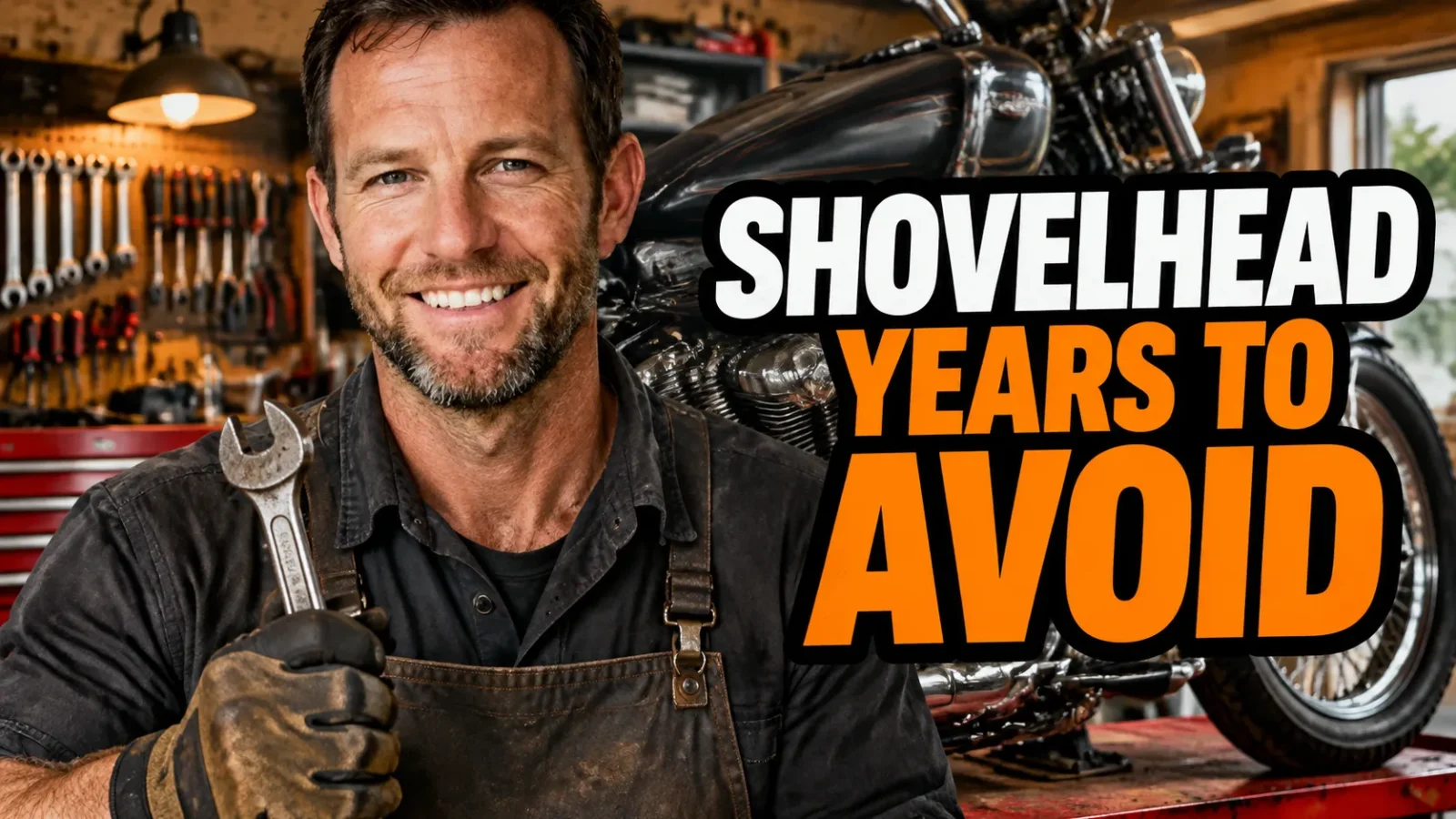
I’ve spent the last two decades riding, wrenching on, and sometimes wrestling with Harley-Davidson Shovelheads. I’ve owned a 1969 FLH, a 1973 FX, a 1978 FLH, and a 1982 FXR. Each one taught me something different about what makes certain Shovelhead years to avoid and which ones are worth the headache.
If you’re shopping for a Shovelhead right now, you’ve probably heard the horror stories. Oil leaks that never stop, cracked cases, stator failures, and transmissions that sound like a rock crusher. Some of those stories are exaggerated. Some are absolutely true. Let me break down what I’ve learned the hard way.
- The worst Shovelhead years to avoid are 1970, 1971, 1972, 1973, and early 1974 due to AMF-era quality control failures.
- 1966-1969 generator Shovelheads are the most reliable and desirable, especially 1969.
- 1978-1979 models have specific valve seat and oiling issues that can get expensive fast.
- 1980-1984 Shovelheads improved, but you still need to check cases, oil pressure, and top-end noise before buying.
My Love-Hate Relationship with the Shovelhead
I didn’t start out disliking certain Shovelhead years. I started out broke and optimistic. My first Shovelhead was a 1973 FX Super Glide that I bought for $1,800. It looked cool and sounded mean. It also leaked oil from places I didn’t know could leak oil.
That bike taught me more about AMF-era corner cutting than any book ever could. I pulled the primary cover and found casting sand still inside the cases. The transmission output shaft had more play than a worn-out door hinge. And the oil pump? Let’s just say it was more of a suggestion than a pump.
But I also owned a 1969 FLH that ran flawlessly for years. Same engine family, completely different character. That’s when I realized the year of manufacture matters a whole lot more than people admit.
So when I talk about Shovelhead years to avoid, I’m not parroting forum myths. I’m talking about actual patterns I’ve seen in my own garage and in the garages of friends who trusted me to help them buy their first old Harley.
The Good Years: Why the Late 1960s Were Golden
Before AMF took over Harley-Davidson in 1969, the Shovelhead was still built with a lot of Panhead DNA. The bottom end, generator drive, and transmission were essentially carryovers from the Panhead. That continuity made a huge difference.
1966-1969: The Generator Era
The Shovelhead engine debuted in 1966 as an evolution of the Panhead. The top end was new, but the lower end stayed tried and true. These generator-equipped Shovelheads are, in my opinion, the best of the breed.
Why? Because the generator bottom end had been refined for over a decade. The cases were thick and well-cast. The oiling system was simple and effective. The four-speed transmission was the same unit that had been proven on thousands of Panheads.
I’ve personally put over 40,000 miles on a 1969 FLH without a single catastrophic failure. I adjusted the pushrods, changed the oil, and kept the points clean. That was about it. No stator replacements, no cracked case repairs, no transmission rebuilds every other season.
If you find a clean 1966, 1967, 1968, or 1969 Shovelhead, buy it. Yes, they’re getting more expensive. But they’re expensive for a reason. The 1969 model is particularly prized because it was the last year before AMF’s full influence, and many consider it the most refined generator Shovelhead ever made.
The AMF Takeover and the Quality Slide
When AMF bought Harley-Davidson in 1969, things changed almost immediately. The new corporate owners pushed for higher production numbers and lower costs. The result was a series of Shovelhead years that earned a reputation for unreliability.
I’m not saying every 1970s Shovelhead is junk. But the odds of getting a problem bike go way up in the early AMF years. Let me walk you through exactly which years I’d avoid, and why.
1970-1974: The Notorious Years
If I had to pick the absolute worst Shovelhead years to avoid, it would be 1970, 1971, 1972, 1973, and the first half of 1974. These bikes were built during the darkest days of AMF quality control.
The problems start with the cases. AMF began using cheaper casting methods and lower-quality aluminum. I’ve seen more porous, cracked, and leaking cases from this era than from any other. A tiny pinhole in a case can drive you insane trying to find the leak.
Then there’s the transmission. The four-speed gearbox was carried over, but the metallurgy of the gears and shafts took a nosedive. I’ve seen second gear teeth shear off on a bone-stock 1972 FLH with less than 15,000 miles. The owner babied that bike, too.
The oiling system also suffered. The early 1970s Shovelheads used a gerotor oil pump that was sometimes machined out of spec. Low oil pressure at hot idle is common, which leads to top-end wear and noisy lifters. If you’re looking at a 1970-1974 Shovelhead, ask the seller to show you hot idle oil pressure. If it’s below 5 psi, walk away.
And don’t forget the electricals. The switch from generator to alternator in 1970 brought new problems. Stators burned out, voltage regulators failed, and wiring harnesses crumbled. Some of that is just age, but the early AMF harnesses were noticeably worse than the late 1960s stuff.
My rule of thumb: If a Shovelhead is from 1970, 1971, 1972, or 1973, I assume it needs a full engine and transmission rebuild unless the seller has receipts proving otherwise. That rebuilding cost alone often exceeds the purchase price of the bike.
1975-1977: A Slight Improvement, But Still Risky
By 1975, AMF had started to address some of the worst quality issues. The cases got a little better, the transmissions got a little stronger, and the oil pumps were more consistent. But don’t let that fool you into thinking these are trouble-free years.
I’ve seen plenty of 1975 and 1976 Shovelheads with the same porous case problems and weak transmission internals. The improvements were incremental, not transformative. The 1977 models are slightly better again, but still not up to the standards of the late 1960s.
If you find a well-maintained 1975-1977 Shovelhead with documented service history, it can be a decent buy. But I’d still budget for a top-end refresh and a good look at the oil pump. These years are not in my “avoid at all costs” list, but they’re not my first choice either.
Later Shovelheads: The Alternator Years and Their Own Problems
After AMF’s quality started to recover in the late 1970s, the Shovelhead entered its final phase. These bikes have different issues than the early 1970s models, but they’re not immune to trouble.
1978-1979: Valve Seat and Oiling Woes
I have a love-hate spot for 1978 and 1979 Shovelheads. They look great, and the quality control was much improved over 1973. But two specific problems keep me from recommending them without caveats.
First, the valve seats. Harley used a new valve seat material in 1978-1979 that was prone to coming loose and dropping into the combustion chamber. That destroys the piston, the head, and often the cylinder. It’s an expensive failure. I’ve seen it happen on a 1978 FLH with 28,000 miles.
Second, the oiling system still wasn’t perfect. The 1978-1979 models used a different oil pump drive than earlier years, and if the drive gear wore out, you’d lose oil pressure without warning. That’s a silent killer.
If you buy a 1978 or 1979 Shovelhead, budget for a valve job with aftermarket seats and a thorough oil pump inspection. Many owners already did this fix, so ask for receipts. If not, factor $1,500 to $2,500 into your budget.
1980-1984: The Final Years, Better But Not Perfect
The last Shovelheads rolled off the line in 1984. By then, Harley had restructured and quality was significantly better than the early AMF era. The cases were cleaner, the transmissions were stronger, and the oil pumps were generally reliable.
But these late Shovelheads still have their quirks. The alternator rotors can still fail, the electronic ignition (on some models) is finicky, and the rubber-mounted FLT models from 1980-1983 have their own frame and vibration issues. The FXR models from 1982-1984 are actually quite good, but they’re not traditional Shovelheads in the old sense.
Still, if I had to choose a non-generator Shovelhead, I’d pick a 1982, 1983, or 1984 model that’s been well maintained. They’re not as desirable as a 1969, but they’re far less problematic than a 1972.
How to Spot a Problem Shovelhead Before You Buy
No matter what year you’re looking at, there are a few checks that can save you thousands of dollars. I’ve walked away from bikes that looked beautiful on the outside but were disasters inside. Here’s what I look for first.
Check the Cases and Castings
Bring a flashlight and look closely at the engine cases, especially around the cylinder bases and the oil pump area. Look for hairline cracks, repaired welds, or signs of epoxy. Porous castings often show up as oil seeping through the aluminum itself, leaving a dark stain that never wipes clean.
If the seller won’t let you remove the primary cover or timing cover, that’s a red flag. A honest seller will let you look. A dishonest one will try to hide something.
Listen for Top-End Noise
Start the bike cold and listen. Some lifter noise is normal on a Shovelhead, but a loud knock or a sharp tapping that doesn’t go away when the bike warms up indicates worn lifters, rocker arms, or valve guides. That’s a top-end rebuild at minimum.
On 1978-1979 models, ask specifically about the valve seats. If the seller looks confused or changes the subject, be very careful.
Look for Leaks
All old Harleys leak a little. But a Shovelhead that leaves a puddle every time it’s parked has a serious problem. Check under the bike after it’s been sitting for a few minutes. Look at the pushrod tubes, the cylinder base gaskets, and the oil pump. If oil is dripping from between the cases, that’s often a sign of porous castings or a failed case seal.
I once looked at a 1973 FLH that the seller had freshly degreased. It looked dry and clean. I came back an hour later without telling him, and there was a quarter-sized puddle under the primary. He’d wiped it down right before I arrived. That bike probably needed a full case reseal.
My Honest Recommendation on What to Buy Instead
If you’re dead set on a Shovelhead, and I understand why you would be, my clear advice is this: Buy a 1966-1969 generator Shovelhead if you can afford it. The 1969 is the best of all, but any of those four years will treat you well.
If you can’t afford a generator Shovelhead, then look for a 1982-1984 model with documented maintenance. These bikes are still relatively affordable and don’t have the glaring quality problems of the early AMF years. Just budget for a valve job if it’s a 1978-1979, or find one that already had the fix.
What should you absolutely avoid? Any 1970, 1971, 1972, or 1973 Shovelhead that hasn’t had a complete engine and transmission rebuild with receipts to prove it. I’ve seen too many riders buy a “bargain” early AMF Shovelhead for $3,000 and then spend $6,000 making it rideable. That’s not a bargain.
I also get asked about 1974 models. The first half of 1974 still had many of the 1973 problems. Late 1974 bikes are a bit better. If you find one, inspect it as if it were a 1973, because it probably has the same DNA.
Final Thoughts: Don’t Fear the Shovelhead, Respect It
I don’t want to scare you away from Shovelheads entirely. They’re some of the most characterful, soulful motorcycles ever built. The sound of a well-tuned Shovelhead at idle is pure magic. The torque, the vibration, the raw mechanical feel — nothing else comes close.
But you have to go in with your eyes open. The Shovelhead years to avoid are real, and they can turn a dream bike into a money pit faster than almost anything else on two wheels. Know the bad years, know the good years, and inspect every bike like your wallet depends on it. Because it does.
I’ve made my mistakes so you don’t have to. Buy smart, ride safe, and keep the shiny side up.
Frequently Asked Questions
What are the worst years for Harley-Davidson Shovelhead engines?
In my experience, the 1970, 1971, 1972, 1973, and early 1974 model years are the most problematic. These early AMF-era bikes suffered from porous castings, weak transmissions, oil pump issues, and inconsistent quality control.
Is a 1969 Shovelhead reliable?
Yes, a 1969 Shovelhead is generally considered one of the best years. It still used the generator bottom end from the Panhead, which was robust and well-proven. The 1966-1969 generator Shovelheads are my personal favorites for reliability.
Are late 1970s Shovelheads better than early 1970s?
Slightly better, but not without issues. The 1978-1979 models had valve seat and oiling problems, while 1980-1984 improved somewhat with better quality control. However, you still need to inspect any Shovelhead carefully before buying.
Should I avoid all Shovelheads?
Not at all. A well-sorted Shovelhead from any year can be a great bike. The key is knowing which years have more inherent weaknesses and budgeting for fixes. The late 1960s models and well-maintained 1980s models are generally the safest bets.

Related Articles

The Best Stuff for Cleaning a Harley: What I Actually Keep in My Garage
After years of trial and error on my own Harleys, here are the cleaners, polishes, and towels I actually trust,…
Jake Miller
11 min read
Best Heat Shield for a Harley Softail: What I Actually Run (And Why)
After years of burnt thighs and melted denim, here are the best heat shields for a Harley Softail, what I…
Jake Miller
8 min read
Harley Davidson Bolt Size Chart: The Rider’s Guide to Every Fastener You’ll Touch
Stop guessing bolt sizes on your Harley Davidson. I share my personal bolt size chart, torque tips, metric vs SAE…
Jake Miller
12 min read