
Harley Stage 4 Upgrade Cost: My Real-World Budget Breakdown (And What I Overpaid For)
 Jake Miller
9 min read
Jake Miller
9 min read
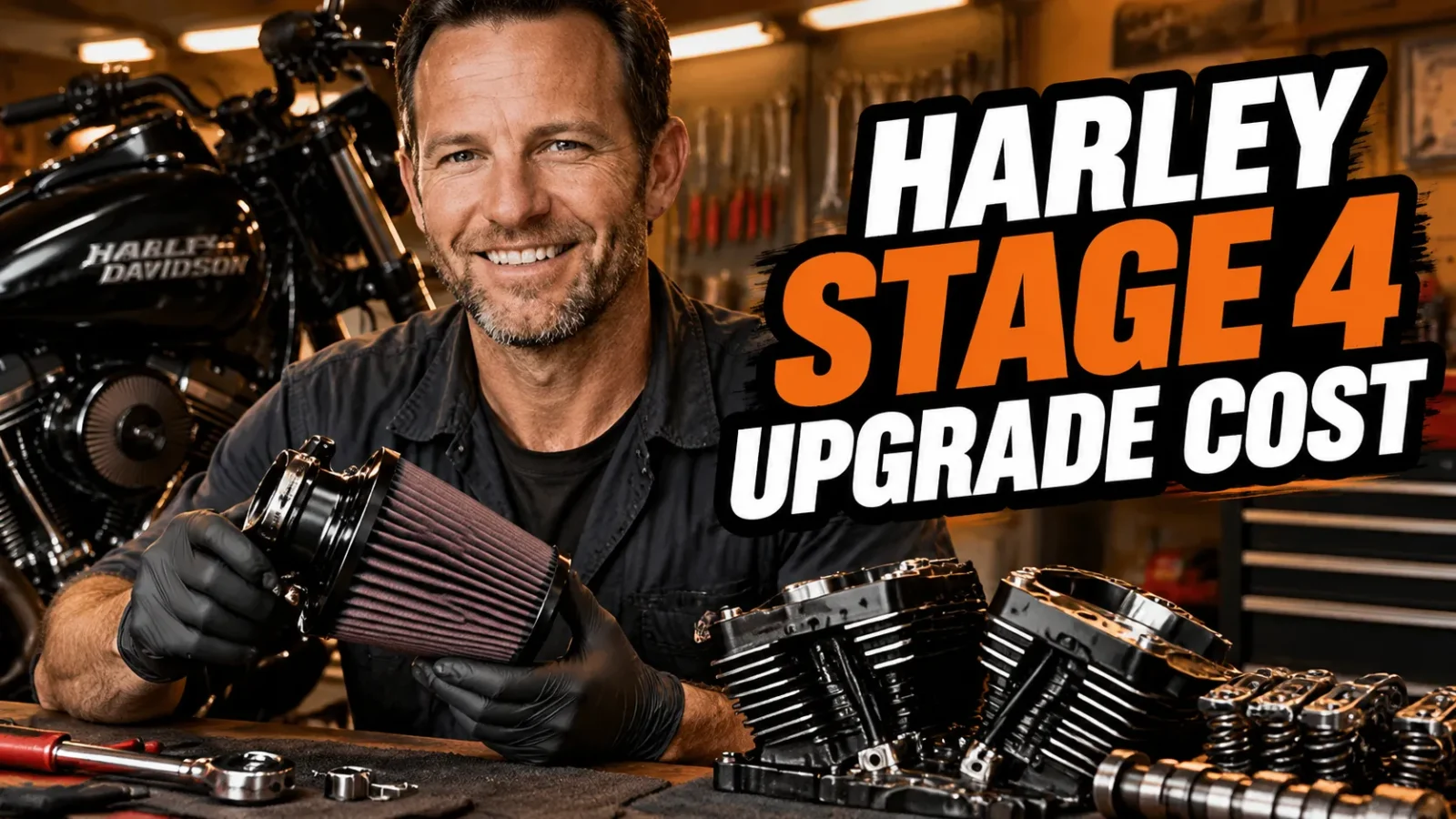
I still remember the exact moment I decided to go all in on my 2019 Road Glide Special. I had already done the exhaust, intake, and a decent tune. It was fun, but I wanted that raw, pull-your-arms-out-of-the-sockets power that only a serious engine build can deliver.
So I started researching the Harley Stage 4 upgrade cost. What I found online was a mess. Forums said $4,000. Shops quoted me $9,500. YouTube builders casually mentioned $6,000 “plus a few extras.”
After going through the entire process myself, I can tell you the truth sits somewhere in the middle, but only if you know exactly what to ask for. I made mistakes, overpaid on a few things, and discovered some hidden costs that nobody talks about until it’s too late.
This is my personal breakdown of what a Harley Stage 4 upgrade actually costs, how I would budget it differently today, and what I would say to any rider thinking about pulling the trigger.
- A realistic Harley Stage 4 upgrade cost is $5,500 to $8,500 for most Milwaukee-Eight builds, with premium parts pushing past $10,000.
- Parts account for roughly 60% of the total; labor and dyno tuning eat up the other 40%.
- The biggest hidden costs are clutch upgrades, high-flow injectors, and machine work on your stock cylinders or heads.
- I would absolutely do it again, but I would buy a complete kit instead of piecing parts together to save money.
What a Stage 4 Upgrade Really Does to Your Harley
Before you spend a dime, you need to understand what “Stage 4” actually means. In the Harley world, stages are not standardized, but Stage 4 generally means you are replacing or heavily modifying the top end of the engine.
On a Milwaukee-Eight, this usually means boring the stock cylinders or installing larger aftermarket cylinders and pistons. You also need performance heads, a more aggressive camshaft, and a high-flow throttle body to feed the bigger displacement.
On my build, I went from a 107 cubic inch M8 to a 124 inch monster. That jump required new cylinders, forged pistons, a stronger crankshaft consideration, and a complete valve train upgrade.
The end result is a bike that produces significantly more horsepower and torque. My Road Glide went from roughly 88 horsepower at the wheel to over 130. That sounds amazing, and it is, but the price tag comes with a lot of smaller bills attached.
Breaking Down the Harley Stage 4 Upgrade Cost
When I first sat down with my local performance shop, I expected two line items: parts and labor. I was naive. The real cost has at least six distinct buckets, and each one can swing the final number by hundreds or even thousands of dollars.
Here is the simplified sheet I wish I had before I started:
| Cost Category | Typical Range | What I Actually Paid |
|---|---|---|
| Stage 4 cylinders and pistons | $1,200 – $2,500 | $1,850 |
| Performance heads or porting | $1,000 – $2,200 | $1,600 |
| Camshaft and valve train | $600 – $1,200 | $900 |
| Throttle body and injectors | $600 – $1,400 | $1,100 |
| Clutch upgrade | $500 – $1,100 | $750 |
| Labor and machine work | $1,500 – $3,000 | $2,200 |
| Dyno tune | $500 – $800 | $650 |
| Total | $5,900 – $12,200 | $9,050 |
My final number was just over $9,000 after tax and a few “while we’re in there” recommendations. That’s not cheap, but I also didn’t go with the lowest bid. I wanted reliability, not just a dyno sheet.
Parts: The Heart of the Upgrade Cost
The biggest variable in your Harley Stage 4 upgrade cost is the parts selection. I could have saved money by reusing my stock throttle body or running a less aggressive cam. But that would have limited the final power number.
Cylinders and pistons are usually the largest single parts expense. If you buy a complete kit from S&S, Fuel Moto, or Harley-Davidson’s own Screamin’ Eagle catalog, you often get a better price than buying pieces individually.
I originally planned to piece the kit together. I thought I was being smart by shopping around. In reality, I wasted hours, paid extra shipping, and ended up with a mismatched combination that my tuner had to work around.
A complete Stage 4 kit typically includes matched cylinders, pistons, cams, gaskets, and sometimes heads. If I could do it over, I would buy the kit first and only add external upgrades if absolutely necessary.
Labor: Where Shops Make Their Money
Unless you are a certified Harley mechanic with a fully equipped garage, you are paying for labor. My shop charged $120 per hour, and the build took about 18 hours total.
That included disassembly, cylinder boring or replacement, head installation, cam timing, clutch work, and final assembly. If you want your heads ported rather than replaced, machine work adds another $300 to $600 on top of labor.
I also paid for “engine case clearance” work because the larger pistons required it. That was not in my initial quote. It added $350. These small surprises are common with big-bore builds.
My advice: get a written quote that explicitly lists what is included. Ask if machine work, gaskets, fluids, and shop supplies are separate. If they are vague, walk away.
The Dyno Tune Is Not Optional
After the engine work is done, the bike will not run correctly on the old fuel map. A professional dyno tune is mandatory. This is not the same as flashing a generic map from a fuel tuner.
My tuner spent four hours on the dyno. He adjusted fuel curves, timing, and throttle response across the entire RPM range. The result was a smooth, ridable bike that didn’t pop on decel or stumble off idle.
I have seen riders skip the dyno to save $600. That is a mistake. A poorly tuned Stage 4 bike can run lean, overheat, and destroy the very engine you just spent thousands building.
Do not cheap out on tuning. It is the difference between a reliable hot rod and a ticking time bomb.
My Biggest Hidden Costs and Mistakes
The base Harley Stage 4 upgrade cost is just the beginning. I got hit with several extras that I genuinely did not see coming.
Clutch slip. My stock clutch could not handle the extra torque. Within a week, it started slipping under hard acceleration. I had to go back for a heavy-duty clutch kit and another half day of labor.
Fuel injector mismatch. I tried to reuse my stock injectors for a few days. The bike ran lean at wide open throttle. Upgraded injectors were another $400, plus another dyno session.
Heat management. A big-bore Milwaukee-Eight runs hotter. I ended up with a high-flow oil pump and a better cooling fan. That was another $500 I had not planned for.
The lesson here is simple: if you are already opening the engine, do it right the first time. Skimping on auxiliary parts will cost you more in the long run.
Stage 4 vs. Stage 2 vs. Stage 3: Did I Overspend?
Whenever I tell another rider what I spent, the first question is always: “Was it really worth it compared to a Stage 2 or Stage 3?”
Stage 2 is usually just a cam swap, maybe an exhaust and tune. You can get 100 to 110 horsepower for around $2,500 to $3,500 total. That is a great value for most street riders.
Stage 3 adds displacement but often keeps your stock heads. You might land at 115 to 125 horsepower for $4,000 to $6,000. For many riders, Stage 3 is the sweet spot.
Stage 4 gives you the full package: bigger displacement, better heads, more aggressive cam, and the supporting mods. You gain more top-end power and a broader torque curve, but the cost per horsepower gets worse at this level.
I have zero regrets because I wanted the strongest naturally aspirated M8 build without going to a crate engine. But if I only rode casually, a Stage 3 would have saved me thousands with 90% of the real-world fun.
How to Budget for a Stage 4 Build the Smart Way
If I were starting over with a blank checkbook, I would set aside $8,000 as a baseline and add a 15% buffer. That brings my realistic Harley Stage 4 upgrade cost target to around $9,200.
That buffer covers the “while you’re in there” items you will absolutely hear about. Things like lifters, oil pump, motor mounts, and even a new gasket set can sneak into the final invoice.
I would also choose a complete kit from a reputable manufacturer. Avoid the urge to mix and match. Matched components are more reliable and easier to tune.
Finally, I would schedule the entire build during the off-season. Many shops offer winter discounts on labor, and you won’t miss riding time while your bike sits in pieces for three weeks.
What I Would Tell a Friend Who Is Thinking About It
If you have the money and you love your current Harley, a Stage 4 build transforms the bike into something truly special. It pulls hard from 2,500 RPM all the way to the rev limiter. The sound alone is worth half the cost.
But if you are stretching your budget or using a credit card, think twice. This is not a necessary upgrade. A well-tuned Stage 2 or Stage 3 bike already outperforms what most riders will ever use on the street.
For me, the Harley Stage 4 upgrade cost was justified because I plan to keep this Road Glide for another five years. I wanted a reliable, powerful, daily-rideable hot rod. That’s exactly what I got.
Would I do it again? Yes. But I would buy a complete kit, plan for the hidden costs, and never, ever skip the dyno tune.
If you are serious about a Stage 4 build, find a shop that specializes in Harley performance work. Talk to them about your riding style. The best tuners will ask you how you actually ride before they recommend a parts list.
And remember: the cheapest quote is rarely the best deal. You are building an engine, not shopping for floor mats. Pay for quality parts, professional labor, and a proper tune. Your engine will thank you every time you twist the throttle.
Frequently Asked Questions
How much does a Harley Stage 4 upgrade cost on average?
A complete Harley Stage 4 upgrade usually runs between $4,500 and $8,500, depending on your model, parts selection, and labor rates. High-end builds can exceed $10,000.
What is included in a Stage 4 upgrade?
A Stage 4 kit typically includes larger cylinders and pistons, performance cylinder heads or porting, a more aggressive camshaft, a high-flow throttle body and injectors, a stronger clutch, and a professional dyno tune.
Is a Stage 4 upgrade worth the money?
For riders who want major horsepower and torque gains and plan to keep the bike for a while, yes. For casual riders, a Stage 2 or Stage 3 may deliver more value per dollar.
Can I install a Harley Stage 4 kit myself to save labor costs?
If you have advanced mechanical skills and the right tools, you can save $1,500 to $3,000 in labor. However, a professional dyno tune is still strongly recommended.

Related Articles

The Best Stuff for Cleaning a Harley: What I Actually Keep in My Garage
After years of trial and error on my own Harleys, here are the cleaners, polishes, and towels I actually trust,…
Jake Miller
11 min read
Best Heat Shield for a Harley Softail: What I Actually Run (And Why)
After years of burnt thighs and melted denim, here are the best heat shields for a Harley Softail, what I…
Jake Miller
8 min read
Harley Davidson Bolt Size Chart: The Rider’s Guide to Every Fastener You’ll Touch
Stop guessing bolt sizes on your Harley Davidson. I share my personal bolt size chart, torque tips, metric vs SAE…
Jake Miller
12 min read