
Harley Dyno Tune Cost: What I Actually Paid and Why It Varies So Much
 Jake Miller
10 min read
Jake Miller
10 min read
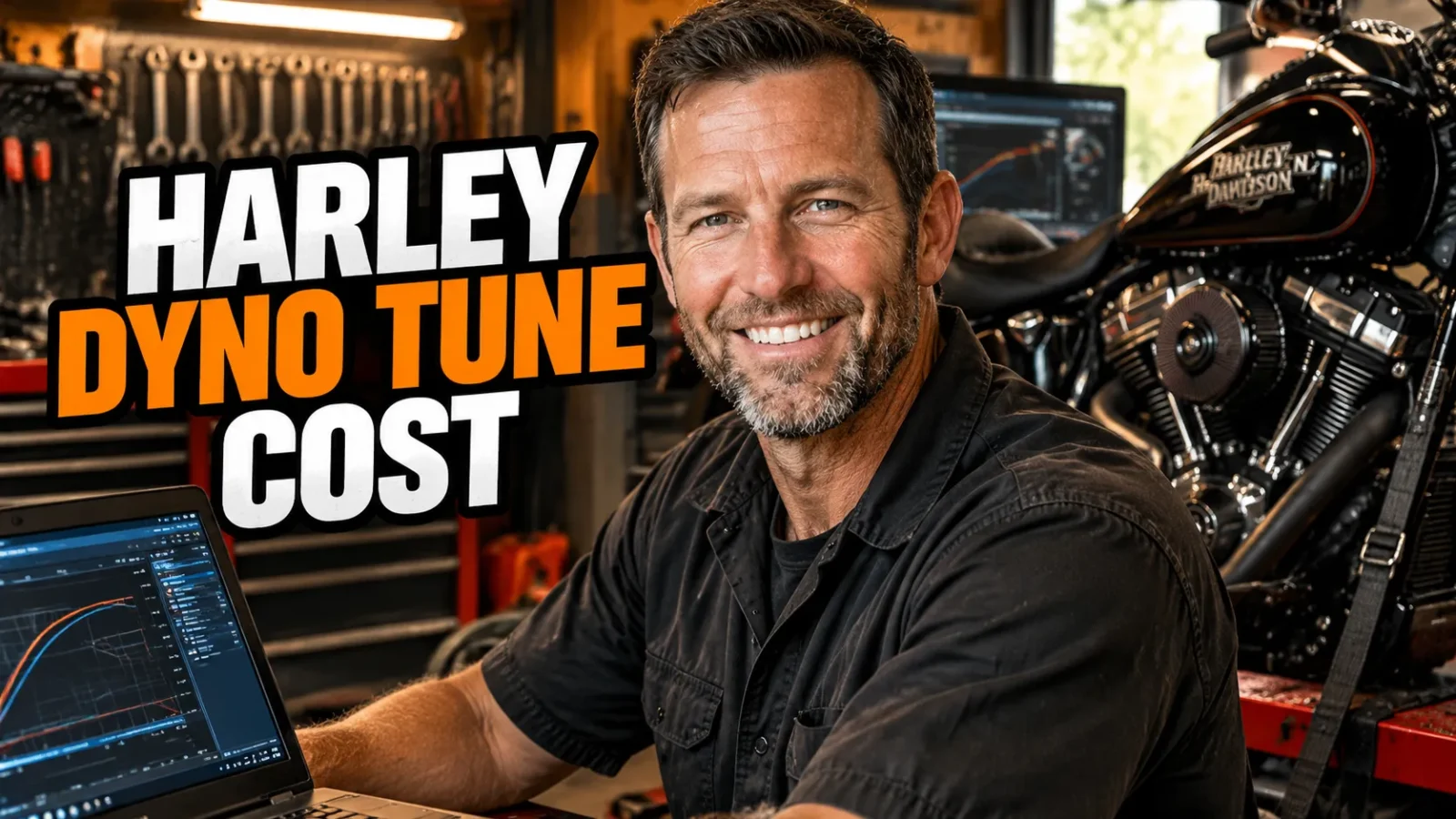
I remember the first time I got a real harley dyno tune cost quote. It was 2019, I had just bolted on a set of Vance & Hines pipes and a high-flow air cleaner to my Street Bob, and the bike ran like garbage. Popping on decel, flat spots in the mid-range, and a weird surge at highway speed. I called three shops. The quotes were $350, $500, and $750. I was confused. Why the huge spread? Same bike, same parts, same city. After years of wrenching, tuning, and talking to builders, I now know exactly what drives that price. And more importantly, I know when a dyno tune is worth it and when you can skip it.
- A real custom harley dyno tune cost usually lands between $350 and $600 for most street bikes.
- Prices vary based on shop overhead, tuner experience, and whether you need a full ECU flash or just a piggyback adjustment.
- Skip the dyno if your bike is 100% stock. But with any exhaust or intake change, a tune is the best money you’ll spend.
- Watch for hidden fees like “shop supplies,” baseline pulls, or hourly add-ons that can inflate the final bill.
My First Dyno Tune: The Sticker Shock
I ended up going with the middle quote. $500 flat, including the baseline pull and a printed air/fuel chart. The tuner spent almost three hours on my bike. He adjusted ignition timing, fuel trims, and even tweaked the decel enleanment to stop the popping.
When I rode away, the difference was night and day. Throttle response was crisp. The surge was gone. The bike pulled harder from 2,500 rpm all the way to redline. It felt like a different motorcycle.
Was $500 a fair harley dyno tune cost? Honestly, yes. But I’ve also paid less and more since then. Let me break down what actually goes into that number.
What Affects Harley Dyno Tune Cost?
Not all dyno tunes are created equal. A “tune” at one shop might be a 20-minute flash, while another shop spends half a day on your bike. Here’s what moves the price.
Shop Location and Overhead
Dyno tuning in Miami, Los Angeles, or New York will almost always cost more than in rural Iowa or Ohio. That’s just real estate and labor rates. Big dealerships also tend to charge more than independent performance shops.
Independent tuners often have lower overhead and more passion for the work. But they may lack the warranty backing or the latest software updates. I’ve had great experiences with both.
Type of Tuning System
Harley’s factory ECM can be flashed with software like Screamin’ Eagle Pro Super Tuner, TTS Mastertune, or Dynojet Power Vision. Piggyback systems like Power Commander or Fuelpak also get tuned differently.
A full ECU flash allows deeper changes to timing, rev limits, and throttle-by-wire tables. That usually costs more because it takes more dyno time and expertise. Piggyback adjustments are quicker but less precise.
For a modern Harley with throttle-by-wire, a full flash is the way to go. The harley dyno tune cost for that type of work is typically on the higher end, but the rideability improvement is worth it.
Tuner Experience and Reputation
I’ve seen backyard “tuners” with a used dyno charge $200 for a pull. And I’ve seen championship-winning engine builders charge $900 for a full calibration. The difference is not just time, it’s knowledge.
A good tuner reads the air/fuel curve, watches for knock, and adjusts part-throttle fueling, not just wide-open throttle. That kind of detail takes years to learn. You are paying for that expertise.
Bike Modifications
A stage 1 bike with just pipes and an air cleaner is a straightforward tune. A big-bore 124ci build with cams, headwork, and throttle body upgrades takes much longer. More ignition cells, more fuel maps, more dyno pulls.
If you have forced induction or a turbo, expect to pay $1,000 or more. Those tunes often require multiple sessions and custom sensor scaling. The harley dyno tune cost for a high-compression race motor is a whole different animal.
What Actually Happens During a Dyno Tune
I used to think a dyno tune was just strapping the bike down and doing a few full-throttle pulls. Boy, was I wrong. There’s a lot more going on.
The Baseline Pull
Most shops start with a baseline run to see where your bike currently sits. This gives them a starting point and reveals any mechanical issues like vacuum leaks or weak fuel pressure. Some shops include this baseline in the price. Others charge extra.
I always ask if the baseline pull is included. It should be. If a shop wants $50 extra just to tell you how your bike runs before tuning, that’s a red flag.
Steady-State Tuning
This is the part most riders never see. The tuner holds the bike at specific RPM and throttle positions, often for 30 to 60 seconds at a time. They watch the wideband O2 sensor and adjust fuel trims cell by cell.
This is tedious work. It’s also what separates a real dyno tune from a canned flash. A proper harley dyno tune cost accounts for this labor, not just the horsepower number.
Ignition Timing Adjustments
Fuel gets most of the attention, but ignition timing is just as important. Advancing timing can add power, but too much causes detonation. A skilled tuner will find the safe edge without crossing into knock territory.
On my last tune, the tuner found 3 extra horsepower just by cleaning up the timing curve in the mid-range. That’s free power hidden in the stock map.
Final Verification Pull
After all the adjustments, the tuner does a final full-throttle pull to confirm the air/fuel ratio is consistent and safe. You should get a printout or digital file of the before and after curves.
If a shop refuses to give you the dyno chart, walk away. A reputable tuner is proud of their work and will show you the data.
Dyno Tune vs. Mail-In Flash vs. Piggyback: Real Cost Comparison
I’ve tried all three methods over the years. Here’s how they stack up in terms of cost and actual results.
Mail-In ECM Flash
You remove your ECM, ship it to a company, and they flash a pre-made map based on your parts list. Cost is usually $150 to $300. Turnaround is a few days.
This works okay for a basic stage 1 with common parts. But it’s a guess. It’s not tuned for your specific bike, altitude, or riding style. I’ve had mail-in flashes that ran rich, lean, and everywhere in between.
Piggyback Fuel Controller
A Power Commander or Fuelpak plugs into your injectors and modifies the signal. You install it yourself and either use a pre-loaded map or pay for dyno time. The unit itself costs $250 to $400. Dyno tuning for a piggyback typically costs $200 to $400.
Total cost often ends up higher than a direct ECU flash. And piggyback controllers can’t adjust ignition timing or throttle-by-wire. I don’t use them on modern Harleys anymore.
Full Custom Dyno Tune
This is the gold standard. You get a baseline, steady-state tuning, timing adjustments, and a final verified map. The harley dyno tune cost for this ranges from $350 to $600 for most bikes.
In my experience, the custom tune pays for itself in rideability alone. The bike runs cooler, smoother, and more predictably. Plus you’re not chasing a lean condition that could damage the engine long term.
Hidden Costs and Fees to Watch For
I’ve been burned by add-ons before. Here are the sneaky charges that can inflate a harley dyno tune cost quote.
Shop Supplies and Disposables
Some shops add a “shop supplies” fee of $20 to $50 on top of the quoted price. That’s just a money grab. A dyno tune doesn’t use $50 worth of rags and zip ties.
O2 Sensor Bungs
If your exhaust doesn’t have O2 sensor bungs, the shop may need to weld in a port for the wideband sensor. That can cost $50 to $150 extra. Good exhaust systems already have bungs, so check before you buy.
Multiple Sessions
Some tunes require a follow-up session, especially if you change parts later or the first tune reveals a mechanical issue. A reputable shop will often give you a discount on retunes within a certain time. Ask upfront.
Storage or Wait Fees
If you drop the bike off and the shop gets backed up, you shouldn’t be charged for their scheduling problems. But some places charge a daily storage fee after the first 24 hours. Clarify this before you leave your bike.
When a Dyno Tune Is Absolutely Worth It
I’m not going to tell you to spend $500 on a stock bike. That’s a waste. Here’s when I personally think a dyno tune is non-negotiable.
After an Exhaust or Intake Change
Any time you change airflow in or out, the factory fueling is no longer optimal. Harley runs these bikes lean from the factory to meet emissions. Add a free-flowing exhaust and the lean condition gets worse. A dyno tune corrects that.
After Engine Work
Cams, big-bore kits, head porting, throttle body upgrades. These all change the volumetric efficiency of the engine. A canned map cannot account for the exact combination of parts. Only a custom tune can.
If You Ride in Extreme Conditions
High altitude, extreme heat, or heavy stop-and-go traffic all stress the engine. A custom tune can enrich the fuel slightly at low RPM to keep cylinder head temps down. I noticed a 20-degree drop in oil temp after my last tune.
If You Want Maximum Power
A good dyno tuner can often find 5 to 10 horsepower hidden in the stock map. If you’re chasing numbers, that’s worth the cost. But honestly, the part-throttle smoothness matters more for everyday riding.
When You Can Skip the Dyno
If your bike is completely stock, save your money. The factory map, while lean, is safe and consistent. A dyno tune on a stock 114ci Harley might gain you 2 or 3 horsepower at best. Not worth $500.
If you only ride gently and never go above 3,500 rpm, a mail-in flash might be enough. But if you ever crack the throttle hard, that lean spot in the mid-range can cause pinging. I’d rather be safe.
How to Find a Good Dyno Tuner Without Getting Ripped Off
Over the years, I’ve learned to ask specific questions before handing over my bike and my credit card. Here’s my personal checklist.
Ask About Their Experience with Your Exact Model
A tuner who specializes in Twin Cams might not be the best choice for an M8 with throttle-by-wire. Ask how many bikes like yours they’ve tuned in the last year. A good answer is “dozens.”
Request a Sample Dyno Chart
Ask to see a before and after chart from a similar bike. Look for a clean air/fuel line that stays between 12.8 and 13.2 at wide-open throttle. If the line is jagged or the tuner won’t show you, keep looking.
Get a Written Quote with Breakdown
Never accept a verbal price. Ask for a written estimate that includes the baseline pull, all dyno time, any software licensing fees, and the final map. If they won’t put it in writing, walk.
Check Reviews and Word of Mouth
Local riding forums and Facebook groups are goldmines. Search for the shop name plus “dyno tune.” Look for consistent praise about throttle response and reliability, not just peak horsepower numbers.
My Personal Take on Harley Dyno Tune Cost
After years of riding and tuning Harleys, I’ve settled into a simple rule. If I change anything that affects airflow, I budget $400 to $600 for a quality dyno tune. That’s the sweet spot for a stage 1 or mild stage 2 bike.
I do not cheap out on tuning. A bad tune can destroy an engine. A good tune can make a bike feel brand new. The harley dyno tune cost is not an expense, it’s an investment in your motor’s longevity.
If you’re on the fence, do it. You’ll thank yourself the first time you roll on the throttle and the bike just pulls cleanly through every gear.

Related Articles

The Best Stuff for Cleaning a Harley: What I Actually Keep in My Garage
After years of trial and error on my own Harleys, here are the cleaners, polishes, and towels I actually trust,…
Jake Miller
11 min read
Best Heat Shield for a Harley Softail: What I Actually Run (And Why)
After years of burnt thighs and melted denim, here are the best heat shields for a Harley Softail, what I…
Jake Miller
8 min read
Harley Davidson Bolt Size Chart: The Rider’s Guide to Every Fastener You’ll Touch
Stop guessing bolt sizes on your Harley Davidson. I share my personal bolt size chart, torque tips, metric vs SAE…
Jake Miller
12 min read