
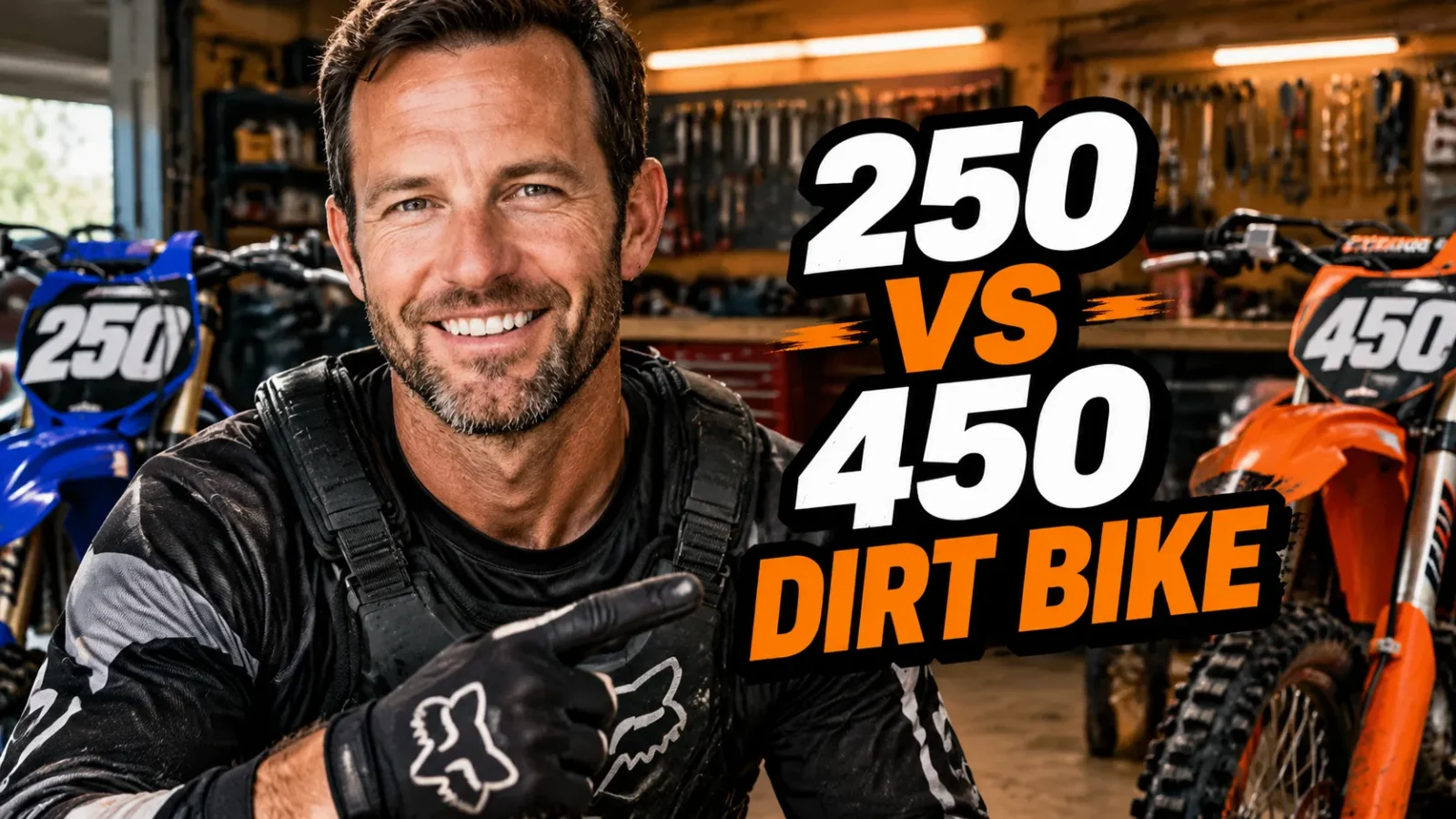
I still remember the first time I twisted the throttle on a 450. I had been riding a 250 four-stroke for two seasons, and I genuinely thought I was fast. Then I hit a fire road on that 450, grabbed a handful of throttle in third gear, and watched the front wheel climb toward the sky like it had somewhere better to be.
That moment taught me more about the 250 vs 450 dirt bike debate than any spec sheet ever could. It is not really about which bike is “better.” It is about which bike is better for you, on the terrain you actually ride, at the pace you actually ride it.
I have owned four 250s and two 450s over the past decade. I have raced them, crashed them, rebuilt them in a cold garage, and sold a couple of them with genuine regret. Here is what I have learned.
- A 250 is easier to ride, lighter, and usually faster in tight woods and technical terrain.
- A 450 wins on open ground, long climbs, deep sand, and for heavier or very experienced riders.
- The biggest difference is not peak power, it is how early and how hard that power hits.
- Fatigue is the hidden factor. On a long day, the 250 often leaves you fresher and therefore faster.
- If you are unsure, buy the 250. You can always move up, and you will be a better rider for it.
Why This Question Never Goes Away
Every few months someone in my riding group asks it again. Usually right after they get passed by a 450 on a hill climb, or right after they get arm-pumped into oblivion on one.
The reason the debate never dies is that displacement is the only number most riders can compare easily. It is printed right there on the side panel. Everything else, gearing, mapping, flywheel weight, suspension setup, is invisible and complicated.
But displacement alone tells you surprisingly little. A modern 250 four-stroke makes more usable power than a 450 from fifteen years ago. The bikes have changed. The trade-offs have not.
The Real Difference: Power Delivery, Not Just Displacement
Here is the thing I wish someone had told me early on. A 450 does not just make more power than a 250. It makes that power earlier, harder, and with far less warning.
On my 250, I can be lazy with the throttle. Roll it on mid-corner, short-shift, lug it a gear high. The bike forgives me. It pulls cleanly and keeps the rear tire hooked up.
On a 450, that same laziness gets you punished. The torque arrives instantly, the rear tire breaks loose, and suddenly you are steering with your elbows.
What a 250 Actually Feels Like
A 250 feels light, revvy, and eager. You ride it with momentum. You keep the revs up, you carry corner speed, and you use the gearbox constantly.
It rewards good technique and punishes laziness far less. That is exactly why I put so many of my friends on 250s when they are coming back after years away from riding.
What a 450 Actually Feels Like
A 450 feels planted, torquey, and slightly intimidating. You can be in the wrong gear and still clear the jump. You can be exhausted and still make the climb.
The trade-off is that it demands respect every single lap. When I am fresh, my 450 is a weapon. When I am tired, it is a handful, and that is when I make mistakes.
Weight and Flickability Matter More Than Horsepower
On paper, the weight difference between a 250 and a 450 looks small. Somewhere around ten to fifteen pounds on comparable models.
In the woods, it feels like fifty. That extra mass sits high and forward, and you feel it every time you change direction, every time you pick the bike up off a root, every time you stab the front brake into a tight turn.
I have ridden back-to-back laps on the same trail with both. On the 250 I could flick the bike into ruts without thinking. On the 450 I had to plan a half-second earlier. Over a four-hour ride, those half-seconds compound into real fatigue.
Who Should Buy a 250?
Honestly? Most people. I know that is not the exciting answer, but it is the accurate one.
New Riders and Returning Riders
If you are still learning throttle control, clutch feel, and body position, a 250 will teach you faster. You will crash less, and the crashes you do have will be slower and gentler.
My rule is simple. If you cannot confidently wheelie a 250, you are not ready to manage a 450’s power delivery in the dirt.
Tight Woods and Technical Terrain
Single track, rocky creek beds, rooty climbs, tight switchbacks. This is 250 territory, and it is not close.
The lighter chassis turns quicker, stalls less, and is dramatically easier to muscle through a technical section when your legs are shot. I have watched plenty of 450 riders get absolutely smoked by 250s in the trees.
A Note on 250 Two-Strokes vs 250 Four-Strokes
These are very different bikes sharing the same number. A 250 two-stroke is light, cheap to rebuild, and hits hard when it comes on the pipe.
A 250 four-stroke is smoother, more tractable, and easier to ride for hours. If you ride long distances or fast tracks, I would lean four-stroke. For pure woods fun, the two-stroke is hard to beat.
Who Should Buy a 450?
There are legitimate reasons to go big. I am not anti-450 at all, and I still keep one in the garage.
Open Desert, Hills, and Fast Tracks
If your riding is mostly wide-open, sandy, or uphill, the 450’s torque is genuinely useful. You can run a gear high, stay off the clutch, and let the motor do the work.
On long sand washes and big hill climbs, a 250 has to be ridden perfectly. A 450 just goes. That difference is real and worth paying for.
Bigger and Heavier Riders
If you are a large rider, a 250 can feel like it is working hard just to move you. A 450 carries that weight without complaint and holds its line better in rough terrain.
Suspension spring rates matter here too. A properly set up 450 for a 220-pound rider will feel far better than an undersprung 250.
The Fatigue Factor Nobody Warns You About
This is the part of the 250 vs 450 dirt bike conversation that gets ignored, and it is arguably the most important.
Raw lap times favor the 450 for a few laps. But most of us are not racing three-lap motos. We are out for two, three, four hours, and the last hour is where rides are won or lost.
I have finished rides on a 450 with my forearms locked into claws. The same trail on a 250 left me tired but functional. Fresher riders make fewer mistakes, and fewer mistakes means faster, safer riding.
That is why so many fast woods riders choose smaller bikes. They are not giving up speed. They are buying endurance.
Cost, Maintenance, and Resale
A 450 costs more up front, and it costs more to keep running. Tires, chains, sprockets, and fuel all wear faster because there is simply more power going through them.
Top-end rebuilds tend to be pricier as well, and the intervals are not dramatically longer. You are paying more to maintain more motor.
Resale is a mixed bag. Clean 450s hold value well because the demand is steady. But clean, well-maintained 250s sell almost instantly, especially two-strokes in good shape.
My Honest Take After Riding Both
If I could only own one dirt bike for the rest of my life, it would be a 250. Specifically a 250 two-stroke for the woods and a 250 four-stroke for everything else.
I am faster on it more of the time, I am less tired at the end of the day, and I enjoy riding it more. That last point matters more than any dyno chart.
That said, I understand the appeal of the 450 completely. There is nothing like that surge of torque when you get it right. It is addictive, and on the right terrain it is unbeatable.
If You’re Stuck on the Fence
Buy the 250. Ride it for a full season. Learn to carry momentum, learn to use the clutch, learn to be smooth.
If you outride it, you will know. And if you do move up to a 450 later, you will ride it far better than you would have if you started there.
The riders I know who started on 450s almost all plateaued early. They relied on power instead of technique, and it took years to unlearn.
Final Thoughts
The 250 vs 450 dirt bike question does not have a universal answer, but it does have a personal one. Match the bike to your terrain, your size, your experience, and honestly, your fitness.
Be honest with yourself about all four. A 450 you cannot control is slower than a 250 you can ride at the limit, every single time.
And if you take nothing else from my decade of garage time and blown-up top ends, take this. The fastest bike is the one you can ride hard for the longest. For most of us, that bike has a 250 on the side panel.
Frequently Asked Questions
Is a 250 or a 450 better for a beginner?
For almost every beginner, a 250 is the better choice. The power is easier to manage, the bike is lighter, and you will learn throttle control faster. A 450 punishes small mistakes with a lot more force.
Can a 250 keep up with a 450 on the trail?
In tight, technical woods, yes, and often a 250 will be faster because it turns quicker and wears you out less. On long, fast, open climbs the 450’s torque advantage becomes very real.
Does a 450 cost more to maintain than a 250?
Generally yes. A 450 uses more fuel, eats tires and chains faster, and top end rebuilds tend to cost a bit more. The gap is not huge, but over a few seasons it adds up.
Should I buy a 250 two stroke or a 250 four stroke?
It depends on your terrain. A 250 two stroke is light, cheap to rebuild, and great in the woods. A 250 four stroke is smoother, easier to ride on long days, and better on fast tracks.

Related Articles

CBR650R vs R7: Which Middleweight Sportbike Actually Won Me Over
I've ridden both the Honda CBR650R and Yamaha YZF-R7 back to back. Here's how they really compare on power, weight,…
 Jake Miller
9 min read
Jake Miller
9 min read

DRZ400E vs DRZ400S: I’ve Ridden Both, and Here’s the One I’d Actually Buy
DRZ400E vs DRZ400S: I break down carb, power, weight, street legality, and which of these two Suzuki dual sports I'd…
Jake Miller
9 min read

Ironhead vs Shovelhead: An Honest Wrench Turner’s Guide to Picking Your Vintage Harley
I've ridden and wrenched on both Ironhead Sportsters and Shovelhead Big Twins. Here's the honest difference in power, reliability, parts,…
Jake Miller
9 min read