
Hayabusa 1300 vs Kawasaki 1400: An Owner’s Honest Hyperbike Showdown
 Jake Miller
9 min read
Jake Miller
9 min read
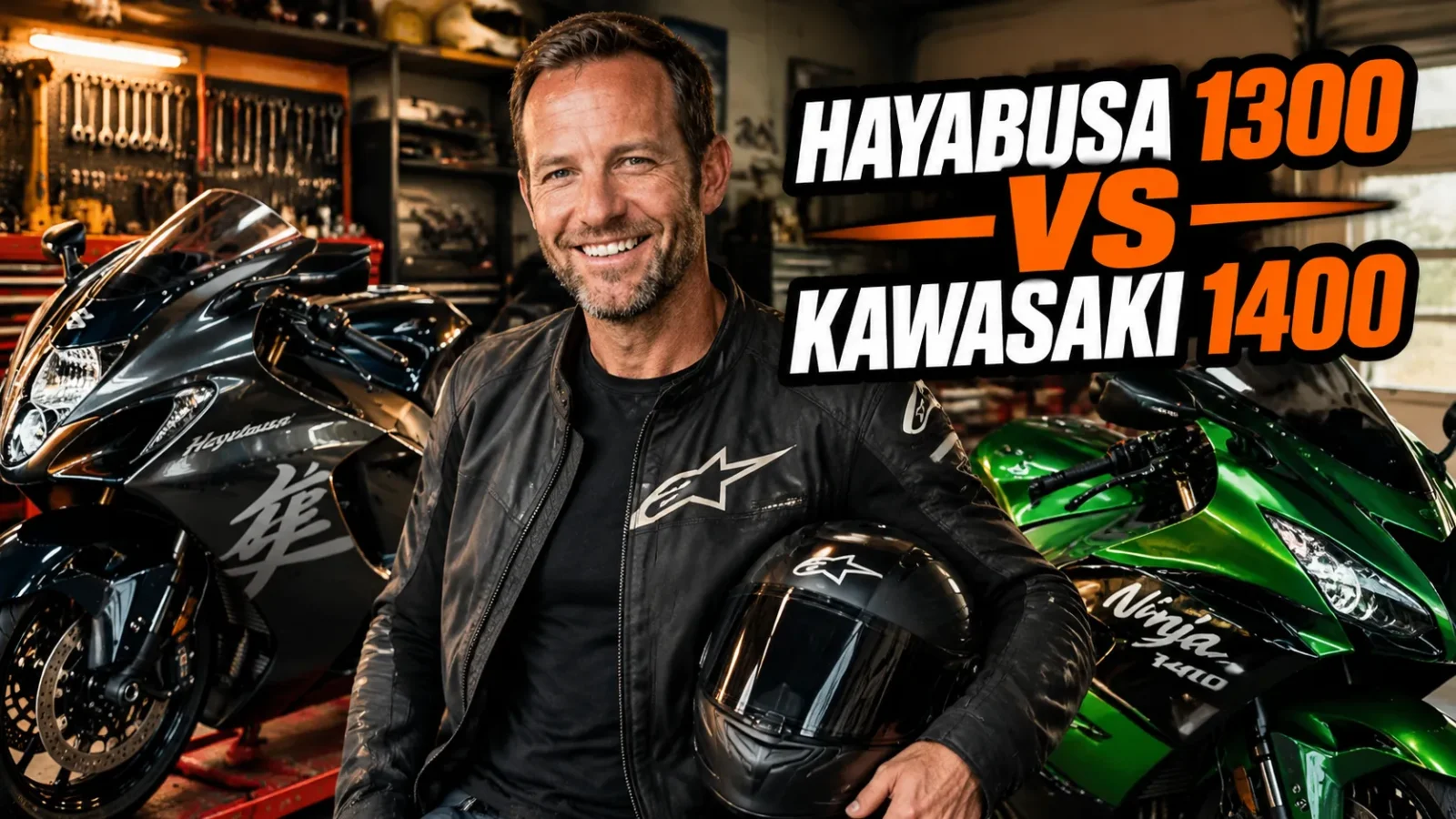
I still remember the first time I cracked the throttle on a Hayabusa wide open in third gear. The horizon didn’t move closer, it just sort of arrived. That was on a friend’s 2008 model, and it ruined me for a while. A few summers later I spent three weeks swapping between my own Hayabusa and a mate’s Kawasaki ZX-14R, and that comparison is what I want to walk you through here.
These two bikes are the last of a dying breed. They are hyperbikes: 1300cc-plus monsters built for one thing, which is going very, very fast in a straight line while somehow still being rideable across a continent. If you’re shopping used or you’ve got a soft spot for the class, this is the comparison I wish someone had handed me before I spent my money.
- The Kawasaki ZX-14R (1441cc) is the drag strip king and pulls harder from low revs thanks to more torque.
- The modern Hayabusa (1340cc) is smoother, better finished and packed with far superior electronics including a six axis IMU.
- Both are limited to roughly 299 km/h, so top speed is a tie in practice.
- The Hayabusa is the better tourer and holds its value better; the ZX-14R is the cheaper used buy and the more brutal ride.
- If I had to pick one for a 3000 km road trip, I’d take the Hayabusa every single time.
Why These Two Bikes Keep Getting Compared
Blame Suzuki. When the original GSX1300R Hayabusa landed in 1999 it didn’t just beat Honda’s Blackbird, it humiliated it. The name means peregrine falcon, a bird that hunts blackbirds, which tells you everything about Suzuki’s sense of humour at the time.
Kawasaki responded with the Ninja ZX-14, later the ZX-14R, which grew to 1441cc. In Europe you’ll know it as the ZZR1400. The point was simple: take the Hayabusa formula, add capacity, and win back the crown.
That rivalry never really ended, even though both bikes have quietly slipped out of showrooms in most markets. Used examples are everywhere, parts are cheap, and the arguments in pub car parks rage on. I’ve had the argument myself, usually after a long ride and one too many coffees.
A quick word on the “Kawasaki 1400” badge
Worth clarifying, because it trips people up. Kawasaki used “1400” on two very different machines. The first is the ZX-14R hyperbike I’m talking about here. The second is the 1400GTR, also sold as the Concours 14, which is a shaft-driven sport tourer with a completely different character.
If you’re cross-shopping a Hayabusa, you almost certainly mean the ZX-14R. That’s what I’m comparing, though I’ll nod to the GTR where it matters.
Engine, Power and Torque: The Numbers That Actually Matter
On paper this looks like a mismatch. The ZX-14R’s 1441cc inline four makes roughly 200 hp at the crank and a thumping 158 Nm of torque. The current Hayabusa runs 1340cc, about 187 hp and 150 Nm.
Numbers lie, though. What matters on the road is where the power arrives.
The Kawasaki’s low down punch
The ZX-14R’s party trick is its midrange. Twist the throttle at 4000 rpm in top gear and it simply leaves. No downshift, no drama, just a wall of torque that shoves you towards the horizon. On a drag strip it’s genuinely savage.
I’ve never ridden anything that gathers speed so casually from such low revs. It feels like the engine has no idea what gear it’s in, and doesn’t care.
The Hayabusa’s smoothness
The Hayabusa feels different. It’s more rev-happy, more turbine-smooth, and it builds speed with a refinement the Kawasaki can’t match. My 2008 model was buzzy at motorway speeds; the 2021-onwards bike is glassy by comparison.
Where the ZX-14R punches, the Hayabusa flows. It’s less brutal and, to me, more satisfying over a long day.
| Spec | Suzuki Hayabusa (2021+) | Kawasaki ZX-14R |
|---|---|---|
| Capacity | 1340cc inline four | 1441cc inline four |
| Peak power | ~187 hp | ~200 hp |
| Torque | ~150 Nm | ~158 Nm |
| Wet weight | ~264 kg | ~268 kg |
| Top speed | Limited to ~299 km/h | Limited to ~299 km/h |
Real World Acceleration and Top Speed
Here’s the thing nobody tells you: both bikes are limited to 299 km/h by that long-standing gentleman’s agreement between the Japanese manufacturers. So the top speed argument is dead on arrival.
Quarter mile times are where the Kawasaki genuinely wins. It’s the quicker bike off the line, and if you spend your weekends at the strip, that matters enormously.
On the road, though? I found the gap almost irrelevant. Rolling on from 100 km/h, both bikes will put you well past legal speeds before you’ve finished the thought. The difference is measured in fractions of a second, and your licence doesn’t care about fractions.
What I did notice is how much easier the Hayabusa is to ride fast. Its throttle mapping is gentler, its fuelling is cleaner, and it doesn’t try to wheelie every time you sneeze.
Handling, Weight and Chassis Feel
Neither of these is a sports bike. Let’s not pretend otherwise. They weigh around 265 kg wet, which is a lot of motorcycle to convince to change direction.
That said, they hide their weight surprisingly well. Both use long wheelbases and stiff aluminium frames, and both feel planted at speed in a way lighter bikes can’t match.
Where the Hayabusa feels better
The modern Hayabusa’s suspension is more compliant and its steering is more neutral. I could hustle it through a set of sweepers without feeling like I was fighting it. Brakes are strong, with plenty of feel.
Where the Kawasaki fights back
The ZX-14R feels heavier tipping in and its front end is vaguer when you push. It’s not bad, it’s just less polished. Where it wins is stability under hard acceleration, which is exactly the point of the bike.
My honest take: if your riding involves corners, the Hayabusa is the better tool. If it involves long straights, the Kawasaki is.
Comfort and Ergonomics Over a Long Day
This is where the Hayabusa runs away with it. The seat is broad and genuinely comfortable, the bars are reachable without folding you in half, and the fairing does a brilliant job of keeping wind off your chest.
I’ve done 800 km days on mine and stepped off feeling human. On the ZX-14R, my wrists and knees were complaining well before the tank ran dry.
The 2021-onwards Hayabusa adds cruise control, which is a game changer for motorway miles. The Kawasaki never got that, and it shows how much newer the Suzuki’s design brief is.
Electronics: This Isn’t Close
Modern Hayabusa versus ZX-14R is a bit like comparing a smartphone to a flip phone. Harsh, but fair.
The Suzuki runs a six axis IMU. That means cornering aware traction control, launch control, engine brake control, anti-lift, multiple ride modes, cruise control and a bidirectional quickshifter. It’s a full modern suite.
The Kawasaki makes do with basic traction control and power modes. No IMU, no cornering ABS, no quickshifter on most examples. It’s not unsafe, it’s just old.
For me, that electronics gap is the single strongest argument for the Hayabusa. It makes a 260 kg, 190 hp motorcycle feel manageable in the rain, and that’s worth more than 13 hp.
Running Costs, Fuel and Reliability
Neither bike is cheap to run, but the differences are worth knowing before you buy.
Fuel economy
Realistically you’re looking at around 6 to 7 litres per 100 km on both. Ride them properly and that number gets worse fast. The Hayabusa is marginally thriftier in my experience, mostly because it doesn’t need as much throttle to make progress.
Servicing and tyres
Both eat rear tyres, both need quality oil, and both have valve clearance intervals that will make you wince. The Kawasaki’s larger capacity doesn’t translate into meaningfully higher servicing costs.
Parts availability is good for both, though Suzuki’s global dealer network is broader. The Hayabusa also has an enormous aftermarket, from exhausts to turbo kits, which keeps long term ownership costs sane.
Reliability
Both are legendarily tough. The Hayabusa engine is famously overbuilt and will happily do 150,000 km with routine maintenance. The ZX-14R is similarly robust.
Buy either with a full service history and you’ll likely be fine. Buy one that’s been drag raced every weekend and you won’t be.
Resale Value and Buying Used
Here’s a practical point that surprised me. Hayabusas hold their value remarkably well. Even older models command strong money because demand never really died.
The ZX-14R is the bargain of the two. You can pick up a clean low mileage example for noticeably less than an equivalent Hayabusa, which makes it the smarter buy if you’re chasing straight line performance on a budget.
But if you want the bike that’s easier to live with, easier to sell later, and better supported, the Suzuki wins.
Which One Would I Buy?
I’ve owned a Hayabusa and I’d own another. For the way I ride, which is long distance with occasional moments of poor judgement, it’s simply the better motorcycle.
The electronics, the comfort, the refinement and the resale all point one way. It’s the more complete bike, and the 2021-onwards model is the best hyperbike ever built in my honest opinion.
That said, if you want the fastest thing at the drag strip, if you love that enormous torque shove, and if you don’t mind older tech, the Kawasaki ZX-14R is an absolute weapon. It’s cheaper, it’s angrier, and it has a character all of its own.
My Final Verdict
If I could only have one, it would be the Hayabusa. It does 90 percent of what the Kawasaki does while being dramatically nicer to live with, and that trade off suits me perfectly.
But here’s the thing. These bikes aren’t really rivals in the way they once were. They’re two different answers to the same question, and the right answer depends entirely on what you want from a motorcycle.
Ride both if you can. Borrow one, rent one, do whatever it takes. Because the spec sheet won’t tell you which one makes you grin, and that’s the only metric that actually matters.
Frequently Asked Questions
Which is faster, the Hayabusa 1300 or the Kawasaki 1400?
In pure straight line terms the Kawasaki Ninja ZX-14R has the edge. Its 1441cc engine makes more torque and it is famously one of the quickest production bikes over a quarter mile. Both are electronically limited to around 299 km/h (186 mph), so real world differences show up in roll on acceleration rather than top speed.
Is the Hayabusa 1300 comfortable enough for long distance touring?
Yes. The Hayabusa is one of the most relaxed hyperbikes ever built. The seat is plush, the wind protection is excellent and the 2021 onward model adds cruise control, making it a genuine sport tourer that can cover 800 km days without punishing you.
Can a beginner ride a Hayabusa 1300 or a Kawasaki 1400?
Technically yes, but I would not recommend it. Both bikes weigh over 260 kg and make close to 200 hp. Rider modes and traction control help, but the weight and instant torque demand real throttle discipline that new riders simply have not developed yet.
Which bike has better electronics, the Hayabusa or the ZX-14R?
The modern Hayabusa wins comfortably. It uses a six axis IMU with cornering traction control, launch control, cruise control, engine brake control and a bidirectional quickshifter. The ZX-14R relies on older tech with basic traction control and power modes only.

Related Articles

CBR650R vs R7: Which Middleweight Sportbike Actually Won Me Over
I've ridden both the Honda CBR650R and Yamaha YZF-R7 back to back. Here's how they really compare on power, weight,…
Jake Miller
9 min read

DRZ400E vs DRZ400S: I’ve Ridden Both, and Here’s the One I’d Actually Buy
DRZ400E vs DRZ400S: I break down carb, power, weight, street legality, and which of these two Suzuki dual sports I'd…
Jake Miller
9 min read

Ironhead vs Shovelhead: An Honest Wrench Turner’s Guide to Picking Your Vintage Harley
I've ridden and wrenched on both Ironhead Sportsters and Shovelhead Big Twins. Here's the honest difference in power, reliability, parts,…
Jake Miller
9 min read