
Bike vs Bicycle: A Rider’s Honest Guide to Which Word to Actually Use
 Jake Miller
9 min read
Jake Miller
9 min read
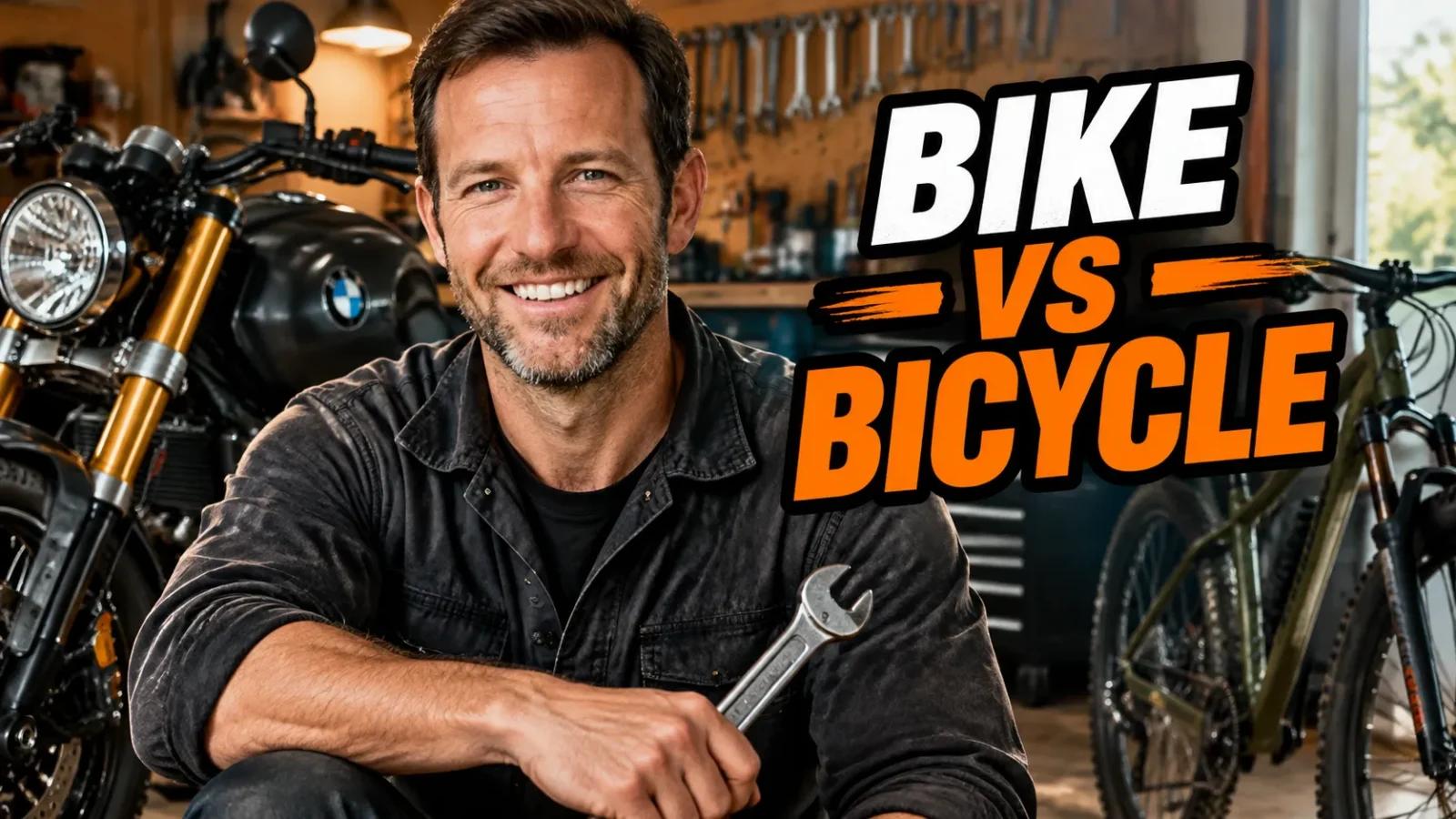
I’ve been riding for the better part of two decades, and I still catch myself switching between “bike” and “bicycle” mid-sentence. I’ll text a buddy “bring your bike” and then, ten minutes later, write a review that says “this bicycle handles gravel beautifully.” Same machine. Two words. And somehow both feel completely right in their own moment.
That tiny word choice matters more than most people realize, especially if you’re shopping for gear, searching for parts, or writing about cycling. So let me walk you through how I actually think about the bike vs bicycle question after years of riding, wrenching, and rambling about two-wheelers.
- “Bicycle” is the precise, formal term for a pedal-powered two-wheeler; “bike” is its casual short form.
- “Bike” is broader and can mean a motorcycle, dirt bike, or e-bike, so context does all the heavy lifting.
- I use “bicycle” in writing, specs, and searches where clarity matters, and “bike” in conversation and community spaces.
- Regional habits matter: in the US “bike” usually means bicycle, while in India and parts of Asia it often means motorcycle.
The Real Difference in One Sentence
If you want the shortest possible answer, here it is: a bicycle is a specific thing, and a bike is a nickname that usually points at that same thing but doesn’t have to.
Every bicycle is a bike. Not every bike is a bicycle. That asymmetry is the entire debate in a nutshell, and it’s the reason I’m careful about which word I reach for.
When I’m standing in my garage looking at my steel touring frame, the words are fully interchangeable. When I’m standing in a parking lot full of cruisers with chrome exhaust pipes, they absolutely are not.
Why “Bicycle” Is the More Precise Word
Let’s get a little nerdy for a second, because the etymology here is genuinely useful. “Bicycle” comes from the Latin bi (two) and the Greek kyklos (wheel or circle). Two wheels. That’s it. That’s the machine.
The word entered English in the mid-1800s and it has always described a human-powered, pedal-driven vehicle. No engine, no motor, no ambiguity. When I read “bicycle” in a legal document, a product spec sheet, or a trailhead sign, I know exactly what’s being discussed.
Where “Bicycle” Shows Up in Real Life
I notice the formal term most often in contexts where precision protects someone. Insurance policies say bicycle. City ordinances say bicycle. Bike manufacturers put “bicycle” on the box and “bike” in the marketing copy.
Here’s a fun wrinkle: we all say bike lane, not bicycle lane, even though the lane is legally for bicycles. That’s a perfect example of how the short form wins in everyday speech while the long form holds the legal ground.
Why “Bike” Wins in Conversation
Try this experiment with a friend. Say “let’s go for a bicycle ride this weekend.” Now say “let’s go for a bike ride.” I’ve done this, and the second one gets a yes roughly every time. The first one gets a raised eyebrow.
“Bike” is one syllable. It’s warm, fast, and casual. It’s the word I use when I’m excited about a Sunday morning loop, when I’m complaining about headwinds, and when I’m texting the group chat about meeting at the coffee shop.
There’s also a social signal buried in it. Cyclists who say “bike” sound like they ride. Cyclists who only ever say “bicycle” can sound like they’re reading from a brochure. Neither is wrong, but I know which one I’d rather sound like.
Where It Gets Messy: Motorcycles and Dirt Bikes
This is where the whole conversation gets interesting, and honestly, this is where most people get tripped up.
In motorcycle culture, “bike” is the default word and always has been. Nobody at a Harley dealership says “I’m picking up my motorcycle” when “I’m picking up my bike” works fine. Same with dirt bikes, sport bikes, and cafe racers.
So when someone says “I ride a bike,” you genuinely need more information. Are they wearing Lycra or leather? Are they clipped into pedals or twisting a throttle? Context is doing all the work.
How I Disambiguate Without Being Annoying
When I’m writing and I need to be clear, I add one qualifier and move on. “Road bike,” “mountain bike,” “motorcycle,” “dirt bike.” One extra word removes all doubt.
In person, I just ask. “Pedal bike or motorbike?” Nobody has ever been offended by that question, and it saves me from a five-minute conversation about the wrong machine.
E-Bikes Blur Everything Again
Electric bikes are the newest wrench in the works. A pedal-assist e-bike is, in most jurisdictions, legally a bicycle. It has pedals, it has a modest motor, and it’s allowed wherever bicycles are allowed.
But a high-powered throttle-only machine that’ll do 35 mph without pedaling? That starts drifting toward moped or motorcycle territory, and local laws treat it differently. I always check the rules before I assume.
Practically speaking, I call all of them bikes in conversation and get specific when it matters. “E-bike” is a beautifully efficient word and I use it constantly.
Regional Differences I’ve Noticed on the Road
Where you are changes everything. This is probably the single most underrated part of the bike vs bicycle conversation.
In the United States, “bike” almost always means bicycle by default. If I say bike in Portland or Boulder, people picture a bicycle. Motorcycles get the full word or “motorcycle.”
In the UK, you’ll hear “pushbike” and “pedal cycle” alongside “bike,” and “cycle” is a very common verb and noun. “I’m going out for a cycle” is completely normal there and would sound odd in Ohio.
In India, Pakistan, and much of Southeast Asia, “bike” overwhelmingly means motorcycle. If you ask for a bike there, you’ll get a motor. The word for the pedal-powered machine is cycle. I learned this the hard way while traveling and trying to rent something to ride up a hill.
What That Means for Travelers and Buyers
If you’re renting abroad, be specific. Say “bicycle,” say “cycle,” or point at the thing. Ambiguity in a rental shop can cost you an afternoon and a deposit.
The same applies online. If you’re shopping from a marketplace that serves multiple regions, a search for “bike” can return results you never wanted to see.
How I Choose Between Them in Practice
After years of overthinking this, I’ve landed on a simple set of rules that I follow almost automatically now.
I Reach for “Bicycle” When…
I’m writing something formal, technical, or legal. Spec sheets, reviews with precise language, insurance claims, warranty forms, and anything that might be read by someone who doesn’t ride.
I also use it when I’m searching for parts online, because “bicycle” filters out motorcycle listings in a way that “bike” simply doesn’t. That one habit has saved me a lot of scrolling.
I Reach for “Bike” When…
I’m talking, texting, or posting. Community forums, group rides, social media, casual reviews. Anywhere the tone is human and the context already makes the machine obvious.
I also use “bike” as a modifier constantly. Bike lane, bike path, bike shop, bike fit, bike packing. Nobody says bicycle lane in conversation, and I’m not about to start.
A Quick Side-by-Side Comparison
| Factor | Bike | Bicycle |
|---|---|---|
| Formality | Casual, conversational | Formal, precise |
| Scope | Broad; includes motorcycles and e-bikes | Narrow; pedal-powered only |
| Best used in | Speech, forums, social posts, marketing | Law, specs, signage, product listings |
| Ambiguity risk | High without context | Almost none |
What This Means When You’re Shopping or Searching
Here’s the practical payoff, because I know most people reading this aren’t here for a linguistics lecture. They’re here because they typed something into a search bar and got weird results.
My rule is simple. Start with bicycle when you need precision. Tires, chains, bottom brackets, brake pads. The formal term cuts through the noise and keeps motorcycle parts out of your results.
Switch to bike when you want breadth or you’re reading community content. Reviews, forum threads, YouTube titles, and buying guides almost always use the short form, so searching only for “bicycle” can actually hide great information from you.
The Mistake I Made for Years
For a long time I searched only one term and wondered why my results felt thin. Then I started running both searches back to back. The overlap is huge, but the edges are different, and the edges are where the good stuff lives.
Now I search bicycle first for hard specs, then bike for real-world opinions from people who actually ride. That combination has never let me down.
Style Notes for Anyone Writing About Cycling
If you write about bikes for a living, or even just for a blog, consistency matters more than which word you pick. Pick one as your default and stick with it.
I default to “bike” in casual pieces and “bicycle” in technical or legal-adjacent content. When I need to switch, I switch once, clearly, and then stay there.
What I avoid is stuffing both words into every paragraph just to cover my bases. That reads like a robot wrote it, and readers notice immediately. Natural language beats keyword coverage every single time.
I also lean on compound terms where they already exist. Bike lane, bike path, bike shop, bicycle helmet, bicycle frame. Those pairings are established and they sound right to anyone who rides.
My Final Take
After all these years, here’s where I’ve landed. Bike vs bicycle isn’t a competition. It’s a register shift. Same machine, different room.
“Bicycle” is the word I use when I need to be understood precisely by anyone, including people who have never thrown a leg over a top tube. It’s clean, it’s accurate, and it never causes confusion.
“Bike” is the word I use when I’m being a person. It’s shorter, friendlier, and it’s what actual riders say when they’re talking to each other. It carries warmth that “bicycle” just doesn’t have.
So if you’re writing, buying, or just trying to sound like you know what you’re talking about, use both. Know the difference, know when it matters, and then stop worrying about it and go ride.
Because honestly, whatever you call it, the feeling of rolling out of the driveway on two wheels is exactly the same.
Frequently Asked Questions
Is a bike always a bicycle?
No. In everyday English, bike can mean a bicycle, a motorcycle, a dirt bike, or even an e-bike. The word only becomes specific when the context makes it clear, which is why cyclists usually say bicycle when they want zero ambiguity.
What is the actual difference between a bike and a bicycle?
A bicycle is the precise term for a two-wheeled, human-powered, pedal-driven machine. A bike is the informal short form of that same word, but it also covers motorcycles and e-bikes, so it is broader and more context-dependent.
Should I search for bike parts or bicycle parts online?
I usually start with bicycle when I want precision, because it filters out motorcycle listings, and switch to bike when I want a wider net or I am browsing community forums and reviews.
Is an e-bike a bicycle or a motorcycle?
In most places, a pedal-assist e-bike is legally classified as a bicycle, not a motorcycle. Throttle-only models with high top speeds often land in a separate category with their own rules, so check your local regulations before assuming.

Related Articles

CBR650R vs R7: Which Middleweight Sportbike Actually Won Me Over
I've ridden both the Honda CBR650R and Yamaha YZF-R7 back to back. Here's how they really compare on power, weight,…
Jake Miller
9 min read

DRZ400E vs DRZ400S: I’ve Ridden Both, and Here’s the One I’d Actually Buy
DRZ400E vs DRZ400S: I break down carb, power, weight, street legality, and which of these two Suzuki dual sports I'd…
Jake Miller
9 min read

Ironhead vs Shovelhead: An Honest Wrench Turner’s Guide to Picking Your Vintage Harley
I've ridden and wrenched on both Ironhead Sportsters and Shovelhead Big Twins. Here's the honest difference in power, reliability, parts,…
Jake Miller
9 min read