
Road Glide vs Street Glide: Which Harley Touring Bike Actually Fits You?
 Jake Miller
7 min read
Jake Miller
7 min read
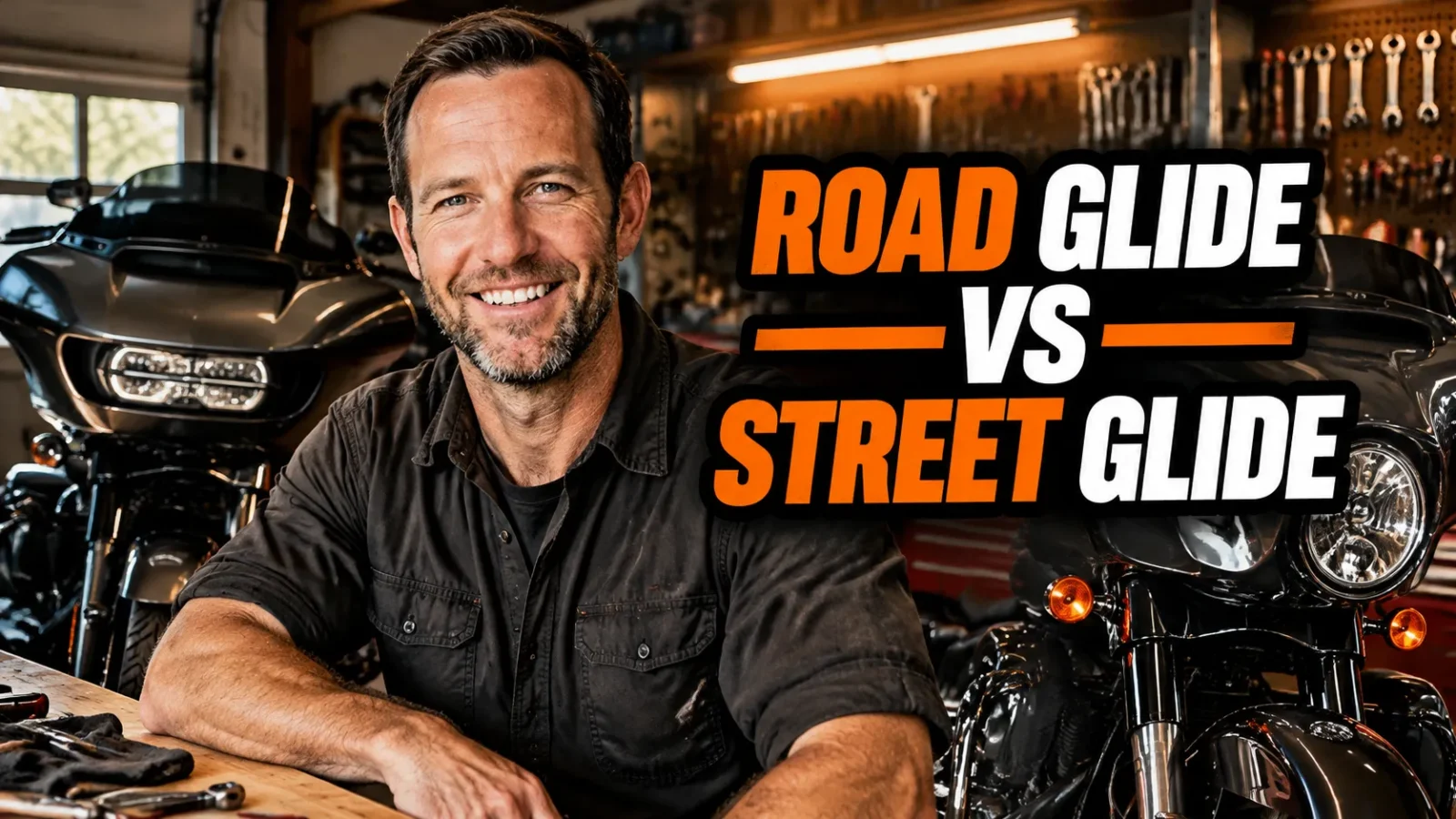
I still remember the first time I swapped bikes with a buddy halfway through a 900-mile weekend. He took my Street Glide, I climbed onto his Road Glide, and within ten minutes I understood why this debate never dies. Both bikes share the same Milwaukee-Eight V-twin, the same touring chassis DNA, and the same basic mission. Yet they feel like completely different motorcycles the moment you pull away from a stoplight. I’ve now logged serious miles on both, including a 2,000-mile road trip, daily commuting, and more than a few rainy highway slogs. Here’s my honest breakdown of road glide vs street glide, based on what I actually felt in the saddle rather than what the spec sheet says.
- The Road Glide’s fixed shark-nose fairing wins for highway wind protection and long-distance comfort.
- The Street Glide’s fork-mounted fairing feels lighter and more agile around town.
- Engine, suspension, and luggage are nearly identical, so the fairing is the real decision.
- If you ride mostly highway miles, I’d buy the Road Glide. If you ride mostly city, I’d buy the Street Glide.
The One Difference That Changes Everything
Strip away the paint, the wheels, and the trim packages, and you’re left with one fundamental difference: where the fairing is mounted.
The Street Glide carries its fairing on the forks. When you turn the handlebars, the whole front end, including the windshield and gauges, swings with you.
The Road Glide bolts its fairing to the frame. It stays perfectly still while the bars turn underneath it. That’s it. That’s the whole argument.
Everything else I’m about to describe flows directly from that single design choice, and it shapes the entire riding experience in ways you don’t fully appreciate until you’ve spent real time on both.
Wind Protection: Where the Road Glide Pulls Ahead
I’ll be blunt about this one. On the highway, the Road Glide is the more comfortable bike, and it isn’t particularly close.
The fixed shark-nose fairing punches a cleaner hole in the air. Wind gets diverted around you instead of piling up behind a windshield that’s constantly changing angle as you make small steering corrections.
Why Crosswinds Favor the Fixed Fairing
Riding through Kansas on a gusty afternoon, I felt the difference immediately. On my Street Glide, a stiff crosswind required constant little counter-steering inputs because the fairing acted like a sail attached to the bars.
On the Road Glide, that same wind hit a fairing that couldn’t move. The bike tracked straighter and my arms stayed relaxed. After six hours, that matters more than any spec.
The Buffeting Question
Neither bike is perfect out of the crate. The Street Glide’s short stock windshield is stylish but pushes turbulent air right at helmet level for taller riders.
I swapped to a slightly taller shield and solved most of it. The Road Glide has its own quirks, but in my experience the clean air pocket is larger and easier to fine-tune with a windshield change.
Handling: The Street Glide Feels Smaller Than It Is
Here’s where the Street Glide fights back hard, and it’s the reason so many riders stay loyal to it.
Because the fairing turns with the bars, the front end feels lighter and more connected at low speeds. Parking lots, tight U-turns, and city traffic all feel less intimidating.
Low-Speed Confidence
At walking pace, I can feel exactly where the Street Glide’s front wheel is pointing. The Road Glide’s fixed fairing creates a slight disconnect, like steering a machine where the visual reference doesn’t quite match the input.
It’s not dangerous. It’s just different. New Road Glide owners often describe a short adjustment period, and I went through the same thing.
Highway Stability
Flip the script at 75 mph. The Road Glide settles into a rock-solid groove and stays there. The Street Glide is stable too, but it asks for more micro-corrections over long distances.
If your riding is 80% highway, my pick is the Road Glide without hesitation. If it’s 80% city, I’d hand the keys to the Street Glide.
Comfort and Ergonomics Over the Long Haul
Both bikes share the same basic seating position, floorboards, and touring saddle, so your knees and back won’t notice much difference.
What changes is your upper body. On the Road Glide, I finish long days with noticeably less tension in my shoulders and forearms.
On the Street Glide, the constant small steering inputs add up. It’s subtle over an hour and obvious over eight.
Passenger Perspective
My wife has ridden behind me on both, and she preferred the Road Glide. She said the air behind her was calmer and she got less helmet buffeting at speed.
That’s worth factoring in if you ride two-up regularly. A happy passenger makes every trip better.
Infotainment, Storage, and Practical Stuff
Here’s the good news: most of the ownership experience is identical, so you’re not sacrificing anything by choosing one over the other.
Both come with Harley’s touchscreen infotainment system, hard saddlebags, and the same suspension layout across comparable trim levels. Audio quality is strong on both, though the Road Glide’s fairing placement gives it a slight edge in speaker staging at speed.
Storage capacity is effectively the same. If you’re comparing specific trims, check the exact model year, because Harley shuffles standard features around fairly often.
Which One Looks Better?
This is pure personal taste and I won’t pretend otherwise. The Street Glide has that classic, swept-back batwing profile that reads as timeless Harley.
The Road Glide’s shark nose is more aggressive and polarizing. Some riders love it instantly, others take a year to warm up to it. I was in the second camp, and now I prefer it.
Cost and Resale
The Street Glide typically starts a few hundred dollars below a comparable Road Glide, but the gap shrinks fast once you start adding options.
Both hold value well, and both have deep aftermarket support. In my experience, resale differences come down to condition, mileage, and local demand more than the model name itself.
Don’t let a $500 price difference decide a $25,000 purchase. Buy the one you’ll actually enjoy riding.
My Honest Verdict
After thousands of miles on both, here’s where I land: the Road Glide is the better touring motorcycle, and the Street Glide is the better everyday motorcycle.
If you dream about cross-country trips, spend most of your time on interstates, or ride two-up often, I’d buy the Road Glide. The wind protection and reduced fatigue are worth every penny.
If your riding is mostly commuting, weekend backroad loops, and city errands, the Street Glide’s agility and lighter feel will make you happier every single day.
And honestly? You can’t go wrong either way. These are two of the finest touring bikes on the road, and the fact that this debate rages on is proof of how good both of them really are.
Frequently Asked Questions
Is the Road Glide better than the Street Glide for long trips?
In my experience, yes. The fixed shark-nose fairing cuts through crosswinds and reduces rider fatigue on long highway days, which is why I’d pick the Road Glide for serious touring.
Does the Street Glide handle better in the city?
I find the Street Glide feels lighter at parking-lot speeds because the fork-mounted fairing turns with the bars. Around town and in traffic, that low-speed agility is a real advantage.
Are the Road Glide and Street Glide the same price?
They’re close. The Street Glide usually starts a few hundred dollars cheaper, but once you add a windshield or audio upgrades, the gap basically disappears.
Can I switch between the two without relearning how to ride?
Mostly, yes. The biggest adjustment is the Road Glide’s fixed fairing, which stays put when you turn the bars. It took me about a week to stop noticing it.
Frequently Asked Questions
Is the Road Glide better than the Street Glide for long trips?
In my experience, yes. The fixed shark-nose fairing cuts through crosswinds and reduces rider fatigue on long highway days, which is why I’d pick the Road Glide for serious touring.
Does the Street Glide handle better in the city?
I find the Street Glide feels lighter at parking-lot speeds because the fork-mounted fairing turns with the bars. Around town and in traffic, that low-speed agility is a real advantage.
Are the Road Glide and Street Glide the same price?
They’re close. The Street Glide usually starts a few hundred dollars cheaper, but once you add a windshield or audio upgrades, the gap basically disappears.
Can I switch between the two without relearning how to ride?
Mostly, yes. The biggest adjustment is the Road Glide’s fixed fairing, which stays put when you turn the bars. It took me about a week to stop noticing it.

Related Articles

CBR650R vs R7: Which Middleweight Sportbike Actually Won Me Over
I've ridden both the Honda CBR650R and Yamaha YZF-R7 back to back. Here's how they really compare on power, weight,…
Jake Miller
9 min read

DRZ400E vs DRZ400S: I’ve Ridden Both, and Here’s the One I’d Actually Buy
DRZ400E vs DRZ400S: I break down carb, power, weight, street legality, and which of these two Suzuki dual sports I'd…
Jake Miller
9 min read

Ironhead vs Shovelhead: An Honest Wrench Turner’s Guide to Picking Your Vintage Harley
I've ridden and wrenched on both Ironhead Sportsters and Shovelhead Big Twins. Here's the honest difference in power, reliability, parts,…
Jake Miller
9 min read