
Sena 20S Evo vs 30K: Which Bluetooth Headset Should You Actually Buy?
 Jake Miller
8 min read
Jake Miller
8 min read
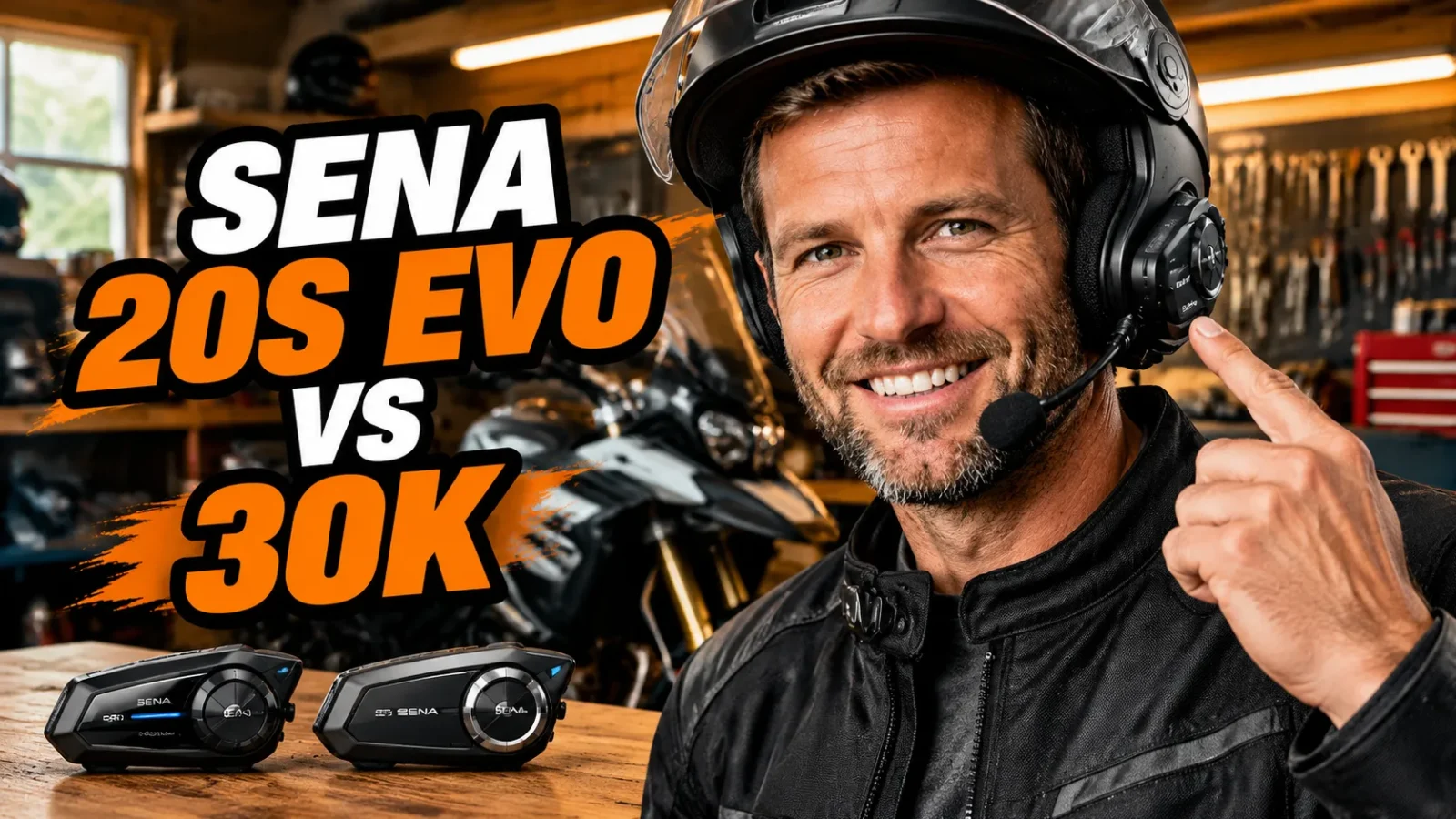
I’ve spent the last few riding seasons with a Sena unit clamped to my helmet, and I’ve owned both of the headsets everyone keeps asking me about. Friends message me constantly with the same question: is the newer 30K actually worth the extra cash, or should I just grab a discounted 20S Evo and ride off into the sunset?
It’s a fair question, because on paper these two look awfully similar. Both are Sena, both do intercom, both play music and take calls. But after living with each one for months, I can tell you the differences run deeper than the spec sheet suggests. Some of them matter enormously depending on how you ride.
So let me walk you through my real-world experience. I’ll cover audio, battery, range, group riding, and the little annoyances that only show up after a few thousand miles. By the end, you’ll know exactly which one belongs on your helmet.
- The 30K’s Mesh Intercom is the single biggest reason to upgrade, especially for groups of four or more riders.
- Audio quality on the 30K is noticeably better thanks to upgraded HD speakers; the 20S Evo sounds thinner by comparison.
- Battery life is close, but the 30K edges ahead in my testing, particularly on mesh.
- For solo riders or tight two-up groups, a discounted 20S Evo is still a fantastic value.
- Mixed groups work fine, since the 30K can fall back to standard Bluetooth to talk to a 20S Evo.
Why I Ended Up Comparing These Two in the First Place
I didn’t set out to become a Sena nerd. It just happened. I started with the 20S Evo because it was the obvious choice a few years back, and it served me well on countless solo rides and a handful of group trips.
Then a riding buddy showed up with a 30K, and the difference in our group conversations was immediately obvious. He could drop out of range and pop back in without anyone pressing a button. I was stuck managing Bluetooth connections like it was 2014.
That trip convinced me to buy a 30K of my own. Since then I’ve run both units back to back, sometimes on the same helmet, sometimes on two helmets so I could compare directly. Here’s what I found.
Audio Quality: The 30K Wins, and It’s Not Close
Let’s start with what you’ll notice in the first thirty seconds. The 30K ships with upgraded HD speakers, and the difference is immediate and obvious. Music has actual bass. Vocals are clearer. Wind noise doesn’t swallow the midrange the way it does on the older unit.
The 20S Evo sounds fine, don’t get me wrong. But “fine” is the right word. It’s a bit thin, a little tinny at higher volumes, and I always found myself cranking it just to hear lyrics over highway noise.
Does the Speaker Upgrade Actually Matter?
Yes, and I’d argue it matters more than most reviewers admit. If you listen to music or podcasts on long rides, the 30K’s audio alone might justify the price difference for you.
I’ve also played with aftermarket speaker upgrades on both units, and the 30K takes to them better. Its audio processing just seems more capable.
One caveat: if you mostly ride with earplugs and only use the headset for occasional voice prompts, the gap shrinks considerably. In that scenario, the 20S Evo’s audio is perfectly serviceable.
Mesh Intercom vs Bluetooth: The Real Dividing Line
This is the heart of the whole comparison. The 20S Evo uses traditional Bluetooth intercom. The 30K uses Sena’s Mesh Intercom, and that changes everything about how group rides feel.
How Bluetooth Intercom Works on the 20S Evo
With the 20S Evo, you’re essentially daisy-chaining connections. You pair with rider A, who pairs with rider B, and so on. It works, and for two or three riders it works well.
But the moment someone drops out of range, the chain breaks. Reconnecting means fiddling with buttons at speed, which I absolutely hate doing. And the more riders you add, the more fragile the whole setup becomes.
How Mesh Changes the Game on the 30K
Mesh Intercom is a different philosophy entirely. Instead of a chain, every rider becomes a node in a network. Riders can join and leave freely, and the network heals itself automatically.
In my experience, this is transformative for groups of four or more. I’ve ridden with six people spread out over a mile of twisty road, and the conversation never dropped. Someone would fall back, then reappear in the chat like nothing happened.
The range is also genuinely better. Sena claims up to five miles between riders in ideal conditions, and while I’ve never hit that on real roads, I’ve comfortably doubled what I got from the 20S Evo.
Battery Life: Closer Than You’d Think
Here’s where the 20S Evo puts up a real fight. Its battery life is excellent, and for pure Bluetooth intercom I regularly got eight to nine hours of talk time.
The 30K, running Mesh Intercom, lasted me roughly ten to eleven hours in similar conditions. That’s better, but not dramatically so.
What surprised me is how much usage pattern affects the numbers. Music streaming drains both units faster. Cold weather hurts both. If you’re a fair-weather rider doing four-hour day trips, battery life is a non-issue on either headset.
For multi-day touring, though, that extra hour or two on the 30K has saved me more than once. There’s nothing worse than your intercom dying halfway through a long afternoon.
Group Size: The Question That Decides Everything
If I had to boil this entire comparison down to one question, it would be this: how many people do you actually ride with?
Solo Riders and Two-Up
If you ride alone or with one other person, the 20S Evo is honestly hard to beat. It does everything you need, and a discounted unit is one of the best values in motorcycling.
You’ll get music, calls, GPS prompts, and reliable two-way intercom. The mesh advantage simply doesn’t apply to you.
Groups of Three or More
This is where I’d push you toward the 30K without hesitation. The moment you have three or more riders, Bluetooth daisy-chaining becomes a chore. Mesh makes it effortless.
I’ve watched friends struggle with dropped connections on 20S Evo units while my 30K group chatted away uninterrupted. That experience alone sold me.
Build, Controls, and Everyday Usability
Both units feel well-made, and both use the same jog-dial-plus-buttons control scheme that Sena fans know well. If you’ve used one, you can use the other.
The 30K is slightly bulkier, which I noticed when mounting it, but it’s nothing that bothered me on the road. The 20S Evo is a touch sleeker.
Firmware updates have improved both over time. Sena has kept the 30K current with meaningful updates, which gives me more confidence in its long-term support.
App Experience
The Sena smartphone app works with both, and I’ve found it genuinely useful for changing settings without pulling over. The 30K’s app integration feels a bit more polished, especially around mesh group management.
Mixed Groups: Can They Talk to Each Other?
Good news here, because this comes up constantly. Yes, a 30K can connect to a 20S Evo over standard Bluetooth intercom.
You lose the mesh benefits for that specific connection, but it works reliably. I’ve done it many times when riding with friends who hadn’t upgraded yet.
The practical takeaway: upgrading to a 30K doesn’t orphan your old riding buddies. You just get the best of both worlds depending on who’s with you.
Price and Value: Where the 20S Evo Fights Back
Let’s talk money, because this is where the older unit makes its strongest case. The 20S Evo is often available at a significant discount, and at that price it’s a phenomenal deal.
The 30K costs more, and you’re paying a premium for mesh and better audio. Whether that premium is worth it depends entirely on your riding style.
My honest take: if you ride in groups, the 30K pays for itself in frustration avoided. If you ride solo, save the money and put it toward tires.
My Final Verdict After Living With Both
I still own both headsets, and I still use both. The 20S Evo lives on my backup helmet and handles solo rides beautifully. The 30K is my primary unit, and I wouldn’t go back.
If you’re a group rider, buy the 30K. The mesh intercom, better audio, and stronger range make it the clear winner for how most people actually ride with friends.
If you’re a solo rider or ride two-up, grab a discounted 20S Evo and enjoy one of the best values in the category. You genuinely won’t feel like you’re missing out.
Either way, you’re getting a solid Sena product that will serve you for years. The real question isn’t which is better in the abstract. It’s which one fits your riding life. Figure that out, and the decision makes itself.
Frequently Asked Questions
Is the Sena 30K worth upgrading from a 20S Evo?
If you ride in groups of four or more, yes. The 30K’s Mesh Intercom is a genuine leap over Bluetooth daisy-chaining, and the audio upgrade is noticeable. Solo riders and small groups may not see the value.
Does the Sena 30K have better battery life than the 20S Evo?
In my testing, the 30K lasted slightly longer on Mesh Intercom than the 20S Evo managed on Bluetooth, roughly 10 to 11 hours versus 8 to 9 hours of real-world talk time.
Can a Sena 20S Evo and a 30K talk to each other?
Yes. The 30K can connect to the 20S Evo over standard Bluetooth intercom, so mixed groups still work. You just lose the mesh advantages for that particular connection.
Which Sena headset has better speakers?
The 30K ships with upgraded HD speakers that deliver noticeably richer bass and clearer vocals. It is one of the most tangible improvements over the 20S Evo.

Related Articles

CBR650R vs R7: Which Middleweight Sportbike Actually Won Me Over
I've ridden both the Honda CBR650R and Yamaha YZF-R7 back to back. Here's how they really compare on power, weight,…
Jake Miller
9 min read

DRZ400E vs DRZ400S: I’ve Ridden Both, and Here’s the One I’d Actually Buy
DRZ400E vs DRZ400S: I break down carb, power, weight, street legality, and which of these two Suzuki dual sports I'd…
Jake Miller
9 min read

Ironhead vs Shovelhead: An Honest Wrench Turner’s Guide to Picking Your Vintage Harley
I've ridden and wrenched on both Ironhead Sportsters and Shovelhead Big Twins. Here's the honest difference in power, reliability, parts,…
Jake Miller
9 min read