
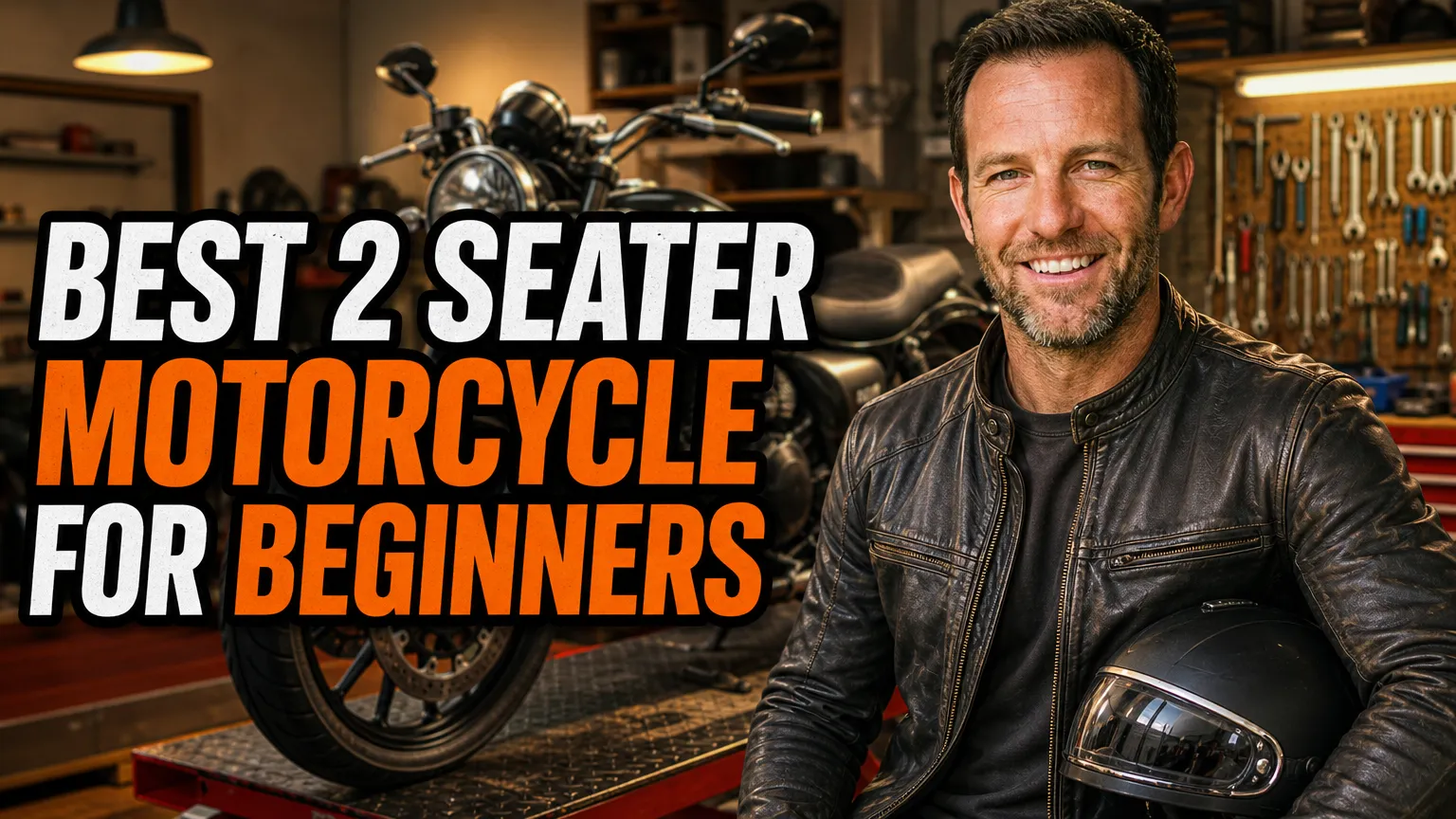
When I’m choosing the best 2 seater motorcycle for beginners, I look beyond engine size and low purchase price. A new rider needs manageable weight, predictable power and controls they can operate confidently, while a passenger needs a real seat, usable footpegs and enough room to feel secure.
There isn’t one perfect answer for every rider. I’d match the motorcycle to your height, experience, budget and typical passenger trips, then check the exact model year and local equipment before buying. The models below give me a useful range, from low-seat cruisers to lighter standard bikes.
- I’d shortlist the Kawasaki Eliminator and Honda Rebel 500 for approachable, low-seat two-up riding.
- The Royal Enfield Meteor 350 suits relaxed, slower trips, but two adults may want more passing power.
- Light standards such as the Yamaha MT-03 are easy to manage, though their passenger seats can be compact.
- I always check load limits, passenger equipment, licensing rules and fit before carrying a passenger.
1. Kawasaki Eliminator 500 — My Pick for an Approachable Cruiser
The Kawasaki Eliminator 500 is one of my first comparisons for a beginner who wants a low seat and a passenger perch. Its 451cc parallel-twin makes a claimed 51 horsepower in many markets, so it has more passing reserve than a small single without jumping straight to a heavyweight motorcycle.
The seat height is about 28.9 inches, which can make stops less intimidating for many newer riders. I also like that the bike has a relatively narrow cruiser-style layout, but I’d still sit on it in person: seat height alone doesn’t tell me how easily my feet reach the ground.
What I’d consider before buying
The Eliminator has a dedicated passenger seat and passenger footpegs, but that doesn’t make every long ride comfortable. I’d ask my passenger to sit on the exact bike and check the seat width, reach to the pegs and handholds before planning regular two-up travel.
Depending on market and model year, the Eliminator 500 is commonly priced in the mid-$6,000 range before taxes, fees and accessories. I’d compare the ABS version where available and confirm which features are included on the specific bike for sale.
2. Honda Rebel 500 — My Favorite Low-Seat All-Rounder
I like the Honda Rebel 500 because its 471cc parallel-twin is approachable, but it still offers a useful step up from a small-displacement starter bike. Honda lists output around 46 horsepower, with the exact published figures and equipment varying by market and model year.
Its low 27.2-inch seat is a major advantage for riders who feel more confident with their feet closer to the ground. I find that reassuring at a stop, although the Rebel’s low-slung riding position and compact passenger area may not suit every body or every kind of trip.
Why I’d shortlist it for two-up riding
The Rebel 500 has passenger provisions, and the twin-cylinder engine gives me more confidence for ordinary roads than a very small commuter engine. I’d still treat it as a sensible middleweight, not a touring machine: luggage, hills and two adults all use some of its available performance and payload.
New-bike pricing often lands around the mid-$6,000 range in the United States, with ABS, destination charges and model-year changes affecting the final figure. If seat reach is your main concern, I’d also compare my guide to the best motorcycle for short beginners before settling on a model.
3. Royal Enfield Meteor 350 — My Choice for Relaxed, Unhurried Rides
The Royal Enfield Meteor 350 appeals to me when the goal is easygoing riding rather than fast acceleration. Its air-oil-cooled 349cc single produces about 20.2 horsepower, and its low 27.6-inch seat helps keep the bike approachable for many newer riders.
I like its upright cruiser posture and relaxed character for neighborhood streets and scenic roads. It includes a passenger seat and passenger footpegs, and some trims or accessories may add a backrest, but I’d confirm exactly what comes with the bike in my market.
Where its limits matter
With two adults aboard, the Meteor 350’s modest power is most noticeable when joining faster traffic, climbing steep hills or overtaking. I’d be comfortable considering it for shorter, slower trips, but I’d take a two-up test ride if possible before choosing it for regular highway use.
Pricing is generally below many 500cc twins, often around the mid-$4,000 range in the United States before fees. For riders focused on a smaller engine, I’d compare other options in my guide to the best 350cc motorcycle for beginners if one is available on the site; for a wider small-bike comparison, see the best 250cc motorcycle for beginners.
4. Honda NX500 — My Pick for More Versatile Two-Up Days
The Honda NX500 is a small adventure-style motorcycle with a 471cc parallel-twin, around 47 horsepower and a comfortable upright riding position. I’d consider it when I want a beginner-manageable engine but also value wind protection, a broad view of traffic and the option to explore rougher roads.
Its seat is much taller than the cruisers here, at roughly 32.8 inches, so I wouldn’t recommend it based on engine size alone. The passenger seat and pegs make two-up riding possible, but I’d check passenger comfort and the bike’s overall fit carefully, especially if either rider is new or shorter-legged.
Why I’d choose it over a small cruiser
The NX500’s upright layout and twin-cylinder engine make it a more versatile choice for mixed roads and longer days. It’s also heavier and taller than a Rebel or Eliminator, so I’d want to feel comfortable maneuvering it at walking pace before treating it as my beginner pick.
New pricing is typically in the upper-$7,000 range in the United States, depending on year and fees. If I want a beginner motorcycle with a stronger road focus, I’d compare the related class in my guide to the best 500cc motorcycle for beginners, while remembering that passenger comfort is model-specific.
5. Kawasaki Z500 — My Pick for a Light, Lively Standard
The Kawasaki Z500 uses a 451cc parallel-twin that produces about 51 horsepower in common specifications. I like the standard-bike layout because it feels more upright than a sportbike, and the engine gives a newer rider room to grow without demanding the performance of a much larger machine.
Its seat height is about 30.9 inches, placing it higher than the low cruisers on this list. The Z500 has a passenger seat and pegs, but the rear seat is still compact, so I’d view it as suitable for occasional two-up rides rather than automatically assuming it’s a passenger-comfort specialist.
What I’d check at the dealership
I’d ask to sit on the Z500 with my passenger and check how the rear seat feels, whether the passenger can reach the pegs comfortably and how easily I can support the bike at a stop. Those small fit details matter more to real-world confidence than a specification sheet can show.
Depending on trim and market, new pricing is often in the mid-$5,000 range before fees. If I’m specifically trying to keep engine capacity lower, I’d also compare the best 300cc motorcycle for beginners and decide whether the extra power of the Z500 is useful for my passenger and routes.
6. Triumph Speed 400 — My Pick for a Compact, Premium-Feeling Standard
The Triumph Speed 400 pairs a 398cc liquid-cooled single with a beginner-friendly standard-bike posture. Its claimed output is about 39.5 horsepower, and its seat height is around 31.1 inches, giving it a manageable middle ground between small commuters and larger middleweights.
I appreciate that the Speed 400 has passenger seating and footpegs while keeping a compact overall feel. For me, it’s a candidate for city riding and shorter two-up outings, though I’d check the passenger seat in person because compact bikes can feel cramped for a taller passenger.
How I’d judge its value
The Speed 400 has a modern liquid-cooled engine, ride-by-wire throttle and a six-speed gearbox. Features and specifications can vary by market or model year, so I’d confirm the local version rather than assume every listing includes identical equipment.
Its new price has generally been around the $5,000 mark in the United States, before taxes and dealer fees. I’d compare it with the Z500 and Rebel 500: the Triumph may appeal if I want a lighter, single-cylinder character, while the twins offer a different style of power delivery.
7. Yamaha MT-03 — My Pick for Light Controls and Solo Practice
The Yamaha MT-03 is powered by a 321cc parallel-twin producing about 42 horsepower in common specifications. Its relatively light feel and upright position make it attractive to a new rider who wants a responsive, compact motorcycle, and I’d value those traits during solo practice.
It has a passenger seat and footpegs, but I wouldn’t mistake “two-up capable” for roomy. The rear seat is small, and the passenger may find the posture less comfortable on a long ride, so I’d reserve the MT-03 for shorter trips unless both riders genuinely like the fit.
Who I think it suits
I’d put the MT-03 on the list for someone who expects to ride mostly alone but wants the option to carry a passenger occasionally. Its approximately 30.7-inch seat height is worth checking in person, especially if a low seat is important to your confidence.
New U.S. pricing is often around the mid-$5,000 range, with year and fees changing the final cost. If I’m comparing smaller beginner bikes, I’d also read the best 125cc motorcycle for beginners guide, while keeping in mind that a 125cc bike may feel underpowered with two adults on faster roads.
8. Honda CB500 Hornet — My Pick for a Practical Middleweight Standard
The Honda CB500 Hornet, sold under different names or model-year designations in some markets, is a 471cc parallel-twin standard with roughly 47 horsepower. I like its straightforward upright layout and balanced middleweight character for a rider who wants one motorcycle for commuting, weekend rides and occasional passenger trips.
It has a passenger seat and pegs, but I’d compare the specific version available locally because names, specifications and equipment can differ. Its seat height is around 31 inches, so it won’t feel as low as the Rebel 500, but it may suit riders who prefer a more conventional standard-bike stance.
My practical take
I’d expect the CB500 Hornet to be a more versatile choice than a tiny starter bike when carrying a passenger on ordinary roads. Still, two-up comfort depends on passenger size, seat shape, suspension setup and luggage, so I’d check the maximum permitted load in the owner’s manual before buying.
Depending on market and model year, pricing is commonly in the mid-$6,000 to upper-$7,000 range. I’d compare it against the NX500 if I want a more upright adventure-style setup, and against the Rebel 500 if a low seat matters more than a standard riding position.
How I Choose a Beginner Motorcycle for Two
I prioritize fit and control over engine size
A motorcycle that feels manageable at a stop and at walking pace can help me build confidence. I’d sit on several models, turn the handlebars fully, test the reach to the controls and see how the weight feels when I walk the bike backward. Riders who want a smaller engine can also compare the best 400cc motorcycle for beginners before choosing.
I check the passenger setup and load limit
Before carrying anyone, I’d confirm that the motorcycle has a proper passenger seat, passenger footpegs and a published maximum load that covers both riders and any luggage. I’d also check the manual for recommended passenger-related tire pressures or suspension adjustments; I wouldn’t guess at those settings.
I build up to riding with a passenger
A passenger changes how a motorcycle accelerates, brakes, turns and balances. I’d first get comfortable riding solo, practice the basics in a safe area, and then begin with a short, low-speed ride with a passenger who understands how to stay relaxed and move with the bike.
I also check local licensing rules before carrying a passenger, and I make sure both of us wear properly fitted protective gear. A motorcycle can be passenger-capable on paper and still be the wrong fit for our bodies, experience or roads.
My Final Picks
If I wanted a low-seat beginner motorcycle for occasional two-up trips, I’d start with the Kawasaki Eliminator 500 and Honda Rebel 500. For relaxed riding at a gentler pace, I’d consider the Royal Enfield Meteor 350; for more varied roads, I’d look at the Honda NX500.
My shortlist would depend on a passenger actually trying the seat, the bike’s load limit and my comfort handling it at low speed. I’d compare local prices and specifications, take a supervised test ride if available, and choose the motorcycle that feels calm and controllable rather than simply buying the biggest engine I can afford.
Frequently Asked Questions
Can a beginner ride a motorcycle with a passenger?
Yes, if the motorcycle is suitable for two-up riding and the rider has the skills and legal licensing to carry a passenger. I recommend practicing solo first and checking the owner’s manual for load limits.
Which beginner motorcycle is easiest to ride with a passenger?
I’d start by comparing the Kawasaki Eliminator and Honda Rebel 500. Both have approachable power and low seats, though passenger comfort and fit still depend on your passengers’ size and the length of your rides.
Is a 300cc motorcycle powerful enough for two people?
It can be, especially for short, slower trips, but acceleration and hill climbing may feel limited with two adults. I’d check the total load limit and take a careful test ride before deciding.
What should I check before carrying a passenger?
I check the motorcycle’s maximum load, passenger seat and footpeg setup, tire pressures, suspension settings, and local licensing rules. I also make sure both riders have properly fitted protective gear.

Related Articles
Motorcycle Wheelbase Explained: How It Shapes Stability, Handling, and Comfort
Learn what motorcycle wheelbase measures, how it influences stability, cornering and comfort, and how I compare the spec when choosing…
 Jake Miller
11 min read
Jake Miller
11 min read
Inside the Backbone: How This Motorcycle Frame Works and What Riders Should Know
Learn how a motorcycle backbone frame works, how it compares with other chassis designs, and what I check for in…
Jake Miller
10 min read
7 Best Touring Motorcycles for New Riders Who Want to Go Far
Seven approachable touring motorcycles for new riders, with real specs, comfort trade-offs, price guidance, and my picks for highways, weekends,…
Jake Miller
12 min read