
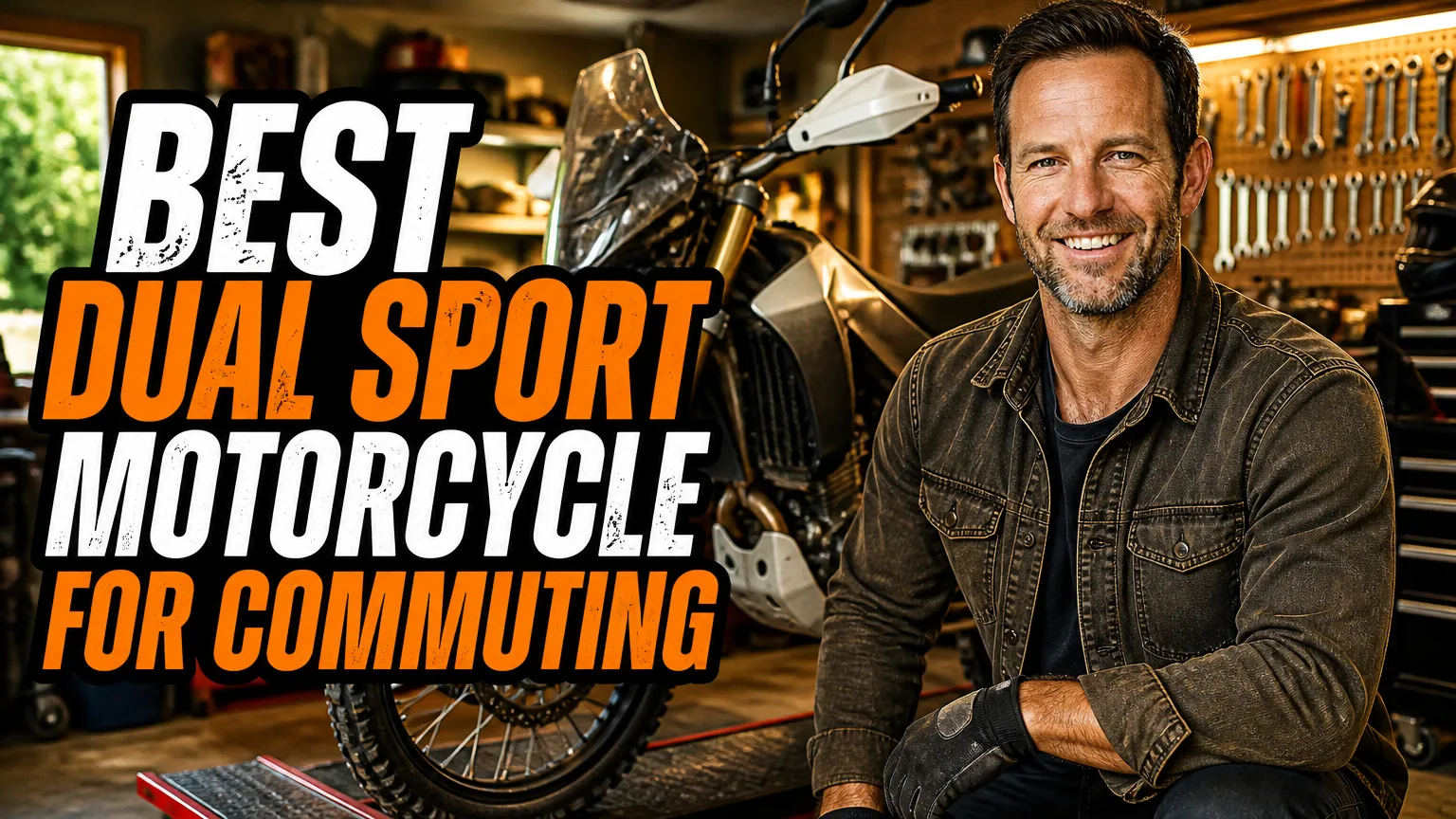
I like a commuter motorcycle that can handle more than the smoothest route across town. A dual-sport gives me the freedom to take a rough shortcut, deal with broken pavement, and explore a dirt road after work, while still being street legal for everyday errands.
There isn’t one perfect choice for every rider. I weigh seat height, weight, highway speed, fuel range, service needs, and price against the roads I actually ride. Here are eight specific models I’d consider, with the strengths and compromises I’d keep in mind before buying.
- I’d start with the Honda CRF300L for a balanced mix of commuting and light off-road riding.
- I’d choose the Suzuki DR-Z4S or KTM 390 Enduro R if my commute includes faster roads.
- I’d look at the Kawasaki KLX230 S or Yamaha TW200 if manageable seat height matters most.
- I’d match the bike to my route, because small dual-sports have real limits on long, fast highway trips.
1. Honda CRF300L — My All-Round Commuting Pick
The Honda CRF300L is the first bike I’d consider if I wanted one machine for commuting, back roads, and occasional dirt. Its 286cc liquid-cooled single-cylinder engine gives me a useful step up from a small trail-oriented bike without making the motorcycle feel unnecessarily large for urban riding.
I like that Honda pairs fuel injection with a six-speed gearbox, a 21-inch front wheel, and long-travel suspension. The CRF300L’s seat is roughly 34.7 inches high, depending on version and market, so I’d make a point of sitting on it before buying. Its low overall weight helps when I’m filtering through traffic or maneuvering in a parking lot.
What I’d consider before buying
For daily use, I appreciate the CRF300L’s upright position and simple, practical design. I’d still budget for luggage, hand guards, or a small windscreen if my commute involves regular highway miles. The stock seat and suspension are adequate for many riders, but I wouldn’t expect plush touring comfort or strong wind protection straight from the showroom.
I’d put the Honda CRF300L near the top of my list for a newer rider, too, provided the seat height feels manageable. If I were comparing more road-focused options for a first bike, I’d also look at this guide to the best sport touring motorcycle for beginners.
2. Kawasaki KLX300 — My Choice for a Lively, Lightweight Feel
I’d choose the Kawasaki KLX300 when I wanted a light-feeling dual-sport that still has enough engine to make ordinary commuting practical. Its 292cc liquid-cooled engine, fuel injection, and six-speed transmission give it a similar broad purpose to the CRF300L, but the riding feel and details differ enough that I’d try both before deciding.
The KLX300 has long-travel suspension and a tall seat, usually around 35 inches. That height can be useful on rough tracks, but I’d treat it as a real fit consideration for stop-and-go city riding. I value its compact character for tight streets and uneven parking areas, where a heavy motorcycle can feel like more work than fun.
Where I think it fits best
The Kawasaki KLX300 makes the most sense to me when my commute includes urban streets, suburban roads, and some slower back-road exploration. Like most dual-sports in this class, it has limited wind protection, and I wouldn’t pick it as my first choice for long stretches of high-speed highway every day.
I’d compare the KLX300 and CRF300L by sitting on both, checking local dealer pricing, and paying attention to how each feels at a stop. Specifications and equipment can change by model year and market, so I’d confirm the exact version available where I live.
3. Suzuki DR-Z4S — My Pick for More Highway Headroom
The Suzuki DR-Z4S brings a larger 398cc single-cylinder engine to the dual-sport category. I’d consider it when my commute includes faster roads and I want more power in reserve than I’d expect from a 230cc or 300cc bike. Its modern fuel injection and six-speed transmission also make it a notable option for riders who want a current, road-legal machine with off-pavement ability.
It remains a tall, dirt-oriented motorcycle, with a seat height around 36 inches and long-travel suspension. That height and suspension travel can be valuable on rough ground, but I’d want to be confident handling the bike at low speed and placing a foot down at intersections. I’d also check the specific model-year equipment and local specifications before making a purchase.
My daily-use trade-off
I’d favor the DR-Z4S if I needed stronger acceleration for faster commuting and still wanted to ride trails on weekends. I wouldn’t confuse “more power” with full touring comfort, though: the upright, exposed riding position can still make sustained highway travel tiring. I’d plan for suitable luggage and protective gear rather than expecting a dirt-focused bike to provide touring features automatically.
Its higher purchase price compared with smaller dual-sports may also matter to my budget. Before choosing it, I’d weigh the extra performance against how often I truly need it on my everyday route.
4. KTM 390 Enduro R — My Pick for a More Road-Ready Performance Feel
The KTM 390 Enduro R is a modern, street-legal option I’d consider if I wanted a sharper performance character and a stronger engine than a basic small-displacement commuter. Its liquid-cooled 399cc single-cylinder engine and six-speed transmission make it appealing for mixed routes that include city traffic, open roads, and unpaved sections.
I’d pay attention to its seat height, which is roughly 34.5 inches, along with the bike’s overall dimensions and suspension setup. The Enduro R is not a small, low-seat scooter substitute; it’s a capable motorcycle built for riders who want genuine off-road potential. Exact electronics, equipment, and pricing can vary by model year and country, so I’d confirm those details with a local dealer.
Who I’d recommend it to
I’d put the KTM on my shortlist if I wanted a dual-sport with a contemporary feel and enough power for a wider variety of roads. I’d also compare its dealer support, service intervals, parts availability, and insurance costs in my area, because ownership convenience matters just as much as a spec sheet when I depend on a bike to get to work.
For me, the 390 Enduro R is most compelling when I’ll use its broader performance range. If most of my riding is slow city traffic with little or no dirt, a simpler and less expensive machine may be a better match.
5. Kawasaki KLX230 S — My Lower-Seat, Everyday Option
The Kawasaki KLX230 S is a model I’d look at when I want a more approachable seat height without giving up the basic dual-sport formula. Its 233cc air-cooled, fuel-injected single-cylinder engine and six-speed transmission suit local roads, errands, and slower commutes particularly well.
The “S” version is designed with a lower seat than the standard KLX230, making it worth a closer look for riders who feel stretched on taller off-road-oriented bikes. I’d still check the listed seat height for the exact year and market, then sit on the motorcycle in riding boots. Seat shape and suspension sag can change how tall a bike feels in practice.
What I’d use it for
I’d use the KLX230 S for city streets, secondary roads, and moderate speeds rather than expecting effortless high-speed highway commuting. Its smaller engine helps keep the bike approachable, but it leaves less passing power in reserve than the larger models on this list. That trade-off seems sensible to me if my daily route is mostly local.
If seat height is a deciding factor, I’d compare it directly with the Yamaha TW200 and try both at a dealership. I’d also check a fit-focused guide to the best sport touring motorcycle for short riders for ideas about evaluating reach and comfort across different motorcycle styles.
6. Suzuki DR650S — My Rugged, Simple Larger-Single Choice
The Suzuki DR650S has a long-running reputation as a straightforward dual-sport, and I’d consider it if I wanted a larger air-cooled single-cylinder motorcycle for commuting and rougher roads. Its 644cc engine gives it more displacement than the lightweight options here, while its basic, practical layout appeals to me if I value a relatively uncomplicated motorcycle.
That larger engine does not make the DR650S a polished touring bike. It has a tall seat, a relatively old-school feel, and limited wind protection, so I’d test its comfort on roads like the ones I ride daily. The bike’s weight and reach also deserve attention when I’m considering frequent stops, tight parking, or low-speed maneuvers.
How I’d decide if it suits my commute
I’d shortlist the DR650S if I wanted a durable-feeling, full-size machine and had enough experience to manage its height and weight confidently. I’d also check local availability, model-year updates, and the condition of any used examples; equipment and pricing can differ substantially between markets and years.
For taller riders, the DR650S may feel roomier than a compact commuter, but I wouldn’t assume every tall rider will find it comfortable. I’d compare seat-to-peg space and bar reach, and I’d browse the best sport touring motorcycle for tall riders guide if I wanted another perspective on fit.
7. Yamaha TW200 — My Friendly Choice for Low-Speed Routes
The Yamaha TW200 stands out to me because of its distinctive fat tires, modest 196cc air-cooled engine, and approachable character. With a seat height around 31 inches, it can feel less intimidating than taller dual-sports, and I like the idea of a nimble machine for local commuting and short trips on mixed surfaces.
I wouldn’t pick the TW200 for a fast highway commute. Its small engine and relaxed pace are better suited to town streets and moderate-speed routes, where I can enjoy its easygoing nature without asking it to do work it wasn’t designed to do. I’d also account for its unique tires when checking replacement availability and cost.
Why I’d consider it for daily errands
The TW200 makes sense to me when my commute is short, my speeds are moderate, and I value low-speed confidence over high-speed performance. Its simple character can be appealing for a rider who wants a practical motorcycle that also handles rough lanes and easy trails.
I’d be honest with myself about route length before buying one. If I needed to maintain highway speed for a significant part of each commute, I’d move toward a larger-engine model instead.
8. Honda XR150L — My Budget-Minded Pick for Short, Slower Commutes
The Honda XR150L is a small-displacement dual-sport I’d consider if purchase price, simplicity, and manageable performance were my main priorities. Its 149cc air-cooled single-cylinder engine and five-speed gearbox suit local errands and slower routes better than long stretches of fast highway riding.
I like the XR150L’s straightforward approach, but I’d be careful not to treat its low cost as a substitute for checking the fit and capability. Its seat is roughly 32.8 inches high, depending on specification, and its modest engine means I’d want to plan around traffic speeds and passing opportunities. For a short urban commute, that may be perfectly reasonable; for a fast rural route, it may not be.
My value check
I’d compare the XR150L’s current local price with the cost of a helmet, protective clothing, registration, and any accessories I need. I’d also ask a dealer about parts and service support in my area. A lower purchase price is most useful when I can maintain the bike conveniently and confidently.
For me, the XR150L works best as a practical, modest-speed commuter rather than an all-purpose machine for every kind of road. I’d move up in displacement if my regular route included fast traffic or long-distance riding.
How I’d Choose Between These Bikes
I start with my actual commute, not the most adventurous ride I imagine taking once a year. If I spend most of my time on city streets and local roads, I’d put the CRF300L, KLX300, KLX230 S, TW200, and XR150L on my comparison list. If I regularly ride faster roads, I’d give the DR-Z4S, KTM 390 Enduro R, and DR650S more attention.
Fit, comfort, and passenger plans
I never choose by seat-height numbers alone. I sit on the bike, check how it balances at a stop, and think about the weight I’ll manage in a parking lot or on a sloped driveway. I also consider whether I can add a luggage rack, soft bags, hand guards, or a windscreen without compromising the way I use the motorcycle.
I’d be realistic about carrying a passenger. Dual-sports can take a passenger on some models, but compact seats and off-road suspension are not always ideal for regular two-up journeys. If that’s central to my plans, I’d compare road-focused alternatives in the best sport touring motorcycle for passenger guide and the best sport touring motorcycle for two up riding guide.
Highway ability and ownership costs
I match engine size and wind protection to my route. A smaller dual-sport can be a pleasant city commuter, but that doesn’t mean it will feel relaxed when I’m holding high speeds for a long time. I’d take a test ride where possible, check the owner’s manual for service requirements, and compare insurance, tires, fuel use, and dealer support before I commit.
Prices, equipment, and availability can change by model year and location, so I’d verify current details with a local dealer. My best pick is the bike that fits my body, route, budget, and riding experience—not simply the one with the biggest engine or the most aggressive off-road appearance.
Frequently Asked Questions
What makes a dual-sport motorcycle good for commuting?
I look for manageable weight, predictable road manners, useful fuel range, comfortable ergonomics, and tires suited to the roads I ride most.
Which dual-sport is easiest for a shorter rider to manage?
I would start by sitting on the Kawasaki KLX230 S or Yamaha TW200. Their lower seats can help, but I always recommend checking the actual seat height and balance in person.
Can I use a dual-sport motorcycle for highway commuting?
Yes, but I match the engine and wind protection to my route. Smaller models are happiest at moderate speeds, while larger bikes handle sustained highway stretches more comfortably.
Are dual-sport motorcycles comfortable for carrying a passenger?
Some can carry a passenger, but I find their seats and rear suspension less suited to regular two-up trips than touring-focused motorcycles.

Related Articles

7 Best Motorcycles for Short Highway Commutes: Comfortable, Capable Picks
I compare seven commuter-friendly motorcycles for brief highway rides, covering power, comfort, seat height, wind protection, and how I’d choose…
 Jake Miller
12 min read
Jake Miller
12 min read

8 Best Motorcycles for Comfortable, Confident Freeway Commuting
Compare eight freeway-ready motorcycles, from practical middleweights to luxury tourers, with real-world comfort, power, features, and buying advice for daily…
Jake Miller
13 min read

8 Best Motorcycles for Los Angeles Commuting: City Scooters to Freeway Bikes
Compare eight commuter-friendly motorcycles and scooters for Los Angeles traffic, from nimble city picks to freeway-ready bikes, with prices, specs,…
Jake Miller
11 min read