
How Long Should a Motorcycle Chain Last? Real-World Mileage, Warning Signs, and How I Double Mine
 Jake Miller
10 min read
Jake Miller
10 min read
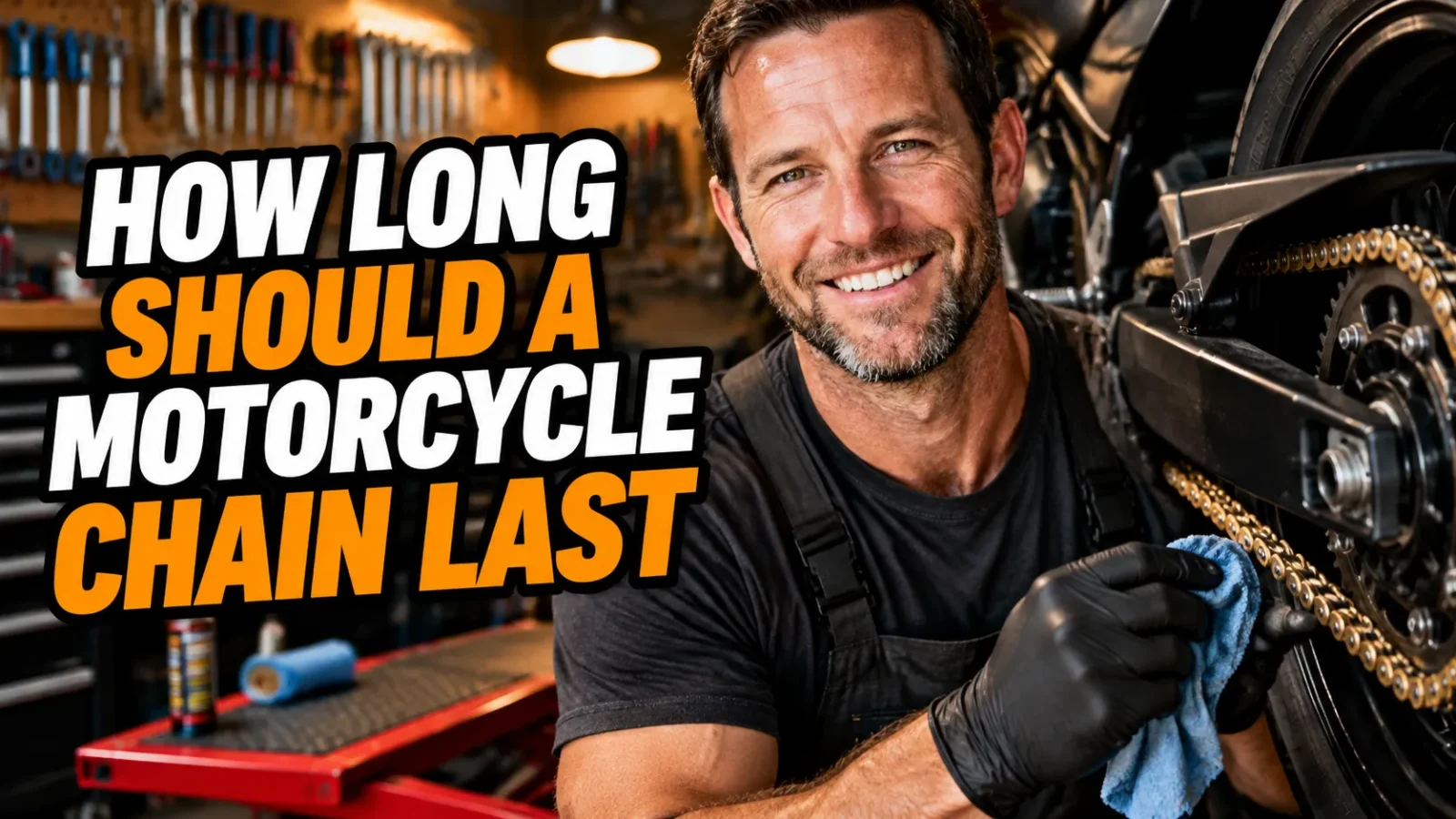
I still remember the first chain I ever killed. It was on a tired 600 I bought for cheap, and I figured a chain was a chain, so I ignored it for a whole season. Somewhere around 9,000 miles it started howling like a dying cat, and by 11,000 it had enough tight spots that I could feel them through the pegs on every rotation.
That lesson cost me a chain, a rear sprocket, and a lot of pride. Since then I’ve ridden belt-drive cruisers, shaft-drive tourers, and more chain-driven bikes than I can count, and I’ve learned that the honest answer to how long should a motorcycle chain last is: it depends almost entirely on you.
So let me give you the numbers I’ve actually lived, the warning signs I check for, and the routine that took me from replacing a chain every 12,000 miles to getting well over 25,000 out of the same setup.
- A neglected chain might be done at 8,000 to 12,000 miles; a properly cared-for chain regularly hits 20,000 to 30,000 miles.
- Lubrication, correct tension, and keeping it clean matter more than brand or price.
- Chains rarely die suddenly. They stretch, kink, and develop tight spots long before they snap.
- Always replace chain and sprockets as a set, or the new chain will die fast.
The Short Answer I Give My Riding Buddies
When someone asks me at a gas station how long a motorcycle chain should last, I usually say 15,000 to 30,000 miles. That’s the range I’ve seen across dozens of bikes and hundreds of thousands of combined miles with the people I ride with.
The low end is real. If you ride in the rain, never clean the thing, and only think about tension when it’s slapping the swingarm, 10,000 miles is a good run. The high end is real too. I know a guy with a well-loved sport-tourer who got 34,000 miles out of a quality X-ring chain because he cleaned and lubed it like it was a religious obligation.
What surprised me most over the years is how little the bike matters compared to the owner. I’ve seen identical models where one chain was trash at 9,000 miles and the other was still going strong at 24,000.
What Actually Wears a Chain Out
A motorcycle chain isn’t really stretching, by the way. Steel doesn’t stretch. What happens is the pins and bushings inside each link wear down, and that accumulated slop shows up as length. Every mile you ride removes a microscopic amount of metal from those internal surfaces.
Once that wear starts, it accelerates. A slightly worn chain rides higher on the sprocket teeth, which puts more load on fewer contact points, which wears things faster. It’s a snowball, and your maintenance habits decide how fast it rolls.
Lubrication: The Single Biggest Factor
I used to think chain lube was mostly about rust prevention. It isn’t. The lubricant that matters is the stuff that stays inside the links, keeping those pins and bushings from grinding each other to dust.
On a sealed O-ring or X-ring chain, that internal grease is sealed in at the factory. Your job is protecting the seals so the grease stays put. On a non-sealed chain, you’re constantly fighting a losing battle, which is why I stopped buying them years ago.
My rule is simple: lube every 300 to 500 miles, and always right after a ride while the chain is still warm. Warm chain, lube penetrates better, and the carrier evaporates faster.
Tension: Too Tight Is Worse Than Too Loose
This one catches people out constantly. A slightly loose chain is annoying. A too-tight chain is destructive.
When a chain is over-tensioned, every bump in the road yanks on the countershaft bearing and the rear wheel bearings. I’ve seen gearbox output shaft seals destroyed by nothing more than a chain adjusted to “guitar string” tightness. If your chain has no slack at all, you’re slowly cooking your transmission.
Check your manual, but most street bikes want somewhere between 25 and 35mm of slack measured at the tightest point. Rotate the wheel and check in several spots, because a worn chain will have tight and loose sections.
Where and How You Ride
Riding in the rain is brutal on chains. Water gets past tired seals, washes out lube, and starts rust inside the links. Winter salt is even worse, and if you commute through road salt, your chain is basically being chemically attacked every day.
Dust and dirt do their own damage. I rode a lot of gravel one summer, and my chain life dropped noticeably because grit was grinding away at the sprockets and seals. Hard acceleration from a standstill is another killer. Every hard launch puts a shock load through the chain that no amount of lube can fully absorb.
Horsepower and Riding Style
Big torque eats chains. A liter-bike ridden hard, or a big V-twin with a heavy throttle hand, will chew through a chain faster than a modest parallel twin ridden gently. That’s just physics.
Riding style matters just as much. Smooth roll-ons and gentle clutch work stretch chain life, while clutch-dump launches and constant on-off throttle hammer the pins. Which reminds me: a jerky, badly adjusted clutch makes the chain’s job harder, because the chain ends up absorbing shock it was never designed to take.
Why the Clutch and Gearbox Are Part of This Story
People treat the drivetrain as separate systems, but they’re not. Everything from your left hand to your rear tire is one chain of load transfer, pun intended, and a worn final drive chain puts extra stress on everything upstream.
A chain with tight spots creates a rhythmic snatch that travels back through the gearbox and into the clutch. If you’ve ever wondered about the juddering you feel at low speed, it’s worth understanding how does a wet clutch work, because a lot of what feels like clutch trouble is actually drivetrain lash showing up in a place you can feel it.
On the other end of the spectrum, a loose chain flogging against the swingarm under deceleration is the classic cause of drivetrain snatch on big twins. I’ve ridden bikes where fixing the chain tension made more difference to shift quality than any other single adjustment. If you ride a V-twin and your shifts feel clunky, it’s worth reading up on harley davidson transmission problems before you assume the gearbox is failing, because a lot of those complaints trace back to final drive setup.
And if you’ve just done chain and sprocket work, that’s the perfect moment to check the clutch too. I always do a fresh clutch adjustment on harley davidson whenever I’ve had the rear wheel off, since you’re already in there with tools in hand and the bike on a stand.
How I Tell a Chain Is Finished
Chains almost never fail without warning. They give you signs for thousands of miles. Here’s the checklist I run through every time I clean my bike.
The 12-Inch Ruler Test
Pull the chain tight against the rear sprocket and measure 12 inches from the first pin. Count how many pins fall inside that span. Your manual gives a spec, but a common rule is that more than 12 pins across 12 inches means the chain is worn out. It’s a two-minute check and it’s far more reliable than eyeballing it.
The Pull-Away Test
Grab the chain at the rear of the sprocket and pull it straight back, away from the sprocket. On a healthy chain, you’ll barely be able to lift it. If you can see daylight between the chain and the sprocket, the chain has worn into the teeth, and it’s time to replace both.
Signs You Can Feel and Hear
- Tight spots — rotate the rear wheel slowly. If tension changes noticeably as it turns, the chain is done.
- Kinked or seized links — if any link stays bent after it comes off the sprocket, the internal lube is gone.
- Noise — a healthy chain is nearly silent. A whining or clunking chain is telling you something.
- Constant adjustment — if you’re tightening it every few hundred miles, it’s stretching fast and failing.
I also look at the O-rings. If I can see cracked, missing, or flattened seals, the internal grease is already gone and the chain is on borrowed time, even if it still measures okay.
Sprockets: The Half of the Equation Everyone Ignores
Here’s the thing I wish someone had told me fifteen years ago: a chain and sprockets wear together, and they need to be replaced together. Period.
I once tried to save money by fitting a new chain to old sprockets. The chain lasted about 6,000 miles. The worn teeth had reshaped themselves to match the old chain’s stretched pitch, and they ate the new chain alive.
Look at your rear sprocket teeth. New ones are symmetrical, with a flat top. Worn ones hook forward like shark fins. If yours look like fins, they’re finished, no matter how the chain measures.
Aluminum sprockets wear faster than steel, which is the trade-off for weight savings. On a touring or commuting bike, I’ll happily take the steel sprocket and the extra few thousand miles of life.
My Maintenance Routine That Doubles Chain Life
I’ve refined this over the years, and it’s the reason my current chain is past 22,000 miles and still measuring within spec.
Cleaning
Every 500 miles or after any wet ride, I spray the chain with a dedicated chain cleaner and wipe it down with a stiff brush and a rag. I never use a pressure washer on the chain. High-pressure water drives grit past the O-rings and washes out the factory grease, and once that’s gone, the chain is finished.
Lubrication
After cleaning and after the chain dries, I apply lube to the inside of the rollers while spinning the wheel. Then I let it sit for at least fifteen minutes before riding, so the carrier solvent can flash off and the lube can tack up instead of flinging everywhere.
Wax-based lubes are cleaner and fling less. Heavier chain oils last longer in the rain. I keep both on the shelf and pick based on the forecast.
Tension Checks
I check slack every 500 miles and after any long trip. I always check at multiple points around the wheel, and I always set it to the loose end of the spec rather than the tight end. Slightly loose is safe. Slightly tight is expensive.
The One Thing I Never Skip
After a long ride in the rain, I lube the chain before I park the bike for the night. It takes three minutes and it’s the difference between a chain that lasts 12,000 miles and one that lasts 25,000.
Sealed vs Non-Sealed: Why It Changes the Math
O-ring and X-ring chains come pre-greased and sealed, and they last dramatically longer than the cheap non-sealed chains that come on some budget bikes. The X-ring profile seals better and has less friction, which is why I default to it on everything I own.
The trade-off is cost, and the fact that you can’t repack the grease. But I’ll take 25,000 miles from a $120 chain over 8,000 miles from a $40 chain every single time.
So, What Number Should You Plan For?
If you’re a fair-weather rider who cleans and lubes regularly and keeps tension in spec, I’d plan on 20,000 to 30,000 miles. If you commute year-round through rain and salt, budget for 12,000 to 18,000. If you ignore it entirely, expect 8,000 to 12,000 and a bigger repair bill somewhere down the line.
But here’s my real advice: stop thinking in miles and start thinking in inspections. Check tension every 500 miles, measure wear every few thousand, and replace the whole set the moment you see tight spots or hooked sprocket teeth. Do that, and you’ll never be the person stranded on the shoulder with a chain wrapped around the rear axle.
I’ve been that person once. Once was enough.
Frequently Asked Questions
How long should a motorcycle chain last?
Most well-maintained chains last between 15,000 and 30,000 miles. Budget bikes and commuters often see 12,000 to 18,000 miles, while a chain that gets cleaned and lubed every 500 miles on a touring bike can push past 30,000.
How do I know when my chain needs replacing?
Check the 12-inch ruler test on the rear sprocket, pull the chain away from the back of the sprocket, and look for tight spots, kinked links, or a stretched chain that will not adjust. If any of those show up, replace it.
Does a new chain need new sprockets?
In my experience, yes. A worn sprocket will chew through a brand-new chain in a few thousand miles. Chains and sprockets wear into each other, so I always replace them as a set.
Can I just ride until the chain breaks?
I would not recommend it. A snapped chain can whip through your crankcase, lock the rear wheel, or wreck the gearbox. I have seen a broken chain punch a hole in an engine case, and that repair cost far more than the chain.

Related Articles

Motorcycle Chain Keeps Getting Loose? Why It Happens and How I Finally Fixed It
Motorcycle chain keeps getting loose no matter how often you adjust it? I break down the causes, from worn sprockets…
Jake Miller
10 min read

Loose Motorcycle Chain Symptoms: 9 Warning Signs I Learned the Hard Way
Loose motorcycle chain? I walk through the symptoms I've felt and heard, how to measure slack in 5 minutes, and…
Jake Miller
11 min read

Motorcycle Clutch Problems Symptoms: 9 Warning Signs I Wish I’d Caught Sooner
Slipping, dragging, or a mushy lever? I break down the real motorcycle clutch problems symptoms I've found on my own…
Jake Miller
10 min read