
9 Best Torque Wrenches for Harley-Davidson Motorcycles: Rider-Tested Picks for Every Budget
 Jake Miller
11 min read
Jake Miller
11 min read
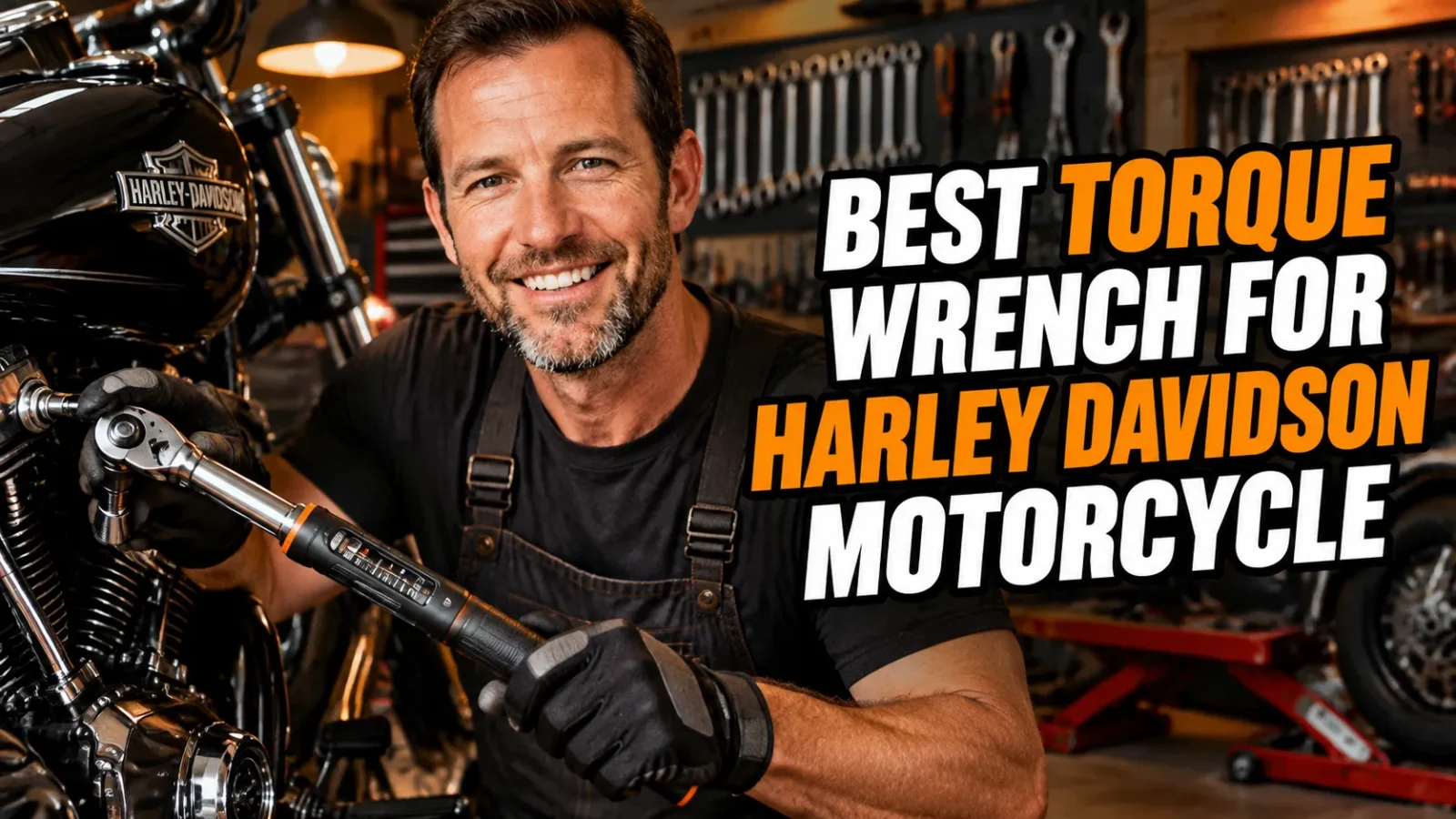
I’ve been wrenching on my own Harleys for the better part of two decades, and if there’s one lesson that keeps repeating itself, it’s this: nothing on a V-Twin forgives a guessed torque value. I’ve watched a friend strip the threads on an aluminum primary cover because he “felt” the ratchet was tight enough. I’ve also seen a rear axle nut work loose on a 500-mile trip because someone treated a torque spec as a suggestion.
A Harley is a strange mix of old-school engineering and modern precision. You’ve got chunky 1/2-inch fasteners holding your axles and compensator in place, and then right next to them, delicate little 1/4-inch bolts holding a derby cover that costs more than my first motorcycle. You genuinely need two torque wrenches to do this properly.
Over the years I’ve owned or borrowed pretty much every torque wrench that gets recommended in Harley forums, from Harbor Freight specials to a Snap-on that cost more than my first bike. Below are the ones I’d actually spend my own money on again.
- My overall pick for Harley work is the CDI Torque 2503MFRPH — a US-made 1/2-inch clicker covering 30-250 ft-lb, which hits nearly every big fastener on a Touring or Softail.
- You need two wrenches: a 1/2-inch ft-lb unit for axles and engine work, plus a 1/4-inch in-lb unit like the CDI 1501MRMH for covers and small bolts.
- Best value overall is the Tekton 24335 at under $60, and it’s accurate enough for everything short of head bolts.
- If you’re rebuilding a Twin Cam or Milwaukee-Eight, the Snap-on TechAngle ATECH3FR250 with torque angle is worth the pain.
- Always store a click-type wrench at its lowest setting — that one habit will keep it honest for years.
1. CDI Torque 2503MFRPH — Best Overall for Harley Big Fasteners
If I could only own one torque wrench for a Harley, this is it. The CDI 2503MFRPH is a 1/2-inch drive micrometer click-type wrench spanning 30 to 250 ft-lb, and that range covers almost everything that matters on a big twin.
Rear axle nuts, compensator bolts, pulley bolts, fork caps, engine mount bolts — all of it lives inside that window. CDI is owned by Snap-on Industrial, and this wrench is built in the USA with the same internal mechanism philosophy as the tool truck stuff, just without the truck markup.
I’ve had mine for six years and had it calibrated twice. Both times it came back within a couple of percent. The click is crisp and unmistakable, which sounds trivial until you’ve used a cheap wrench where you’re never quite sure if that was the click or your imagination.
At roughly $150 to $180, it’s not the cheapest option, but it’s the one I reach for first every single time. If you’re pairing it with a full motorcycle tool kit for Harley-Davidson, this is the anchor piece.
2. Precision Instruments PREC3FR250H — Best Split-Beam Clicker
Here’s a fun piece of trivia: Precision Instruments makes the split-beam torque wrenches that Snap-on sells under its own name. The PREC3FR250H is essentially the same tool minus the branding, and it costs a fraction of the Snap-on price.
It’s a 1/2-inch drive unit rated from 50 to 250 ft-lb with an accuracy spec of around ±4%. The split-beam design means there’s no coiled spring under tension, so you never have to dial it back to zero before storage. That’s genuinely nice when you’re tired and just want to put tools away.
The tradeoff is the narrow-ish low end. Fifty ft-lb is above spark plugs and drain plugs, so this is strictly a big-fastener tool. I keep mine for axle and suspension work and grab something else for the small stuff.
Expect to pay around $130 to $170. It’s the pick I recommend to riders who want tool-truck durability without tool-truck pricing.
3. Snap-on TechAngle ATECH3FR250 — Best Premium Electronic with Torque Angle
Yes, it’s expensive. Yes, I bought one anyway, and no, I don’t regret it. The TechAngle ATECH3FR250 is a 1/2-inch electronic torque wrench covering roughly 12.5 to 250 ft-lb, and it does something no mechanical clicker can do: it measures torque angle.
Why does that matter on a Harley? Because plenty of head bolt and connecting rod sequences in the factory service manual read something like “torque to 42 ft-lb, then rotate an additional 90 degrees.” Doing that with a breaker bar and a protractor is guesswork. The TechAngle counts the degrees for you and beeps when you hit the target.
Accuracy is excellent, the display is readable in direct sunlight, and the memory function stores your last reading — handy when you’re under the bike and can’t see the screen. It runs on AA batteries, which is a small mercy.
The catch is price: figure on $600 to $750. If you’re paying a shop to do your engine work anyway, skip it. If you’re rebuilding top ends in your own garage, it pays for itself in one job.
4. GearWrench 85066 — Best Micrometer-Style Mid-Range Pick
The GearWrench 85066 is the wrench I recommend to friends who want something better than a bargain-bin clicker but aren’t ready to spend CDI money. It’s a 1/2-inch drive micrometer torque wrench rated 30 to 250 ft-lb with a claimed accuracy of ±3%.
The knurled handle is comfortable even with oily gloves, and the adjustment collar locks positively so you’re not accidentally changing your setting mid-job. I’ve used one on a friend’s Road King for a full fork service and the readings matched my CDI closely enough that I stopped worrying about it.
It’s typically $80 to $110, which puts it in a sweet spot. The one knock is that the case is a bit flimsy compared to what you get from CDI, but that’s a storage problem, not an accuracy problem.
5. Tekton 24335 — Best Budget Pick That’s Still Accurate
I’ll be honest: I bought my Tekton 24335 expecting to be underwhelmed. I wasn’t. It’s a 1/2-inch drive wrench covering 10 to 150 ft-lb with a ±4% accuracy claim, and it costs under $60.
The low end is what makes it interesting. Ten ft-lb is low enough to handle spark plugs and oil drain plugs, which is where a lot of cheap 1/2-inch wrenches tap out. The dual-range scale is printed clearly on both sides, so you can read it from either direction.
Where it falls short is the top end. If you’re torquing a Touring rear axle to around 95 to 100 ft-lb, you’re fine. If you need a compensator bolt at 140 ft-lb, you’re near the ceiling and I’d rather have more headroom — Tekton’s own 24340 covers 25 to 250 ft-lb if you need that.
For a rider doing routine maintenance, this plus a small inch-pound wrench is a complete setup for under $100.
6. eTORK EC3250 — Best Value 30-250 ft-lb Clicker
The eTORK EC3250 is the wrench I keep in my travel toolbox, mostly because it’s good enough to trust and cheap enough that I won’t cry if it disappears from a hotel parking lot.
It’s a 1/2-inch drive click-type wrench rated 30 to 250 ft-lb, so it duplicates the range of the CDI and GearWrench options at roughly $60 to $75. The click is audible and the handle has a nice rubberized grip that doesn’t slip when your hands are covered in 20W-50.
The scale markings are a little harder to read than the CDI’s, and the included case is basic. But the mechanism has held up through three seasons of road trips without drifting noticeably.
If you’re torquing an axle in a campground because you had to swap a rear tire, this is the wrench you want in the bag. It pairs well with a motorcycle wheel roller for Harley if you’re doing the tire change yourself.
7. CDI Torque 1501MRMH — Best Inch-Pound Wrench for Small Fasteners
This is the wrench people forget to buy, and then they strip a primary cover bolt. The CDI 1501MRMH is a 1/4-inch drive click-type wrench covering 30 to 150 in-lb, which is exactly the range Harley uses for derby covers, primary covers, and a long list of other small fasteners.
On my own bikes, derby cover bolts spec around 84 to 108 in-lb. That’s about 7 to 9 ft-lb. There is no way to feel that accurately with a 1/2-inch ratchet — you will overtighten it, and if you’re lucky you’ll only crack the gasket instead of the threads.
It’s built to the same standard as the 2503MFRPH, made in the USA, and runs about $120 to $150. Yes, that’s a lot for a tiny wrench. Yes, it’s cheaper than helicoiling a primary case.
One practical note: you’ll want a set of motorcycle chock for Harley touring to hold the bike upright while you’re working down low on the primary side. It makes the whole job less of a balancing act.
8. Wera Click-Torque C 4 — Best Premium Mechanical Alternative
Wera’s Click-Torque C 4 is the wrench I’d buy if I wanted something a little more refined than the usual American tool-truck aesthetic. It’s a 1/2-inch drive unit rated 40 to 200 Nm, which works out to roughly 30 to 148 ft-lb.
The headline feature is the reversible ratchet head with a clearly marked scale and a very positive click. Wera’s tolerances are tight, and the tool feels precise in a way that’s hard to describe until you handle one. Accuracy is spec’d around ±4%.
The limitation is the top end. At roughly 148 ft-lb, it won’t cover a big compensator bolt or the higher axle specs on some Touring models. It’s a beautiful tool for the mid-range, but you’ll still want a 250 ft-lb wrench alongside it.
Pricing lands around $180 to $220. It’s a lovely thing to own — just know what you’re buying it for.
9. Brown Line Metalworks BLD0212 — Best Digital Option Under $150
Digital torque wrenches used to be a rich man’s game. The Brown Line Metalworks BLD0212 changed that. It’s a 1/2-inch drive digital wrench covering 25 to 250 ft-lb with an accuracy claim of ±2%.
It beeps and vibrates when you hit your target, and the LCD shows both your set value and your live reading. For a rider working alone in a garage, that feedback loop is genuinely useful — especially when you’re at an awkward angle and can’t see the scale on a mechanical wrench.
Battery life is good, and the tool switches between ft-lb, in-lb and Nm, which is handy if you’re mixing Harley factory specs with aftermarket parts that publish in metric. Price is typically $110 to $140.
The one thing I’d flag: electronics don’t love extreme cold, so if you’re doing winter work in an unheated garage, let it warm up before trusting the reading.
How I Actually Set Up My Harley Torque Toolkit
The Two-Wrench Rule
Every Harley owner doing their own maintenance needs two torque wrenches minimum. A 1/2-inch ft-lb wrench for axles, engine mounts, suspension and compensator work, and a 1/4-inch in-lb wrench for covers, fasteners and anything aluminum.
If you buy one wrench and try to cover both jobs, you’ll either be wildly inaccurate at the low end or you’ll break something. There’s no way around it.
Click vs. Split-Beam vs. Digital
Click-type wrenches are the standard, and they’re what I’d buy first. Split-beam wrenches like the Precision Instruments hold calibration longer and don’t need to be zeroed. Digital wrenches give you the best feedback and often torque angle, but they depend on batteries and electronics.
My honest recommendation: start with a good click-type in 1/2-inch, add an inch-pound clicker, and only go digital if you’re doing engine work.
Why the Bike Needs to Be Stable First
You can’t torque anything accurately if the bike is wobbling. I learned this the hard way trying to torque an axle nut on a bike that was only on a sidestand. The whole thing shifted, and my reading was garbage.
These days I always get the bike up on a proper motorcycle lift table for Harley-Davidson before I touch anything with a torque spec. It’s the single biggest upgrade to my garage workflow.
Calibration and Storage Habits
Wind click-type wrenches back to the lowest setting before storage. Don’t use them to break fasteners loose. Don’t drop them. Get them checked every year or two if you use them heavily, or after any accidental drop.
I also keep a Leatherman tool for motorcycle adventures in my saddlebag for roadside fixes, but I never use it for anything that has a published torque value. Multi-tools are for getting home, not for doing the job right.
My Final Take
If you’re buying one wrench today, get the CDI Torque 2503MFRPH. It covers the range that matters on a Harley, it’s made by the people who own Snap-on, and it’ll outlive the bike.
If budget is the constraint, the Tekton 24335 is genuinely good and I still use mine. Then add the CDI 1501MRMH as soon as you can afford it, because the inch-pound fasteners are where things go wrong fastest.
And if you’re doing engine work, stop reading listicles and buy the Snap-on TechAngle. Torque angle isn’t a luxury on a Harley head — it’s the difference between a job done once and a job done twice.
Frequently Asked Questions
What size torque wrench do I need for a Harley-Davidson?
Most Harley axle nuts, compensator bolts and pulley bolts fall between 60 and 150 ft-lb, so a 1/2-inch drive wrench covering 25 to 250 ft-lb handles the heavy work. You also want a small 1/4-inch drive inch-pound wrench for derby covers, primary covers and other low-torque fasteners that spec around 80 to 120 in-lb.
Are cheap torque wrenches accurate enough for a Harley?
A good budget clicker like the Tekton 24335 or eTORK EC3250 holds roughly plus or minus 4 percent, which is fine for axles, engine covers and suspension bolts. Where I would not cheap out is on head bolts and compensator nuts, so if you are doing engine work, spend the money on a CDI, Precision Instruments or Snap-on unit.
Do I need a torque angle wrench for my Harley?
Only if you are doing cylinder head work or rebuilding a Twin Cam or Milwaukee-Eight. Several Harley head bolt sequences call for a torque figure plus a 90-degree turn, and a digital torque angle wrench like the Snap-on TechAngle makes that repeatable instead of guesswork.
Should I store my torque wrench at zero?
Yes for micrometer click-type wrenches. I always wind mine back to the lowest setting before it goes in the drawer, because leaving a spring compressed for months throws off calibration. Split-beam wrenches like the Precision Instruments PREC3FR250H are the exception, since they do not need to be zeroed.

Related Articles

8 Best Ultrasonic Cleaners for Motorcycle Parts — Garage-Tested Picks
I tested eight ultrasonic cleaners on grimy motorcycle carbs and engine cases. Here are the best ultrasonic cleaners for motorcycle…
Jake Miller
11 min read

8 Best Motorcycle Jacks for Harley-Davidson: Bagger-Tested Picks That Fit
I've lifted everything from a Sportster to a Street Glide. These are the 8 best motorcycle jacks for Harley-Davidson, ranked…
Jake Miller
12 min read

8 Best Workbench Mats for Motorcycle Engine Work: My Tested Picks
I tested 8 workbench mats for motorcycle engine work, from oil absorbent pit mats to grease resistant anti fatigue rubber.…
Jake Miller
10 min read