
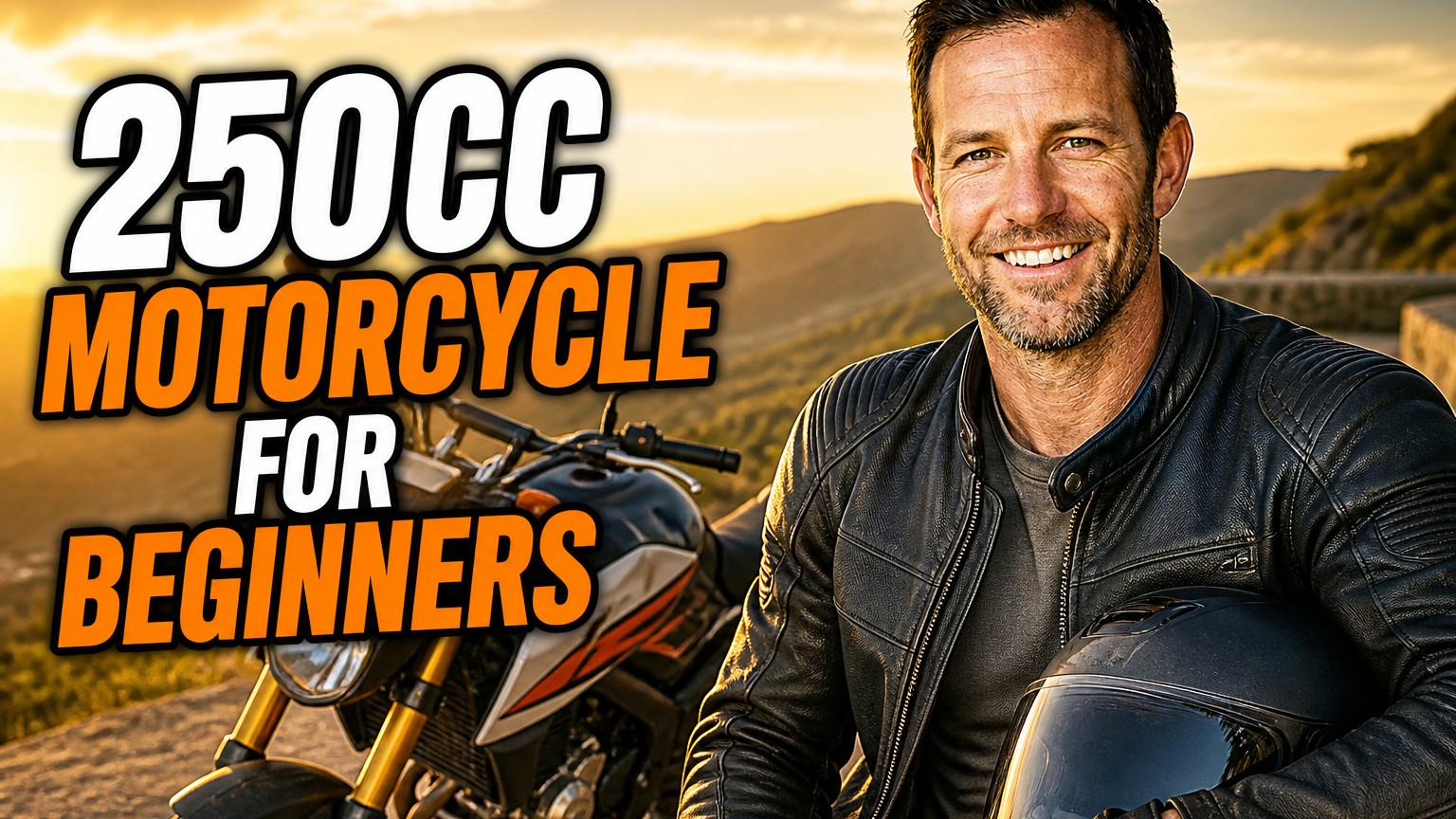
I still remember my first day on a 250. I’d been nervous about stalling, dropping it, and getting overwhelmed by speed. None of that happened, because the bike was light, predictable, and honest.
Since then I’ve ridden, borrowed, and spent time around most of the popular quarter-liter bikes. In this guide I share my picks for the best 250cc motorcycle for beginners, plus what I think matters most when you’re choosing your first ride.
Availability differs by country, so I’ve noted where a model is sold. Specs are approximate and vary by year and market, so check with your local dealer before buying.
- My top overall pick is the Kawasaki Ninja 250: smooth, forgiving, and fun to ride.
- For a low seat and a relaxed riding position, I’d go with the Honda Rebel 250.
- For budget and value in Asian markets, the Suzuki Gixxer SF 250 and Bajaj Dominar 250 are hard to beat.
- Seat height, weight, and ABS matter more than raw horsepower for a first bike.
Why a 250cc Bike Is Such a Smart First Motorcycle
In my experience, 250cc bikes sit in a sweet spot. They’re quick enough to merge and cruise, but not so powerful that a twitchy throttle hand gets you into trouble.
They’re also lighter, cheaper to insure, and kinder to your wallet when you inevitably tip one over in a parking lot. I’d rather you learn on a bike you’re not afraid to scratch.
What I Looked For When Ranking These Bikes
I judged each bike on five things. These are the same things I’d tell a friend to check before handing over cash.
- Seat height and weight: can you flat-foot it and push it around easily?
- Power delivery: smooth and predictable, with no sudden surges.
- Braking and safety: ABS availability and brake feel.
- Running costs: fuel economy, maintenance, and parts.
- Fun factor: because a bike you love is a bike you’ll practice on.
1. Kawasaki Ninja 250 — Best Overall for New Riders
If someone asked me for one bike to recommend without hesitation, it would be the Kawasaki Ninja 250. It’s the benchmark that other 250s get measured against.
The 249cc parallel-twin makes roughly 37 hp and revs happily. Power builds in a linear, friendly way, and the slip-assist clutch keeps lever effort light in traffic.
What I Like
The seat sits at around 785 mm and the bike weighs about 166 kg wet. That’s manageable for most riders, and the sporty fairing doesn’t force a painful tuck.
On the highway, the Ninja 250 feels stable and relaxed. I’ve held 70 mph comfortably, which is more than I can say for many singles.
What to Watch
You need to rev it to get real pace, which can feel busy if you like low-end grunt. In some markets, such as the US, it’s now sold only used, so check what’s available near you.
2. Yamaha YZF-R25 — Best for Sporty Looks and Handling
The Yamaha YZF-R25 looks like a mini R1, and it rides with real polish. Its 249cc twin makes about 35 hp, and the chassis is tight and confidence-inspiring.
I found the R25 especially good when I started leaning into corners. The front end gives lots of feedback, which helps you build skill without feeling lost.
Strengths
- Seat height around 780 mm, with a slim tank that makes reaching the ground easy.
- Weight of roughly 166 to 170 kg, depending on the market and spec.
- Optional or standard ABS in most regions, and sharp, progressive brakes.
Drawbacks
The riding position leans forward more than a naked bike, so your wrists may complain on long rides. It’s still gentle compared with a full supersport.
3. Honda Rebel 250 — Best Low-Seat, Relaxed Cruiser
If sporty bikes make you nervous, the Honda Rebel 250 is the bike I’d steer you toward. Its seat height is only about 690 mm, among the lowest of any bike on this list.
The 249cc air-cooled single produces roughly 26 hp. It’s friendly, thumpy, and easy to modulate at low speeds.
Why It Works for Beginners
I’ve watched nervous new riders sit on a Rebel and instantly relax. Both feet go flat on the ground, and the upright position feels natural.
It’s also cheap to maintain and sold with a classic, simple design that doesn’t date. Availability varies, and some markets, including the US, get the larger Rebel 300 as the closest equivalent.
Trade-Offs
Don’t expect sporty acceleration. Highway work is fine, but you’ll feel the single working hard above 70 mph.
4. KTM 250 Duke — Best for Punchy, Playful Performance
The KTM 250 Duke is the bike I’d pick if you want something with attitude. Its 248.8cc single produces around 31 hp, which is strong for the class.
It feels eager and lively, and the upright naked riding position gives you a great view of traffic. I enjoyed how easy it was to flick through tight city streets.
Things to Know
The seat is taller at roughly 830 mm, so shorter riders should sit on one first. The throttle is also a bit snappier than on the Ninja 250 or Rebel 250.
Because of that, I’d call it best for beginners who are confident and a little athletic. It’s currently sold mainly in India and select markets.
5. Suzuki Gixxer SF 250 — Best Value Fully Faired Bike
The Suzuki Gixxer SF 250 is one of the best-value sporty bikes I’ve come across in Asian markets. Its 249cc oil-cooled single makes about 26.5 PS and 22 Nm of torque.
What stands out is how smooth it is. Suzuki’s engine is refined, relaxed, and surprisingly happy to cruise at higher speeds.
Highlights
- Seat height near 800 mm and weight of about 161 kg.
- Full fairing with a comfortable, semi-sporty stance.
- Dual-channel ABS on current models, and strong fuel economy for the class.
Downsides
It lacks the outright pace of the twin-cylinder Japanese bikes. Still, for a first motorcycle I’d call that a feature rather than a flaw.
6. Bajaj Dominar 250 — Best for Touring and Daily Commuting
The Bajaj Dominar 250 is built for riders who want to cover distance. Its 248.8cc liquid-cooled single makes roughly 27 PS and 23.5 Nm, with a steady, torquey midrange.
I like it because it’s comfortable and unfussy. The upright seating, wide bars, and decent wind protection make it surprisingly capable on long days.
Is It Beginner-Friendly?
Mostly, yes. At about 180 kg it’s heavier than the others, so parking-lot maneuvers take some care.
The seat is around 800 mm, and dual-channel ABS comes standard. I’d put it on my list for commuters who want one bike to do everything.
7. Yamaha MT-25 — Best Naked Bike for City Riding
The Yamaha MT-25 shares its 249cc twin with the R25, but the naked styling and upright bars make it feel more casual. I think it’s the better choice if you mainly ride in town.
Power is about 35 hp, and the bike weighs around 166 kg. Seat height is roughly 780 mm, so most riders can plant their feet comfortably.
Why I’d Recommend It
Without a fairing, the MT-25 feels light and agile. It lets you place the bike precisely in traffic, and your wrists carry no load.
The downside is wind blast at higher speeds. On a long motorway stint, I’d rather have the R25’s fairing.
How to Choose the Right 250 for You
Specs only tell part of the story. The best bike is the one that fits your body, your commute, and your confidence level.
Start With Seat Height and Ergonomics
Sit on every bike you’re considering. If you can’t get at least the balls of both feet down, keep looking, because that confidence matters at stoplights and in slow-speed turns.
Prioritize ABS
I’d always choose a bike with anti-lock brakes if the option exists. Emergency stops are scary when you’re new, and ABS gives you a real safety net.
Think About Used vs New
A used 250 can be a brilliant deal because these bikes tend to be well cared for. Just check service records, chain condition, tire age, and signs of a previous drop.
Keeping Your First Bike Healthy
The cheapest way to make any of these bikes last is regular maintenance. Oil is the big one, and I never skip changes.
If you’re not sure what to buy, my go-to starting point is this guide to the best motor oil for 4 stroke motorcycle engines. It covers viscosity and the JASO ratings you should look for.
You can also read about the top engine oil for 4 stroke motorcycle options. If you ride in Asia, there’s a useful rundown of the best engine oil for 4 stroke motorcycle in india as well.
Still comparing? Here’s another look at what is the best engine oil for 4 stroke motorcycle riders can trust. And for a broader overview, check the best engine oil for motorcycle roundup.
My Basic Maintenance Checklist
- Check tire pressure every week.
- Lube and adjust the chain every 500 to 1,000 km.
- Change the oil and filter on schedule.
- Inspect brake pads and fluid regularly.
Gear Up Before You Ride
Whichever bike you pick, don’t skimp on protection. I never ride without a certified helmet, armored jacket, gloves, sturdy pants, and over-the-ankle boots.
Spend a bit of your budget on a rider training course too. It’s the best money I ever spent as a new rider, and it made every bike feel easier.
My Final Thoughts
For most new riders, I’d point to the Kawasaki Ninja 250 first. It’s friendly, smooth, and endlessly fun, with enough room to grow into.
If you’re shorter or want a relaxed stance, the Honda Rebel 250 is a gem. If value matters most, the Suzuki Gixxer SF 250 and Bajaj Dominar 250 are excellent choices.
Whatever you choose, sit on it, ride it if you can, and trust your gut. The right first bike should make you want to ride again tomorrow.
Frequently Asked Questions
Is a 250cc motorcycle good for beginners?
Yes. A 250cc bike has enough power to keep up with traffic but is light and forgiving enough to learn on. Most are cheap to insure, easy to maintain, and don’t punish small throttle or clutch mistakes.
Can a 250cc motorcycle go on the highway?
Yes, most 250s cruise at 65 to 75 mph comfortably. Twin-cylinder models like the Kawasaki Ninja 250 and Yamaha YZF-R25 feel more relaxed at highway speed than the single-cylinder bikes.
Which 250cc motorcycle is the most comfortable for beginners?
For upright ergonomics and a low seat, I’d choose the Honda Rebel 250 or the Yamaha MT-25. The Rebel is lower and more relaxed, while the MT-25 is sportier but still easy to sit on.
How often should I change the oil on a 250cc motorcycle?
Follow your owner’s manual, but most 250cc four-strokes need fresh oil roughly every 3,000 to 6,000 km (about 2,000 to 4,000 miles). Use a quality motorcycle-specific oil with the right JASO MA rating.

Related Articles
7 Best Batteries for Motorcycles I’ve Tested and Trust in 2026
I've tested dozens of motorcycle batteries to find the best performers. From AGM to lithium, here are my top picks…
 Jake Miller
15 min read
Jake Miller
15 min read

The Perfect Battery for Your Harley Davidson Softail: A Rider’s Complete Guide
Discover the perfect battery for your Harley Davidson Softail. I've tested multiple options and share real-world performance data, maintenance tips,…
Jake Miller
14 min read

The Best Battery for Your Harley Davidson: My Complete Guide After Years of Testing
Discover which battery truly performs best for Harley Davidson motorcycles. Real rider experience with AGM, lithium, and OEM options to…
Jake Miller
12 min read