
Are Motorcycle Throttle Cables Interchangeable? What I Learned the Hard Way
 Jake Miller
10 min read
Jake Miller
10 min read
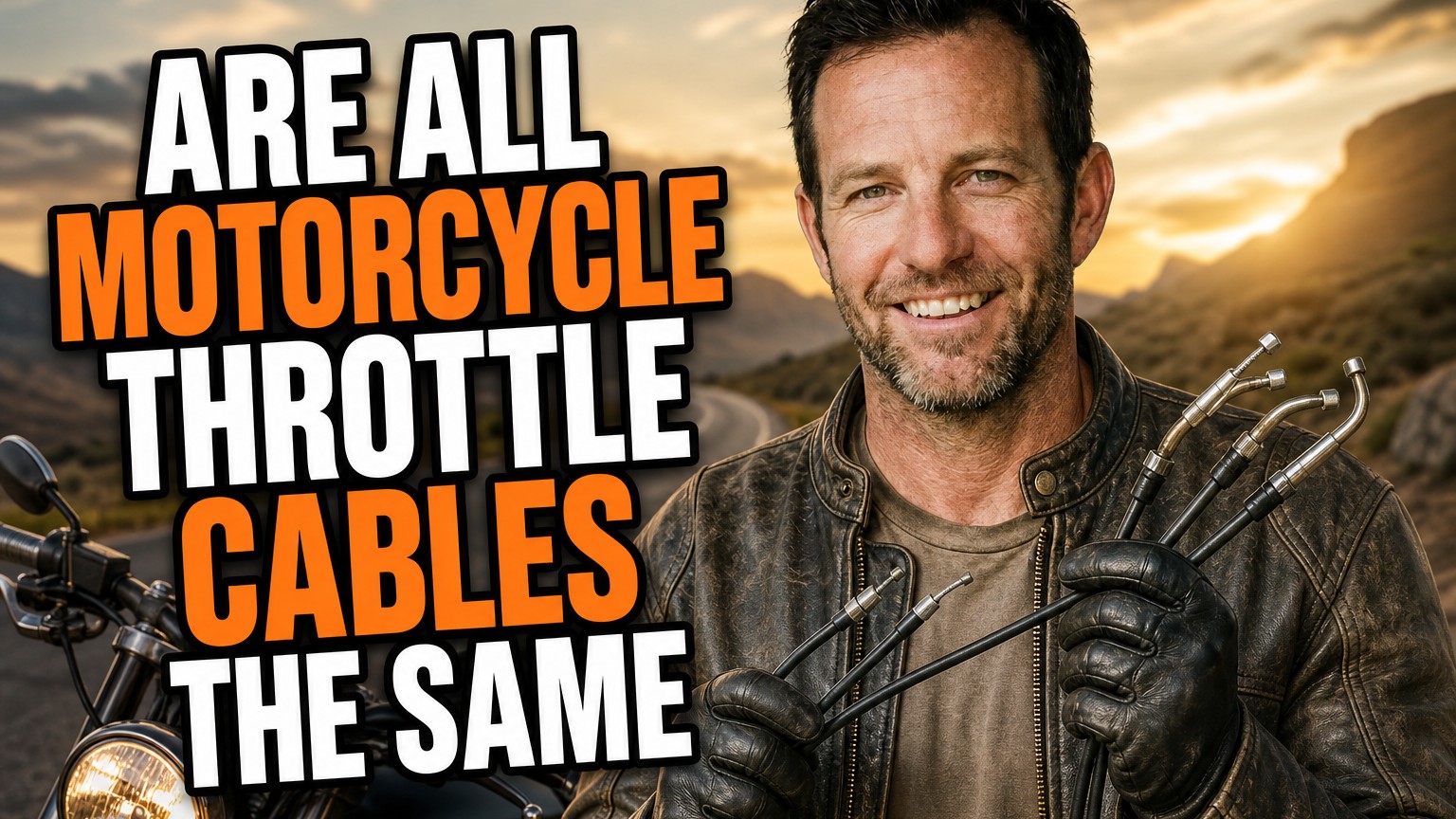
The first time I replaced a throttle cable, I thought it would be a five-minute job. I grabbed a cheap cable that looked identical to the old one, and I was sure it would work. It didn’t, and I ended up with a throttle that hung open for a heart-stopping half second at a stop sign.
That moment taught me that throttle cables look far more alike than they actually are. In this guide, I’ll share what I’ve learned about how they differ and how to pick the right one. I’ll also cover how to keep it working smoothly so you never get that surprise.
- No, throttle cables are not universal. Length, end fittings, cable count, and routing vary a lot between bikes.
- Match your OEM part number or measure carefully before buying, especially if you changed your handlebars.
- A wrong or worn cable can cause a sticky or hanging throttle, which is a real safety risk.
- Regular lubrication, correct free play, and smooth routing make a cable last for years.
Why Throttle Cables All Look the Same (But Aren’t)
Pull one off the shelf and you’ll see a braided steel wire inside a flexible sheath, with a fitting on each end. That basic design is shared by almost every cable-operated throttle on the road. So it’s easy to assume one fits all.
The trouble is in the details. A few millimeters of difference in length, or a slightly different barrel end, is enough to make a cable unusable. Close doesn’t count with a part that controls your engine.
In my experience, most buying mistakes come from trusting the look of the cable instead of its specs. I’ve learned to treat it like a tire: it has to be the right fit, not just a similar one.
The Key Differences Between Throttle Cables
Let me walk through the things that actually separate one cable from another. Once you know these, shopping gets a lot easier.
Cable Length
Length is the biggest factor. A cable for a compact commuter is much shorter than one for a big touring bike with a wide fairing and tall bars. Too short and it pulls tight at full lock, which can rev the engine when you turn the bars.
Too long causes its own problems. Excess slack can loop, kink, or snag on other parts, and it can make the throttle feel mushy. I always test full lock to full lock after any install.
End Fittings and Nipples
Each end of the cable has a fitting that connects either to the throttle tube or to the carburetor or throttle body. These come in different shapes and sizes, such as barrel, ball, and cylindrical nipples.
If the end doesn’t seat properly in the throttle pulley or twist grip, it can slip out under tension. That’s the sort of failure you never want to discover at speed.
Single Cable vs. Dual Cable Systems
Some bikes use a single pull cable with a return spring at the throttle body. Others use two cables: one that pulls the throttle open and one that pulls it closed. This is often called a push-pull setup.
The two are not interchangeable. A push-pull system is designed to close the throttle positively even if a spring weakens, which is why many riders like it. If your bike came with two cables, replace them as a matched pair.
Adjusters and Splitters
Many cables include barrel adjusters at the handlebar end, the carb end, or both. Some also have a junction block that splits one cable into several for multi-carb or multi-throttle-body bikes.
If your replacement doesn’t have the same adjuster layout, you may not be able to set free play properly. I’ve seen riders cut corners here and live with a twitchy throttle for months.
Sheath Material and Liner
The outer sheath and the inner liner affect how smoothly the cable slides. Quality cables often use a low-friction liner that resists wear and moisture. Cheap ones can feel gritty out of the box.
Stainless inner wires resist corrosion better than basic steel. For a bike that lives outdoors or gets ridden in the rain, I think that’s worth paying a bit more for.
Carbureted, Fuel-Injected, and Ride-by-Wire Bikes
The type of fuel system matters too. Carbureted bikes use cables that open a slide or butterfly in each carb. Fuel-injected bikes may use cables that open throttle bodies in a similar way.
Ride-by-wire bikes are different. They use a sensor at the grip and a motor at the throttle body, so there may be no traditional cable at all. Some models still use a short cable just to feed a sensor.
That’s why I always check my service manual before ordering. Assuming your bike works like another one is how people end up with the wrong part.
Do Handlebar Changes Affect Your Cable?
Absolutely. I learned this when I swapped my stock bars for a taller, wider set. The original cable was suddenly too short, and I could feel it pulling at full lock.
If you change your bars, risers, or control layout, you’ll likely need a longer cable. Many aftermarket brands sell cables in standard extended lengths for exactly this reason.
Measuring the Right Length
Here’s my approach when I can’t find an exact part number. I route a piece of string along the same path as the cable, with the bars at full lock in both directions. Then I measure the string and compare it to the cable specs.
I add no more than a small amount of slack. It’s better to have a cable that’s a hair long than one that’s even a hair short, but not by much.
OEM vs. Aftermarket Throttle Cables
I get asked all the time whether aftermarket cables are as good as factory ones. My honest answer is that it depends on the brand. Reputable aftermarket makers produce excellent cables, sometimes better than stock.
Cheap no-name cables are a gamble. I’ve had one with a rough liner that stuck in cold weather, and another whose end fitting didn’t seat well. Neither was worth the few dollars I saved.
When I Choose OEM
If my bike is stock and I want a guaranteed fit, I go OEM. The part number removes all guesswork, and the routing and adjusters match exactly. For a daily rider, that peace of mind matters.
When I Go Aftermarket
I choose aftermarket when I’ve modified the bike, such as with new bars or a different grip setup. I also do it when I want a stainless inner wire or a smoother liner. I stick with brands that publish exact lengths and fitment lists.
Signs Your Throttle Cable Needs Attention
A throttle cable rarely fails without warning. If you pay attention, it gives you hints. Here are the ones I watch for:
- A sticky or slow-returning throttle after you let go of the grip
- Rough or notchy feel as you roll on and off
- Excess free play that adjustment can’t fix
- Visible fraying or kinks in the sheath
- Idle that changes when you turn the handlebars
If any of these show up, I stop riding until I’ve sorted it out. A throttle that doesn’t close is not something to mess around with.
How I Install and Set Up a New Cable
Installing a cable isn’t hard, but it rewards patience. Here’s the process I follow every time.
Step 1: Photograph the Routing
Before removing anything, I take photos of how the old cable runs. It should pass through the same guides and avoid sharp bends. Routing mistakes are the number one reason new cables bind.
Step 2: Lubricate Before Installing
I give the inner wire a light coat of cable lubricant. A good lube cuts friction and keeps moisture out. Skip heavy grease, which can gum up in cold weather.
Step 3: Set Free Play
I set the free play to my manual’s spec, usually a few millimeters at the grip flange. Too little keeps the throttle slightly open, and too much feels laggy. Small tweaks at the adjuster make a big difference.
Step 4: Test Full Lock and Return
With the engine off, I turn the bars fully left and right and watch for any movement at the throttle. Then I snap the throttle open and let go to confirm it snaps back every time. I repeat this several times before I even start the bike.
Keeping Your Cable Healthy for the Long Haul
The best throttle cable is the one that never gives you trouble, and a little routine care goes a long way. I check mine every time I do an oil change, which makes it easy to remember.
Speaking of oil changes, I’m picky about what goes in my engine because I want everything running smoothly. If you’re shopping, I found this guide to the best motor oil for 4 stroke motorcycle engines helpful when I was comparing options. It’s a good reminder that small maintenance habits add up.
If you want to dig deeper into viscosity and ratings, this breakdown of the top engine oil for 4 stroke motorcycle choices is worth a read. And for riders in warm, dusty climates, there’s a useful take on the best engine oil for 4 stroke motorcycle in india that applies to hot-weather riding generally.
I also like having more than one reference when I’m deciding. This explainer on what is the best engine oil for 4 stroke motorcycle engines helped me understand the basics. For a quick overview, you can also look at the best engine oil for motorcycle roundup.
Lubrication Habits That Work
Every few months, I disconnect the cable at one end and run a few drops of lube down the sheath. I let it work through, wipe off any excess, and reconnect. It takes about ten minutes.
I also check the sheath for cracks, since water getting in is what kills cables fastest. If I see damage, I replace the cable instead of hoping it holds.
Common Mistakes I See Riders Make
I’ve made a few of these myself, so I say this with sympathy. Learning from them is much cheaper than learning the hard way.
- Buying by looks alone instead of checking length and fittings
- Ignoring free play after installing a new cable
- Routing the cable too tightly around the steering head
- Skipping lubrication on a brand-new cable
- Reusing a stretched or kinked cable to save a few dollars
Avoid these and you’ll dodge almost every throttle problem I’ve run into over the years.
My Final Take
So, can you grab any cable and expect it to work? No, and I wouldn’t try. Throttle cables vary in length, end fittings, cable count, adjusters, and materials, and each of those details matters.
My advice is simple. Match your OEM part number, measure carefully if you’ve modified your bike, and buy from a brand you trust. Then lubricate, adjust, and inspect regularly.
A good throttle cable should be something you never think about. Get the right one, install it carefully, and you can focus on the road instead of the twist grip.
Frequently Asked Questions
Can I use a throttle cable from a different motorcycle?
Only if the length, end fittings, cable count, and routing all match your bike. Even two models from the same brand can use different cables, so always match the part number or measure carefully before you buy.
Can I use a longer throttle cable for taller handlebars?
Yes, but you need the correct longer cable with the right end fittings, not just any cable that happens to reach. Too much slack can cause lag or snagging, so confirm the exact length your new bar setup needs.
How often should I replace my throttle cable?
There is no fixed interval. I inspect mine at every oil change and replace it if it feels sticky, frays, or shows free play that adjustment cannot fix. Many cables last years with regular lubrication.
Are fuel-injected bikes still using throttle cables?
Many are. Some bikes use a cable that opens throttle bodies directly, while newer ride-by-wire models use a sensor and electronic control instead. Check your service manual to see which system your bike uses.

Related Articles
7 Best Batteries for Motorcycles I’ve Tested and Trust in 2026
I've tested dozens of motorcycle batteries to find the best performers. From AGM to lithium, here are my top picks…
Jake Miller
15 min read

The Perfect Battery for Your Harley Davidson Softail: A Rider’s Complete Guide
Discover the perfect battery for your Harley Davidson Softail. I've tested multiple options and share real-world performance data, maintenance tips,…
Jake Miller
14 min read

The Best Battery for Your Harley Davidson: My Complete Guide After Years of Testing
Discover which battery truly performs best for Harley Davidson motorcycles. Real rider experience with AGM, lithium, and OEM options to…
Jake Miller
12 min read