
8 Best Motorcycles for Riding Around the World: My Real-World Picks
 Jake Miller
9 min read
Jake Miller
9 min read
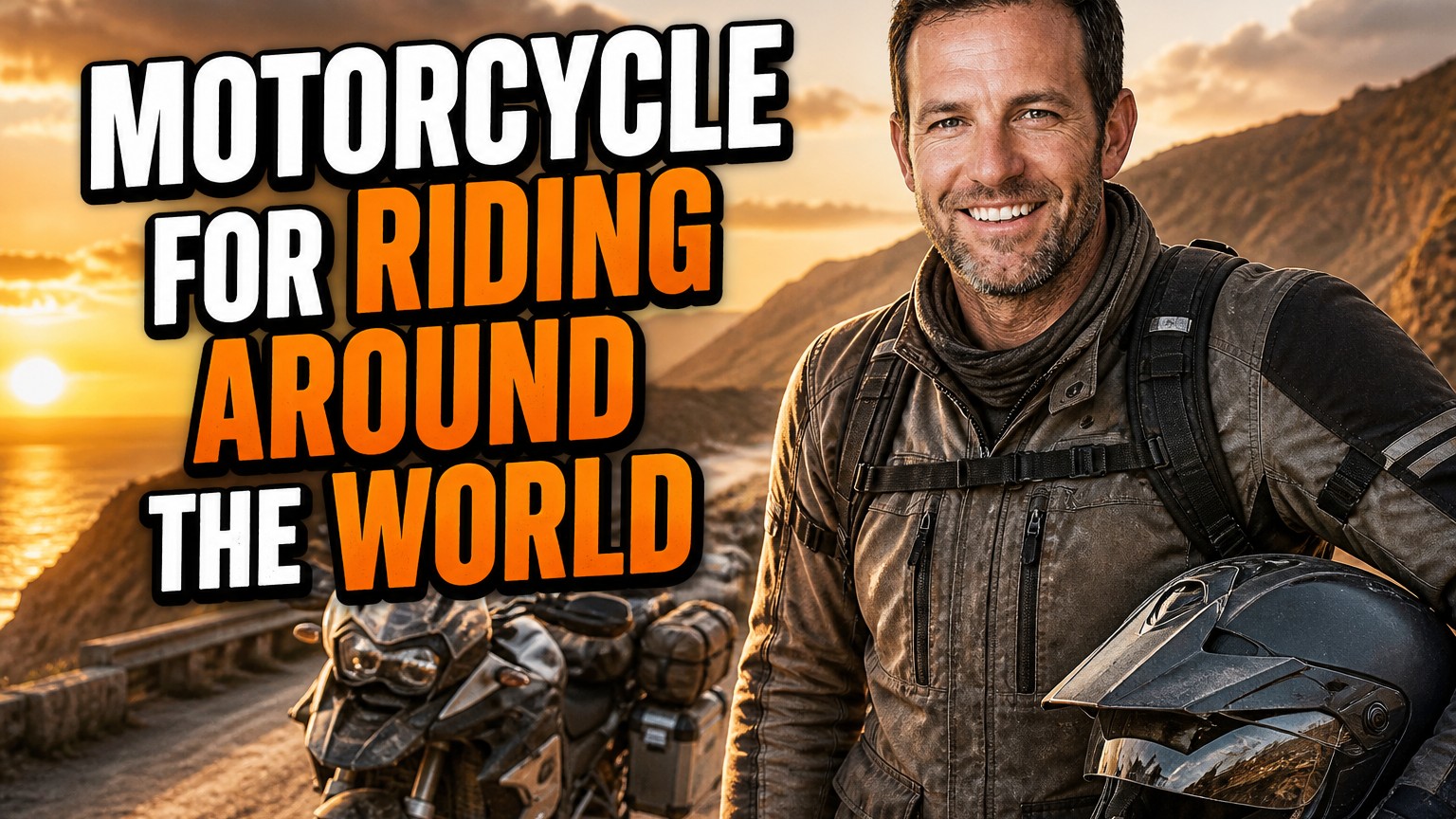
I’ve spent years chasing horizons on two wheels, and the question I get asked most is simple: which bike should I take? Choosing the best motorcycle for riding around the world is part science and part gut feeling. It’s also the decision that shapes your whole trip.
I’ve ridden, borrowed, broken and rebuilt a lot of machines on long journeys. In this guide I’ll share eight bikes I’d trust to cross continents, with real specs, honest downsides, and who each one suits best.
Whether you’re dreaming of the Pan-American Highway, the Silk Road, or a lap of Africa, there’s a bike here for you.
- The Yamaha Ténéré 700 is my best all-rounder for mixed terrain and global parts support.
- The Suzuki V-Strom 650 XT and Kawasaki KLR650 are the best choices for a tight budget and simple repairs.
- The BMW R 1300 GS Adventure and Honda Africa Twin Adventure Sports are the comfort kings for long days and two-up travel.
- Lighter bikes like the Royal Enfield Himalayan 450 make remote riding far less stressful.
What I Look for in a Round-the-World Motorcycle
Before the list, here’s the checklist I use. A world-tour bike isn’t the fastest or the flashiest. It’s the one that keeps running when you’re 500 km from the nearest dealer.
Reliability and Simplicity
I’d always take a proven engine over a cutting-edge one. Fewer electronics mean fewer things that can fail in a dusty border town. Mechanical simplicity is a form of insurance.
Weight and Seat Height
You will drop your bike, probably in mud, sand or a gas station forecourt. The lighter it is, the easier the recovery. If you’re shorter, my guide to the best all around motorcycle for short people covers lower-seat options that still handle a long trip.
Range, Comfort and Parts Availability
A tank that delivers 300 km or more makes remote stretches stress-free. Comfort matters too, because you’ll sit on this seat for months. Finally, think about whether a mechanic in Mongolia or Bolivia can source parts for your model.
1. Yamaha Ténéré 700 — Best Overall for Mixed Terrain
If someone made me pick one bike for a round-the-world ride, the Yamaha Ténéré 700 would be near the top. Its 689cc CP2 parallel twin makes about 72 hp. That’s enough to cruise comfortably on highways without being a handful off-road.
The Ténéré 700 weighs roughly 205 kg wet and has a 16-litre tank. The seat sits around 875 mm, which is tall but manageable with a good lowering link. Prices usually land between $10,500 and $11,500 in the US.
I love how it feels on a rutted track. The long-travel suspension and slim chassis give you confidence. The same engine is used in other Yamaha models, so mechanics in many countries already know it.
Downside: the stock seat is hard on long days, and the tank range is modest. I’d budget for an aftermarket seat and a rally-style fuel upgrade.
2. BMW R 1300 GS Adventure — Best for Maximum Comfort
The BMW R 1300 GS Adventure is the luxury liner of this list. Its 1,300cc boxer twin produces around 145 hp and 149 Nm of torque. That makes loaded mountain passes feel effortless.
The R 1300 GS Adventure has a 30-litre tank, a shaft drive that needs almost no chain maintenance, and electronically adjustable suspension. Expect to pay in the range of $23,000 to $28,000, depending on options.
On my longest paved stretches, nothing beats the GS Adventure’s wind protection and range. It’s also a great platform if you’re planning to carry a passenger. If that’s your plan, take a look at my picks for the best adventure motorcycle for 2up riding.
Downside: it’s heavy and complex. A dropped R 1300 GS Adventure in sand is a two-person job, and electronics are harder to fix remotely.
3. Honda Africa Twin Adventure Sports — Best for Reliability and Long Days
The Honda Africa Twin Adventure Sports feels like a Honda in the best sense: calm, solid, and built to last. Its 1,084cc parallel twin delivers about 100 hp with very friendly power delivery.
It carries a large 24.8-litre tank, which gives excellent range. A dual-clutch transmission (DCT) option is available, and I’ve found it surprisingly capable in traffic and on gravel. Pricing generally runs about $16,000 to $18,000.
The Africa Twin Adventure Sports is happy cruising all day at 120 km/h with luggage. It’s also more off-road ready than most big adventure bikes. I’d pick it for long continental routes where I expect plenty of tarmac and some rough sections.
Downside: it’s tall and heavy, at roughly 240 kg wet. Shorter riders may struggle at stops.
4. Suzuki V-Strom 650 XT — Best Value Workhorse
The Suzuki V-Strom 650 XT is the bike I recommend most to first-time world travelers. Its 645cc V-twin makes about 70 hp and is famously durable. Plenty of owners have clocked well over 100,000 km on this engine.
The V-Strom 650 XT has a 20-litre tank, spoked wheels, and a seat height of about 82 cm. It’s relatively light and comfortable, and costs roughly $9,500 to $10,500 new. Used examples are even cheaper.
On my own tours, the V-Strom just keeps going. Its fuel economy often tops 4.5 L/100 km, so range is excellent for a bike this size. Parts and service are easy to find in much of the world.
Downside: it’s more road-biased. Deep sand and tough technical trails aren’t its strength.
5. Royal Enfield Himalayan 450 — Best Lightweight Adventure Bike
The Royal Enfield Himalayan 450 is a big step up from the old Himalayan. Its liquid-cooled 452cc single makes roughly 40 hp and 40 Nm. It’s not fast, but it’s light, friendly, and surprisingly capable.
It has a 17-litre tank, a seat height of around 825 mm (lowerable with accessories), and a kerb weight near 196 kg. In many markets it costs about $6,000 or less, which leaves more budget for the actual trip.
If you want a mid-size option, check my guide to the best 300cc motorcycle for 2 up riding. It’s useful if you’re weighing smaller bikes for a couple’s tour.
Downside: it’s a newer design, so long-term reliability data is still building. Highway speeds above 110 km/h feel busy.
6. KTM 890 Adventure — Best for Spirited Riders
The KTM 890 Adventure is for riders who want a little excitement along the way. Its 889cc parallel twin delivers about 105 hp in a relatively light chassis. It feels sharp and responsive on twisty roads.
The 890 Adventure has a 20-litre tank, WP XPLOR suspension, and a rider-aid package that includes ride modes and cornering ABS. Prices are typically in the $13,000 to $14,500 range.
I’d pick it for a world trip focused on mountain roads and mixed terrain, where handling matters. It’s also lighter than most big-bore rivals, which helps when the tarmac ends.
Downside: KTM service networks are thinner in some regions, and the electronics add complexity. I’d carry spare levers and a basic toolkit.
7. Kawasaki KLR650 — Best Budget Overlander
The Kawasaki KLR650 has been a world-touring legend for decades. The latest version has fuel injection, a 652cc single, and a 23-litre tank. Pricing is usually around $7,000 to $8,000 new.
It’s not light (about 210 kg wet), but it’s simple, tough and easy to fix with basic tools. Aftermarket support is huge, from racks to bash plates to bigger tanks.
Maintenance matters on a bike like this. I always change oil often on long trips, and my breakdowns of the best motor oil for 4 stroke motorcycle and the top engine oil for 4 stroke motorcycle will help you choose wisely before you leave.
Downside: it’s slow by modern standards and vibrates at highway speeds. But for the price, it’s tough to beat.
8. Triumph Tiger 900 Rally Pro — Best Premium Mid-Weight Adventure Bike
The Triumph Tiger 900 Rally Pro blends refinement and real off-road capability. Its 888cc triple delivers about 106 hp with a lovely, smooth character. It’s one of the nicest engines to live with for months on the road.
The Rally Pro has a 20-litre tank, long-travel Showa suspension, and a rider-focused cockpit with a TFT display. It generally costs between $15,500 and $17,000.
I’d choose it for riders who want a premium feel without the bulk of a 1300cc machine. It handles beautifully on mixed roads and has an upright, comfortable stance for standing on the pegs.
Downside: it’s pricey, and the triple engine is more complex than a single or twin. Make sure you have a plan for servicing it overseas.
How I Choose Between These Bikes
If You’re on a Tight Budget
I’d go with the Kawasaki KLR650, the Suzuki V-Strom 650 XT, or the Royal Enfield Himalayan 450. They leave you money for fuel, visas, and the unexpected. A cheaper bike means a longer trip.
If You Want Maximum Capability Off-Road
The Yamaha Ténéré 700 is my pick, with the KTM 890 Adventure close behind. Both are lighter and more nimble than the big GS-style machines.
If You Plan to Ride Two-Up
The BMW R 1300 GS Adventure and Honda Africa Twin Adventure Sports offer the power, range and comfort a passenger will appreciate. They also cope better with heavy luggage.
Essential Prep Before You Leave
Luggage and Protection
Soft panniers are lighter and safer in a fall than hard cases. Add crash bars and a bash plate for protection. A good tank bag also helps with navigation and daily essentials.
Maintenance and Spares
Do a full service before you go, and carry spare levers, a clutch cable, tubes, and a puncture kit. Learn to change a tire yourself. That single skill has saved me more times than I can count.
Paperwork and Insurance
Check carnet requirements, border insurance and visa timelines well ahead. A bike is only as useful as your ability to cross the next border.
My Final Thoughts
There’s no perfect bike, only the right bike for your route, budget and riding style. For most riders, I’d start with the Yamaha Ténéré 700 or the Suzuki V-Strom 650 XT. They balance capability, cost and global support better than almost anything else.
If comfort is your priority, the BMW R 1300 GS Adventure or Honda Africa Twin Adventure Sports are superb. And if you want the cheapest ticket to adventure, the KLR650 and Himalayan 450 will get you there.
Whatever you choose, remember that the best bike is the one that gets you out the door. Pick one, prepare well, and go ride.
Frequently Asked Questions
What is the best motorcycle for riding around the world?
There is no single perfect bike, but the Yamaha Ténéré 700, Suzuki V-Strom 650 XT and BMW R 1300 GS Adventure are among the most proven choices. Pick based on your budget, your height, how much dirt you expect, and how easy parts and repairs will be along your route.
Is a bigger engine better for a round-the-world trip?
Not necessarily. Bikes between 450cc and 800cc are lighter, cheaper to run and easier to pick up when you drop them. Larger bikes like the Africa Twin or R 1300 GS Adventure add comfort and power, but they are heavier and more expensive to repair.
How much does it cost to prepare a motorcycle for a world trip?
Budget for the bike plus roughly $2,000 to $5,000 in extras. That covers luggage, crash protection, a bigger screen or seat, spare parts, tires, and a full service before departure. Costs vary a lot depending on the bike and how remote your route is.
Should I choose a single, twin or triple for a long-distance trip?
Singles like the KLR650 and Himalayan 450 are simple and easy to fix. Parallel twins such as the Ténéré 700 balance power and reliability. Triples and boxers offer smoother power and more comfort, but they usually need more specialized service.

Related Articles
7 Best Batteries for Motorcycles I’ve Tested and Trust in 2026
I've tested dozens of motorcycle batteries to find the best performers. From AGM to lithium, here are my top picks…
Jake Miller
15 min read

The Perfect Battery for Your Harley Davidson Softail: A Rider’s Complete Guide
Discover the perfect battery for your Harley Davidson Softail. I've tested multiple options and share real-world performance data, maintenance tips,…
Jake Miller
14 min read

The Best Battery for Your Harley Davidson: My Complete Guide After Years of Testing
Discover which battery truly performs best for Harley Davidson motorcycles. Real rider experience with AGM, lithium, and OEM options to…
Jake Miller
12 min read