
Throttle Sticking on a Carburetor? Here’s How I Diagnose and Fix It for Good
 Jake Miller
9 min read
Jake Miller
9 min read
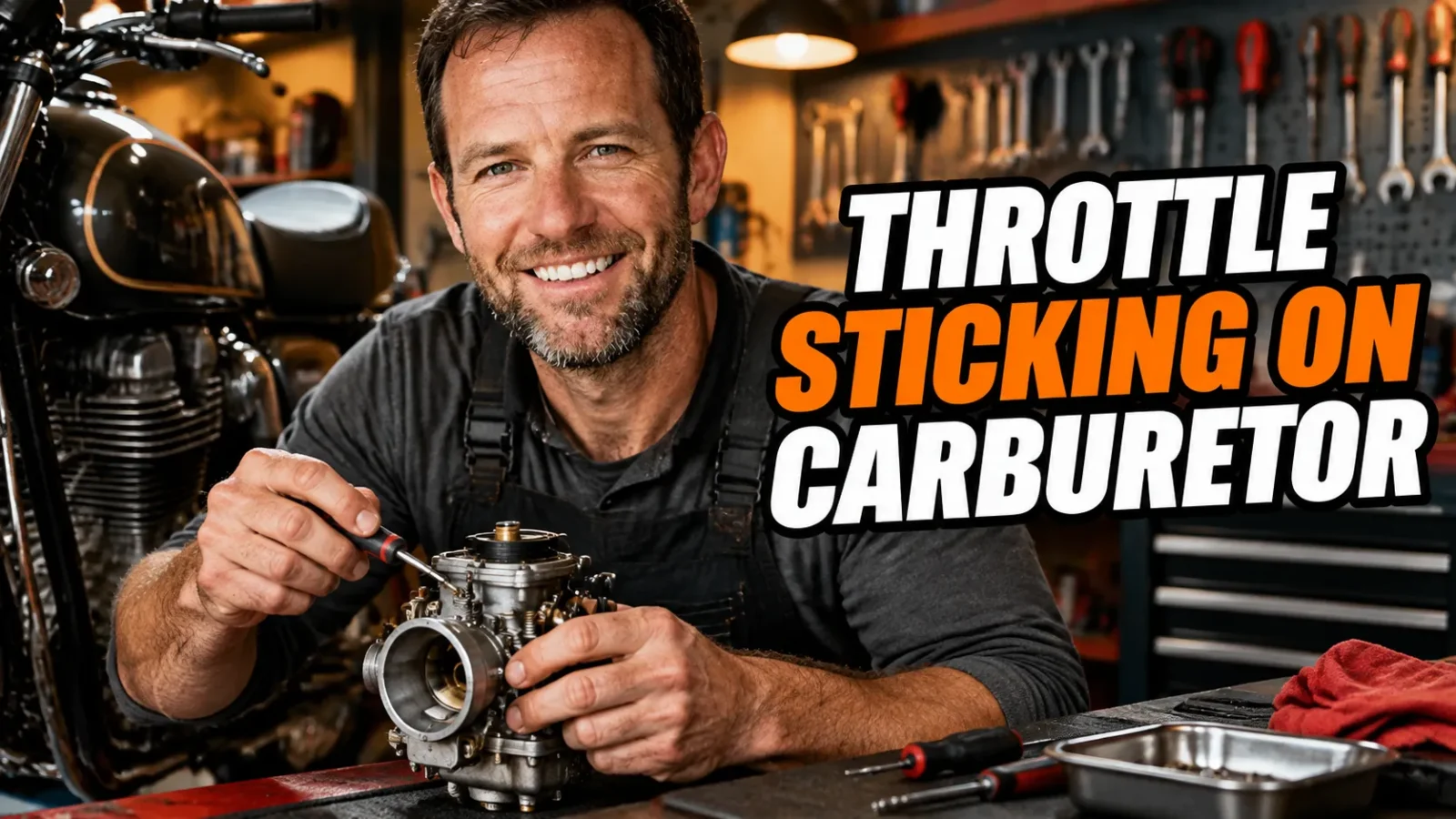
The first time my throttle stuck, I was mid-corner on a 1982 Honda CB750 with a fresh set of carb rebuild kits in it. I rolled off, and nothing happened. The revs just hung there at four thousand, the bike kept pulling, and I had about half a second to decide between the clutch and the kill switch. I hit both.
That moment taught me more about carbureted fuel systems than any manual ever did. A throttle that won’t snap shut is one of the few faults on an old bike that can genuinely hurt you, and it almost never fixes itself.
The good news? In my experience, about nine out of ten sticky throttles come down to three things: a dry or frayed cable, gummy old fuel varnish in the slide bore, or a cable that’s been routed wrong. All three are cheap to fix and easy to diagnose if you know the order to check things in.
I’ve now sorted sticky throttles on everything from a single-cylinder thumper to a four-bank of CV carbs, and I’ve settled on a routine that finds the culprit in about ten minutes. Here’s exactly how I do it.
- Disconnect the cable at the carb first. If the grip still sticks, the problem is in the cable or twist grip, not the carburetor.
- The number one cause I find is old fuel varnish gumming the slide or butterfly in its bore.
- Check throttle free play (2 to 3 mm) with the bars at full lock, both directions.
- Most sticky throttle cables aren’t worth saving. A new cable costs less than a tank of fuel and removes all doubt.
- Never ride a bike with a throttle that won’t snap shut. Kill switch and clutch, every time.
Why a Sticky Throttle Is a Safety Fault, Not an Annoyance
I want to be blunt about this, because I’ve seen riders shrug it off. A throttle that returns slowly isn’t “a bit sticky.” It’s a control that has stopped doing what you told it to do.
On a carbureted bike, the only thing closing that throttle is a return spring and your wrist. There’s no ride-by-wire safety logic, no limp mode, no ECU cutting fuel because two sensors disagree. If the slide hangs open, the engine keeps making power.
And it always happens at the worst moment. Heat, vibration, and cornering loads are exactly the conditions that turn a slightly draggy slide into a stuck one. My rule is simple: if I can’t hear the slide snap shut when I let go of the grip, the bike doesn’t leave the garage.
My Ten-Minute Diagnostic Routine
Before I touch a single screwdriver, I do the free check. It costs nothing and it tells me roughly where the fault lives.
Step 1: The Free-Play and Full-Lock Test
With the engine off, I turn the bars fully left and then fully right, twisting the grip slightly at each extreme. If the idle note changes or the throttle starts to bind at full lock, the cable is too tight or routed badly.
Then I measure free play at the grip flange. Most manuals want 2 to 3 mm. Anything tighter than that and the cable is preloaded, which means it’s already pulling the slide before you ask it to.
Step 2: Isolate the Cable from the Carburetor
This is the step most people skip, and it’s the one that saves the most time. I disconnect the cable at the carburetor and twist the grip again.
If the grip snaps back crisply with the cable disconnected, my carburetor is the problem. If it still drags, the fault is upstream, in the cable, the twist grip housing, or the grip itself.
Nine times out of ten, this one test halves the job.
Step 3: Work the Slide or Butterfly by Hand
With the cable off, I push the slide or butterfly open with a finger and let it go. On a healthy carb, it drops back with an audible click.
If it creeps, sticks, or feels gritty, I’ve found my culprit. On CV carbs, I also lift the vacuum slide with a finger and check that it falls freely under its own weight, and I look at the diaphragm for pinches or tears.
The Causes I Actually Find, Ranked by Frequency
After a decade of resurrecting old carbureted bikes, these are the faults I run into over and over.
1. Old Fuel Varnish in the Slide Bore
This is my number one. Modern pump fuel with ethanol in it goes stale fast, and when it evaporates it leaves a sticky amber film that’s basically glue. That film builds up on the slide and inside its bore, and suddenly the clearance that used to be a few thousandths of an inch is gone.
It’s worst on bikes that sit. I’ve pulled slides out of carbs that hadn’t run in two years and found them practically welded in place.
2. A Dry, Frayed, or Kinked Cable
Throttle cables are consumable items, and nobody treats them that way. The inner cable wears against the liner, the strands fray near the barrel nipple, and the whole thing starts dragging inside the sheath.
If I see rust-colored dust come out when I move the inner cable, the cable is done. No amount of lubrication brings back a frayed strand.
3. Bad Cable Routing After a Repair
I can’t count how many sticky throttles I’ve traced to a cable that was zip-tied too tightly to the frame after a handlebar swap or a steering head bearing job. A tight bend or a cable pulled against the tank will bind every time.
If your throttle got sticky right after you or a shop touched the bars, start here.
4. A Weak or Broken Return Spring
Less common, but real. Springs fatigue, and a spring that’s lost 20 percent of its tension will feel fine in the garage and hang open on a hot day. If everything else checks out and the slide still returns lazily, replace the spring.
5. Grip, Housing, or Bar-End Interference
Sometimes the carburetor is completely innocent. A grip that’s slid inward and rubs the switch housing, a bar-end weight that’s pressing on the grip, or a twist grip tube that’s cracked will all feel exactly like a sticking throttle.
6. A Worn or Bent Throttle Shaft
On high-mileage CV carbureted bikes, the throttle shaft can wear its bushings or get bent in a drop. That’s a carb-off-the-bike job, and it’s the one cause on this list that usually means a rebuild or a replacement rack.
Cleaning a Gummy Carburetor the Way I Do It
If the slide is varnished, cleaning is straightforward, but there are a couple of ways to ruin parts if you’re careless.
I pull the carb, remove the slide or the top cover, and soak the metal parts in a proper carburetor dip or spray them down with aerosol carb cleaner. I never soak rubber diaphragms, O-rings, or plastic floats in dip. They swell and die.
For the bore itself, I use a lint-free cloth and carb cleaner, then follow up with a light pass of gray Scotch-Brite only if there’s actual corrosion. I do not use a wire brush or sandpaper on a slide. Those surfaces are precision fits, and scratching them creates a permanent sticky spot.
Once everything’s clean, I test-fit the slide dry. It should drop through the bore with a satisfying clack. If it doesn’t, I keep cleaning until it does.
Cables: Lubricate or Replace?
I’ll be honest, I almost always replace. A new throttle cable for most bikes runs $15 to $30, and it comes with fresh inner cable, fresh liner, and a properly swaged nipple.
If you want to save the old one, a cable luber and a proper cable-specific lubricant will buy you time. Just understand that lubrication slows wear, it doesn’t reverse it. I’d only go this route if the cable is smooth, un-frayed, and the bike is a Sunday rider.
While I’m in there, I check the twist grip tube for cracks and clean out the housing. A tiny bit of grease on the tube where it rides in the housing makes a surprising difference.
Adjusting Free Play Correctly
Once everything’s back together, I set free play with the bars straight, then re-check at both full-lock positions. If the free play disappears at full lock, the cable is routed wrong, not adjusted wrong.
I also make sure the cable isn’t zip-tied so tight it can’t move, and that it isn’t rubbing on the fork leg or tank at any steering angle. A cable that’s under tension will eventually fray.
How I Keep It From Coming Back
Prevention on a carbureted bike is mostly about not letting fuel sit. I ride the thing, and when I can’t, I drain the float bowls or add a quality fuel stabilizer and run it through the system.
I use ethanol-free fuel when I can find it, especially for winter storage. Ethanol absorbs water and leaves that gummy residue behind, and it’s the single biggest reason I see sticky slides.
Once a year, I check free play, look at the cable ends for fraying, and give the twist grip a listen. That’s a ten-minute job that has saved me from repeating that CB750 moment.
What I’d Do If It Sticks on the Road
Pull the clutch. Hit the kill switch. Coast to a stop somewhere safe. Don’t try to ride it home by feathering the grip, because the next time it sticks, you might be leaned over with a car coming the other way.
A sticky throttle on a carburetor is almost always a simple fix, and most of the time it costs you an afternoon and twenty bucks in parts. It’s one of the most satisfying repairs on an old bike, because you feel the difference the instant you twist the grip and hear that slide snap shut.
Take the ten minutes. Your right hand will thank you.
Frequently Asked Questions
Why does my throttle stick when the engine is hot?
Heat makes old fuel varnish and swollen rubber parts grab harder. If the slide or butterfly is already gummy, expansion closes up the clearance and the throttle hangs. It’s also common for a cable to bind inside a dry sheath once everything warms up.
Can I ride with a sticking throttle?
No, and I mean that. A throttle that won’t snap shut is a genuine safety fault. If it happens on the road, pull the clutch, hit the kill switch, and coast to a safe stop. Fix it before your next ride.
Will WD-40 fix a sticky throttle cable?
It might free it up for a week, but WD-40 is a solvent, not a lubricant. It flushes out whatever grease is left and then evaporates. Use a proper cable lubricant, or better yet, spend the $15 to $30 on a new cable.
How much throttle free play should I have?
Most manuals call for 2 to 3 mm of free play at the grip flange before the cable starts pulling. I check it with the bars turned fully left and fully right, because a tight cable only shows itself at full lock.

Related Articles

Harley Fuel Pump Problems: What I’ve Learned Fixing My Own Bikes
From dead primes to hot-start stumbles, here's how I diagnose and fix Harley fuel pump problems, what repairs cost, and…
Jake Miller
8 min read

Does a Bigger Carburetor Really Mean More Power? What I Learned Losing (and Gaining) Horsepower
I've bolted on oversized carbs and lost horsepower. Here's the honest truth about carb sizing, airflow velocity, jetting, and when…
Jake Miller
9 min read

How to Clean a Dirt Bike Carburetor the Right Way: A Rider’s Step-by-Step Garage Guide
A rider's step-by-step guide to cleaning a dirt bike carburetor: tools, jet cleaning, float checks, and the mistakes that cost…
Jake Miller
11 min read