
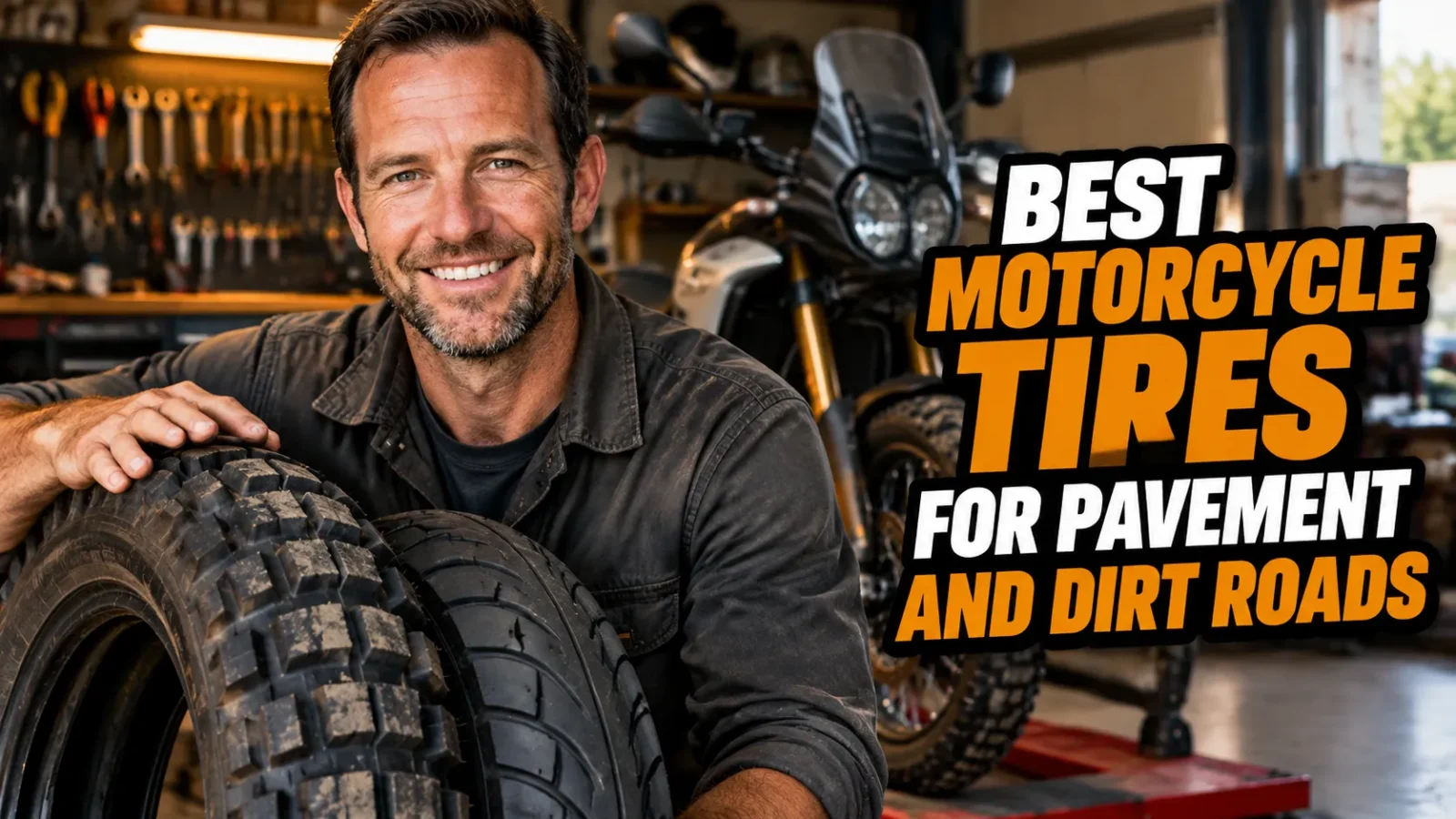
I’ve spent years splitting my riding between twisty asphalt and the dusty dirt roads that connect my favorite routes. The tire question never goes away. Pick a tire that’s too aggressive and the highway turns into a buzzing, wandering mess. Pick one that’s too street-focused and the first washboard hill climb feels like skating on marbles.
This list is my honest attempt to sort through the real-world options. I’ve ridden several of these tires myself, and I’ve leaned on long-term feedback from fellow riders for the rest. Every tire below is a current, widely available model, and I’ve called out where each one shines and where it doesn’t.
- My top all-rounder is the Michelin Anakee Adventure for its mileage and wet-weather confidence.
- The Continental TKC 70 is my pick for a true 70/30 balance of road manners and dirt traction.
- The Shinko 705 is the best budget option, and the Heidenau K60 Scout is the toughest, longest-lasting choice.
- Be honest about your road-to-dirt ratio, because that single decision matters more than the brand.
How I Judge a Tire That Has to Do Two Jobs
A dual-sport tire is always a compromise, so I judge each one on how gracefully it makes that compromise. I look at wet and dry pavement grip, stability at highway speed, behavior on loose gravel and hardpack, and how many miles I can realistically expect.
I also pay attention to how a tire feels when it’s worn. Some tires are great for the first 2,000 miles and then turn vague and squirmy. If you want a broader brand-level view, my guide to the best brand for motorcycle tires goes deeper on who makes what.
1. Michelin Anakee Adventure — Best Overall for Mixed Riding
If I could only recommend one tire for a rider who spends most of their time on asphalt but regularly detours onto dirt, it would be the Michelin Anakee Adventure. It’s built around roughly an 80/20 road-to-dirt philosophy. That means a tread pattern that clears water well but still has enough void to bite into graded gravel.
Why I Like It
The Anakee Adventure uses Michelin’s dual-compound technology, with a harder center for mileage and a softer shoulder for lean-angle grip. On wet pavement, it inspires more confidence than almost anything else I’ve tried in this category. It also tracks straight on the highway without that nervous wiggle many knobby-style tires have.
Where It Falls Short
It’s not a mud tire, and I wouldn’t take it on deep sand or wet clay. Think of it as a graded-dirt, forest-service-road tire. Expect pricing around $150 to $230 per tire depending on size, and note that tubeless is offered in certain sizes, so confirm yours.
2. Continental TKC 70 — Best Balanced 70/30 Dual-Sport Tire
The Continental TKC 70 is the tire I reach for when my dirt percentage creeps up. It’s marketed around a 70/30 road-to-off-road split, and in my experience that’s honest. The block pattern is clearly more aggressive than the Anakee, yet it stays remarkably civil on the pavement.
Real-World Performance
On gravel and packed dirt, the TKC 70 gives noticeably better feedback than road-biased options. Its tread blocks flex and bite without feeling squirrelly. If gravel is your main concern, take a look at my roundup of the best motorcycle tires for gravel roads too.
Things to Know
Highway noise is a bit higher than with the Michelin, and the center tread wears faster if you commute on slab. Prices typically run about $110 to $190 per tire. It’s available in both tube-type and tubeless variants depending on size, so check before you order.
3. Pirelli Scorpion Trail II — Best for Road-Biased Adventure Bikes
The Pirelli Scorpion Trail II is honestly closer to a sport-touring tire that happens to tolerate dirt roads. I’d choose it for a big adventure bike that lives on pavement. Think of riding a heavy twin through mountain curves with an occasional graded gravel shortcut.
Why It Stands Out
Pirelli designed it with a multi-compound construction aimed at strong wet and dry grip and stable handling at lean. It’s one of the most confidence-inspiring tires I’ve used when the road gets slick. If that’s your priority, my guide to the best motorcycle tires for wet and dry roads is a good companion read.
The Trade-Off
Dirt ability is modest. On loose or rutted surfaces it works, but you’ll feel the limits quickly. Expect around $170 to $260 per tire, which is premium, but the mileage and road manners justify it for the right bike.
4. Metzeler Karoo 4 — Best for Riders Who Lean Toward Dirt
When my route is mostly dirt with pavement connecting the segments, I want the Metzeler Karoo 4. It’s a more aggressive, knobbier design that still behaves reasonably on tarmac. The Karoo line has a strong reputation among riders who actually go off the beaten path.
What I Notice on the Trail
The wide-spaced blocks dig into loose soil and shed it well, so traction stays predictable on climbs and in corners. On the road, it’s fine for moderate speeds, though you’ll feel some squirm in a fast sweeper. It’s a fair trade if dirt is the real destination.
Cost and Fitment
Pricing generally falls between $140 and $230 per tire based on size. Check your wheel type, since availability of tubeless versus tube-type options varies by dimension. I’d skip it if you commute long highway miles daily.
5. Heidenau K60 Scout — Best for Longevity and Heavy Loads
If I’m loading up a bike for a multi-week trip, the Heidenau K60 Scout is the tire I trust most. It’s known for a stiff, reinforced carcass and a rugged, long-wearing compound. Riders on heavy adventure bikes with luggage love it for exactly that reason.
Strengths
Mileage is the headline. Many riders report lasting far longer than with typical knobby-style tires. It’s also very stable under load, which helps on rough roads where a flexible carcass can feel vague.
Weaknesses
The firm construction means it’s not the grippiest tire in cold or wet conditions, and it can feel stiff right out of the box. I’d say give it a few hundred miles to scrub in. Pricing usually lands around $120 to $200 per tire, and some sizes come in tubeless versions.
6. Shinko 705 — Best Budget Pick
I’ll say it plainly: the Shinko 705 punches well above its price. It’s a classic 60/40-style dual-sport design that you’ll see on everything from small-displacement dual-sports to older adventure bikes. For riders watching their wallets, it’s hard to beat.
Where It Works
On dirt and gravel, the chunky tread gives solid traction and a planted feel. On pavement it’s perfectly acceptable at moderate speeds, if a bit noisy. Pricing is often around $60 to $120 per tire, which makes it a great choice for riders who change tires frequently.
Where It Doesn’t
Wet-road grip and high-speed refinement lag behind the premium brands. If outright traction matters most to you, see my list of the best grip tires for motorcycle for stickier alternatives. Also note many sizes are tube-type only.
7. Dunlop Trailmax Mission — Best True 50/50 Option
The Dunlop Trailmax Mission is built for riders who want real off-road capability without giving up the ability to ride to the trailhead. It’s roughly a 50/50 design with a tread pattern that looks and acts like a proper adventure knobby. I like it for lighter and mid-weight adventure bikes.
My Take
In loose gravel and dirt, it’s confident and predictable, with good braking traction. On pavement, it’s better than its looks suggest, though you’ll notice tread squirm at spirited paces. I’d keep it for trips where dirt is at least a third of the mileage.
Price and Availability
Expect roughly $130 to $210 per tire, depending on size. Construction varies, so confirm whether your size is tube-type or tubeless before buying.
8. Bridgestone Battlax Adventure A41 — Best for Smooth, Quiet Road Manners
The Bridgestone Battlax Adventure A41 is my choice for riders who want the quietest, most refined road feel while keeping the option of light dirt. It’s firmly road-biased, designed for large-displacement adventure-tourers that rack up highway miles.
Handling Character
Turn-in is neutral and predictable, and it holds a line well in long sweepers. If you care about carving, it pairs nicely with the advice in my guide to the best motorcycle tires for cornering. On hardpack and light gravel it’s perfectly capable.
Limitations
It won’t thrill you in loose or rutted terrain, and I wouldn’t ride it in mud. Pricing is typically $150 to $240 per tire. This one is for the rider who puts pavement first and treats dirt as an occasional bonus.
How to Choose the Right Tire for Your Riding Split
The biggest mistake I see is riders overestimating how much dirt they actually ride. Be honest with yourself. If 85 percent of your miles are paved, an 80/20 tire will serve you far better than a 50/50 knobby, even if the knobby looks cooler.
Match the Tire to the Bike
Heavy bikes with luggage benefit from stiffer carcasses like the Heidenau K60 Scout. Lighter dual-sports often do better with more flexible, aggressive designs like the Shinko 705 or Dunlop Trailmax Mission. Always check the load and speed ratings against your owner’s manual.
Watch Your Pressures
Tire pressure is the cheapest performance upgrade you have. I drop a few PSI on loose dirt for traction and comfort, then bring it back up before returning to pavement. Never go below the tire maker’s minimum recommendation.
Think About Tubes Versus Tubeless
Tubeless tires make small punctures easier to manage, but they require compatible rims. Spoked wheels with tubes are easier to patch on the trail with basic tools. Check what your specific wheel and tire size support before you buy.
My Final Thoughts
There’s no perfect tire, only the right compromise for the way you ride. For most riders, I’d start with the Michelin Anakee Adventure or the Continental TKC 70. They cover the widest range of conditions without major drawbacks.
If your budget is tight, the Shinko 705 is a smart, honest choice. If you’re loading up for a long expedition, the Heidenau K60 Scout earns its reputation. Whatever you pick, get the pressure right, scrub it in gently, and enjoy the ride, wherever the road turns to dirt.
Frequently Asked Questions
What is the best tire split for a bike that sees both pavement and dirt roads?
For most riders, a 70/30 to 80/20 road-to-dirt split is the sweet spot. It keeps highway manners and wet grip good while still working on graded gravel and hardpack. Choose 50/50 only if you ride dirt at least a third of the time.
Do dual-sport tires wear out faster than street tires?
Usually they wear faster than a dedicated touring tire, but the gap depends on the compound and tread. Road-biased tires like the Michelin Anakee Adventure often last far longer than aggressive 50/50 knobbies. Heavy loads and hard highway riding shorten life for any of them.
Should I choose tube-type or tubeless dual-sport tires?
Tubeless is easier to live with on pavement because small punctures often seal or plug quickly. Tube-type is still common on spoked wheels and is easier to repair on the trail with the right kit. Always check that your wheel and the specific tire size support the construction you choose.
What tire pressure should I run on mixed surfaces?
Start with the pressures in your owner’s manual for pavement, then drop a few PSI for loose dirt to improve traction and comfort. Never go below the tire manufacturer’s minimum and always re-inflate before hitting the highway. Adjust for load and speed.

Related Articles

8 Best Cruiser Motorcycle Tires for Street Riding: My Real-World Picks
I rank the 8 best cruiser motorcycle tires for street riding, from Michelin to Pirelli, with real notes on grip,…
 Jake Miller
9 min read
Jake Miller
9 min read

8 Best Michelin Motorcycle Tires for Every Riding Style (Tested Picks)
Looking for the best Michelin motorcycle tires? I break down my 8 favorite models for sport, touring, adventure, cruiser, and…
Jake Miller
9 min read

Yamaha Tire Pressure Guide: The Right PSI for Safer, Smoother Rides
Learn the right tire pressure for your Yamaha, from sportbikes to cruisers and dirt bikes. Check, adjust and maintain PSI…
Jake Miller
9 min read