
9 Best Motorcycle Tires for Riding Confidently in Rain and Sunshine
 Jake Miller
9 min read
Jake Miller
9 min read
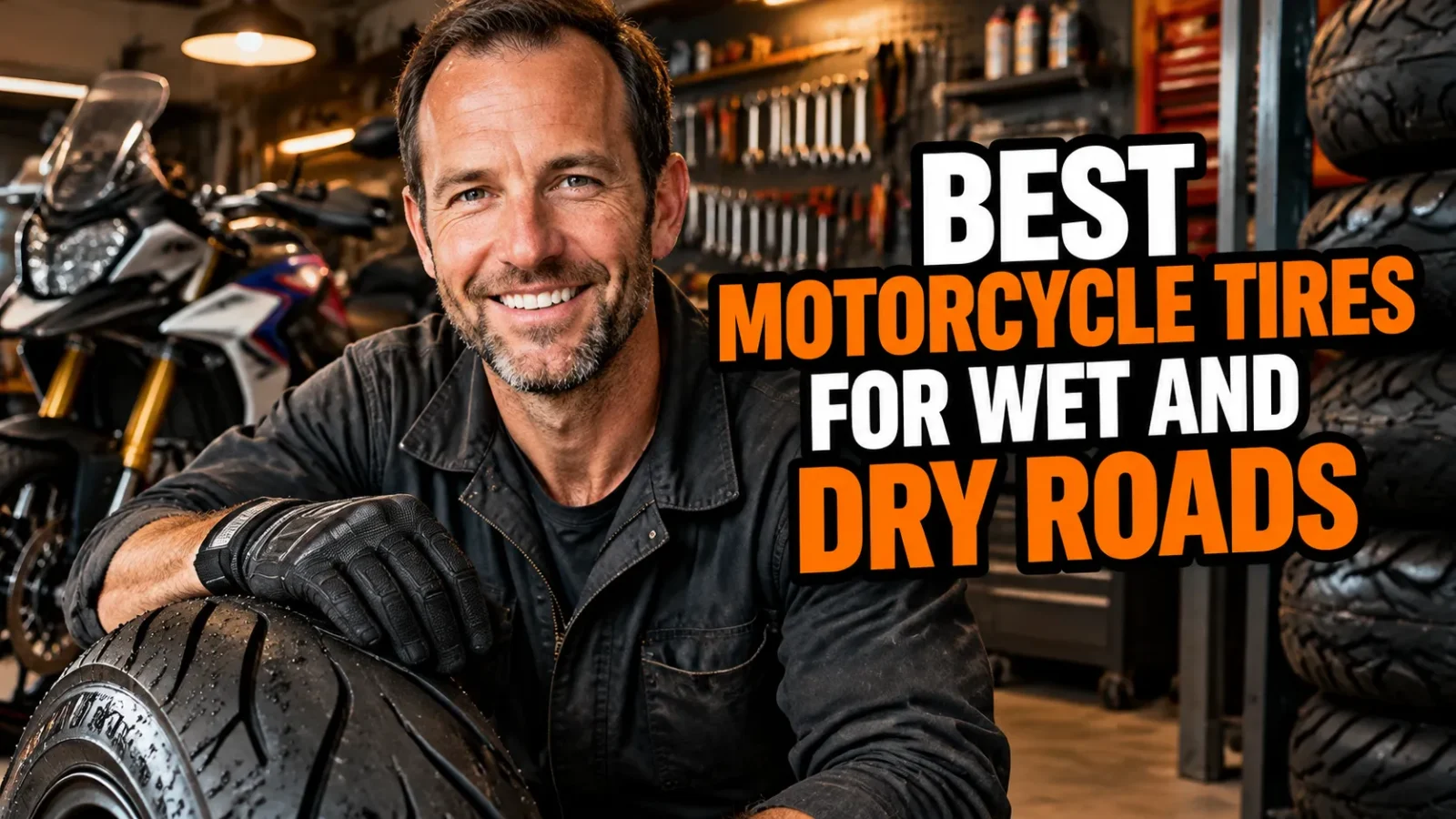
I’ve been riding in all kinds of weather for years, and nothing changes how a bike feels quite like a fresh set of tires. A great tire makes a damp commute feel routine, and a mediocre one makes every painted line feel like a threat. The tire is the only thing connecting you to the road, so it deserves real attention.
In this guide I’m sharing the tires I’d actually put on my own bikes, or recommend to a friend, for riding in both wet and dry conditions. I’ve grouped them by riding style, so you can jump straight to the one that fits your machine. Specs and prices are approximate and vary by size and retailer, so always confirm fitment for your bike.
- My top all-rounder for sport-touring bikes is the Michelin Pilot Road 5, with the newer Michelin Road 6 as the upgrade.
- For sportier riding with serious wet grip, I’d go with the Bridgestone Battlax Hypersport S22 or Pirelli Angel GT II.
- Adventure riders should look at the Michelin Anakee Adventure, and cruiser riders at the Michelin Commander III.
- Budget and small-bike riders get great value from the Michelin Pilot Street 2.
- Correct tire pressure matters as much as the tire you choose.
How I Judged These Tires
I focused on what matters on real roads: wet braking, cornering confidence, mileage, and how predictable the tire feels when it gets worn. Lab numbers are useful, but I trust long-term riding impressions and consistent feedback from other riders even more.
What Makes a Tire Good in Both Rain and Sun
The secret is the rubber compound and the tread design. Modern tires use silica-rich compounds that stay flexible and grippy when the pavement is cold and wet. Many also use dual or triple compounds, with harder rubber in the center for mileage and softer rubber on the shoulders for lean-angle grip.
Tread grooves matter too. They channel water out from under the contact patch, which reduces hydroplaning risk. A tire with well-designed grooves can feel almost identical in a light shower and on a dry road.
1. Michelin Pilot Road 5 — Best Overall Sport-Touring Tire
If you ask me for one tire that does nearly everything well, the Michelin Pilot Road 5 is my answer. I’ve found it to be remarkably confident in the rain, and it settles quickly on cold mornings. It uses Michelin’s XST Evo tread pattern, designed to evacuate water efficiently, plus a dual-compound construction on the rear.
On dry roads, the Pilot Road 5 turns in smoothly and holds a line beautifully through long sweepers. It isn’t a track tire, but I’ve never felt it run out of grip on a spirited road ride.
Why I Like It
- Excellent wet braking and cornering feel
- Strong mileage for a grippy tire
- Predictable behavior as it wears
Expect to pay roughly $300 to $420 for a front and rear set, depending on size. For a lot of riders, that’s money very well spent.
2. Michelin Road 6 — Best Upgrade for Modern Sport-Touring Bikes
The Michelin Road 6 is the newer evolution of the Pilot Road family, and I think it’s a meaningful step forward. Michelin positioned it as improved in wet grip and mileage, and my impressions match that. It uses an updated tread pattern and compound tuned for both rain and dry performance.
On a powerful sport-tourer, the Road 6 feels planted and sharp. It handles heavy bikes well, and it’s a tire I’d happily load up for a weekend away.
Pricing generally sits a bit above the Pilot Road 5, often $320 to $450 a set. If you’re mounting new rubber on a recent bike, this is the one I’d look at first.
3. Pirelli Angel GT II — Best for Long-Distance Touring Comfort
The Pirelli Angel GT II is a tire I trust for high-mileage riding. It has a strong reputation for stability under load, which makes it popular on heavier bikes. Its tread design focuses on wet grip, and it handles surprise downpours with composure.
If you ride a big tourer, it’s worth reading my guide to the best motorcycle tires for touring bikes, where tires like the Angel GT II come into play for long days in the saddle.
Standout Features
- Multi-compound rear designed for longevity and lean-angle grip
- Sturdy construction suited to loaded bikes
- Confident feedback in mixed conditions
Typical pricing is about $300 to $420 for a set. It’s a fantastic partner for riders who cover serious distance.
4. Dunlop Roadsmart IV — Best Value Sport-Touring Option
The Dunlop Roadsmart IV is where I point riders who want strong all-weather ability without paying top dollar. Dunlop built it around wet-weather performance, and it shows. Water clears quickly, and the tire stays secure on slick painted markings and wet corners.
In the dry, the Roadsmart IV is stable and easy to ride. It isn’t the sharpest tire on this list, but its calm, predictable character is something I appreciate on long days.
Prices commonly run $270 to $380 a set, which makes it one of the more affordable ways to get serious all-weather capability.
5. Bridgestone Battlax Hypersport S22 — Best for Sporty Riders Who Still Ride in Rain
The Bridgestone Battlax Hypersport S22 is for riders who want sharp handling and still need wet-weather security. It’s a sport tire, but a surprisingly livable one. Bridgestone designed it with a dual-compound rear and a tread layout that keeps water manageable.
On dry back roads, I love how crisp the steering feels. The S22 asks for a little more attention to temperature than a touring tire, so give it a moment to warm up on chilly days.
Who It Suits
It fits supersport and sport-naked bikes well. If you ride aggressively on weekends but commute in all weather, this is a strong middle ground. Expect roughly $300 to $420 per set.
6. Continental ContiRoadAttack 4 — Best for Sharp Handling With Wet-Weather Confidence
The Continental ContiRoadAttack 4 is one of the most underrated tires in my book. Continental has a long reputation for wet-road engineering, and this tire carries it forward. It blends sporty steering response with grip that holds up when the road turns damp.
I find it especially rewarding on lighter, more agile bikes. It turns in with enthusiasm and gives clear feedback through the bars.
- Strong wet and dry grip balance
- Quick, light steering feel
- Good choice for sport-touring and street-focused bikes
Prices typically fall between $280 and $400 for a set.
7. Michelin Pilot Street 2 — Best for Small Bikes and Commuters
Not every bike needs a premium sport-touring tire. For small-displacement machines and commuters, the Michelin Pilot Street 2 is an excellent, affordable choice. It’s offered in many smaller sizes and is designed for urban riding in changing weather.
I like how stable it feels in the wet at moderate speeds. For more options in this category, take a look at my roundup of the best tires for small motorcycle models.
Why It Works
It has a long-wearing compound that suits daily riding, and the price is hard to beat. A pair often lands around $80 to $150, depending on size.
8. Michelin Anakee Adventure — Best for Adventure Bikes on Mixed Surfaces
Adventure riders face the toughest tire compromise, and the Michelin Anakee Adventure handles it well. It’s designed for bikes that spend most of their time on pavement but venture onto light trails. Its tread has a dual-compound construction aimed at wet-road confidence and long life.
On wet tarmac, it feels far more secure than its aggressive looks suggest. On packed dirt and light gravel, it holds its own, too.
If your riding leans more toward loose surfaces, I’d also read my guide to the best adventure motorcycle tires for gravel. Expect to pay about $300 to $420 for a set of Anakee Adventures.
9. Michelin Commander III Touring — Best for Cruisers and Baggers
Cruiser riders deserve great wet-weather tires, too. The Michelin Commander III Touring is built for heavy bikes and long rides. Its tread pattern includes plenty of grooves to channel water, and its construction is designed to handle the weight of a fully loaded bagger.
I appreciate how steady it feels in a crosswind or on a damp highway. The ride is smooth and the mileage is impressive for a tire with this much grip.
Good to Know
Make sure you choose the right variant for your bike, because Michelin offers Cruiser and Touring versions with different construction. Pricing generally runs $250 to $380 a set.
Tire Pressure Matters More Than You Think
Even the best tire performs poorly if the pressure is wrong. Too low and the bike feels vague and overheats the carcass. Too high and you shrink the contact patch, which hurts grip in the wet.
Always check your pressure cold, and follow the numbers from your bike maker. If you’re unsure, my guide on what psi should motorcycle tires be walks through the basics.
Matching Tires to Specific Bikes
Tire choice often depends on the bike itself. Heavy sport-tourers like the BMW R1200RT put specific demands on a tire, especially for stability and mileage. I covered those needs in detail in my article on the best tires for bmw r1200rt motorcycle owners.
As a general rule, check your owner’s manual for approved sizes and speed ratings. Then pick the tire whose character matches how you actually ride, not how you wish you rode.
My Final Thoughts on Choosing the Right Tires
If I had to pick one tire for most riders who want reliable wet and dry performance, I’d choose the Michelin Pilot Road 5 or its successor, the Michelin Road 6. They simply do everything well. For sportier riders, the Bridgestone Battlax Hypersport S22 is my pick.
Whatever you choose, don’t skimp on tires. They cost far less than a crash, and the confidence they give you in the rain is priceless. Ride safe, check your pressures, and enjoy every mile, wet or dry.
Frequently Asked Questions
Can one motorcycle tire really handle both wet and dry roads?
Yes. Modern sport-touring and dual-compound tires use silica-rich rubber and sipe-heavy tread patterns that grip well in the rain and still deliver strong dry grip. You give up a little ultimate track-day grip, but for road riding the tradeoff is well worth it.
How often should I replace motorcycle tires?
Replace them when the tread reaches the wear indicators, or when the tire is roughly five to six years old, whichever comes first. Cracking, hardening, or flat spots are also signs it is time for a new set, regardless of mileage.
What tire pressure is best for wet roads?
Stick to the pressure your bike manufacturer recommends, measured cold. Dropping pressure below spec in the rain does not improve grip and can hurt stability and tire life. Always check your owner’s manual and the tire maker’s guidance.
Are sport-touring tires better than sport tires for mixed weather?
For most street riders, yes. Sport-touring tires usually prioritize wet grip, mileage, and consistent behavior as they wear, while pure sport tires favor maximum dry grip and feel best when warm.

Related Articles

8 Best Cruiser Motorcycle Tires for Street Riding: My Real-World Picks
I rank the 8 best cruiser motorcycle tires for street riding, from Michelin to Pirelli, with real notes on grip,…
Jake Miller
9 min read

8 Best Michelin Motorcycle Tires for Every Riding Style (Tested Picks)
Looking for the best Michelin motorcycle tires? I break down my 8 favorite models for sport, touring, adventure, cruiser, and…
Jake Miller
9 min read

Yamaha Tire Pressure Guide: The Right PSI for Safer, Smoother Rides
Learn the right tire pressure for your Yamaha, from sportbikes to cruisers and dirt bikes. Check, adjust and maintain PSI…
Jake Miller
9 min read