
7 Best Compact 12V Tire Inflators for Motorcycles (Rider-Tested Picks)
 Jake Miller
9 min read
Jake Miller
9 min read
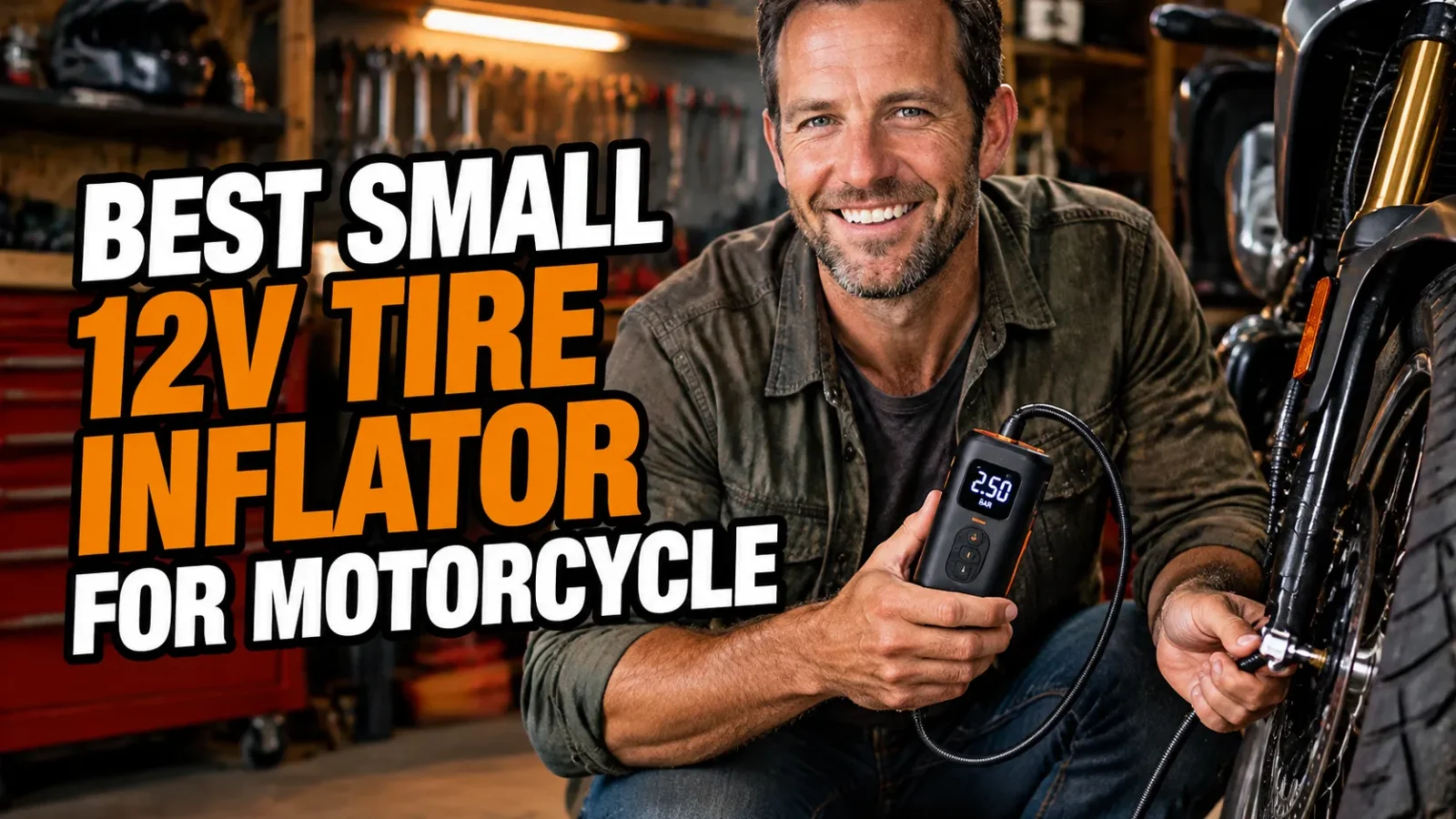
I’ve been caught out by a soft tire more times than I’d like to admit. Once it was a slow leak at a gas station in the middle of nowhere, and once it was a cold morning that dropped my pressure by 5 PSI before a canyon ride.
That’s why a small 12V inflator lives under my seat. Over the years I’ve used, borrowed, and compared plenty of them, and in this guide I’m sharing the seven I’d actually trust on a bike.
I focused on size, inflation speed, accuracy, and how well each one handles the small air volume of a motorcycle tire. Here’s what I found.
- My top overall pick is the Motopressor, built specifically for motorcycles and easy to pack.
- The VIAIR 88P is my choice if you want tougher, longer-lasting build quality.
- The Slime 40026 and EPAuto are the best budget-friendly options I’ve used.
- Look for a 100+ PSI rating, an accurate gauge, and a compact case you can stash under the seat.
1. Motopressor Digital Tire Inflator — Best Overall for Motorcycles
The Motopressor Digital Tire Inflator is the one I reach for first, mainly because it was designed with riders in mind. It’s compact, light, and easy to tuck into a tail bag or under-seat storage.
Why I Like It
The Motopressor has a digital gauge with a preset target PSI, so it shuts off when your tire reaches the number you chose. That matters on a bike, where a few extra PSI can change how the front end feels.
It connects directly to the battery with a clamp-style lead, so you aren’t stuck looking for a cigarette lighter socket that most bikes don’t have. I’ve found that it fills a flat-ish rear tire in a few minutes without getting uncomfortably hot.
What to Watch For
It’s priced a bit above generic car inflators, typically in the $50 to $80 range. In my experience, the extra money buys better ergonomics and a motorcycle-friendly setup, which is worth it if you ride often.
2. VIAIR 88P Portable Compressor — Best for Durability
The VIAIR 88P is the toughest compressor in this list. It’s a well-known name among overlanders and off-roaders, and its metal-bodied construction shows it.
Performance in My Experience
The 88P is rated for up to 120 PSI, which is far more than any motorcycle tire needs. That headroom means the motor isn’t straining at 36 PSI, and in my experience it runs cooler and lasts longer as a result.
It’s a little larger and heavier than the Motopressor, so it fits better in a saddlebag or a hard case than under a sport bike seat. Prices usually land around $70 to $100.
Who It’s For
I recommend the VIAIR 88P for adventure and touring riders who carry luggage and want a “buy it once” compressor. If you ride off-pavement, pair it with a solid plug kit like the ones in my guide to the best tire repair kit for motorcycle riders.
3. Slime 40026 Digital Tire Inflator — Best Value Pick
The Slime 40026 is a no-nonsense 12V inflator that I’ve seen in many riders’ garages, usually because it costs very little. It has a digital display and a built-in LED light, which is surprisingly handy when you’re topping off a tire at night.
Strengths
I like the Slime 40026 for its simplicity. You set the target pressure, press start, and it stops on its own, and the hose is long enough to reach a bike’s valve stem on a center stand or side stand.
It usually sells for around $25 to $40, which makes it a great backup unit to keep in a car or truck that follows your trips.
Limitations
It’s built primarily for cars, so it’s a touch bulkier than motorcycle-specific models. The plug-in power cord is designed for a 12V socket, so you may need an adapter for direct battery use.
4. AstroAI Digital Tire Inflator — Best Budget Option With a Clear Display
The AstroAI Digital Tire Inflator is another affordable, widely available unit that has earned a loyal following. It typically has a rated max of 100 PSI, which is plenty for a motorcycle.
What Stands Out
The AstroAI’s backlit display is easy to read in low light, and the auto-shutoff feature works well enough for casual use. I’ve found its gauge readings to be reasonably close to my reference gauge, though I always double-check with a separate pencil gauge.
It’s typically priced at about $25 to $35, and it comes with a few nozzle attachments for inflating things like bicycle tires or sports balls.
Is It Right for You?
If you’re a commuter who only needs occasional top-offs, the AstroAI is a very smart buy. If you ride hard and expect to fill from low pressure often, I’d step up to the VIAIR.
5. EPAuto 12V DC Portable Air Compressor — Best for Backup Use
The EPAuto 12V DC Portable Air Compressor is one of the best-known small inflators sold online. It has a rated max of 100 PSI and comes with a carry bag and a few adapters.
Real-World Use
I like that the EPAuto has an easy-to-read analog or digital display, depending on the version, and the hose is a comfortable length for working around a bike. It’s not the fastest unit I’ve tested, but it’s perfectly adequate for small motorcycle tires.
Pricing is generally in the $25 to $40 range. This is a great pick if you already have a roadside kit and just want something dependable in the trunk of your support vehicle.
A Tip From Me
If you ride a small-displacement bike with narrow tires, check your pressure before every ride. For ideas on tires that suit lighter machines, see my breakdown of the best tires for small motorcycle models.
6. Airmoto Portable Motorcycle Air Compressor — Best Ultra-Compact Design
The Airmoto compressor is a purpose-built option designed to be carried on a motorcycle. It’s one of the smallest dedicated units available, and it was clearly engineered by people who ride.
Why It Earns a Spot
What I like most about the Airmoto is its footprint. It packs down small enough to ride with every day, which means you’ll actually have it when you need it, and that’s the whole point of a roadside inflator.
It’s more of a premium purchase, usually costing more than the generic units, so I see it as a good fit for touring riders who value compact packing over raw speed.
The Trade-Off
Small compressors can take a little longer to fill a large rear tire. I’d budget a few extra minutes, and I’d let the unit rest if it feels hot.
7. BLACK+DECKER ASI300 Air Station — Best for Garage and Home Use
The BLACK+DECKER ASI300 is a 12V inflator I’d call a garage workhorse. It’s a little bigger than the others, but it has a rated pressure of 120 PSI and a solid, well-built feel.
Where It Shines
I use a unit like this at home to check pressures before weekend rides and to set the exact PSI I want for track or spirited days. If you’re chasing grip on a sport bike, it pairs well with a tire such as those I cover in my guide to the best micheline sport tire for motorcycle options.
Prices usually run about $35 to $55. It’s not the smallest, so I wouldn’t pack it on a long trip, but it’s reliable and easy to use.
Who Should Skip It
If your storage space is tight, the ASI300 is probably too bulky for under-seat use. In that case, one of the first two or the Airmoto will serve you better.
How I Choose a Small 12V Inflator
After testing a lot of these, I’ve settled on a few criteria that matter far more than marketing claims. Here’s what I look for before I trust one on a ride.
Size and Weight
If it doesn’t fit on the bike, you won’t carry it. I look for something that fits in a small pouch and weighs under a couple of pounds.
Gauge Accuracy
Motorcycle tires are sensitive to pressure, so I want an inflator that reads close to my own gauge. I always verify with a separate gauge, since built-in readings can drift a few PSI.
Power Connection
Most bikes don’t have a cigarette lighter socket, so direct battery clamps or an SAE connector are a big plus. I also recommend running the engine while inflating to protect your battery.
Duty Cycle and Heat
Small pumps overheat if you run them continuously. Motorcycle tires hold little air, so you rarely hit the limit, but it’s worth knowing before you inflate a big touring tire from flat.
Pressure Tips I Rely On
An inflator is only useful if you use it correctly. These are the habits I’ve built over thousands of miles.
Check Cold, Every Time
Tire pressure rises as the tire heats up, so I check mine before I ride. A cold reading gives you the most honest number to compare against the manufacturer’s spec.
Match Pressure to Conditions
I tweak pressure slightly depending on load and weather, but I always stay within the recommended range. If you ride in the rain a lot, tire choice matters as much as pressure, which is why I wrote about the best motorcycle tire for wet roads.
Off-Road Adjustments
Riders who venture into sand or rocks often drop pressure for traction and then re-inflate for the highway ride home. If that’s you, an inflator is essential, and my picks for the best motorcycle tire for desert racing cover what to run in the harshest terrain.
My Final Thoughts
If I had to choose just one, I’d go with the Motopressor for its mix of size, battery-ready design, and motorcycle-friendly features. For maximum toughness, the VIAIR 88P is hard to beat.
On a budget, the Slime 40026, AstroAI, and EPAuto all do the job well. Whichever you choose, carry it, use it, and check your pressure often, because it’s one of the cheapest ways to make every ride safer.
Pair your inflator with a good plug kit and a quality gauge, and you’ll be prepared for almost anything the road throws at you. Ride safe out there.
Frequently Asked Questions
What PSI should a 12V inflator reach for a motorcycle?
Most motorcycle tires run between 28 and 42 PSI, so any inflator rated to at least 100 PSI is more than enough. Always check your owner’s manual or swingarm sticker for the exact number.
Can I run a 12V inflator directly off my motorcycle battery?
Yes, but most small inflators draw 10 to 15 amps, so I recommend running the bike’s engine to avoid draining the battery. Use an inflator that has battery clamps or a SAE connector with a quality pigtail.
Is a CO2 cartridge better than a 12V pump?
CO2 is lighter, but it’s single-use and runs out fast. A 12V inflator gives you unlimited top-ups and is far more practical for regular pressure checks and long tours.
Where should I store an inflator on a motorcycle?
Most compact units fit under the seat, in a tail bag, or in a saddlebag. Choose a model with a hard case or pouch so vibration and moisture don’t damage it.

Related Articles

8 Best Cruiser Motorcycle Tires for Street Riding: My Real-World Picks
I rank the 8 best cruiser motorcycle tires for street riding, from Michelin to Pirelli, with real notes on grip,…
Jake Miller
9 min read

8 Best Michelin Motorcycle Tires for Every Riding Style (Tested Picks)
Looking for the best Michelin motorcycle tires? I break down my 8 favorite models for sport, touring, adventure, cruiser, and…
Jake Miller
9 min read

Yamaha Tire Pressure Guide: The Right PSI for Safer, Smoother Rides
Learn the right tire pressure for your Yamaha, from sportbikes to cruisers and dirt bikes. Check, adjust and maintain PSI…
Jake Miller
9 min read