
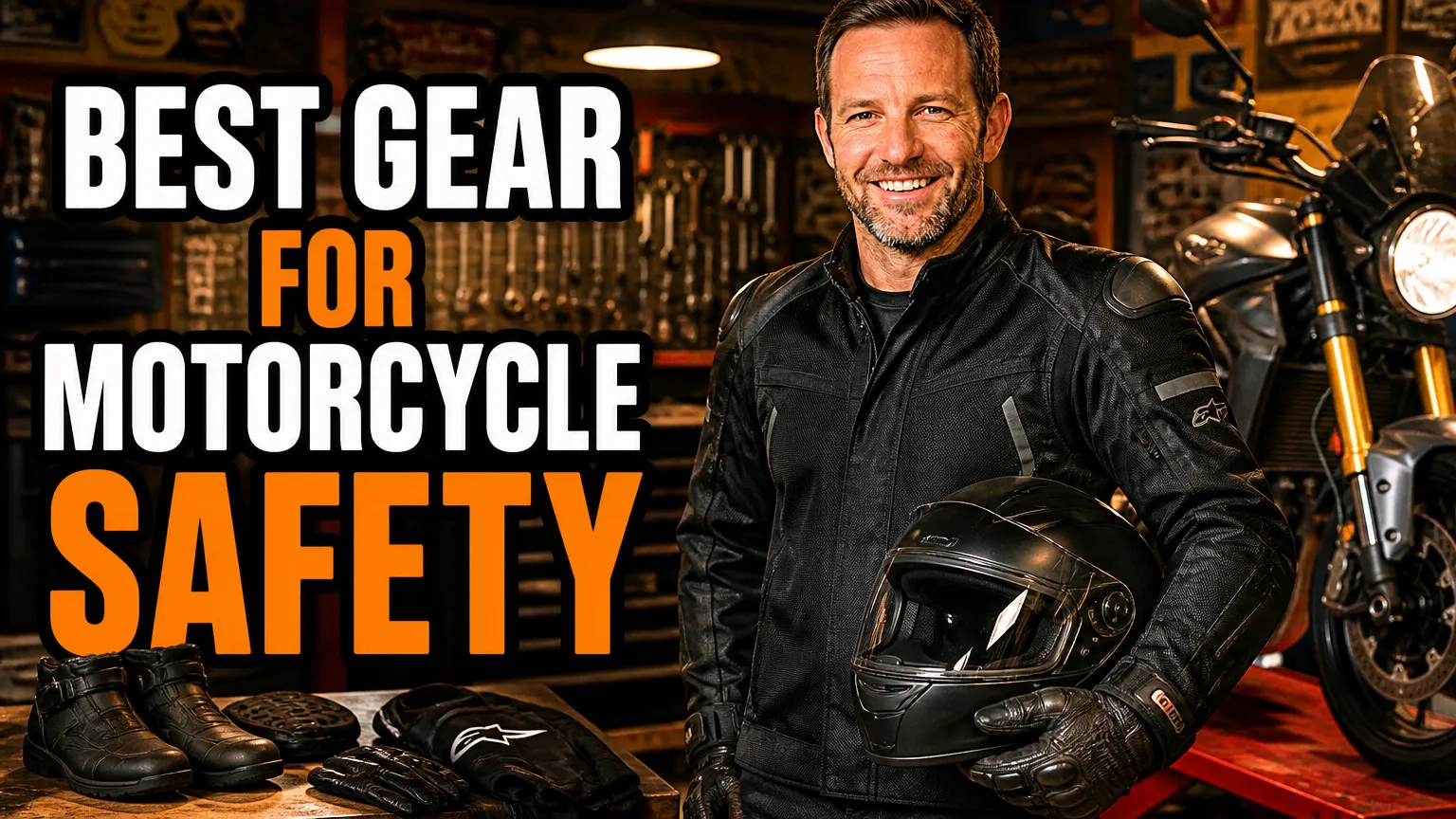
I choose motorcycle safety gear by asking one practical question: will it stay in the right place and protect me comfortably enough that I’ll wear it on every ride? A certified helmet matters, but so do abrasion-resistant clothing, gloves, boots and gear that helps me see and hear clearly.
Below, I’ve gathered nine specific products across those categories. My picks cover different needs, from a full-face helmet and ventilated clothing to an airbag vest and hearing protection. Product availability and specifications can vary by region or model year, so I always check the product label and current manufacturer information before buying.
- I prioritize a properly fitted, certified helmet and gear that stays securely in place.
- I match jackets, pants, gloves and boots to my riding conditions without sacrificing coverage.
- I treat an airbag vest, back protector and earplugs as useful additions, not substitutes for core gear.
- I check certification labels, armor compatibility and fit before making a purchase.
1. Shoei RF-1400 — My Full-Face Helmet Pick
I put the helmet first because it protects the part of me I’m least willing to compromise: my head. The Shoei RF-1400 is a full-face helmet with Shoei’s AIM+ shell construction, a multi-ply composite design, and a face shield system made for a secure seal. It’s a premium option, but its fit and finish make it one I’d consider for frequent road riding.
The RF-1400 carries DOT certification in the United States and Snell M2020D certification. I still check the certification label inside the specific helmet I’m buying, since requirements and labels can differ by market. Shoei also includes an emergency cheek-pad release system, which can help trained responders remove the cheek pads during an emergency.
What I like and what I check
I value the RF-1400’s shield fit and its Pinlock-ready shield setup, which gives me the option to add a compatible anti-fog insert. A helmet can’t help much if it distracts me with fogging or discomfort, so I treat clear vision and a comfortable fit as real safety considerations.
I never buy a helmet based on brand reputation alone. I try it on and check that it sits snugly without painful pressure points, moves very little when I rotate it, and suits my head shape. If the RF-1400 doesn’t fit securely, I’d choose another certified helmet that does.
2. REV’IT! Sand 4 H2O Jacket — My Versatile Textile Choice
For an all-around textile jacket, I like the modular approach of the REV’IT! Sand 4 H2O. It’s built for changing conditions, with ventilation, a removable waterproof layer and a removable thermal liner. I find that combination useful when one ride starts cool, turns warm and ends in rain.
The Sand 4 H2O uses abrasion-resistant textile construction and includes SEEFLEX CE Level 2 armor at the shoulders and elbows. It also has a pocket for a compatible back protector, which I’d fill rather than treat as an optional detail. I check the garment’s certification label and current spec sheet, since exact construction and included components can vary by version or market.
Why fit matters as much as features
I check that the shoulder and elbow armor remains centered when I reach for the bars. A jacket with impressive materials can still be a poor choice if it rides up or lets its protectors shift out of place. I also adjust the waist, cuffs and arm closures so the jacket stays settled when I’m moving.
The Sand 4 H2O can be a substantial investment, and its multiple liners take a little more work than a simple summer jacket. For riders who often encounter mixed weather, though, I see the value in having ventilation and removable layers in one garment.
3. Dainese Drake Super Air Tex Pants — My Hot-Weather Riding Pick
I pay close attention to leg protection because ordinary jeans aren’t designed to provide the abrasion resistance or impact protection I want on a motorcycle. The Dainese Drake Super Air Tex pants are a textile option with ventilated panels, making them worth considering for warm-weather riding when airflow matters.
The pants include removable knee protectors and have pockets for compatible hip protection. I check exactly which protectors come with the version I’m buying and whether hip armor is included or sold separately. I also look at the garment’s certification label rather than assuming that a product name or appearance tells me its protection class.
Getting the coverage right
I want the knee armor to sit over my knees in a normal riding position, not just when I’m standing in a shop. I sit on a motorcycle or a similar seat when I check the fit, then bend my knees and move around to see whether the panels pull or the protectors slide.
The Drake Super Air Tex is a more specialized choice than a heavy, all-season touring pant. I’d choose it when ventilation is a priority, and pair it with a jacket that provides secure waist coverage. If I ride in cold or wet conditions often, I’d compare it with a dedicated weatherproof option instead.
4. Alpinestars SP-8 V3 Gloves — My Protective Street Glove Pick
My hands are among the first things I instinctively put out when I fall, so I don’t ride in casual gloves. The Alpinestars SP-8 V3 is a full-length leather motorcycle glove with a hard knuckle protector, reinforced areas and a design intended to cover more of the wrist than a short-cuff glove.
The SP-8 V3 uses leather construction and includes a bridge between the ring and little fingers. That design helps connect two fingers that can be vulnerable in a slide. The model is sold with CE-rated protection, but I still verify the current label and certification details on the pair I’m considering because product versions can differ.
My glove fit test
I look for a close fit without restricting finger movement or circulation. I make a fist, reach for imaginary controls and check that the glove doesn’t bunch at the palm. I also confirm that the cuffs overlap my jacket sleeves so there’s no exposed gap when I’m in a riding position.
The SP-8 V3 is a good style of glove for street riders who want more coverage than a short summer glove provides. Leather can feel warm on hot days, so I’d weigh ventilation and weather conditions against coverage before choosing it for every season.
5. Alpinestars SMX-6 V2 Boots — My Supportive Road-Riding Boot
I want motorcycle boots to cover my ankles and stay on my feet if I slide. The Alpinestars SMX-6 V2 is a road-focused boot with a tall design, ankle protection and a closure system that helps me secure it around my foot and lower leg. It’s a more protective choice than a regular street shoe.
The SMX-6 V2 has Alpinestars’ ankle protection system and reinforced areas intended for motorcycle use. It’s CE-certified footwear, but I check the boot’s label for the relevant standard and protection markings rather than relying only on a listing. I also pay attention to sole grip, since a boot should give me a stable footing when I stop.
Comfort on and off the bike
I walk around in boots before committing to them, and I check whether I can operate the shifter and rear brake without struggling. The right boot should feel supportive without creating pressure that distracts me. I also confirm that the closure stays secure and that the boot fits under or over my riding pants as intended.
The SMX-6 V2 has a sportier, taller feel than a casual riding shoe, so it may not suit every commute or walking-heavy trip. For me, that trade-off makes sense when I want more ankle coverage and a boot built specifically for riding.
6. Helite Turtle 2 Airbag Vest — My Added Impact-Protection Layer
An airbag vest adds another layer to my setup, but I think of it as a supplement rather than a replacement for a helmet, armor or proper riding clothes. The Helite Turtle 2 is a mechanical-tether airbag vest: a cord attaches to the motorcycle, and the system is designed to inflate if the rider separates from the bike with enough force.
The Turtle 2 places its airbag over an external back protector, a design Helite describes as its Turtle concept. Before riding, I follow the manufacturer’s instructions for choosing and fitting the vest, attaching the tether correctly and checking the CO₂ cartridge. I also review its current certification details and service requirements before buying.
What I consider before using one
I need the vest to fit over my jacket without restricting my movement, and I make sure its tether is routed so it can release correctly if I leave the motorcycle. The setup takes more attention than putting on a regular jacket, but I consider that routine part of using an airbag system responsibly.
The Turtle 2 is a particularly relevant option for riders comfortable with a tethered system. I compare it with electronic airbag products if I don’t want a tether, while keeping in mind that each system has different fit, upkeep and operating requirements.
7. Dainese Pro-Armor G2 2.0 — My Back-Protector Upgrade
Many jackets have a pocket for a back protector but don’t include one. When my jacket is compatible, I consider the Dainese Pro-Armor G2 2.0 as an insert option. It’s a flexible back protector designed to fit selected Dainese jackets, so I check the pocket dimensions and compatibility information before ordering.
The Pro-Armor G2 2.0 is marked as a Level 2 back protector under the applicable EN 1621-2 standard. I confirm that rating on the product label and make sure the protector covers the area intended by the manufacturer. A Level 2 marking is useful information, but it doesn’t mean every protector fits every jacket.
Check the pocket, not just the label
I slide the protector into my jacket and check whether it lies flat, reaches the expected coverage area and stays in position when I move. If it bunches up or hangs too low, I don’t assume it will perform as intended. I look for a protector specifically compatible with my garment instead.
The G2 2.0 is a practical way to complete a jacket that has a suitable insert pocket. I’d rather verify compatibility than buy a highly rated protector that doesn’t sit correctly in the jacket I actually wear.
8. Alpine MotoSafe Tour Earplugs — My Hearing-Protection Essential
Wind noise can become exhausting on a motorcycle, and repeated loud exposure can harm hearing. I use motorcycle-specific earplugs rather than treating noise as an unavoidable part of riding. Alpine MotoSafe Tour earplugs are designed for riding and use acoustic filters intended to reduce wind and traffic noise while keeping important sounds more perceptible than ordinary foam plugs may.
The Tour version is generally listed with an SNR value of 17 dB. I treat that number as a product rating, not a promise that every sound will be reduced by exactly the same amount for every rider. Fit, helmet design and individual hearing all affect the result, so I follow the package instructions and make sure each plug seals correctly.
Comfort and safe awareness
I insert earplugs before putting on my helmet, then check that the helmet doesn’t dislodge them. I want a comfortable seal that reduces fatigue without making me feel disconnected from what’s happening around me. I never use noise reduction as a reason to ride without checking mirrors and surroundings carefully.
Earplugs are small, easy to carry and useful on longer rides, which makes them one of my simplest protective additions. I replace or clean reusable plugs as directed by the manufacturer and avoid using damaged or dirty ones.
9. Pinlock 120XLT Insert — My Anti-Fog Visibility Add-On
Clear vision is part of my safety setup, especially when temperatures drop or moisture builds up inside a helmet. The Pinlock 120XLT is an anti-fog insert that fits inside a compatible helmet face shield. It creates a sealed area that helps limit condensation, but it only works as intended when I buy the exact insert made for my shield.
I check the helmet maker’s compatibility list before ordering, because Pinlock inserts are not universal. I also confirm whether my helmet already includes an insert or only has a Pinlock-ready shield. Installation needs to follow the instructions so the insert sits evenly and forms a proper seal.
Keep the shield and insert in good shape
I handle the insert gently and clean it only as directed. Scratching or damaging the surface can affect visibility, so I avoid treating it like ordinary hard-coated glass. If the insert is loose, damaged or no longer sealing properly, I replace it rather than trusting it to control fogging.
The 120XLT can be a useful addition for riders who regularly encounter cold, damp or changing weather. I still keep my shield clean and leave myself enough time to stop safely if visibility becomes poor.
How I Choose Gear That I’ll Actually Wear
I start with fit, then check certification and coverage, and only then compare extra features. A certified protector that shifts around or a jacket I leave at home because it’s uncomfortable won’t serve me well. I try items on in a riding position and confirm that separate pieces work together.
I also think about the ride I’m preparing for. Ventilated gear suits hot weather, while waterproof layers help in rain; neither is automatically the best choice for every trip. My goal is a setup that matches my conditions and keeps abrasion-resistant material and armor where they belong.
A simple pre-ride check
- I fasten my helmet securely and confirm it fits snugly.
- I check that jacket and pants armor sits over the areas it’s meant to protect.
- I close glove and boot fasteners and make sure clothing overlaps without gaps.
- I attach an airbag tether as instructed and confirm any insert or shield is in good condition.
- I carry and fit earplugs before I set off, not after wind noise becomes distracting.
For me, the best motorcycle safety gear is a complete, well-fitted system rather than one expensive purchase. I’d build it piece by piece, starting with a helmet and protective clothing, then add compatible armor and useful accessories. Before riding, I check the fit, labels and manufacturer instructions so each part is ready to do its job.
Frequently Asked Questions
What motorcycle gear should I prioritize first?
I start with a correctly fitted, certified helmet, then add abrasion-resistant clothing, gloves, boots and impact protection.
Is a more expensive motorcycle helmet always safer?
Not necessarily. I prioritize a secure fit and recognized safety certification over price, then compare comfort, features and construction.
Are motorcycle airbag vests worth considering?
I consider an airbag vest an extra layer of protection, not a replacement for a helmet, armor or abrasion-resistant riding gear.
How should motorcycle gear fit?
I look for a snug, comfortable fit that keeps armor in place while allowing normal movement, and I follow the maker’s fitting guidance.

Related Articles

5 Motorcycle Wrist Braces and Guards I’d Choose for Confident Riding
Compare five wrist braces and guards I’d consider for street and dirt riding, with fit, support, glove compatibility, and buying…
 Jake Miller
11 min read
Jake Miller
11 min read

7 Under Armour Base Layers I’d Choose for Comfortable Motorcycle Rides
Discover seven Under Armour base layers for hot and cold rides, plus my fit tips and safety advice for wearing…
Jake Miller
10 min read

8 Best Motorcycle Base Layers for Staying Warm on Cold Rides
Compare eight rider-ready thermal base layers, from merino to synthetic options, with fit, warmth, layering advice, and picks for cold-weather…
Jake Miller
11 min read