
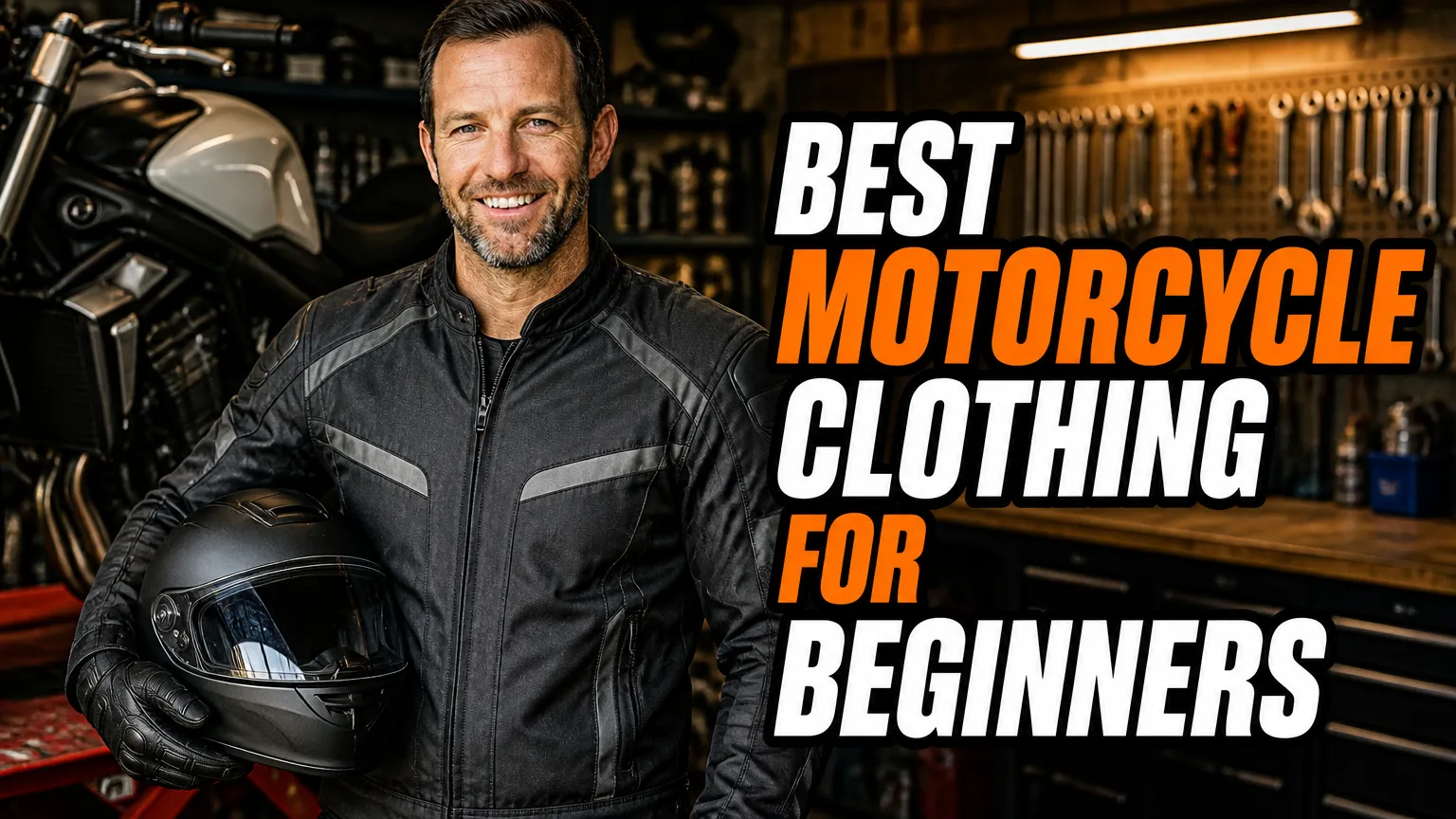
Choosing my first riding outfit was less about looking the part and more about finding gear I’d actually wear on every ride. The best motorcycle clothing for beginners should offer meaningful protection, fit comfortably on the bike, and suit the weather and roads I ride most often.
I’ve put together this list around specific products from established brands, covering jackets, riding jeans, gloves, boots, and rainwear. I also share what I’d check before buying, because protective gear only works as intended when it fits correctly and is made for motorcycle use.
- I’d build a complete kit: jacket, protective pants, gloves, and over-the-ankle boots.
- I check garment certification, armor placement, and fit before focusing on styling or price.
- I prefer versatile gear that suits my usual riding conditions, with a separate rain layer if needed.
- I treat a certified helmet as essential, even though this list focuses on clothing.
One important note from my own gear-buying approach: a product’s protective features and certification can vary by version, market, and year. I always check the label and manufacturer’s current specifications before purchasing, and I try gear on in my normal riding position whenever possible.
1. REV’IT! Eclipse 2 Jacket — My Lightweight Warm-Weather Pick
When I want airflow for summer rides, the REV’IT! Eclipse 2 is one of the first jackets I’d consider. Its large mesh panels are designed to let air through, while the polyester construction and reinforced areas provide more coverage than an ordinary casual jacket.
The Eclipse 2 comes with SEESMART CE-level 1 protectors at the shoulders and elbows, and it has a pocket for a back protector, which is generally sold separately. I like that setup for a beginner because it makes the included protection easy to understand while leaving room to upgrade.
What I’d check before buying
I’d make sure the shoulder and elbow armor sits over my joints when I lean forward, not just when I’m standing in front of a mirror. I’d also budget for a compatible back protector if one isn’t included with the version I’m considering.
This is a warm-weather choice, not my answer to every season. Mesh is great when the air is hot, but I’d pair the jacket with a warm mid-layer or choose a more weather-focused option when temperatures drop.
2. Alpinestars Andes V3 Drystar Jacket — My All-Weather Touring Option
For commuting or longer rides in unpredictable weather, I’d look at the Alpinestars Andes V3 Drystar. It combines a waterproof, breathable Drystar membrane with a removable thermal liner, giving me more flexibility than a dedicated mesh jacket when conditions change.
The Andes V3 includes shoulder and elbow protection, adjustment points, and ventilation openings intended to help manage comfort across different temperatures. Its touring-oriented cut also offers coverage that I appreciate when I’m seated on a bike for longer stretches.
Where I think it makes sense
I’d choose this jacket if I ride regularly in cool or wet weather and want one outer layer to handle a range of conditions. Its waterproof construction is convenient, though I’d still check the cuffs and collar carefully because rain can find its way in through gaps around openings.
I’d confirm the exact armor and garment certification on the model sold in my region, then check the fit with the thermal liner both in and out. If I mostly ride in hot weather, I’d find the less insulated, more ventilated Eclipse 2 easier to live with.
3. Alpinestars Copper V3 Denim Pants — My Casual-Looking Riding Jeans Pick
I understand why beginners are drawn to motorcycle jeans: they look familiar, feel less like a racing suit, and work well for everyday errands. The Alpinestars Copper V3 Denim Pants are motorcycle-specific jeans, with protective construction and knee armor rather than just ordinary denim styling.
The Copper V3 includes knee protectors and has pockets for optional hip armor. I’d check the product listing and label for the exact certification and included components, because the protection package can differ between versions and markets.
Why I wouldn’t substitute regular jeans
Regular denim isn’t designed to provide the same combination of abrasion resistance, reinforcement, and impact protection as riding jeans. I’d also check that the Copper V3’s knee armor stays centered over my knees when I’m seated, since armor that shifts out of place is less useful.
For me, these pants make the most sense for shorter rides and everyday use when I want a familiar fit. I’d still wear dedicated motorcycle pants rather than treating any pair of fashion jeans as riding protection.
4. REV’IT! Detroit 2 TF Jeans — My Alternative for Protective Denim
The REV’IT! Detroit 2 TF is another motorcycle-specific denim option I’d compare with the Copper V3. It uses Cordura denim and includes SEESMART knee protectors, with provision for hip protectors on compatible versions. I like the more straightforward jeans format for riders who want gear that doesn’t feel overly technical.
With any riding jeans, I focus on how the garment behaves when I’m sitting on the motorcycle. A pair can feel comfortable while standing but ride up at the ankles or pull uncomfortably at the knees once I’m in the riding position.
How I’d choose between riding jeans
I’d compare the Detroit 2 TF and Copper V3 in person if I could, paying attention to waist comfort, leg length, stretch, and where the knee armor lands. I’d also look for the garment’s protective classification on its label rather than assuming that two motorcycle jeans provide identical coverage.
Neither pair replaces a more substantial textile or leather trouser for every kind of riding. For my beginner kit, though, a well-fitting, motorcycle-specific jean can make protective gear easier to wear consistently on ordinary trips.
5. Five RS3 Evo Gloves — My Everyday Starter Glove Choice
I consider gloves essential from the first ride, not an optional accessory to add later. The Five RS3 Evo is a practical short-cuff glove with a textile construction, palm reinforcement, and protective elements around the knuckle area, making it a sensible model to try for everyday road use.
Glove protection and certification are important details to check rather than guess at from product photos. I’d look at the current model’s label and specifications, then make sure the glove’s protective panels cover the areas they’re meant to protect without restricting my fingers.
Fit matters as much as features
I want a glove to fit snugly without cutting off circulation or making it difficult to operate the controls. I test the grip, throttle, and brake lever with the gloves on, and I check that the cuffs overlap my jacket sleeves in my usual riding position.
The RS3 Evo’s shorter cuff can feel convenient for casual riding, but I’d pay attention to the gap between glove and jacket. If I wanted a longer cuff or a more substantial glove for colder conditions, I’d compare other models before settling on this one.
6. Alpinestars SMX-1 Air V2 Gloves — My Ventilated Warm-Weather Option
For hot days, I’d also consider the Alpinestars SMX-1 Air V2. It’s a short-cuff glove with mesh and perforated materials to encourage airflow, alongside a hard knuckle protector and reinforcement in key areas. That combination makes it more suitable for riding than an ordinary pair of lightweight summer gloves.
Alpinestars lists the SMX-1 Air V2 as CE-certified to the applicable motorcycle glove standard. I’d still verify the current certification marking and sizing details on the exact version I’m buying, since product specifications can change over time.
My comfort and protection trade-off
I’d choose the SMX-1 Air V2 when ventilation is a priority, but I wouldn’t treat an airy glove as a year-round solution. Cooler-weather gloves usually offer more coverage and insulation, while a full-length cuff can make it easier to cover the wrist and overlap a jacket sleeve.
Before buying, I’d flex my fingers and hold a set of handlebars if the shop allows it. A glove should let me feel the controls without bunching at the palm or pulling tight across my knuckles.
7. TCX Street 3 Air Shoes — My Low-Key Hot-Weather Footwear Pick
I like the TCX Street 3 Air for riders who want footwear with a casual sneaker-inspired look but motorcycle-specific features. The Air version is designed with ventilated materials, while the shoe’s construction includes protective reinforcement and a Groundtrax outsole for grip and stability.
It also uses TCX’s Zplate insert, designed to balance flexibility for walking with resistance to crushing and bending. I’d check the manufacturer’s current information for the precise protective features and certification of the model available to me.
What I’d look for in a riding shoe
I’d make sure the Street 3 Air fits firmly around my heel and doesn’t slide around when I walk. I’d also confirm that its protective coverage suits my needs: this is a shoe-style option, not the same as a tall motorcycle boot that covers more of the lower leg.
For regular warm-weather commuting, I’d value its ventilation and everyday appearance. If I ride in colder or wetter conditions, I’d compare a waterproof or taller boot instead of expecting the Air model to provide weather protection it wasn’t designed for.
8. Oxford Rainseal Over-Jacket and Over-Trousers — My Packable Wet-Weather Layer
I’d keep a waterproof over-layer available if I ride in a place where rain can arrive unexpectedly. Oxford’s Rainseal over-jacket and over-trousers are designed to be worn over riding gear, providing a practical way to add weather protection without replacing my usual jacket and pants.
I like the over-suit approach because it can help me adapt a ventilated or non-waterproof outfit when the forecast changes. Before buying, I’d check the current Rainseal set’s sizing chart, entry openings, and packed dimensions, then make sure it fits over my actual riding clothes.
How I’d make rainwear work
I’d practise putting the layers on before I’m caught in a downpour, especially if I need to pull the trousers over boots. I’d also check that cuffs and closures sit securely, since water can enter through a loose wrist, ankle, or collar opening.
Rainseal is an outer weather layer, not a substitute for protective riding gear. I’d wear it over my motorcycle jacket and pants, and I’d avoid assuming that waterproof fabric alone provides impact or abrasion protection.
How I’d Put Together a Beginner Riding Outfit
If I were buying my first set of clothing now, I’d start with the gear I need for my most common rides: a protective jacket, motorcycle-specific pants, gloves, and footwear made for riding. I’d add rain protection if I expected to ride in wet conditions, and I’d treat a properly certified helmet as essential even though it isn’t clothing.
I’d prioritize fit and protective construction over brand names or a matching look. I’d check that the armor stays in place while seated, that my sleeves and trouser legs overlap appropriately, and that I can move comfortably enough to steer, brake, and shift without restriction.
My pre-purchase checklist
- I check the garment’s label and manufacturer details for its protective certification.
- I confirm which armor is included and whether back or hip protection costs extra.
- I try the gear on in a riding position and check that armor stays over my joints.
- I choose materials and layers that make sense for my local temperatures and rain.
- I leave room in my budget for a complete outfit instead of spending it all on one item.
For my priorities, the REV’IT! Eclipse 2 is a strong place to start for hot weather, while the Alpinestars Andes V3 Drystar offers a more weather-oriented approach. I’d pair either with well-fitting motorcycle jeans, properly protective gloves, and riding footwear suited to the roads and climate I actually experience.
Ultimately, the best motorcycle clothing for a beginner is the protective gear that fits well enough to wear consistently. I’d take time to compare sizes, verify the specifications, and build my kit in sensible stages rather than relying on everyday clothes that were never designed for riding.
Frequently Asked Questions
What motorcycle clothing should a beginner buy first?
I’d start with a certified helmet, a protective jacket and pants, gloves, and over-the-ankle motorcycle boots. Choose gear that fits securely and suits your riding conditions.
Is motorcycle denim protective enough for beginners?
It can be, if it is motorcycle-specific, has abrasion-resistant construction, and includes protective armor. I check the garment’s certification and fit rather than relying on its appearance.
Do I need waterproof motorcycle clothing?
I find waterproof layers useful for regular commuting and changeable weather. A removable liner or separate rain suit can also help you adapt without buying a heavy all-weather outfit.
How should motorcycle clothing fit?
I look for a snug, comfortable fit that keeps armor over the joints when I sit in my riding position. Gear should not restrict movement or flap excessively at speed.

Related Articles

5 Motorcycle Wrist Braces and Guards I’d Choose for Confident Riding
Compare five wrist braces and guards I’d consider for street and dirt riding, with fit, support, glove compatibility, and buying…
 Jake Miller
11 min read
Jake Miller
11 min read

7 Under Armour Base Layers I’d Choose for Comfortable Motorcycle Rides
Discover seven Under Armour base layers for hot and cold rides, plus my fit tips and safety advice for wearing…
Jake Miller
10 min read

8 Best Motorcycle Base Layers for Staying Warm on Cold Rides
Compare eight rider-ready thermal base layers, from merino to synthetic options, with fit, warmth, layering advice, and picks for cold-weather…
Jake Miller
11 min read