
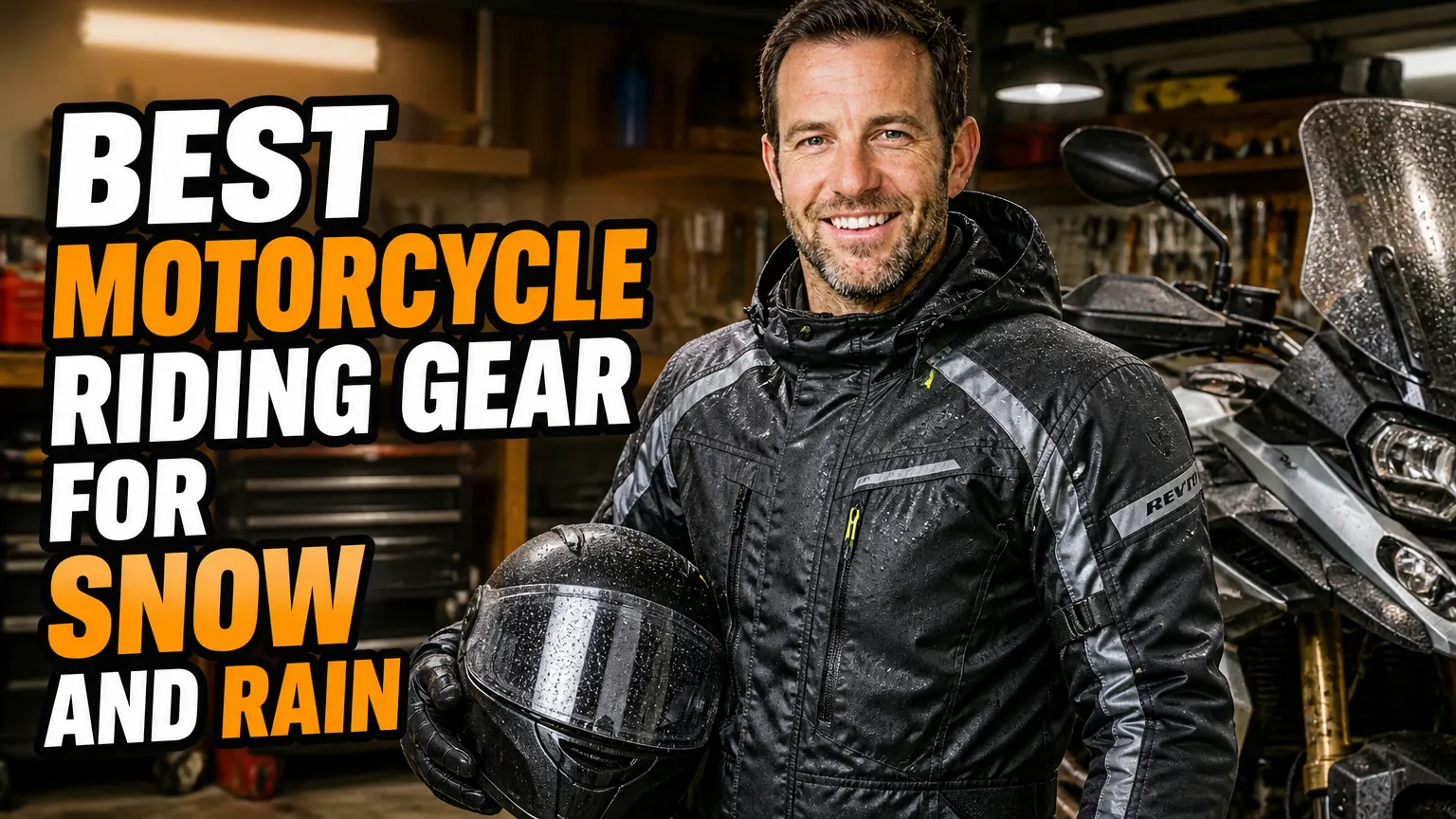
Cold, wet rides can turn uncomfortable quickly, especially when rain gets through a cuff or wind chills damp clothing. When I choose gear for winter conditions, I focus on keeping water out, retaining warmth, and preserving the freedom of movement I need to control the motorcycle.
There is no outfit that makes icy roads safe. I treat snow as a warning to check the route and conditions carefully, and I do not ride when ice, packed snow, or poor visibility makes traction or stopping unreliable. The gear below can help with cold rain and chilly commutes, but it cannot replace sound judgment.
- I prioritize waterproof construction, insulated layers, and closures that seal at the neck, wrists, and ankles.
- Laminated jackets and pants are my preference for long stretches of steady rain.
- I use heated gear to supplement insulation, not as a substitute for a weatherproof outer layer.
- I check fit with all my layers on and avoid riding on icy or traction-compromised roads.
1. Klim Badlands Pro A3 Jacket — My Premium All-Weather Shell
When I want a high-spec jacket for long days in unpredictable weather, I look at the Klim Badlands Pro A3. It uses a Gore-Tex Pro shell designed to keep rain out without relying on a loose drop-in waterproof liner, and its rugged construction is aimed at serious adventure touring.
The Badlands Pro A3 includes impact protection at key areas, with the exact armor configuration depending on the market and jacket version. I always confirm the included shoulder, elbow, and back protection before buying, then check the fit with my cold-weather layers underneath. Its large vents are useful in milder weather, but I close them fully when cold rain is blowing in.
This is a substantial, premium-priced jacket, commonly selling around $1,200 to $1,400 depending on size, region, and retailer. I would consider it for frequent touring in rough weather rather than an occasional rainy commute. For winter use, I pair it with a warm mid-layer because a waterproof shell alone does not provide much insulation.
2. REV’IT! Poseidon 3 GTX Pants — My Pick for Wet-Touring Legs
I pay close attention to pants because cold water can run down a jacket and collect at the waist or knees. The REV’IT! Poseidon 3 GTX pants use a laminated Gore-Tex construction, which I find appealing for sustained rain because the outer fabric is less prone to becoming saturated than many lined designs.
The pants are built for touring and include impact protection at the knees, with hip protection and the precise armor setup varying by specification. I check the product listing for the version sold in my region, then make sure the knee armor stays aligned when I sit in my riding position. A secure connection to a compatible jacket can also help close the gap at the waist.
At roughly $650 to $750, these are an investment. I would choose the Poseidon 3 GTX when long wet rides are part of my routine, and I would wear a thermal base layer beneath them as temperatures fall. I avoid stuffing bulky insulation under snug pants, since restricted movement and displaced knee armor are problems I do not want on the bike.
3. Alpinestars Andes v3 Drystar Jacket — My Versatile Everyday Choice
For a more approachable touring jacket, I consider the Alpinestars Andes v3 Drystar. Its Drystar waterproof and breathable membrane and removable thermal liner give me a flexible setup for changing seasons: I can add the liner on cold days and remove it when the weather warms.
The Andes v3 includes Nucleon Flex Plus protection at the shoulders and elbows, generally listed as Level 1 armor. I check whether a back protector is included or needs to be purchased separately, because the configuration can differ. Its combination of textile construction, storage, and weather features makes it practical for commuting as well as weekend rides.
Prices often fall around $400 to $500, although sales can shift that range. I see the Andes v3 as a good value when I want one jacket for mixed conditions rather than a dedicated premium shell. For hours of heavy rain, I still pay attention to the fit and closure of the cuffs, collar, and waist, and I carry a backup rain layer if conditions are severe.
4. REV’IT! Taurus 2 GTX Gloves — My Choice for Cold, Wet Hands
When my hands get cold, operating controls becomes harder, so I treat gloves as essential safety gear rather than an accessory. The REV’IT! Taurus 2 GTX gloves combine a Gore-Tex waterproof membrane with Gore Grip construction, which is designed to help keep the glove’s layers from shifting and preserve a more direct feel at the controls.
The Taurus 2 GTX is a substantial touring glove with protective features such as a hard knuckle shell and reinforcement in high-wear areas. I check the manufacturer’s current sizing and certification details because product specifications can vary by model year and market. For winter riding, I also test whether the glove fits comfortably over my jacket cuff without bunching or leaving a gap.
These gloves are commonly priced in the premium range, often around $300 to $400. I would pick them for wet touring when I want a waterproof, protective glove without wiring my hands to the bike. If it is cold enough that insulation alone is not working for me, I consider heated gloves or heated grips as an additional measure.
5. Gerbing 12V T5 Heated Gloves — My Heated-Hand Option
For rides where ordinary insulated gloves are not enough, I look at the Gerbing 12V T5 Heated Gloves. They are designed to run from a 12-volt motorcycle power system and use Gerbing’s heating technology, so I can get active warmth instead of relying only on trapped body heat.
Before I buy, I confirm the exact T5 version, its waterproof and insulation details, and what wiring or temperature controller is included. Heated gloves need a reliable power connection, and I route cables so they cannot snag or interfere with steering. I also make sure I can operate the controls comfortably while wearing them, since a warm glove is no help if it compromises dexterity.
Prices vary, but I would budget roughly $200 to $300 before checking for a controller or installation accessories. I treat heated gloves as part of a system: a windproof jacket, warm core, and dry cuffs help my hands stay warmer. If my gloves get soaked or the electrical connection is unreliable, I stop and address the problem rather than assuming the heat will fix it.
6. TCX Infinity 3 GTX Boots — My Waterproof Touring Boot Pick
I want boots that protect my feet and ankles while keeping rain from pooling inside them. The TCX Infinity 3 GTX is a touring and adventure-style boot with a Gore-Tex membrane, a tall profile, and protective construction intended for mixed road and light off-road use.
When I try the Infinity 3 GTX on, I check that the toe box leaves room for a warm sock without making the boot loose. I also test the closure system and ankle movement while seated on the bike. A waterproof boot can still let water in at the top if rain runs down a trouser leg, so I make sure my pants overlap the boot in a way that suits the riding conditions.
The boots are often priced around $350 to $450, depending on retailer and size availability. I like this type of boot for riders who need a balance of touring comfort and added protection, but I would not expect it to feel as light or flexible as a casual motorcycle shoe. I break in new boots before a long winter trip and verify that I can operate the shift and brake levers naturally.
7. Aerostich Roadcrafter Classic — My One-Piece Rain-Blocking Option
When I want a fast layer over regular clothes, I consider the Aerostich Roadcrafter Classic one-piece suit. It is a protective riding suit with a weather-resistant design, built to make getting geared up and sealing out road spray more straightforward than layering a separate jacket and pants.
I see the Roadcrafter Classic as particularly useful for commuting and touring, where I may need to put the suit on over everyday clothing. I pay close attention to the fit across the knees, elbows, and shoulders, because the suit must allow a natural riding position while keeping protective areas correctly placed. I also check care instructions and suit-specific waterproofing guidance rather than assuming any textile suit needs no maintenance.
It is a premium purchase, with prices commonly around $1,300 to $1,600 depending on options and fit. I would choose it for its practical one-piece format, not because one suit eliminates the need for warm layers. In cold conditions, I still add insulation underneath and take time to seal the neck, wrists, and ankles.
8. Warm & Safe Gen X-3 Heated Liner — My Extra Layer for Deep Cold
For a flexible warmth boost under a protective jacket, I look at the Warm & Safe Gen X-3 heated liner. It is designed to connect to a motorcycle’s electrical system and add active heat across the torso and arms, helping me manage cold without relying on an overly bulky jacket.
I confirm the current liner configuration, power draw, controller compatibility, and included cables before ordering, since accessory bundles can vary. I also check the fit under my outer jacket: the liner should sit close enough to transfer warmth but should not pull on the jacket or shift armor out of place. I use the lowest comfortable setting that keeps me warm and monitor battery or charging-system demands on my particular motorcycle.
Depending on the version and accessories, I would expect a price in the neighborhood of $250 to $350. A heated liner does not replace a waterproof shell, and it cannot keep me warm if rain has soaked my base layers. I combine it with dry insulating layers and a properly closed outer jacket for a more dependable cold-weather setup.
How I Put Together a Safer Cold-Rain Setup
I start with fit, not the product label
I try gear on with the base layer and insulation I actually plan to wear. I raise my arms, reach for the handlebars, bend my knees, and check that armor remains in place. If the gear is too tight, it can restrict movement; if it is too loose, protective panels may shift when I need them most.
I seal the places where water gets in
I check the collar, wrists, jacket-to-pants connection, and boot tops before setting off. I arrange cuffs and trouser legs according to the garment maker’s directions and make sure closures are fully secured. I also keep an eye on glove condition, because worn seams or damaged waterproof liners can undermine an otherwise solid setup.
I treat warmth and traction as separate problems
Warm gear can improve comfort, but it does not create grip on ice. I check road and weather conditions before riding, leave extra stopping distance in rain, and choose not to ride if snow or freezing conditions make the route unsafe. I carry dry spare layers for longer trips and stop if I become cold, wet, or less alert.
My Bottom Line
For sustained rain, I lean toward laminated options such as the Klim Badlands Pro A3 jacket and REV’IT! Poseidon 3 GTX pants. For a more adaptable everyday setup, the Alpinestars Andes v3 Drystar offers a removable thermal liner, while waterproof boots and gloves help protect the places that often get cold and wet first.
I add heated gear when insulation is not enough, but I build the outfit around fit, waterproofing, and reliable protection. My final check is always the road itself: if snow or ice has made traction unpredictable, I leave the motorcycle parked.
Frequently Asked Questions
What motorcycle gear matters most for cold, rainy rides?
I prioritize a waterproof outer layer, insulated or heated gloves, waterproof boots, and warm layers that do not restrict movement.
Are waterproof motorcycle clothes enough for winter riding?
Not always. I combine waterproof gear with insulation and wind protection, and I avoid riding when ice or snow makes traction unsafe.
Should I choose a laminated waterproof jacket or one with a removable liner?
I prefer a laminated jacket for sustained rain because its outer fabric is less likely to become waterlogged. A removable-liner jacket can be more versatile in changing weather.
How should motorcycle gear fit over winter layers?
I check that the gear fits comfortably with my intended base and mid-layers, while armor stays correctly positioned and sleeves and closures seal securely.

Related Articles

5 Motorcycle Wrist Braces and Guards I’d Choose for Confident Riding
Compare five wrist braces and guards I’d consider for street and dirt riding, with fit, support, glove compatibility, and buying…
 Jake Miller
11 min read
Jake Miller
11 min read

7 Under Armour Base Layers I’d Choose for Comfortable Motorcycle Rides
Discover seven Under Armour base layers for hot and cold rides, plus my fit tips and safety advice for wearing…
Jake Miller
10 min read

8 Best Motorcycle Base Layers for Staying Warm on Cold Rides
Compare eight rider-ready thermal base layers, from merino to synthetic options, with fit, warmth, layering advice, and picks for cold-weather…
Jake Miller
11 min read