
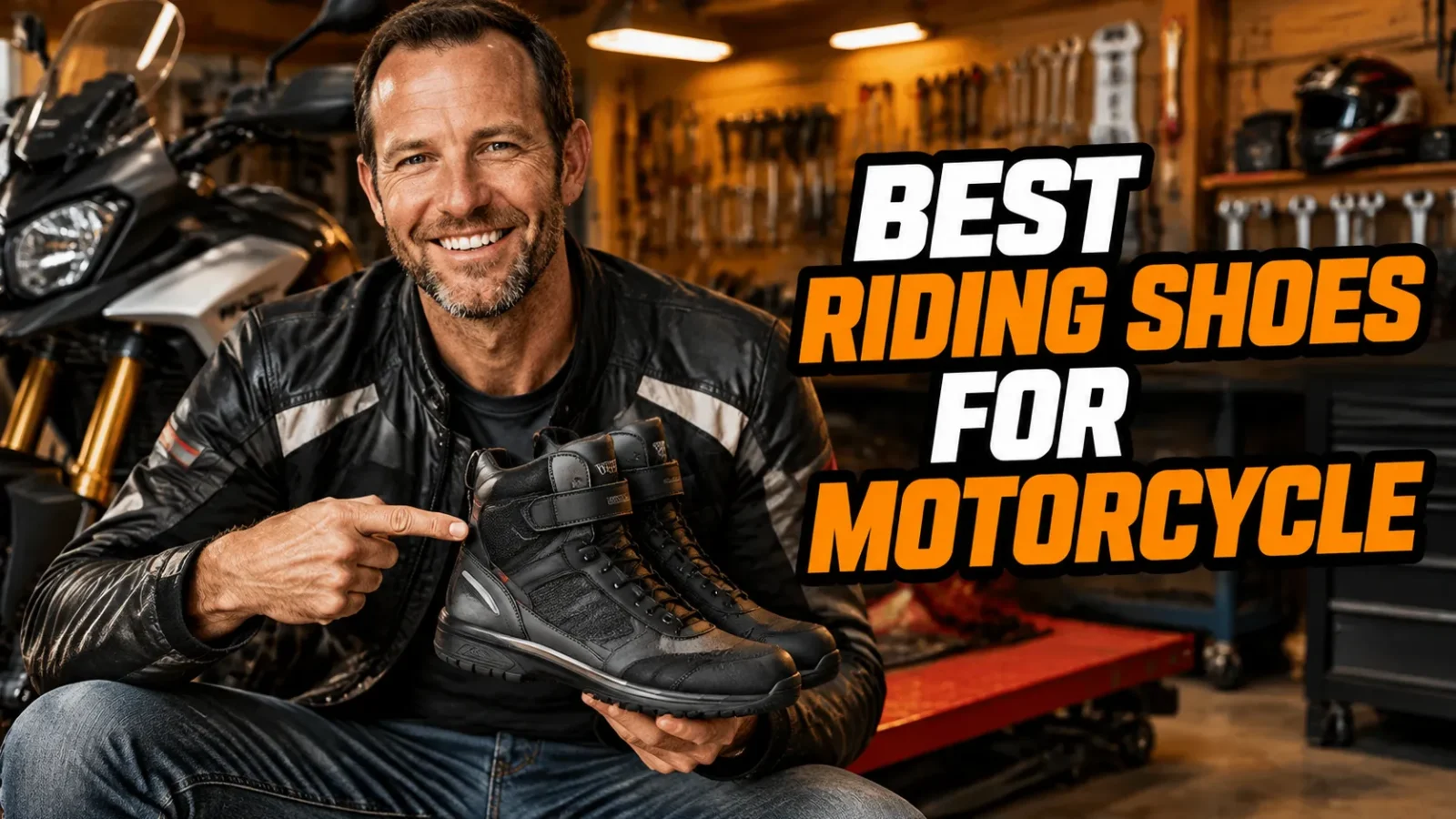
I have a confession to make. For the first few years I rode, my “riding footwear” was whatever sneakers happened to be by the door. I commuted in them, did grocery runs in them, and even took a weekend trip in them. Then I lowsided on a damp roundabout at maybe 30 mph, and my right foot slid along the asphalt for a second and a half. That second and a half changed how I think about footwear forever.
Since then, I have bought, worn out, and occasionally destroyed a genuinely embarrassing number of riding shoes. I have ridden in full race boots, tall touring boots, and everything in between. But the sweet spot for the riding most of us actually do — commuting, city riding, weekend blasts, light touring — is the motorcycle riding shoe. It protects like gear, walks like a sneaker.
If you want the deep background on how footwear protects your feet in a crash, start with this Ultimate Guide to Motorcycle Boots. It covers armor ratings, sole construction and materials in far more detail than I can here. What follows is my personal shortlist of the ten riding shoes I would actually spend my own money on today.
- My overall pick is the Alpinestars Faster-3 Rideknit — light, CE certified and comfortable enough for all-day wear.
- For wet commuting, the Dainese Metractive D-WP and REV’IT! Pioneer GTX are the two I trust most in the rain.
- Best value is the Forma Swift Dry — waterproof, CE certified and usually well under $160.
- Whatever you buy, check for an EN 13634 CE label, reinforced toe and heel, and real ankle protection.
- Riding shoes are for street and light touring. For track days or serious off-road, step up to full boots.
How I Judge a Riding Shoe
Before I get to the list, here is the filter I run every pair through. It is not complicated, but it rules out about 80% of what is sold as “riding footwear” online.
CE Certification (EN 13634)
This is non-negotiable for me. The EN 13634 standard covers abrasion resistance, cut resistance, impact protection and sole integrity. A shoe without that label is a fashion item with a motorcycle sticker on the box.
Most of the shoes below are certified at Level 1 or Level 2. Level 2 gives you more abrasion resistance and taller protective zones, but Level 1 is genuinely fine for street riding.
Ankle and Heel Protection
Your ankle is a complicated joint with a lot of small bones, and asphalt does not care. I look for moulded TPU or D3O ankle discs, a rigid heel counter, and a reinforced toe box.
The heel counter matters more than people think. In a low-side, your heel is often the first thing that hits the ground after your knee.
Sole Construction
A good riding shoe has a shank — a stiff plate inside the sole that stops your foot from folding over the peg. It also needs oil- and petrol-resistant rubber, because you will put a foot down at a fuel station eventually.
Too stiff and you cannot walk. Too soft and the sole flexes when you stamp on the peg. The best shoes balance this, and the ones below mostly get it right.
1. Alpinestars Faster-3 Rideknit — Best Overall Riding Shoe
If you only read one entry in this list, make it this one. The Alpinestars Faster-3 Rideknit is the shoe I recommend to almost every rider who asks me what to buy for street riding.
The upper mixes a lightweight microfibre with Rideknit mesh panels, which keeps weight down and airflow up. It is CE certified to EN 13634, with TPU ankle protection, a reinforced toe box and heel, and a TPR slider on the outer toe area.
What sold me was the sole. Alpinestars uses its TPF sole with an integrated shank, so it feels stiff on the peg but still flexes enough that I can walk a mile to a coffee shop without wincing. The removable anatomical footbed is a nice touch too.
Who it suits
Street riders, commuters, and anyone who wants one pair of shoes to do everything. It runs about $180 to $200, and it also comes in a women’s-specific Stella build if you need a narrower fit.
2. Dainese Metractive D-WP — Best Waterproof Commuter Shoe
I rode a full winter in these and my feet stayed dry through some genuinely miserable Yorkshire rain. The Dainese Metractive D-WP is the shoe I reach for when the forecast looks like a wall of grey.
The D-WP membrane is the headline feature. Unlike a cheap rubber liner, it is breathable, so you do not end up with swamp foot after a 45-minute commute. The upper is a mix of microfibre and textile, with TPU inserts at the ankle and rigid reinforcements in the toe and heel.
Dainese’s Groundtrax outsole gives excellent grip on wet pegs, and the CE certification under EN 13634 is there as you would expect. It looks like a normal casual shoe, which I appreciate when I am walking into a client meeting.
The trade-off
It is heavier and warmer than a mesh summer shoe, and it costs around $250. If you ride in a hot climate, get the air version instead.
3. TCX Street 3 WP — Best Everyday Street Riding Shoe
The TCX Street 3 WP is the shoe that convinced me TCX deserves more attention than it gets. It is a full-grain leather shoe with a T-DRY waterproof membrane, CE certified to EN 13634, and it just quietly works.
Protection is genuinely serious for something that looks like a smart casual boot. There are malleolus reinforcements on both sides of the ankle, a reinforced toe and heel, and a rigid insert in the sole.
TCX also fits an OrthoLite footbed, which is why I can wear these for a ten-hour day that includes three hours of walking. The leather upper breaks in nicely after a couple of weeks.
Real-world notes
Expect to pay around $200. Sizing runs fairly true, though I would go half a size up if you have wide feet or plan to wear thick socks in winter.
4. REV’IT! Pioneer GTX — Best Gore-Tex Touring Shoe
If you want the gold standard of waterproofing, you want GORE-TEX. The REV’IT! Pioneer GTX is the shoe I pack for multi-day trips because I know it will not let me down in a downpour.
The upper is leather with a GORE-TEX membrane underneath, CE certified to EN 13634. REV’IT! uses SEESOFT armor at the ankles, which is flexible when you are walking but hardens on impact.
There is a thermoformed heel cup and toe cap, plus an OrthoLite insole. The lacing system is simple and the tongue is gusseted, so water does not sneak in over the top.
Worth the money?
At roughly $300 it is the most expensive shoe on this list. But I have had a pair of REV’IT! Gore-Tex footwear last me five seasons of hard use, which works out cheaper per mile than three pairs of budget shoes.
5. Sidi Duna — Best Hot-Weather Riding Shoe
Summer riding is its own problem. You want airflow, but you also want protection, and those two goals fight each other. The Sidi Duna is the best compromise I have found.
Sidi builds it with a perforated upper and mesh panels that move a surprising amount of air. Despite the ventilation, it is still CE certified under EN 13634, with ankle protection and reinforced toe and heel sections.
The sole is a nylon-reinforced design with a decent shank, and the reflective inserts on the heel are a small but welcome detail for night riding.
Where it struggles
It is not waterproof, obviously, and the perforations mean it is a three-season shoe at best. Around $170, and worth every penny if you ride somewhere hot.
6. Forma Swift Dry — Best Value Waterproof Riding Shoe
Not everyone wants to spend $250 on footwear, and you do not have to. The Forma Swift Dry is the shoe I recommend to new riders who want real protection without emptying their bank account.
You get a full-grain leather upper, a waterproof and breathable Dry membrane, CE certification to EN 13634, and TPU ankle protection. The anti-slip rubber sole has a proper shank and grips wet pegs well.
It is not as refined as the Dainese or the REV’IT! options. The fit is a little boxier, and the membrane is not GORE-TEX. But at around $130 to $150, it delivers maybe 85% of the performance for half the price.
My honest take
If you are commuting daily in all weather and you are on a budget, buy these. If you ride 15,000 miles a year, save up for the Pioneer GTX instead.
7. Klim Blak Jak — Best Adventure-Ready Riding Shoe
Adventure riding punishes footwear differently. You are standing on pegs, walking around campsites, and occasionally putting a foot down on loose gravel. The Klim Blak Jak handles all three.
It uses a leather and textile upper with D3O ankle inserts, a reinforced toe box, and an oil- and slip-resistant rubber sole with a grippy lug pattern. It is CE certified and built with the same over-engineered mindset Klim applies to its jackets.
I like it because it feels like a proper adventure boot shrunk down to shoe height. It is comfortable off the bike and stable on it. Expect around $200.
That said, if you are doing serious dirt, a shoe is not enough. I would point you toward my roundup of the Best Motorcycle Boots for Adventure Riding, where you get shin and calf coverage that a low-cut shoe simply cannot provide.
8. Stylmartin Redback — Best Retro Urban Riding Shoe
Some of us want gear that does not scream “motorcycle” when we walk into a bar. The Stylmartin Redback is an Italian-made leather shoe that looks like a vintage work boot and protects like real riding gear.
The full-grain leather upper is beautifully finished, and underneath it you get CE certification to EN 13634, internal ankle protection, a reinforced toe and heel, and an anti-slip sole with a shank.
It is heavier than the mesh-heavy options here and it takes a couple of weeks to break in. But the leather ages beautifully, and after three seasons mine looks better than when I bought it.
If you like this military-inspired aesthetic, I have also written about best combat boots for motorcycle riding, which covers the taller, lace-up end of the same look. Expect to pay around $250 for the Redback.
9. Spidi X-Nashville H2Out — Best Sneaker-Style Waterproof Shoe
Spidi is best known for race leathers, but the X-Nashville H2Out is a genuinely good urban shoe. It is the pair I grab when I want to look like I am wearing normal sneakers but still want protection.
The H2Out membrane is Spidi’s in-house waterproof and breathable liner, and it works well in steady rain. The upper is a mix of suede and textile, CE certified to EN 13634, with reinforcements at the ankle, toe and heel.
The sole is a grippy rubber compound with a moderate shank, and there are reflective details on the heel for visibility. It is lighter than the Dainese Metractive and breathes a bit better too.
Small gripes
The laces are a little long and the tongue can dig in if you lace it too tight. Around $230, and sizing runs slightly narrow in my experience.
10. Dainese Metractive Lady D-WP — Best Women’s Riding Shoe
I have bought riding gear for a partner who rides, and the biggest frustration is that women’s versions are often just men’s shoes in smaller sizes. The Dainese Metractive Lady D-WP is not that — it is built on a genuinely different last.
You get the same D-WP waterproof membrane, the same Groundtrax outsole, TPU ankle inserts, and CE certification to EN 13634. What changes is the fit: narrower through the heel, higher through the instep, and shaped for a woman’s foot rather than scaled down.
It costs roughly the same as the men’s version, around $250. For more options in this space, my piece on the best motorcycle riding boots for women covers taller boots with the same attention to fit.
Riding Shoes vs. Full Boots: When I Switch
I love riding shoes, but I am not going to pretend they replace boots. Here is how I decide.
Riding shoes win when…
You are commuting, running errands, touring on pavement, or doing anything that involves walking at the other end. The lower cut is more comfortable, cooler, and socially invisible.
Full boots win when…
You are on track, riding off-road, or doing long high-speed motorway stints where shin and calf protection matter. If that is you, my roundup of the best motorcycle riding boots is the better starting point.
Plenty of riders own both. I certainly do. The shoes get 80% of the miles; the boots get the days that matter most.
What about work boots and combat boots?
I get asked this constantly. Some work boots have decent leather and a stiff sole, and some riders use them successfully. But most lack ankle armor and a proper CE rating. If you want to go down that road, read about best work boots for motorcycle riding first, because the good ones are the exception, not the rule.
Fit, Sizing and Care Tips From Someone Who Learned the Hard Way
Buying the right shoe is half the battle. Wearing it correctly is the other half.
Sizing
Most riding shoes run true to your normal sneaker size, but leather uppers break in and stretch slightly. Mesh and microfibre shoes do not. If you are between sizes on a mesh shoe, go up.
Always try them with the socks you actually ride in. Thick merino socks can add half a size, and cramped toes on a long ride are miserable.
Breaking in
Wear new riding shoes around the house for an hour a day for a week before a long ride. Leather models like the Stylmartin Redback genuinely need this. Mesh models barely do.
Care
Clean leather with a damp cloth and treat it with a proper leather conditioner every couple of months. Let wet shoes dry at room temperature — never on a radiator, which cooks the membrane and cracks the leather.
Final Thoughts
If you take one thing from this list, let it be this: your feet are the first thing to hit the ground in almost every crash. A $150 pair of CE certified riding shoes is not an expense, it is insurance with a sole on it.
My overall pick remains the Alpinestars Faster-3 Rideknit for its balance of protection, weight and comfort. If you ride in the rain, go Dainese Metractive D-WP or REV’IT! Pioneer GTX. If you are on a tight budget, the Forma Swift Dry will not let you down.
Whatever you choose, buy from a shop that lets you try them on, check for that EN 13634 label, and then go ride. Your feet will thank you — mine certainly have.
Frequently Asked Questions
Are motorcycle riding shoes as safe as full boots?
Not quite. Riding shoes are CE certified to EN 13634 just like boots, so they still have abrasion resistant uppers and ankle protection. What you give up is shin and calf coverage, which matters most on the track or in high speed crashes.
Can I wear riding shoes all day at work?
Yes, that is exactly what they are built for. Models like the TCX Street 3 WP and Alpinestars CR-X Drystar use sneaker style soles and cushioned insoles, so I can walk around a job site or an office without my feet screaming.
How do I know a riding shoe actually protects me?
Look for a CE mark under EN 13634 on the label, plus a reinforced toe box, heel counter and ankle discs. If a shoe has none of those, it is fashion footwear, not riding gear.
Do I need waterproof riding shoes?
If you commute year round, yes. A membrane like GORE-TEX or Dainese D-WP keeps rain out while still letting sweat escape. Cheap rubber linings keep water out but turn your feet into a swamp.

Related Articles

10 Best Tennis Shoes for Motorcycle Riding: Honest Picks From a Rider Who Tried Them
I tested the best tennis shoes for motorcycle riding to find out what actually works behind the bars, plus the…
 Jake Miller
10 min read
Jake Miller
10 min read

11 Best Footwear Options for Motorcycle Riding, Ranked by a Rider Who’s Worn Them All
I've put thousands of miles on moto boots. Here are the 11 best footwear options for motorcycle riding, from track-ready…
Jake Miller
10 min read

10 Best Non Riding Shoes That Actually Work on a Motorcycle
I have ridden thousands of miles in shoes that were never designed for a bike. Here are the best non…
Jake Miller
13 min read