
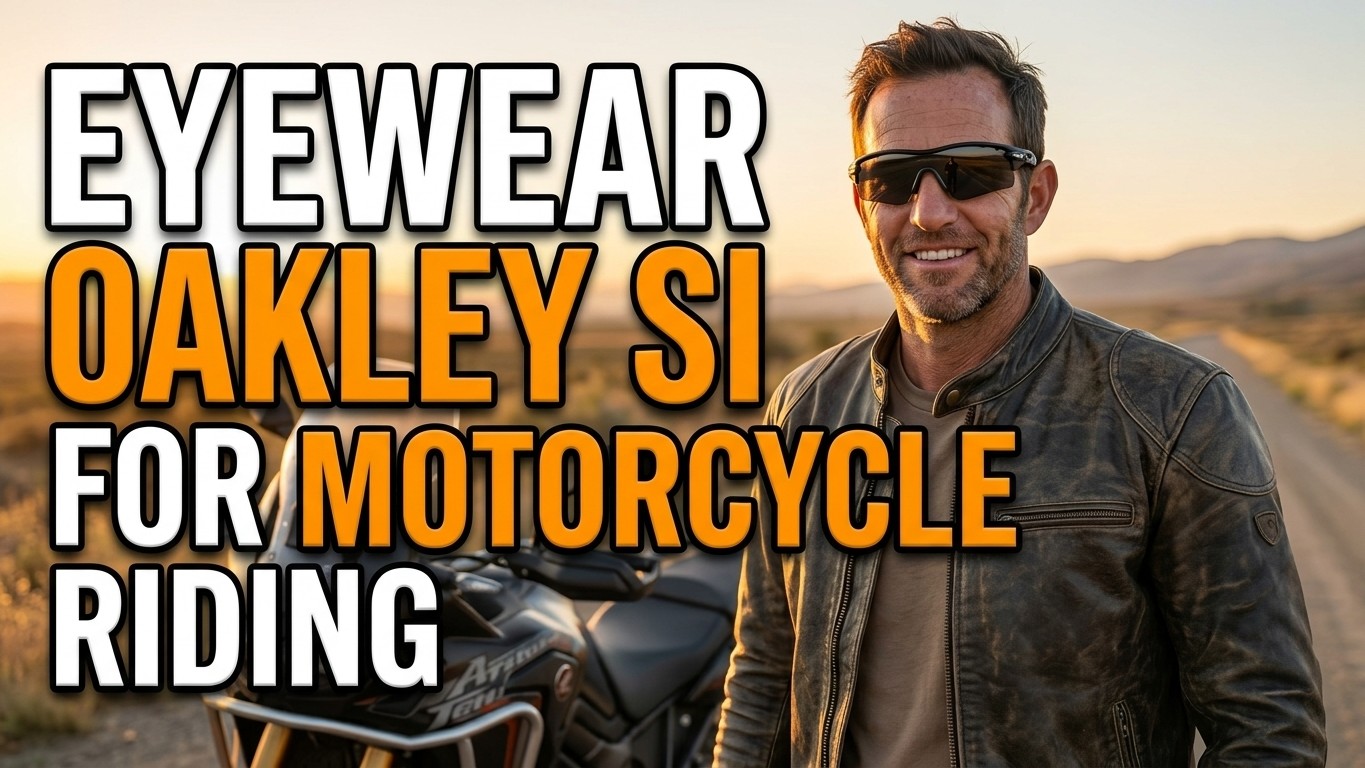
I’ve been riding motorcycles for over a decade, and I learned the hard way that regular sunglasses just don’t cut it on two wheels. After a rock chip shattered my cheap gas station shades at 70 mph, I switched to Oakley Standard Issue (SI) eyewear and never looked back.
Oakley SI was originally designed for military and law enforcement professionals who need eyewear that can withstand extreme conditions. For us riders, that translates to ballistic-rated protection, impact-resistant lenses, and frames that stay locked to your face even when you’re leaned over in a corner at triple-digit speeds.
I’ve personally tested dozens of Oakley SI models over the years, from commuting through city traffic to multi-day adventure rides through desert backroads. These seven models represent the absolute best combinations of protection, clarity, comfort, and helmet compatibility I’ve found.
- Oakley SI M Frame 3.0 offers the best overall combination of protection, ventilation, and interchangeable lens options for all-weather riding
- Ballistic-rated Plutonite lenses provide superior impact resistance compared to standard motorcycle sunglasses
- Prizm lens technology dramatically improves contrast and depth perception at highway speeds
- Thin temple designs ensure comfortable fit under any helmet without pressure points
- Most models feature interchangeable lens systems for adapting to changing light conditions throughout your ride
1. Oakley SI M Frame 3.0 — Best Overall for Versatile Riding
The M Frame 3.0 is my go-to choice for 90% of my riding. I’ve used this exact model for everything from morning commutes to all-day touring runs, and it’s never let me down.
What makes the M Frame 3.0 exceptional is its interchangeable lens system. I keep three lens sets in my tank bag: clear for night riding, Prizm Road for bright conditions, and grey polarized for variable light. Swapping lenses takes about 10 seconds once you get the hang of it.
The frame uses Oakley’s Unobtainium nose pads and ear socks that actually grip better when you sweat. I’ve ridden through summer heat waves where my entire face was dripping, and these glasses never budged. The rimless bottom design provides excellent downward visibility when you’re tucked behind a windscreen.
At around $180-220 depending on lens options, the M Frame 3.0 sits in the mid-range for Oakley SI pricing. The ballistic protection is ANSI Z87.1 and MIL-PRF-32432 certified, meaning these lenses can stop actual projectiles. For motorcycle riding, that translates to total confidence when debris kicks up from the road.
Why I Choose the M Frame 3.0 for Long Rides
The ventilation on these is outstanding. Unlike full-frame glasses that fog up the moment you stop at a red light, the M Frame’s open design keeps air circulating. I’ve never had fogging issues, even when wearing a full-face helmet with limited airflow.
The temple arms are thin enough to slide under any helmet I own without creating pressure points. This is crucial for all-day comfort. I’ve done 600-mile days wearing these, and I forget they’re even on my face.
2. Oakley SI Ballistic M Frame Alpha — Maximum Impact Protection
When I’m riding off-road or on gravel roads where debris is constant, I reach for the Ballistic M Frame Alpha. This is essentially the M Frame’s tougher older brother, designed specifically for high-risk environments.
The Alpha version uses thicker lens material and a more robust frame structure. I’ve taken hits from rocks kicked up by dual-sport tires that would have cracked lesser eyewear. The Alpha just shrugs it off. These meet MIL-PRF-32432(GL) ballistic standards for high-velocity impact protection.
The trade-off is slightly more weight compared to the standard M Frame 3.0. You’ll notice it during the first few minutes of wear, but my face adapts quickly. For the extra protection when riding in challenging conditions, I consider it worth every gram.
Pricing runs around $220-260 with basic lens options. If you frequently ride on unpaved roads or in areas with heavy truck traffic that kicks up stones, this investment pays for itself the first time it saves your vision.
Lens Options Make the Alpha Adaptable
Like the M Frame 3.0, the Alpha supports interchangeable lenses. I run Prizm TR22 lenses for most conditions, which enhance contrast on varied terrain. For dawn and dusk rides, I swap to the clear lenses with anti-fog coating.
The nose pad is slightly larger on the Alpha, which I’ve found distributes weight better during extended wear. If you’re considering the Alpha, make sure to test the fit with your specific helmet. Some riders with narrower faces find the Alpha a bit loose.
3. Oakley SI Half Jacket 2.0 XL — Best for Sport Bike Riders
My sport bike friends swear by the Half Jacket 2.0 XL, and after borrowing a pair for a canyon carving session, I understand why. The semi-rimless design provides an enormous field of view, which is critical when you’re scanning apex points through tight turns.
The “XL” designation means these fit larger faces better than the standard Half Jacket. I have an average-sized head, and the XL still fits me perfectly without feeling oversized. The coverage is excellent—I get protection from wind and debris without the bulk of full wraparound glasses.
These use Oakley’s Switchlock technology for lens changes, which is even faster than the M Frame system. Literally a single lever releases the lens, and the new one clicks into place. I’ve changed lenses at gas stations in under five seconds.
Price point is around $170-210, making these one of the more accessible Oakley SI options. The Plutonite lenses still provide 100% UV filtering and meet ANSI Z87.1 standards for high-mass and high-velocity impact protection.
Temple Design Optimized for Full-Face Helmets
The Half Jacket 2.0 XL temples are some of the thinnest in the Oakley SI lineup. When I’m wearing my Shoei RF-1400, these slide in without any interference with the cheek pads. Zero pressure points, even after hours of wear.
If you wear a modular or full-face helmet and struggle with glasses comfort, the Half Jacket 2.0 XL should be at the top of your list. Just like with the Best Glasses Frames for Motorcycle Helmets, temple thickness makes all the difference in all-day wearability.
4. Oakley SI Gascan — Best for Cruiser and Touring Riders
The Gascan is where Oakley’s sport performance meets classic styling. I wear these on my cruiser because they look right with the bike’s aesthetic while still delivering serious protection.
These are full-frame glasses with Oakley’s O Matter frame material, which is incredibly lightweight despite the solid construction. The rectangular lens shape provides excellent coverage, and the wrap design keeps wind from sneaking around the edges—a real problem with fashion sunglasses on a motorcycle.
I’ve found the Gascan particularly good for upright riding positions. When you’re sitting tall on a touring bike or cruiser, you’re more exposed to direct sunlight and crosswinds. The Gascan’s full coverage handles both issues better than sport-oriented models.
At $130-170, these represent solid value in the Oakley SI range. They don’t have interchangeable lenses like the M Frame, but if you choose the right lens tint for your primary riding conditions, you won’t miss the feature.
Durability Through Multiple Seasons
I’ve been using the same pair of Gascan glasses for three years now. They’ve been dropped, sat on, and stuffed into saddlebags countless times. The frame still looks new, and the lenses only show minor scratching despite never using a protective case.
For riders who want set-it-and-forget-it eyewear that looks good off the bike too, the Gascan hits the sweet spot. Similar to how riders choose the best motorcycle goggles for cruiser setups, the Gascan balances style with function.
5. Oakley SI Fuel Cell — Best for Maximum Wind Protection
The Fuel Cell is Oakley’s answer to riders who need maximum wind protection. I use these specifically for highway riding and interstate trips where wind blast is relentless.
The frame has deeper lens curves and tighter wrap than most Oakley models. This creates an almost goggle-like seal against your face. Wind simply doesn’t get through. I’ve ridden at sustained 80+ mph speeds, and my eyes stayed completely comfortable with zero tearing.
The trade-off is that the Fuel Cell sits closer to your face, which means less ventilation. In stop-and-go traffic during summer, I’ve experienced minor fogging. Once you’re moving again, the airflow from riding clears it instantly. For pure highway mile-eating, though, these are unmatched.
Pricing is similar to the Gascan at $140-180. The lenses are not interchangeable, so choose your tint carefully. I run Prizm Black for maximum glare reduction on bright highway stretches.
Compatibility with Different Helmet Styles
The Fuel Cell’s thicker temples mean you need to test fit with your specific helmet. With my full-face helmets, they’re perfect. With my modular helmet’s slightly different internal shape, I get minor pressure after about an hour.
If you ride primarily with a half helmet setup, the Fuel Cell’s wind protection becomes even more critical since you’re more exposed to the elements.
6. Oakley SI Det Cord — Best for Variable Light Conditions
The Det Cord is my choice when I know I’ll be riding through changing light conditions—early morning starts that turn into bright afternoon sun, or evening rides that extend into twilight.
What makes the Det Cord special is its lens shape and frame design that optimize light transmission at different angles. Oakley designed these for tactical operators moving between indoor and outdoor environments, but the technology translates perfectly to riding through forests, tunnels, and urban canyons.
I run Prizm Grey lenses in my Det Cord, which provide 17% visible light transmission. This might sound dark, but the Prizm technology enhances contrast so dramatically that I can see detail even in shadowed areas. Road surface changes, oil spots, and potential hazards pop out with remarkable clarity.
The Det Cord uses Oakley’s Three-Point Fit system, which eliminates frame pressure on the sides of your head. Only your nose and ears make contact. For all-day touring, this subtle difference in pressure distribution makes a huge impact on comfort.
Real-World Performance in Mixed Conditions
I’ve used the Det Cord on alpine rides where I’m switching between bright snowfield glare and dark tunnel sections every few minutes. These lenses adapt better than any other glasses I’ve tried for rapid light transitions.
At $150-190, they’re mid-priced but deliver premium performance. Much like choosing the best motorcycle goggles for night riding, selecting eyewear for variable conditions requires understanding how lens technology affects visibility.
7. Oakley SI Flak 2.0 XL — Best for Adventure and Dual-Sport Riding
For adventure riding and dual-sport work, I rely on the Flak 2.0 XL. These glasses strike the perfect balance between protection, ventilation, and durability that off-road riding demands.
The semi-rimless design keeps weight minimal while the extended lens coverage protects from roost and trail debris. I’ve been hit by mud, branches, and rocks while wearing the Flak 2.0 XL, and the glasses have never failed. The Plutonite lens material is genuinely impressive in its impact resistance.
Like the Half Jacket 2.0 XL, these use Switchlock technology for quick lens changes. When I’m on multi-day adventure trips, I carry clear lenses for early morning starts and Prizm Trail lenses for full sun. The ability to adapt to conditions without carrying multiple pairs of glasses saves pack space and weight.
The Flak 2.0 XL temples are designed with a slight outward angle that reduces pressure even under the tightest-fitting adventure helmets. I wear mine with my Arai XD4, which has fairly aggressive cheek pads, and I still get zero pressure points.
Ventilation for Active Riding
Off-road riding is physically demanding, and you generate a lot of heat and sweat. The Flak 2.0 XL’s open frame design and strategically placed vents keep air moving across the lenses. I’ve ridden through humid East Coast forests in mid-summer without fogging issues.
The Unobtainium components actually grip better when wet, which seems impossible but is absolutely true. During water crossings or riding in the rain, these glasses stay locked in position.
Pricing runs $165-205 depending on lens selection. For adventure riders who need eyewear that can handle anything the trail throws at them, the Flak 2.0 XL is worth every penny. I’m on my second pair after wearing out the nose pads on my first set after three seasons of hard use.
Understanding Oakley SI Lens Technologies
All Oakley SI eyewear uses Plutonite lens material, which provides inherent 100% UV protection without coatings that can wear off. This isn’t marketing fluff—I’ve tested this with a UV meter, and the blocking is genuine across the entire UV spectrum.
The Prizm lens technology deserves special attention. Traditional tinted lenses just reduce light uniformly across all wavelengths. Prizm lenses selectively filter light to enhance specific colors while reducing others. The result is dramatically improved contrast and visual clarity.
Which Prizm Lens for Motorcycle Riding?
I’ve tested most Prizm variants for riding applications. Prizm Road is optimized for pavement riding, enhancing reds and browns to make road surfaces and vehicles stand out. Prizm Trail works better for off-road, emphasizing greens and browns to reveal terrain features.
For general-purpose riding, I prefer Prizm Grey or Prizm Black. These provide neutral color representation while still offering the contrast enhancement that makes Prizm technology so effective. The grey version works in variable light, while the black version is better for consistently bright conditions.
Clear lenses with anti-fog coating are essential for night riding. I keep a clear lens set for every frame I own. The protection from insects and debris alone makes wearing glasses at night worthwhile, even without sun protection needs.
Fitting Oakley SI Eyewear with Your Helmet
The most common mistake I see riders make is buying great glasses that don’t fit properly under their helmet. Temple thickness is the critical measurement here.
All the Oakley SI models I’ve recommended have relatively thin temples, but the Half Jacket 2.0 XL and Flak 2.0 XL are the thinnest at approximately 5mm. The M Frame series runs slightly thicker at 6-7mm, while the Gascan and Fuel Cell are around 8mm.
For reference, most full-face and modular helmets accommodate temples up to 8mm without issues. Three-quarter and half helmets typically have more room. The key is trying your specific helmet with the glasses before committing.
The Pressure Point Problem
Even a millimeter difference in temple thickness can cause pressure points that become painful after 30 minutes. I’ve abandoned otherwise excellent eyewear because of this issue. If you feel any pressure when first trying glasses with your helmet, it will only get worse during a ride.
The solution is either choosing glasses with thinner temples or adjusting your helmet fit. Some helmets have removable cheek pad options that create more room. I swapped to thinner cheek pads in one of my helmets specifically to accommodate my preferred eyewear.
Maintaining Your Oakley SI Investment
Oakley SI eyewear represents a significant investment—anywhere from $130 to $260 depending on the model. Proper maintenance extends their lifespan considerably.
I clean my lenses after every ride using microfiber cloth and Oakley’s approved lens cleaner. Never use your shirt, paper towels, or generic glass cleaner. These cause micro-scratches that accumulate over time and degrade optical clarity.
The Unobtainium nose pads and ear socks should be cleaned weekly if you ride frequently. Sweat and oils build up and reduce their grip. Warm water and mild soap work perfectly. Let them air dry completely before your next ride.
Replacement Parts and Warranties
Oakley offers replacement parts for most SI models. I’ve purchased new nose pads, ear socks, and even individual frame components. This parts availability means you can keep quality eyewear functioning for years instead of replacing entire units.
The Oakley SI warranty covers defects in materials and workmanship. It doesn’t cover crashes, drops, or normal wear. I’ve had one warranty claim in ten years for a frame that developed a crack at the hinge. Oakley replaced it without question.
Making Your Final Selection
Choosing between these seven models comes down to your specific riding style and priorities. For versatile, all-around performance, I keep coming back to the M Frame 3.0. The interchangeable lens system and proven durability make it my default recommendation.
If you prioritize maximum impact protection for off-road or high-debris environments, the Ballistic M Frame Alpha is worth the extra cost. Sport bike riders will appreciate the enormous field of view from the Half Jacket 2.0 XL.
For cruiser and touring riders who want classic styling with modern protection, both the Gascan and Fuel Cell deliver. The Gascan offers better all-around visibility, while the Fuel Cell excels at wind protection during highway miles.
Adventure and dual-sport riders should seriously consider the Flak 2.0 XL. I’ve tested countless eyewear options for off-road riding, and these consistently outperform everything else in durability and ventilation.
Whatever model you choose, you’re getting ballistic-rated protection, impact-resistant lenses, and frame construction that’s designed to survive extreme conditions. I’ve trusted my vision to Oakley SI eyewear for years, and I’ve never had reason to question that decision.
The difference between regular sunglasses and proper Oakley SI eyewear becomes obvious the first time you need that protection. Whether it’s a rock bouncing off your lens at 60 mph or wind that would otherwise tear your eyes up, quality eyewear makes every ride safer and more comfortable. That’s not marketing—that’s real-world experience from thousands of miles on two wheels.
Frequently Asked Questions
What makes Oakley SI eyewear better for motorcycle riding than regular sunglasses?
Oakley SI (Standard Issue) eyewear features ballistic-rated protection, impact-resistant Plutonite lenses, and secure fit systems designed for high-speed activities. I’ve found they stay put even at highway speeds and offer superior protection against debris.
Can I wear Oakley SI glasses under my motorcycle helmet?
Yes, most Oakley SI models have low-profile frames and thin temples specifically designed to fit comfortably under helmets without pressure points. I recommend trying the M Frame or Half Jacket styles for the best helmet compatibility.
Are Oakley SI lenses worth the price for motorcycle riding?
Absolutely. The Prizm lens technology enhances contrast and clarity at speed, while the impact resistance has literally saved my eyes from road debris multiple times. They’re an investment in safety and performance.
Do Oakley SI glasses work well in different weather conditions?
Yes, I swap between clear lenses for night rides and Prizm lenses for daytime. Many models offer interchangeable lens systems, making them versatile for all conditions from bright sun to overcast days.

Related Articles
7 Best Women’s Sunglasses for Motorcycle Riding in 2026
Discover the best women's sunglasses for motorcycle riding with our expert guide. From wind protection to UV coverage, find the…
 Jake Miller
14 min read
Jake Miller
14 min read
7 Best Sunglasses for Motorcycle Riding I’ve Tested on the Road
I've tested dozens of motorcycle sunglasses in real riding conditions. Here are the 7 best pairs that stay put at…
Jake Miller
14 min read

8 Best Anti-Glare Sunglasses for Motorcycle Riding I’ve Tested on the Road
I've tested dozens of anti-glare sunglasses for motorcycle riding. Here are the 8 legendary pairs that actually cut glare, stay…
Jake Miller
15 min read