
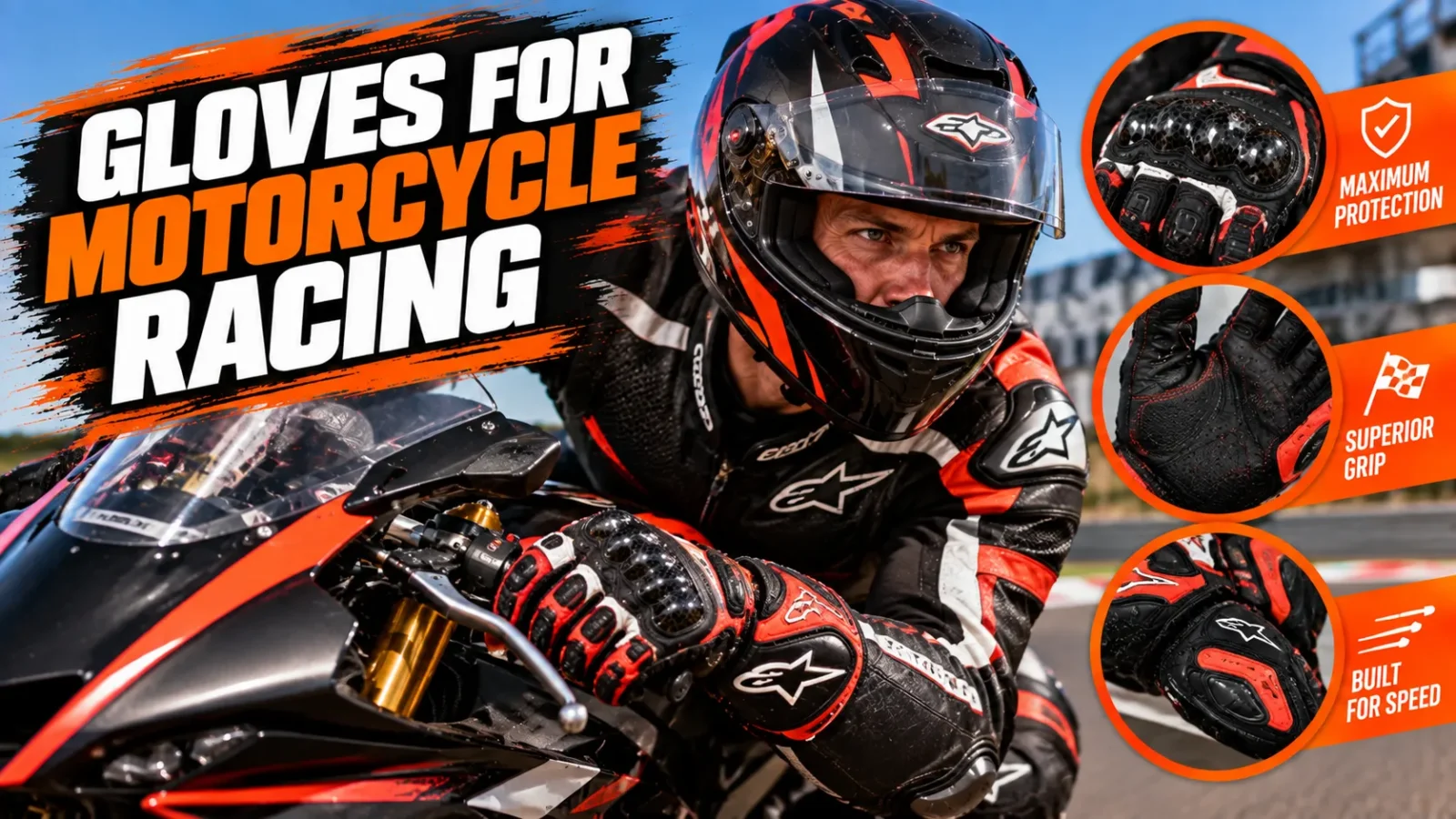
I’ve crashed enough times on track to know one thing for certain: your hands hit the ground first, almost every single time. I’ve slid across asphalt at 90 mph wearing cheap gloves and I’ve done it wearing proper race-spec gloves, and let me tell you, the difference in what’s left of your palms afterward is night and day.
Over the years of racing and doing track days, I’ve gone through more gloves than I’d like to admit. Some tore at the seams on my very first low-side. Others kept my hands completely intact after a 100+ mph tumble. That experience is exactly why I put together this list.
Before we dive in, if you want the full breakdown of certifications, materials, and fit, I’d genuinely recommend reading my Ultimate Guide to Motorcycle Gloves. It covers everything I couldn’t fit into this list.
- My overall top pick is the Alpinestars GP Pro R3 — it’s what I actually race in.
- If budget matters, the Five RFX Race Evo gives you real CE Level 2 protection for under $200.
- For maximum knuckle protection, look at the Dainese Full Metal 6 or Spidi Carbo 5, both of which use hard external plating.
- Fit is everything in a racing glove — a loose glove will bunch up and rip open in a slide no matter how expensive it is.
- Always check for a CE Level 2 rating (EN 13594) before assuming any glove is actually “race-ready.”
1. Alpinestars GP Pro R3 — Best Overall Racing Glove
I’ve raced in the Alpinestars GP Pro R3 for two full seasons now, and it’s still the glove I reach for every single race weekend. It’s built with a full kangaroo leather chassis, which gives it that rare combination of being both tough and genuinely comfortable right out of the box.
The knuckle protector is a dual-density polymer piece that’s articulated to move with your hand, not against it. I’ve had two crashes wearing this glove and both times the armor did exactly what it was supposed to do, sliding rather than gripping the tarmac.
What really sold me was the third-and-fourth-finger bridge, which stops your pinky and ring finger from hyperextending in a fall. That’s a small detail most riders never think about until it saves a finger. Expect to pay around $280-$300 for this one.
Why I keep coming back to it
It’s CE Level 2 certified (EN 13594), has a dual-layer palm slider, and the pre-curved fingers mean less fatigue after a 20-minute race. If I could only own one racing glove for the rest of my life, honestly, this would be it.
2. Dainese Full Metal 6 — Best Titanium Knuckle Protection
The Dainese Full Metal 6 is the glove I recommend to friends who’ve had a bad crash before and are genuinely nervous about their hands. The titanium knuckle guard on this thing is no joke, it’s rigid, lightweight, and it simply doesn’t crush on impact the way plastic armor can.
Dainese uses their own aramidic fiber reinforcements between the fingers, and the palm has a double leather layer with a scaphoid protector built in. I’ve had this glove on during a highside and my wrist barely felt the hit.
It runs around $400-$450, which is on the higher end, but I genuinely think the titanium plating justifies the price if you’re racing regularly rather than just doing the occasional track day.
Fit notes from someone who’s worn it for a season
It runs slightly narrow through the palm, so I’d size up half a size if you’re between two sizes. Dainese’s sizing chart is honestly one of the more accurate ones out there, but this particular model fits snugger than their touring gloves.
3. Alpinestars Supertech — Best for Superbike-Level Track Days
If the GP Pro R3 is my everyday race glove, the Alpinestars Supertech is what I pull out for the days I’m really pushing hard on a superbike. It’s Alpinestars’ top-tier offering, and it shows in every stitch.
The palm slider is a one-piece polymer construction that extends further up the wrist than most gloves I’ve tried, which matters a lot when you’re sliding on your palm at speed. There’s also a titanium knuckle plate here, similar in concept to what Dainese does, but shaped a bit differently to Alpinestars’ own crash data.
Priced around $500-$550, it’s genuinely one of the most expensive gloves on this list. But I’ve watched MotoGP-adjacent riders wear this exact model, and once you feel the fit, you understand why.
The accordion stretch panels on the back of the hand are what impressed me most. They let the glove flex naturally when you’re gripping the bars hard through a fast corner, without ever feeling loose.
4. Held Titan RR — Best Kangaroo Leather Construction
Held doesn’t get talked about as much in the US, but in Europe this brand has a serious racing pedigree, and the Held Titan RR is proof of that. It’s built entirely from kangaroo leather, which I noticed the moment I put it on, it’s noticeably thinner and more supple than cowhide gloves at the same protection level.
The external hard knuckle protector is made from a composite material that Held calls SuperFabric in certain zones, which resists abrasion in a way I honestly wasn’t expecting from a brand outside the “big three” racing brands.
I wore this glove during a particularly hot summer race weekend, and the perforated leather panels on the fingers made a noticeable difference in comfort. It sits around $350, putting it right between the mid-range and premium tiers.
Where it stands out
The wrist closure system uses a wide velcro strap plus a secondary safety strap, which I found gives real peace of mind that the glove won’t come off mid-slide. That’s not something every brand bothers to include.
5. Five RFX Race Evo — Best Value Racing Glove
Not everyone racing club events has a $400 glove budget, and I get that, because I didn’t either when I started out. The Five RFX Race Evo is the glove I point beginner racers toward because it’s genuinely CE Level 2 certified without the premium price tag.
It uses a full grain leather palm with a TPU knuckle protector, and honestly, for around $180-$200, the build quality punches well above its price point. I’ve seen these survive real crashes at club-level track days without falling apart at the seams.
The pre-curved finger construction isn’t quite as refined as what you get on the Alpinestars GP Pro R3, but it’s close enough that most riders won’t notice the difference on track.
If you’re just starting out and want something more forgiving for the street before you commit to full race gear, it’s worth also glancing at my guide to the Best Beginner Gloves for Motorcycle riding, since not every rider needs full race-spec protection on day one.
6. Spidi Carbo 5 — Best Carbon Fiber Protection
Spidi is an Italian brand that I think doesn’t get enough credit outside of Europe, and the Spidi Carbo 5 is a glove that deserves way more attention than it gets. The knuckle protector here is genuine carbon fiber, not just a carbon-look plastic shell, and you can feel the rigidity difference immediately.
The palm uses a suede-and-leather combination with a dedicated slider patch that’s stitched externally, so the seams themselves never touch the ground in a slide. That’s a detail I really appreciate after having a cheaper glove’s internal seams rip open on me years ago.
At roughly $220-$250, I’d call this one of the better mid-tier racing gloves on the market right now. It’s not the flashiest name, but the protection-to-price ratio is excellent.
A note on sizing
Spidi’s gloves tend to run true to European sizing, so if you normally wear a large in Alpinestars, you might actually want a large here too rather than sizing up like you would with some Italian brands.
7. Racer High Speed — Best for Dedicated Sportbike Racing
Racer is a French brand that’s quietly become a favorite among serious sportbike racers, and the Racer High Speed glove is exactly why. It’s built with a kangaroo leather palm and a composite knuckle guard that’s noticeably lower profile than a lot of competitors, which some riders (myself included) prefer for bar feel.
What stood out to me the first time I wore these was how little break-in time they needed. Most premium racing gloves take a few sessions to fully mold to your hand, but the Racer High Speed felt race-ready within one track day.
Pricing sits around $300-$320. It’s not a household name in the US the way Alpinestars or Dainese are, but among endurance racers in Europe, this brand has a serious cult following for good reason.
8. Knox Handroid MK5 — Best Exoskeleton-Style Protection
The Knox Handroid MK5 looks unlike anything else on this list, and that’s intentional. Knox builds the entire back of the hand as a jointed exoskeleton, which sounds excessive until you realize how well it distributes impact force across multiple points instead of one.
I was skeptical about the exoskeleton design at first, thinking it might feel bulky or restrict my grip on the bars. It didn’t. The articulation points move with your knuckles almost like a second skin, and the leather palm underneath still gives you excellent feel for the clutch and brake lever.
It’s priced around $250-$280, which I think is genuinely fair given how much engineering goes into that exoskeleton frame. If you’ve had wrist or knuckle injuries before, this is the glove I’d personally point you toward.
9. Alpinestars GP Tech V2 — Best for Riders Who Want MotoGP-Level Detail
Rounding out my list is the Alpinestars GP Tech V2, which sits just below the Supertech in Alpinestars’ lineup but still packs serious race-grade features. It uses a Kevlar and leather blend on the palm, plus a lightweight external TPU knuckle protector.
I like this glove specifically for its finger bridge system, which links the third and fourth fingers together to prevent hyperextension without limiting your grip on the throttle. It’s a smaller detail than what you’d find on the flagship Supertech, but it still works impressively well.
At around $320-$350, it occupies a nice middle ground between the GP Pro R3 and the full Supertech, giving you near-flagship protection without the flagship price tag.
What I actually look for before buying a racing glove
After going through this many gloves over the years, I’ve developed a mental checklist. I always check the CE rating first, because a glove without EN 13594 Level 2 certification simply hasn’t been tested for real racing impact.
Next, I check where the seams sit. External seams on the palm and outer edge of the hand matter enormously, because internal seams are the first thing to rip open in a slide.
Finally, I always try to try the glove on with my actual riding jacket. A gauntlet that doesn’t overlap your sleeve properly can leave a gap where road rash gets in, and I learned that lesson the hard way years ago.
Fit matters more than brand name
I cannot stress this enough: a $500 glove that’s slightly too loose will perform worse than a $180 glove that fits like a second skin. Slide your hand in, make a fist, reach for imaginary bars, and make sure there’s zero bunching at the palm.
Weather still matters, even for racing
Racing gloves are built for track conditions, but if you’re commuting to the circuit or riding in mixed weather, it’s worth knowing your options outside pure race gear too. I’ve written separately about the best motorcycle gloves for rain, which is a completely different priority set than what we’ve covered here.
Similarly, if you’re racing through a hot summer season, ventilation becomes a real factor even in gloves that prioritize protection. Some riders keep a secondary pair of lighter gloves, and I’ve covered great options in my guide to the best motorcycle gloves for summer for exactly that reason.
A quick word on gender-specific sizing
Most of the gloves on this list run in unisex sizing, but hand shape genuinely varies, and I’ve had female riders tell me repeatedly that standard race gloves run too wide through the palm for them. If that’s you, I’d suggest browsing my roundup of the best summer leather motorcycle gloves for women, though for actual racing, brands like Alpinestars and Dainese do offer women’s-specific cuts in select models worth asking your local dealer about.
If you’re racing on a tighter budget
I know not everyone wants to drop $300+ on a first pair of race gloves, and that’s fair. Beyond the Five RFX Race Evo I mentioned above, it’s worth browsing my picks for best cheap motorcycle gloves for summer if you’re doing casual track days rather than competitive racing, since some of those still offer solid abrasion resistance at a much lower cost.
That said, I’d never recommend skipping CE certification entirely just to save money on something covering your hands at 100+ mph. It’s simply not worth the risk.
My final take
If you asked me to grab just one glove off this list for a race weekend, I’d still grab the Alpinestars GP Pro R3 without hesitation. It’s the glove that’s been on my hands through crashes, hot laps, and long race weekends, and it’s never let me down.
But honestly, any glove on this list will serve you well, because I only included gear I’ve either worn myself or watched perform well for riders I trust. Try a few on, check the fit obsessively, and pick the one that feels like it disappears on your hand once you’re gripping the bars.
Frequently Asked Questions
What makes a glove suitable for motorcycle racing versus street riding?
Racing gloves need CE Level 2 certification, hard knuckle armor, extended gauntlets that overlap the jacket sleeve, and external seams to reduce abrasion. Street gloves prioritize comfort and dexterity over maximum slide protection, which is why I always recommend checking my Ultimate Guide to Motorcycle Gloves before buying.
Do I really need kangaroo leather gloves for racing?
Not strictly, but kangaroo hide is roughly 20% stronger than cowhide at the same thickness, so it lets manufacturers build thinner, more flexible gloves without sacrificing abrasion resistance. That’s why most premium racing gloves like the Dainese Full Metal 6 and Held Titan RR use it.
How much should I expect to spend on a proper racing glove?
Entry-level race-ready gloves start around $150-$180, while top-tier options with titanium or carbon fiber knuckle protection can run $400-$550. I think the sweet spot for most club racers is between $200 and $300.
Are racing gloves overkill for regular street riding?
Honestly, no. A CE Level 2 racing glove will always outperform a casual glove in a crash, though it may feel stiffer at first. If you want something more relaxed for daily commuting, check out my picks for the Best Beginner Gloves for Motorcycle use.

Related Articles
8 Best Waterproof Motorcycle Gloves for Summer Riding
I tested and researched the 8 best waterproof motorcycle gloves for summer, balancing breathability, dry hands, and all-day comfort. Find…
 Jake Miller
10 min read
Jake Miller
10 min read

10 Best Motorcycle Gloves for Protection That I’d Actually Trust My Hands To
I've crashed, dropped bikes, and tested dozens of gloves. Here are the 10 best motorcycle gloves for protection I genuinely…
Jake Miller
11 min read
9 Best Mechanix Gloves for Motorcycle Riding You Can Actually Trust
I've tested Mechanix gloves on real rides—here are the 9 best models for motorcycle riding, from impact protection to cold-weather…
Jake Miller
11 min read