
9 Best Armor Inserts for Motorcycle Jackets I’d Actually Trust on the Road
 Jake Miller
12 min read
Jake Miller
12 min read
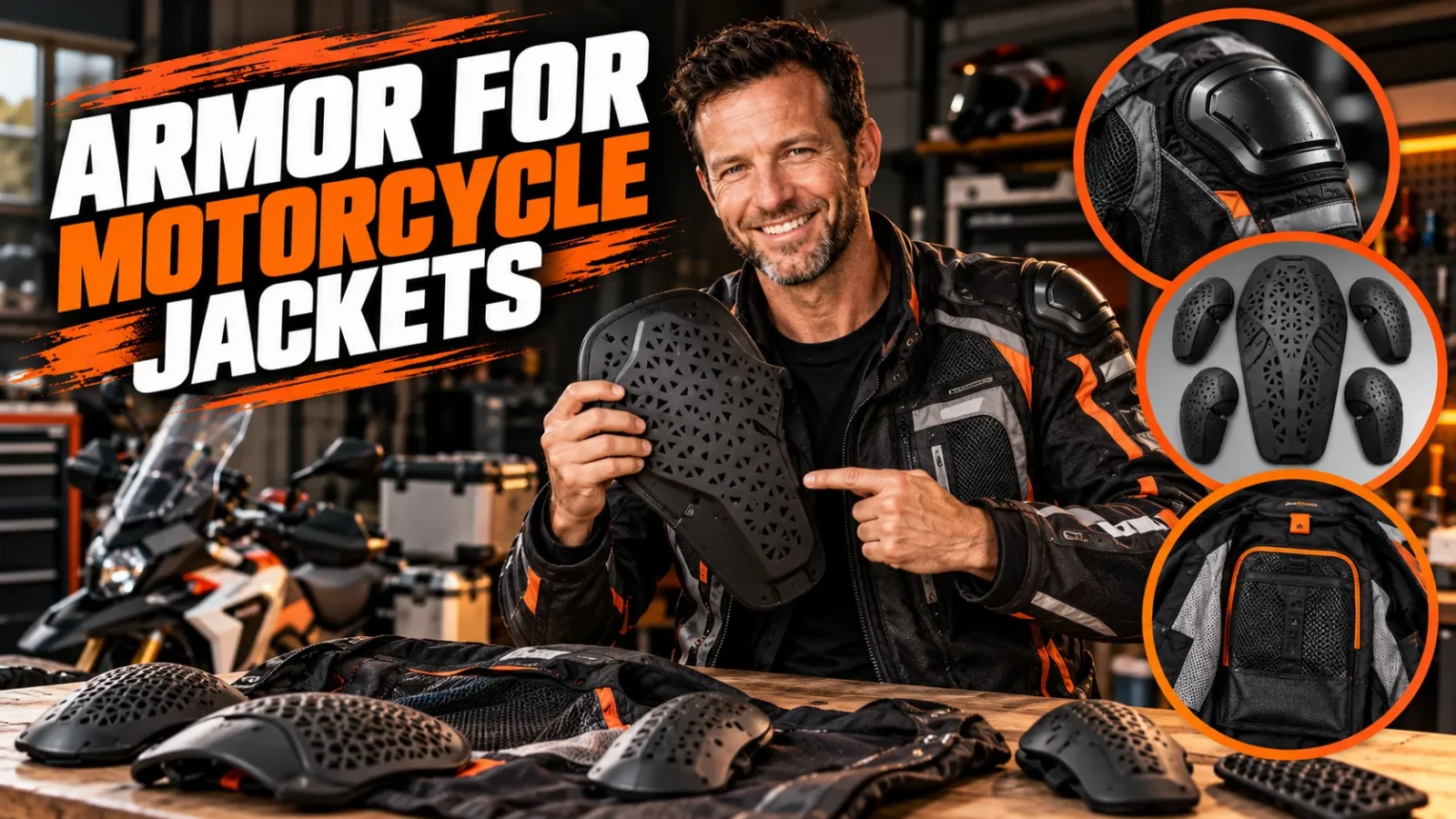
I’ve dropped a bike or two in my riding years, and I can tell you exactly which moments I was grateful for good armor and which moments I wished I’d upgraded sooner. The jacket shell gets all the attention in reviews, but the armor inside it is what actually keeps your shoulders, elbows, and spine in one piece.
Most jackets ship with basic, CE Level 1 foam pads that technically pass safety standards but leave a lot of performance on the table. Swapping in better armor is one of the cheapest, highest-impact upgrades you can make to your riding kit.
I cover the bigger picture of picking a jacket in my Ultimate Guide to Motorcycle Jackets, but this list zeroes in specifically on the armor itself.
Below are the nine armor inserts and protectors I trust most, based on what I’ve worn, what I’ve researched extensively, and what shows up again and again in independent CE testing data.
- D3O Ghost and Knox Micro-Lock are my top picks for CE Level 2 shoulder/elbow armor without the bulk.
- For back protection, the Forcefield Pro L2K and Alpinestars Nucleon KR-3 deliver serious energy absorption in a slim profile.
- SAS-TEC SC-1/10 pads are the budget-friendly workhorse found in dozens of quality jackets.
- Most jackets have removable armor pockets, so upgrading is usually a drop-in swap, not a full gear replacement.
- Always check that any armor you buy is rated CE Level 1 or Level 2 under EN 1621, not just “impact resistant” marketing language.
1. D3O Ghost — Best Overall CE Level 2 Shoulder & Elbow Armor
The D3O Ghost is the armor I’d point most riders toward first. It’s a CE Level 2 certified insert that uses D3O’s signature shear-thickening material, meaning it stays soft and flexible for everyday wear but locks rigid on impact.
I like that it’s noticeably thinner than a lot of competing Level 2 pads, which matters a ton when you’re trying to zip a jacket closed over it in summer heat. It shows up as stock equipment in premium jackets from Alpinestars, Rukka, and REV’IT, and you can also buy it as a standalone replacement insert for around $60-$80 per pad.
If you’re shopping for a beginner-friendly jacket that already includes solid armor out of the box, my guide to the best motorcycle jackets for beginners highlights several models built around D3O inserts.
Why I trust it
D3O has been independently tested well below the CE Level 2 threshold of 9kN transmitted force in multiple lab reports I’ve reviewed, and it doesn’t degrade in cold weather the way some older foam-based armor can. That cold-weather reliability alone makes it worth the upgrade if you ride through shoulder seasons.
2. Knox Micro-Lock CE Level 2 — Best for Low-Profile Comfort
Knox has been making armor longer than most riders have been riding, and the Micro-Lock CE Level 2 pad is proof they’ve refined the formula. It’s built from a honeycomb-style flexible material that’s genuinely comfortable against the skin, which is rare for something rated this protective.
I’ve worn Knox armor in both hot and cold conditions and never felt like it turned into a stiff, uncomfortable slab. It typically retails in the $50-$70 range per insert and fits the standard elbow/shoulder pocket shape used by most major jacket brands.
This is the pad I’d recommend if your current armor feels rigid or chafes after a couple hours in the saddle. Comfort matters more than people admit, because armor you resist wearing isn’t protecting anyone.
3. Forcefield Isolator Pro — Best Elbow & Shoulder Armor for Track-Adjacent Riders
Forcefield’s Isolator Pro line is a step up in aggressiveness, and I mean that in a good way. It’s a CE Level 2 pad that leans into maximum coverage and impact absorption, making it a favorite among sport and track-day riders who want extra margin.
It runs a bit thicker than the D3O Ghost or Knox Micro-Lock, so it’s not my first pick for a slim commuter jacket. But if you’re riding aggressively or spend time on twisty backroads, that extra material is a worthwhile trade-off.
Price sits around $70-$90 per set, and Forcefield sells them individually so you can mix and match coverage where you need it most.
4. Alpinestars Nucleon Flex Pro — Best Armor for Sport Jackets
If you own an Alpinestars jacket, there’s a good chance it already has some version of the Nucleon Flex Pro armor inside it. This is Alpinestars’ in-house CE Level 2 solution, and it’s engineered specifically to work with their jacket geometry, which means fewer gaps or bunching at the shoulder.
I appreciate that Alpinestars designed this armor with articulated segments rather than one solid pad. It moves with your arm through a full range of motion, which matters a lot if you ride in an aggressive, forward-leaning posture.
Standalone replacement units run about $80-$100, which is on the higher end, but the fit-specific engineering justifies it if you’re already in the Alpinestars ecosystem.
5. SAS-TEC SC-1/10 — Best Budget CE Level 1 Armor
Not everyone needs top-shelf armor, and that’s where SAS-TEC’s SC-1/10 pad earns its spot on this list. It’s a CE Level 1 insert made from a dual-density foam that’s been the industry standard in mid-range jackets for years, from brands like Dainese, Held, and Spidi.
It won’t out-perform a Level 2 pad in raw impact numbers, but it’s a massive step up from generic no-name foam, and it costs a fraction of premium options, usually $25-$40 per pad.
If you’re building out a budget-conscious kit, this pairs nicely with jackets covered in my best motorcycle jackets under $500 roundup, several of which already spec SAS-TEC as stock armor.
6. Forcefield Pro L2K — Best Back Protector for Maximum Protection
Your spine deserves better than the thin foam pad that ships in most jackets, and the Forcefield Pro L2K is one of the most protective standalone back protectors I’ve come across. It’s CE Level 2 rated and uses a segmented plate design that flexes with your back while still spreading impact force across a wide surface.
It’s not the thinnest option out there, running noticeably bulkier than integrated jacket armor, but that thickness is exactly why it performs so well in independent impact testing. Expect to pay around $100-$130.
I go into a lot more detail on back protector types, fitment, and CE ratings in my dedicated motorcycle armor and back protectors guide, which is worth a read before you buy.
7. Alpinestars Nucleon KR-3 — Best Slim-Fit Back Protector
The Nucleon KR-3 is Alpinestars’ answer for riders who want strong back protection without a bulky brick strapped to their spine. It’s CE Level 2 certified but noticeably slimmer than the Forcefield Pro L2K, making it a better fit for jackets with tighter back-pocket dimensions.
I like this one for commuting and daily riding specifically because it doesn’t feel like you’re wearing a turtle shell under your jacket. It typically sells for $90-$110 and works as either a standalone insert or paired with a compatible base layer.
If commuting is your main riding scenario, this pairs well with gear discussed in my best motorcycle jackets for commuting article, where all-day comfort matters as much as raw protection numbers.
8. Knox Track back protector — Best for Racers and Aggressive Riders
Knox’s Track back protector takes a race-oriented approach, using a curved, hard-shell design that hugs your spine closely while distributing impact force outward. It’s CE Level 2 rated and has been a long-standing favorite in club racing paddocks.
It’s stiffer than the Nucleon KR-3, which some riders love and others find restrictive for casual street riding. I’d point this one specifically toward riders doing track days or aggressive canyon carving rather than daily commuting.
Pricing lands around $110-$140, putting it firmly in the premium tier, but the protection-to-weight ratio is genuinely excellent.
9. REV’IT Seesoft CE Level 2 — Best All-Around Armor for Adventure & Touring Jackets
REV’IT’s Seesoft armor line deserves more attention than it usually gets. It’s CE Level 2 rated, uses a breathable perforated design, and shows up stock in a lot of REV’IT’s adventure and touring jackets, which tend to see long hours in variable weather.
I’ve found Seesoft holds up well on longer rides where you’re constantly moving your arms and shoulders, since the perforation helps manage heat buildup that stiffer pads can trap. If you’re the type of rider who’s covered ground from dry highways to damp coastal roads, that breathability is a genuine comfort win.
It runs about $50-$75 per insert and fits standard elbow/shoulder pockets, so it’s an easy universal upgrade. Riders dealing with wet, unpredictable climates might also want to check my best jackets for Seattle motorcycle riding guide, since jacket choice and armor breathability both matter a lot in that kind of weather.
How I actually evaluate motorcycle armor
When I’m judging armor, I’m not just looking at the CE sticker. I check the actual kN force transmission numbers where manufacturers publish them, because Level 1 and Level 2 pads can vary quite a bit within their own category.
I also physically flex and fold the armor before I trust it. Good armor should feel pliable at rest and only stiffen dramatically under sharp impact, not feel like a rigid plastic shell all the time.
CE Level 1 vs. CE Level 2, in plain terms
CE Level 1 armor is tested to transmit no more than 18kN of force to your body during a standardized impact test. CE Level 2 cuts that number roughly in half, to 9kN or less.
In practical terms, that means Level 2 armor absorbs significantly more energy before it reaches your joints. It’s usually a bit thicker or denser, but modern materials like D3O and SAS-TEC have closed that comfort gap a lot in the last few years.
Fit matters as much as rating
Even the best-rated armor in the world does nothing if it shifts out of place during a slide. I always double-check that shoulder and elbow pads stay anchored when I move my arms overhead or reach forward like I’m gripping handlebars.
If a pad slides around inside the jacket’s pocket, that’s a sign the armor doesn’t match that jacket’s geometry, even if it’s technically the “right” size. When in doubt, buy from the same brand as your jacket first.
My honest take on upgrading armor vs. buying a new jacket
Here’s something I tell riders all the time: you don’t need to replace your whole jacket to get better protection. If the shell, fit, and features of your current jacket are good, swapping in better armor like the D3O Ghost or Forcefield Pro L2K is a much cheaper path to real safety gains.
That said, if your jacket doesn’t have proper armor pockets at all, or the pockets are the wrong shape for modern inserts, that’s a sign it’s time to look at something new. My Ultimate Guide to Motorcycle Jackets walks through what to look for in a jacket built around quality armor from the start.
A quick gut-check before you buy
Before ordering any replacement armor, measure your jacket’s existing pockets and compare them against the manufacturer’s spec sheet for the new insert. A few millimeters off in shoulder curvature can be the difference between a snug, protective fit and a pad that bunches up under your jacket lining.
It’s a five-minute check that saves you the hassle of a return, and honestly, I’ve skipped this step before and regretted it more than once.
Final thoughts from the saddle
Good armor is one of those things you hope you never need to test in the real world, but I’d rather have the D3O Ghost or Forcefield Pro L2K on my body and never use it than find out the hard way that my factory foam wasn’t up to the job.
My honest advice: start with your back protector if you’re only upgrading one thing, since that’s the area most jackets skimp on. Then move to shoulders and elbows if budget allows.
Whatever you choose from this list, just make sure it’s genuinely CE-rated, fits your specific jacket’s pockets, and is something you’ll actually wear consistently. The best armor in the world only works if it’s on your body when you need it.
Frequently Asked Questions
What’s the difference between CE Level 1 and CE Level 2 armor?
CE Level 1 armor transmits less than 18kN of force to your body on impact, while CE Level 2 transmits less than 9kN, meaning it absorbs roughly twice as much energy. Level 2 is bulkier but offers noticeably better protection for the same coverage area.
Can I upgrade the stock armor in my motorcycle jacket?
In most cases, yes. Nearly all jackets with removable armor use standard-shaped pockets, so inserts like the D3O Ghost or Knox Micro-Lock can usually swap in for factory foam pads, as long as the pocket dimensions roughly match.
Do I really need a back protector if my jacket already has shoulder and elbow armor?
I’d say yes. Your spine is one of the most vulnerable areas in a get-off, and most jackets ship with only a thin foam back pad. A dedicated insert like the Forcefield Pro L2K or Alpinestars Nucleon KR-3 is a worthwhile upgrade covered in more depth in my guide to motorcycle armor and back protectors.
Is more expensive armor always better?
Not necessarily. Price often reflects flexibility, weight, and breathability rather than raw protection. A $40 SAS-TEC pad and a $90 D3O Viper 2 can both meet CE Level 2, so pick based on comfort and fit inside your specific jacket, not just the price tag.

Related Articles

8 Best Motorcycle Jacket Materials (And the Real Jackets That Use Them Best)
I break down the best motorcycle riding materials for jackets—leather, textile, mesh, and laminate—with real jacket picks I've tested for…
Jake Miller
11 min read

9 Best Paints for Nylon Motorcycle Riding Jackets That Actually Hold Up on the Road
I tested 9 paints for nylon motorcycle jackets so you don't have to guess. Here's what actually sticks, flexes, and…
Jake Miller
12 min read

9 Best Female Motorcycle Jackets That Actually Fit Right in 2026
I've tested dozens of women's motorcycle jackets over the years. Here are my 9 favorites for fit, protection, and style—from…
Jake Miller
11 min read