
9 Best Tents for Motorcycle Camping in Australia: Tested Picks for Every Rider
 Jake Miller
12 min read
Jake Miller
12 min read
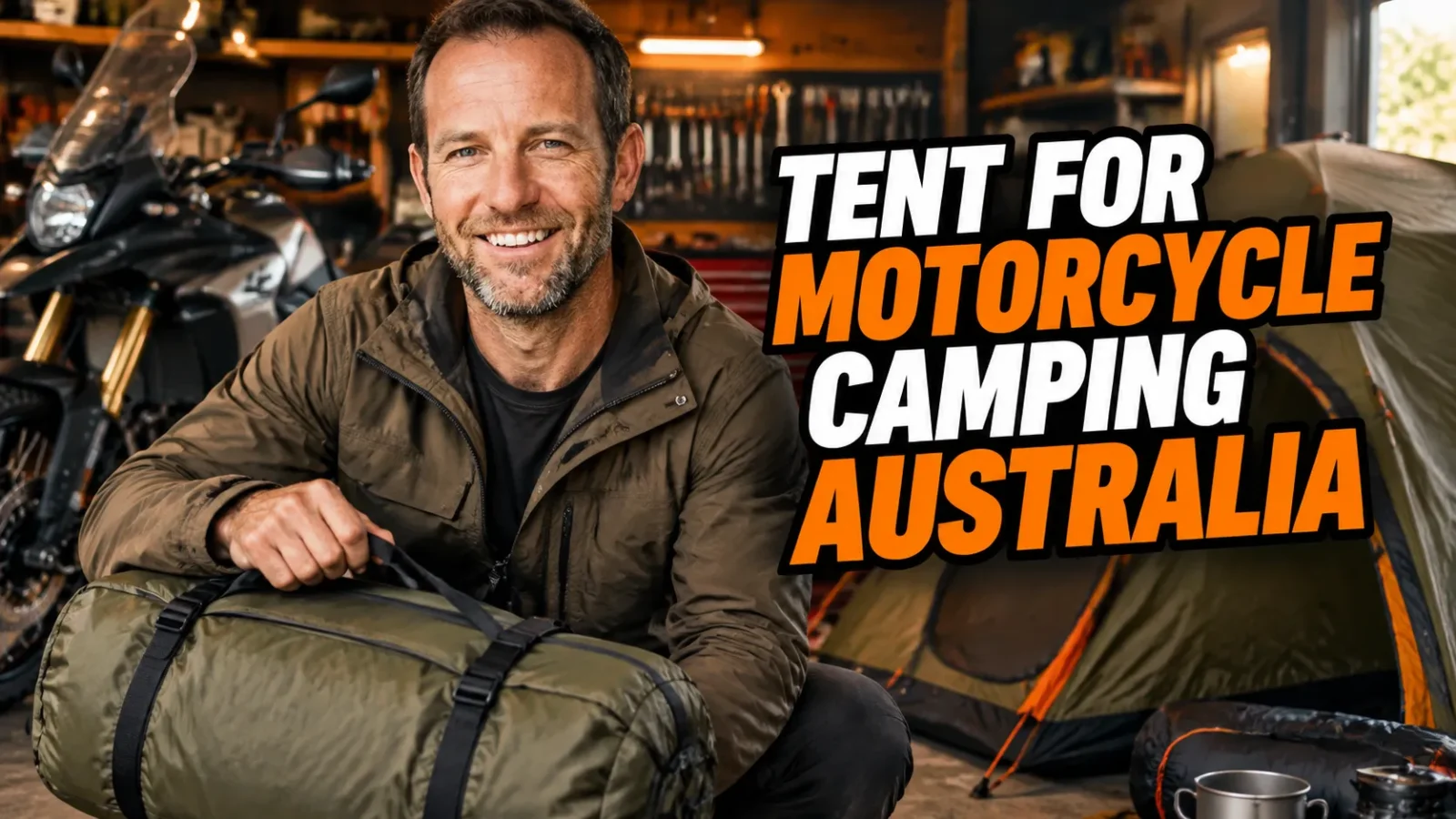
I’ve pitched tents in the Flinders Ranges with the wind trying to rip the fly off, woken up to frost in the Victorian High Country, and sweated through a humid Queensland summer night with a fly that turned my shelter into a sauna. Motorcycle camping in Australia is brutal on gear, and the tent you choose matters far more than most riders think.
When you’re travelling on two wheels, every gram and every litre of packed volume is a negotiation. Your tent has to survive UV that eats cheap nylon, sudden storms that roll in off nowhere, and the reality that you might be setting it up in the dark after a 700km day. I’ve learned all of this the hard way, and I’ve also learned that your bike has to be sorted before your camp is — right down to the battery and fluids. If you’re prepping a big lap, it’s worth understanding what are the different types of motorcycle batteries ultimate guide before you even think about tent shopping, because a flat battery 200km from the nearest town ruins the trip faster than a leaky fly ever will.
Below are the tents I’d genuinely recommend to Australian motorcycle campers, based on real models I’ve used, borrowed, or watched mates abuse on long trips.
- My overall pick is the Big Agnes Copper Spur HV UL2 for its weight-to-space ratio, though the MSR Hubba Hubba NX 2 is the tougher all-rounder.
- For budget riders, the Naturehike Cloud Up 2 punches way above its price and packs tiny.
- Australian conditions demand high UV resistance and a strong fly — cheap single-wall tents fail fast here.
- Match your packed length to your luggage: under 45cm fits panniers, longer tents need a dry bag across the pillion seat.
1. Big Agnes Copper Spur HV UL2 — My Overall Pick for Weight-Conscious Tourers
I’ll be honest: the Copper Spur HV UL2 is the tent I keep coming back to. It’s a two-person, three-season double-wall shelter that weighs around 1.4kg packed, and it collapses small enough that it disappears into my 40L dry bag without a fight.
The “HV” stands for high volume, and that’s the trick here. Big Agnes angled the walls so you get genuine headroom at the foot end — something I appreciate after a long day when I want to sit up and sort gear without headbutting the fly.
Real-world performance in Australia
The fabrics are lightweight silicone-treated nylon with a 1200mm hydrostatic head fly. That handles most Australian rain fine, but I’ll be honest — in a proper tropical downpour, it’s adequate rather than bombproof. The tradeoff is weight, and for me it’s worth it.
UV is the real killer here. I’ve had the Copper Spur out on multiple summer trips and the fly has held up, but I’d still recommend pitching in shade where possible and treating the fabric if you’re doing an extended lap.
Why it suits motorcycle camping
It packs to roughly 40cm x 13cm, which slides neatly into a pannier. Setup is fast — I can have it up in under five minutes in the dark, which matters when you’ve rolled into a rest area at 9pm.
If you’re building a touring rig around a bike that eats long highway days, it’s worth reading up on the best motorcycle for touring australia to make sure your machine and your shelter are matched for the same kind of trip.
2. MSR Hubba Hubba NX 2 — The Toughest All-Rounder
If I had to pick one tent to survive a full lap of Australia on a motorcycle, the MSR Hubba Hubba NX 2 would be high on the list. It’s been around for years, it’s proven, and MSR’s build quality is genuinely a step above most competitors.
Packed weight sits around 1.72kg, and the packed size is about 46cm x 15cm. That’s slightly longer than the Copper Spur, so plan your luggage accordingly — it won’t fit in a small pannier unless you remove the poles and strap them separately.
Build quality that survives Australia
The fly is 20D ripstop nylon with a 1200mm coating, and the floor is 30D. The poles are DAC Featherlite NFL aluminium, which I’ve seen take abuse that would snap cheaper alloy poles.
The real standout is the liveable design — two doors, two vestibules, and a cross-pole that gives you vertical walls. On a hot night, I can open both vestibules and get genuine cross-flow ventilation, which is everything in northern Australia.
Where it falls short
It’s not the lightest option anymore, and the price is steep. But if you value durability over saving 300 grams, this is the tent I’d trust most on a remote trip where there’s no gear shop for 1500km.
3. Naturehike Cloud Up 2 — Best Budget Motorcycle Tent
Here’s the honest truth: you don’t need to spend $700 on a tent to camp comfortably off a motorcycle in Australia. The Naturehike Cloud Up 2 is a two-person, three-season tent that weighs around 1.7kg depending on the version, and it costs a fraction of the premium options.
I’ve recommended this tent to more mates than I can count, and the feedback is consistent — it just works. The 20D nylon fly with a 4000mm hydrostatic head is actually more waterproof than several pricier tents.
What you’re giving up
The poles are decent but not DAC-grade. The zippers are fine but not YKK-smooth over years. And the fabric will degrade faster under harsh Australian UV than a premium tent.
But for a rider doing a few trips a year rather than a permanent lap, the Cloud Up 2 is outstanding value. Packed size is around 45cm x 15cm, so it fits panniers or a dry bag with ease.
Spending less on your tent frees budget for maintenance, and honestly, keeping your engine healthy matters more on a long ride. If your bike is due for a fluid change before a big trip, check out the best motor oil for 4 stroke motorcycle so your machine doesn’t let you down halfway across the Nullarbor.
4. NEMO Dragonfly OSMO 2P — Best for Hot, Humid Rides
Australian summers are the reason I rate the NEMO Dragonfly OSMO 2P so highly. It’s a two-person, three-season tent built with OSMO fabric, which NEMO claims absorbs less water and resists stretching better than standard nylon — and in humid Queensland, that’s not marketing fluff, it genuinely matters.
Packed weight is around 1.4kg, and the packed size is roughly 50cm x 13cm when rolled tight. The poles are DAC Featherlite, and the fly uses a 1200mm coating.
Ventilation done right
This is the key feature for me. The Dragonfly has two large doors with dual vestibules and a high-cut fly that lets heat escape. On a 30°C night with humidity at 80%, this tent is noticeably more comfortable than most of its competitors.
It’s a genuinely premium shelter and priced accordingly, but if you ride in the Top End or along the Queensland coast in summer, the extra ventilation is worth every dollar.
5. Sea to Summit Telos TR2 — Best for Standing Headroom
I’m tall, and that’s the single biggest reason I love the Sea to Summit Telos TR2. It’s a two-person, three-season tent with a “Tension Ridge” design that lifts the ceiling and gives you genuine sitting height across the whole interior.
Packed weight is around 1.6kg, and it packs into roughly 48cm x 13cm. Note that length again — it’s at the upper end for pannier fitment.
The Tension Ridge difference
That ridge pole creates a near-vertical wall at the head end, so you get a huge amount of usable space. I can sit up fully dressed, sort my gear, and even change clothes standing at a crouch. For a long trip, that comfort compounds.
It also converts to a “hangout mode” using just the fly and poles, which is brilliant for shade during a hot lunch stop. Setup is fast and the hardware feels premium.
Worth noting for Australian riders
The fly coating is solid, but like all these lightweight shelters, extended UV exposure will take its toll. I’d rotate my pitch to avoid facing the harsh western sun day after day.
6. Vango Banshee Pro 200 — Best Four-Season Budget Option
If you ride the Snowy Mountains or Victorian High Country in winter, you need a tent that laughs at wind and snow. The Vango Banshee Pro 200 is a two-person, four-season semi-geodesic tent that handles genuinely foul weather.
It’s heavier — packed weight is around 2.4kg — so it’s not for gram-counters. But the geodesic pole structure means it stays standing when a lightweight tunnel tent would collapse.
Built for bad weather
Vango’s TBS (Tension Band System) uses internal straps to brace the poles against high winds, and I’ve seen Banshee tents ride out storms that flattened everything else in the campground.
It’s a UK-designed tent, so it’s built for cold, wet conditions — exactly what you get in the Australian alpine regions in the middle of winter.
The tradeoff
It’s heavy and bulky, so it only makes sense if you’re specifically targeting cold-weather trips. For summer coastal touring, I’d leave it at home.
Cold-weather riding is brutal on your bike too, so before a winter High Country run, make sure your engine is running the right oil. The top engine oil for 4 stroke motorcycle will help your motor cope with cold starts and temperature swings.
7. Zpacks Duplex — Best Ultralight Trekking-Style Shelter
This one is niche, but for the weight-obsessed rider, the Zpacks Duplex is genuinely special. It’s a two-person, single-wall, trekking-pole-style tent made from Dyneema Composite Fabric, and it weighs around 600 grams.
Six hundred grams. That’s less than a water bottle.
The Dyneema advantage
Dyneema is incredibly strong for its weight and doesn’t absorb water or stretch when wet. It’s also far more UV-resistant than standard nylon, which matters enormously in Australia.
The catch: it needs trekking poles or dedicated support poles to pitch, which adds a bit of complexity on a motorcycle trip. And the price is high.
Who it’s for
If you’re a minimalist rider who counts every gram and mostly camps in dry conditions, the Duplex is unmatched. For wet, stormy Australian conditions where you want a double-wall shelter, I’d look elsewhere.
8. REI Co-op Half Dome SL 2+ — Best Value Two-Person Tent
The REI Co-op Half Dome SL 2+ is a workhorse. It’s a two-person, three-season tent that weighs around 1.9kg packed and offers more interior space than almost anything else in its class, thanks to a near-vertical wall design.
Packed size is around 53cm x 15cm — that’s on the long side, so for motorcycle use I’d strap it across the pillion rather than trying to fit it in a pannier.
Durability and livability
The floor is a tough 40D ripstop nylon with a 3000mm coating, and the fly uses 40D ripstop with a 1500mm coating. That’s genuinely robust for Australian conditions.
Two doors, two vestibules, and great ventilation make it very livable. It’s not the lightest or the most compact, but for the money you get a huge amount of tent.
Availability caveat
REI is a US retailer, so getting one in Australia involves shipping or a mate bringing it over. Worth it if you can manage it.
9. Coleman Sundome 2P — Best Cheap Backup Tent
Sometimes you just need a cheap, reliable tent for occasional trips. The Coleman Sundome 2P is a two-person dome tent that costs very little and does the basics well.
It’s heavier — around 2.9kg packed — and bulkier, so it’s not ideal for a minimalist setup. But if you’re doing short trips and don’t want to baby an expensive shelter, it works.
Where it makes sense
Coleman tents are widely available across Australia, which means replacements are easy if something breaks. For a beginner rider testing the waters of motorcycle camping, the Sundome is a low-risk entry point.
Where it doesn’t
The waterproofing is basic, ventilation is average, and the fabric won’t survive years of harsh UV. I wouldn’t take it on a remote Outback trip, but for a weekend near home, it’s fine.
Whichever tent you choose, the same principle applies as with your engine fluids — buy the best your budget allows and maintain it properly. If you’re also prepping your bike for a big trip, the guide to the best engine oil for 4 stroke motorcycle in india is a great reference for understanding oil ratings, many of which apply to Australian conditions too.
How I Choose a Tent for Australian Motorcycle Camping
After years of trial and error, I’ve narrowed my selection criteria down to a few non-negotiables.
Packed size and shape first
Your tent has to fit your luggage system. I measure packed length against my pannier dimensions before I buy anything. If it doesn’t fit, it doesn’t come.
UV resistance matters more here than almost anywhere
Australian sun destroys nylon. I look for tents with higher-denier fabrics and treat them with UV protectant where possible.
Ventilation beats warmth
Unless you’re specifically riding alpine winter, you want airflow above all else. A stuffy tent on a humid night is miserable.
Storm-worthiness
Australian weather turns fast. I favour tents with a strong pole structure and a fly that covers well down the sides, even if that adds a bit of weight. The what is the best engine oil for 4 stroke motorcycle question gets asked constantly by riders prepping big trips, and tents deserve the same scrutiny.
Frequently Asked Questions
What size tent is best for motorcycle camping in Australia?
For solo riders, a 1 to 2 person tent is ideal because it packs small and fits in a 40 to 60L dry bag. If you carry panniers only, look for a packed length under 45cm so it slides in horizontally.
Do I need a 4-season tent for Australian motorcycle camping?
Only if you ride alpine regions like the Snowy Mountains or Victorian High Country in winter. For coastal and Outback touring, a 3-season double-wall tent handles everything from humidity to summer storms.
Can I strap a tent to my motorcycle without panniers?
Yes. I use two 20L dry bags strapped across the pillion seat with Rok Straps, with the tent poles tucked along the frame. Just keep the weight low and centred to protect your handling.
Are swags better than tents for motorcycle camping?
Swags are brilliant for quick overnight stops on flat ground, but they are bulky and heavy on a bike. I only recommend them if you have big panniers and mostly ride Outback roads.

Related Articles

7 Best 1-Person Tents for Motorcycle Adventures: Lightweight Shelters Tested for the Road
I've pitched these 7 one-person motorcycle tents across thousands of miles. From Big Agnes to MSR, here's the best 1…
Jake Miller
10 min read

9 Best Budget Tents for Motorcycle Touring That Actually Survive the Road
I've slept in cheap tents across 30,000+ touring miles. Here are 9 genuinely good budget tents for motorcycle touring, with…
Jake Miller
10 min read

7 Best 2-Person Tents for Motorcycle Camping: Packable Shelters I Actually Trust
I've pitched these 7 two-person tents on real moto trips. From Big Agnes to MSR, here's what actually fits in…
Jake Miller
10 min read