
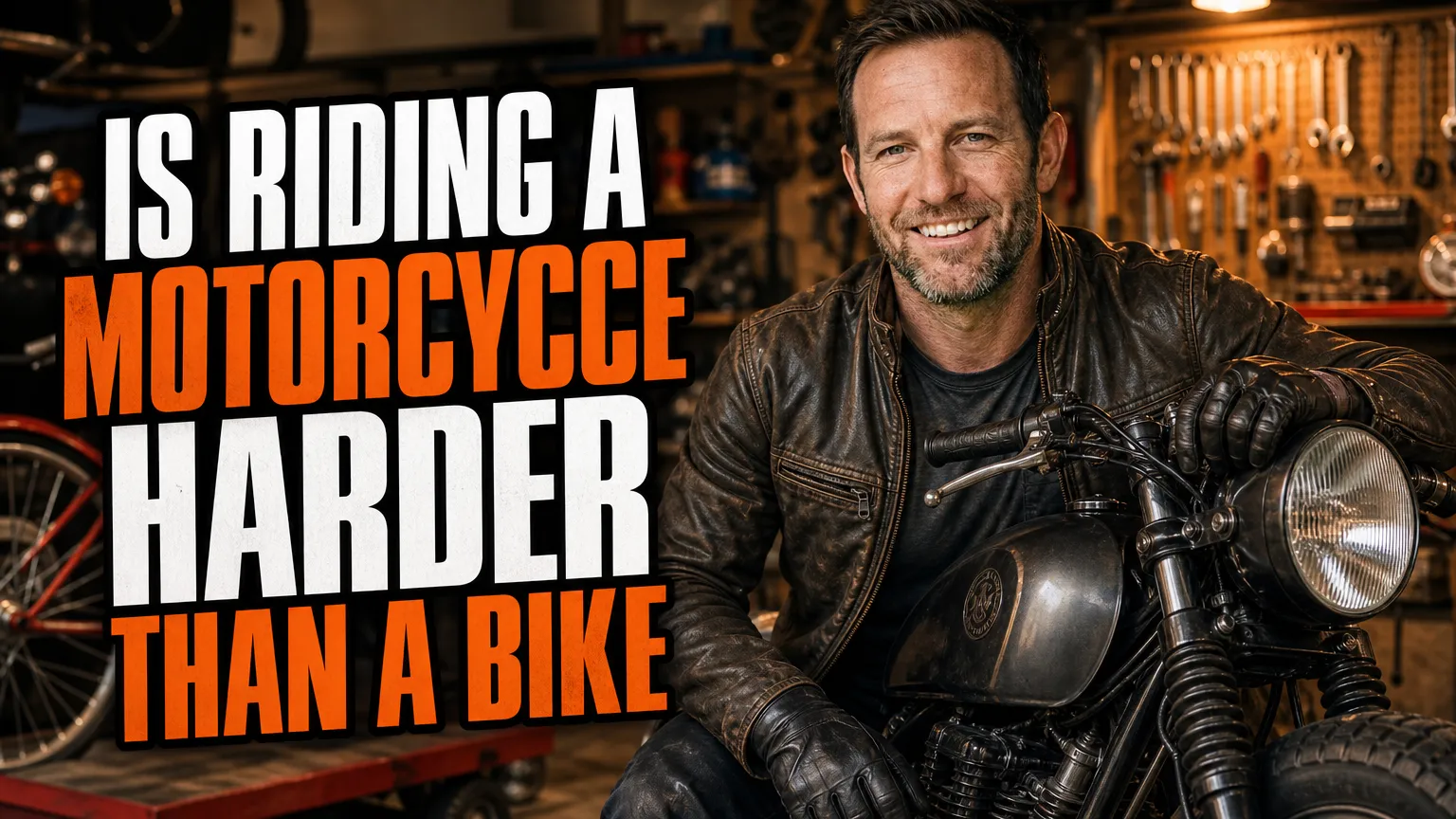
I’ve ridden bicycles for exercise and everyday trips, and I’ve also spent time learning the different demands of motorcycling. When someone asks me, “Is riding a motorcycle harder than a bike?” I don’t think there’s one simple answer: a motorcycle is usually harder to learn and manage safely, while a bicycle can demand more physical effort.
The difference becomes clearer when I separate the skills involved. Balance matters on both, but a motorcycle adds weight, engine power, extra controls, and higher speeds. Here’s how I compare the two, and what I’d keep in mind if I were deciding which one to learn.
- I find motorcycles harder to learn because they are heavier, faster, and have more controls.
- I can get a serious workout on a bicycle, especially on hills or long rides.
- I rely on balance for both, but low-speed motorcycle control takes focused practice.
- I treat motorcycle safety and formal training as essential, not optional extras.
My Short Answer: It Depends on What “Harder” Means
If I’m talking about the first few lessons, I’d say a motorcycle is harder for most beginners. I have to coordinate more controls, judge a heavier machine, and learn to handle engine power smoothly. A bicycle is simpler mechanically, so I can focus mainly on balance, steering, braking, and pedaling.
If I’m talking about physical exertion, the answer can flip. On a bicycle, I provide the power with my legs, so steep climbs and long distances can take a lot out of me. On a motorcycle, the engine does the work of moving the bike, but I still need stamina, concentration, and enough strength to manage the machine.
So my useful rule of thumb is this: motorcycling tends to be more demanding to learn and manage, while bicycling tends to be more demanding physically. That’s a broad comparison, not a promise about every rider or every ride.
Why I Find Motorcycles More Challenging at First
I have more controls to coordinate
On a basic bicycle, I steer with the handlebars, brake with the levers, and pedal to move. Gears add another skill, but I can usually learn them gradually. On a motorcycle, I also need to coordinate the throttle, clutch, gear shifter, and brakes, while keeping my attention on the road.
The clutch-and-throttle combination is often the part that feels least natural to a new rider. I have to release the clutch smoothly while applying just enough throttle, or I can stall, jerk forward, or lose my balance. With practice, the movements become more automatic, but at the beginning they demand deliberate attention.
Weight matters when I’m moving slowly
A motorcycle’s weight is easy to underestimate when it’s moving, because the engine carries it along. At a stop, during a tight turn, or while I’m parking, that weight becomes much more noticeable. I need to control the motorcycle carefully and avoid letting it lean farther than I can comfortably manage.
A bicycle is much lighter, so I can usually catch it or reposition it with less effort. That doesn’t mean bicycle handling is effortless: a loaded touring bike or an awkward turn can still challenge me. But on a motorcycle, a small balance mistake at walking speed can feel consequential because I’m managing a heavier machine.
Engine power raises the stakes
With a bicycle, I control acceleration by pushing harder on the pedals. With a motorcycle, the engine responds to the throttle, and a new rider has to learn to make that input smooth and measured. I don’t treat power as a shortcut to skill; I see it as something I need to understand and respect.
Speed also changes how quickly I approach hazards and how much distance I need to stop. I have less time to react when I’m moving quickly, so anticipation and smooth control matter. That’s one reason I would not assume that being confident on a bicycle automatically prepares me for motorcycling.
What Feels Harder on a Bicycle
My body supplies the power
Bicycling can be simple to start and still be hard work. When I climb a hill, ride into a headwind, or cover a long distance, my legs provide the effort that keeps me moving. Fitness, pacing, bike fit, and route choice can make a dramatic difference to how difficult a ride feels.
Even a familiar route can become physically demanding if I’m carrying a bag or riding over rough ground. I can use easier gears and take breaks, but I’m still the engine. If I compare a relaxed motorcycle ride with a strenuous bicycle climb, the bicycle is obviously more tiring for me.
Balance still takes practice
I wouldn’t describe bicycle riding as effortless for someone who has never learned. A beginner still has to steer, balance, start, stop, and look where they want to go. At very low speeds, a bicycle can wobble, and riding confidently in traffic takes awareness and judgment.
For me, bicycling becomes much easier once those foundational movements feel natural. I can then focus on my route and surroundings instead of thinking through every turn of the pedals. Motorcycle skills also become more comfortable with repetition, but the extra controls and machine weight mean I have more to learn.
How the Skills Compare
I think about the two activities as sharing a foundation but requiring different layers of skill. Both ask me to balance, steer, look ahead, brake smoothly, and make sensible decisions around other road users. Neither is just a matter of hopping on and hoping instinct takes over.
Here’s how I compare some of the main challenges:
- Balance: I use it on both, though the motorcycle’s weight changes how low-speed mistakes feel.
- Starting and stopping: I mainly pedal and brake on a bicycle; on a motorcycle, I also coordinate the clutch, throttle, and gears.
- Physical effort: I supply most of the forward power on a bicycle, while the motorcycle’s engine does that work.
- Speed management: I pay attention on either ride, but a motorcycle’s greater speed makes planning ahead especially important.
- Road awareness: I need to watch for vehicles, pedestrians, road surfaces, and changing conditions on both.
Knowing one doesn’t make the other automatic
If I already ride a bicycle well, I may have useful habits: looking ahead, staying balanced, and noticing how the road surface changes. Those are a helpful starting point, but they don’t teach me how to operate a motorcycle’s clutch or control its power.
The reverse is true too. Motorcycle experience doesn’t mean I’ll be fit enough to ride a bicycle up a long hill or comfortable handling a road bike in a crowded cycling lane. I treat each activity as its own skill set, with some overlap and plenty to learn.
Why I Take Motorcycle Safety Seriously
For me, the question isn’t only which vehicle feels harder to ride. I also consider what happens when something goes wrong. A motorcycle leaves me more exposed than an enclosed vehicle, so training, protective equipment, road awareness, and responsible choices matter every time I ride.
When I want context about the risks, I look beyond anecdotes. I find it useful to read about are motorcycle accidents more common than car, and to understand how other vehicles may be involved by exploring what percentage of motorcycle accidents are caused by cars.
I also think about how often other drivers contribute to crashes, so I’d examine what percent of motorcycle accidents are caused by other drivers. For a broader view of severity, I’d review information on how many fatal motorcycle accidents per day and what percent of motorcycle accidents result in death.
I wouldn’t use a single statistic to decide whether riding is right for me. The details and definitions behind safety data matter, and statistics can’t predict exactly what will happen on an individual ride. I use that information as a reminder to take the risks seriously, not as a substitute for good habits or training.
The preparation I wouldn’t skip
If I were a new motorcycle rider, I’d look for a reputable beginner course and learn the rules that apply where I live. I’d practice in a controlled setting before taking on busy roads, and I’d make sure my helmet and protective gear fit properly. I’d also start with a motorcycle I could handle comfortably rather than choosing one just because it looks impressive.
I’d give myself time to build confidence without rushing. A quiet parking area can help me practice starts, stops, turns, and low-speed control, but it isn’t a replacement for professional instruction. If I feel overwhelmed or make repeated mistakes, I’d slow down and get help before adding more challenging conditions.
Which One Should I Learn First?
If I’m completely new to riding on two wheels, I’d start with a bicycle if I have access to one. It gives me a low-pressure way to practice balance, steering, and braking without having to manage an engine or a heavy machine. Once those basics feel comfortable, I can bring that confidence into motorcycle lessons.
But I wouldn’t treat bicycle experience as a requirement or a guarantee. I can learn motorcycle riding through proper instruction even if I haven’t ridden much as a cyclist. What matters most is approaching the motorcycle as a new skill, following local licensing requirements, and practicing at a pace that suits me.
My recommendation by rider type
- If I want exercise: I’d choose a bicycle, because I control the workout directly with my pace, distance, and route.
- If I want motorized travel: I’d consider a motorcycle only if I’m willing to train, gear up, and stay attentive.
- If I’m nervous about balance: I’d try a bicycle in a safe, open space and build comfort before taking on more complexity.
- If I’m choosing between them as a beginner: I’d focus on the one that fits my goals, while giving myself proper time to learn either one.
What I’d Expect as a Beginner
On my first bicycle rides, I’d expect some wobbling, cautious braking, and a little awkwardness while I get used to steering. I’d choose a flat, open place away from traffic and focus on starting and stopping before attempting longer rides. The physical side could become challenging later, but the early learning curve is often approachable.
On my first motorcycle lessons, I’d expect to spend more time thinking about each action. I’d practice smooth starts, controlled stops, gear changes, and turns before worrying about riding quickly or covering distance. I’d also expect my concentration to tire me out, even if the engine is doing the work of moving the motorcycle.
That mental effort is easy to overlook when comparing the two. A ride can feel physically easy and still demand sustained attention, especially when I’m learning. I try to plan breaks, avoid riding when tired, and keep challenging conditions within my current ability.
My Final Take
So, is riding a motorcycle harder than riding a bike? In my experience, a motorcycle is generally harder to learn and control at first, while a bicycle is more physically demanding. The motorcycle asks me to manage more controls, more weight, and more speed; the bicycle asks my body to provide the power.
I’d choose based on what I want from the ride, not on which one sounds easier in the abstract. If I’m curious about motorcycling, I’d take training seriously and build my skills gradually. If I want a simpler way to get moving and get exercise, I’d start with a bicycle and enjoy learning at my own pace.
Frequently Asked Questions
Is a motorcycle harder to ride than a bicycle?
At first, I find a motorcycle harder to learn because it is heavier, faster, and has more controls. A bicycle can be harder physically, especially uphill or over long distances.
Should I learn to ride a bicycle before a motorcycle?
I recommend getting comfortable on a bicycle first if you are new to two wheels. It can build balance and awareness, but it does not replace professional motorcycle training.
What is the hardest part of learning to ride a motorcycle?
In my experience, coordinating the clutch, throttle, and brakes while managing the motorcycle’s weight at low speed takes the most practice.
Is riding a motorcycle more tiring than riding a bicycle?
It depends on the ride. I may pedal hard on a bicycle, while a motorcycle asks me to stay alert, manage road conditions, and hold a riding posture.

Related Articles

I Dropped My Motorcycle: What I Check Before Riding Again
A motorcycle tip-over may cause only cosmetic damage, but hidden leaks, bent controls, or brake trouble can make riding unsafe.…
 Jake Miller
11 min read
Jake Miller
11 min read

8 Smart Ways to Keep Your Motorcycle Steady When You Park on a Slope
Learn how I choose a safe spot, position my bike, use first gear and a sidestand pad, and secure it…
Jake Miller
12 min read

8 Beginner-Friendly Motorcycles to Try Before You Buy
Learn through rider training, school fleets, and legal rentals with these approachable motorcycles, plus practical safety tips for building skills…
Jake Miller
11 min read