
9 Best Body Cameras for Motorcycle Riders Who Want Bulletproof Proof
 Jake Miller
12 min read
Jake Miller
12 min read
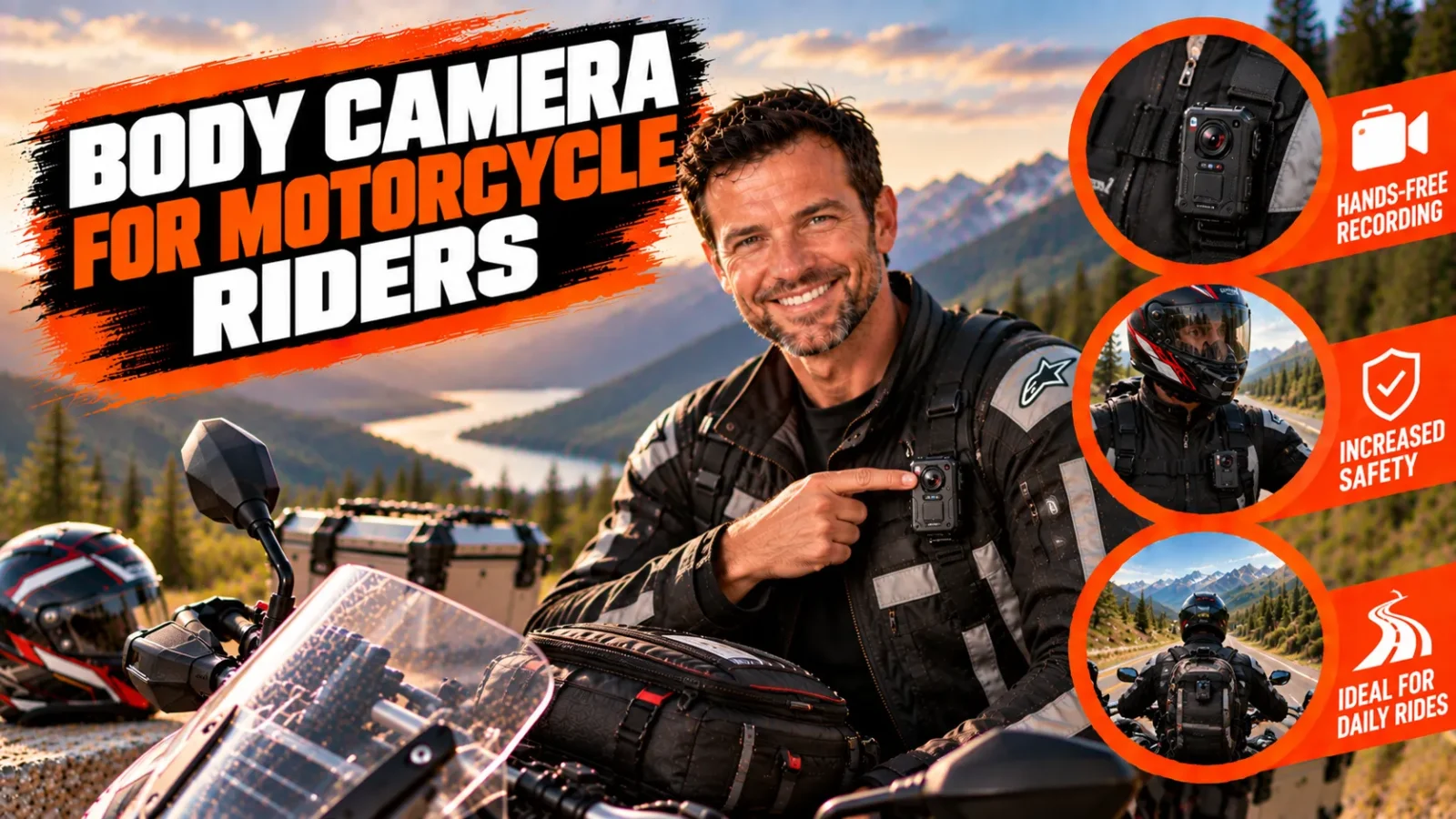
I’ve been strapping cameras to my chest, helmet, and jacket for years, mostly because I got tired of “he said, she said” arguments after close calls with distracted drivers. A body camera for motorcycle riding isn’t just about capturing cool footage anymore — it’s become my insurance policy on two wheels.
I’ve bought, tested, and occasionally returned a small pile of these cameras over the last few riding seasons. Some were fantastic. A couple were genuinely disappointing. Below is my honest breakdown of the ones actually worth your money.
- The GoPro Hero 13 Black on a chest harness is my top all-around pick for footage quality and reliability.
- If you want a dedicated, purpose-built body cam with long recording loops, the Boblov B4K2 is my budget-friendly favorite.
- For evidence-grade footage that holds up legally, the Reveal RS3-A and Transcend DrivePro Body 30 are built exactly for that job.
- Stabilization matters more than resolution on a bike — the DJI Osmo Action 5 Pro and Insta360 Ace Pro 2 both smooth out road vibration beautifully.
- Pairing your body cam with a solid helmet camera setup gives you two angles, which has saved me more than once in insurance disputes.
1. GoPro Hero 13 Black — Best Overall Body Camera for Motorcycle Riders
The GoPro Hero 13 Black is what I reach for on almost every ride, mounted to a chest harness rather than my helmet. It shoots up to 5.3K at 60fps, and the HyperSmooth 6.0 stabilization is genuinely the best I’ve used for taming vibration from the road and engine.
What sold me on using it as a body cam specifically is the wider field of view combined with the new magnetic mounting system, which lets me swap it between my chest rig, tank bag, and helmet in seconds. Battery life sits around 90-120 minutes of 4K recording, so I usually carry a spare Enduro battery for longer rides.
At roughly $400 for the body alone, it’s not cheap, but the image quality and app ecosystem make editing footage for insurance claims or YouTube dramatically easier. If you’re torn between a helmet or chest setup, I’ve written more about the best GoPro camera for motorcycle helmet use if you want to compare both angles.
Why I keep coming back to it
Honestly, it’s the durability. I’ve dropped mine, sprayed it with chain lube by accident, and left it in freezing temps overnight in my top box. It just keeps working, which is more than I can say for a couple of cheaper units on this list.
2. Boblov B4K2 — Best Dedicated Body Camera for Motorcycle Commuting
If you want something that’s actually built as a body-worn camera rather than an action cam repurposed for the job, the Boblov B4K2 is my top pick. It’s a proper clip-on unit with a rotatable lens, 4K recording, and a massive 5000mAh battery that easily outlasts my GoPro on long commutes.
It clips directly onto your jacket strap or chest harness, no separate mount needed, which I appreciate on rushed mornings. The loop recording and password-protected storage also make it feel more like a security tool than a vlogging camera.
At around $130-150, it’s a fraction of the price of premium action cams. The video quality isn’t quite GoPro-level in low light, but for daytime commuting and documenting close calls with cars, it’s more than sharp enough.
Battery life that actually matches the spec sheet
I’ve genuinely gotten 8+ hours of continuous 1080p recording out of the B4K2 on a single charge. That’s rare in this category, where manufacturers love to exaggerate runtime numbers.
3. DJI Osmo Action 5 Pro — Best Stabilization for Rough Roads
DJI’s Osmo Action 5 Pro genuinely surprised me. I was skeptical after using older DJI action cams, but the RockSteady 3.0 stabilization handles pothole-riddled backroads better than anything else I’ve tested, including my GoPro.
The dual screens (front and back) make framing a chest-mounted shot much easier without guessing, which matters a lot when you’re trying to eyeball your own body angle before pulling out of the driveway. It also shoots 4K at 120fps, so slow-motion near-miss footage looks incredibly clean.
Cold weather performance is another standout — DJI rates it down to -4°F, and I’ve used it comfortably on frosty morning rides where my old cameras started lagging. It runs about $350, putting it right in competition with the GoPro Hero 13 Black.
A note on mounting for body use
DJI doesn’t sell a dedicated chest harness, so I pair mine with a third-party magnetic chest mount. It works fine, but GoPro’s mounting ecosystem is still more mature if you want a dozen different carrying options.
4. Reveal RS3-A — Best for Legal-Grade Evidence Footage
The Reveal RS3-A is technically built for law enforcement and security professionals, but I started using one after a bad encounter with an aggressive driver that ended up in small claims court. Its footage is timestamped, GPS-tagged, and designed to hold up as evidence.
It’s rugged — IP67 rated, drop-tested, and built with a metal internal frame — which matters when it’s strapped to your chest and taking wind blast at highway speeds. Recording runs at 1080p, which is lower resolution than a GoPro, but the encryption and chain-of-custody features are what you’re really paying for here.
At $400-500, it’s an investment, but if you ride in an area with a lot of road rage incidents or aggressive traffic, having footage that a court will actually accept without question is worth it.
5. Transcend DrivePro Body 30 — Best Battery Life for All-Day Rides
I picked up the Transcend DrivePro Body 30 specifically for multi-day touring trips, and it hasn’t let me down. It’s rated for up to 10 hours of continuous recording, which is the longest runtime of anything on this list.
It records in 1440p, has a built-in infrared night mode, and features a rotating lens so you can angle it up or down depending on your riding position. The rugged rubberized housing also survived a light rain shower on a trip through the Blue Ridge Parkway without any issues.
Priced around $250-300, it sits in the middle of the pack cost-wise but wins on sheer endurance. If you hate swapping batteries mid-ride, this is the one I’d point you toward.
6. Wolfcom Vision — Best for Riders Who Want Police-Grade Reliability
The Wolfcom Vision is another crossover from the law enforcement world, and it’s built like a tank. IP68 waterproofing, a 140-degree wide-angle lens, and pre-event buffering (it captures a few seconds before you even hit record) make it a serious option for documentation.
I like the pre-event buffer feature the most — it’s saved me from missing the actual moment a car cut me off because I fumbled the record button half a second too late. That alone makes it worth the roughly $300-400 price tag for safety-focused riders.
Video quality tops out at 1080p, so it’s not going to wow anyone on YouTube, but that’s not really its job. This is a “just in case” camera, and it does that job extremely well.
7. Insta360 Ace Pro 2 — Best Low-Light Performance
Night riding is where most action cameras fall apart, but the Insta360 Ace Pro 2 handles it surprisingly well thanks to its 1/1.3-inch sensor, co-engineered with Leica. I’ve used it on dusk commutes and the footage stays usable instead of turning into a grainy mess.
It also shoots 8K at 24fps and 4K at 120fps, giving you plenty of flexibility for slow-motion clips of near misses or just capturing a scenic canyon run. The flip-up touchscreen is genuinely handy for double-checking your chest mount angle before setting off.
At around $350, it competes directly with the GoPro Hero 13 Black and DJI Osmo Action 5 Pro. For riders who do a lot of early morning or evening rides, I’d actually rank this one above both.
8. Boblov N9 — Best Budget Pick for New Riders
Not everyone wants to drop $300-400 on a camera before they’ve even decided if body-cam recording is for them. The Boblov N9 is my go-to recommendation for riders just starting out, priced at around $70-90.
It records in 1296p, has a 140-degree field of view, and offers basic loop recording with a decent 4-5 hour battery life. It’s clearly not going to compete with the GoPro or Insta360 on image quality, but it does the core job — recording your ride and staying out of the way.
I lent mine to a buddy who was nervous about lane-splitting traffic on his commute, and it gave him peace of mind without a big financial commitment. Sometimes that’s exactly what a new rider needs before upgrading later.
9. Insta360 GO 3S — Best Ultra-Compact Clip-On Camera
The Insta360 GO 3S is tiny — like, thumb-sized tiny — and clips onto your jacket lapel or chest strap with a magnetic pendant mount. I was skeptical a camera this small could produce usable footage, but it shoots 4K and has solid stabilization for its size.
Its biggest appeal for motorcycle use is how unobtrusive it is. There’s no bulky housing catching wind or adding weight to your riding gear, which matters on long summer rides when every extra ounce on your jacket starts to feel like more.
At around $400 for the bundle with the action pod, it’s pricier than it looks given the size, but the convenience factor is genuinely unmatched. It’s my pick for riders who want a body camera that basically disappears into their gear.
How I Actually Choose Between These
When I’m deciding which camera to grab before a ride, it usually comes down to purpose. Commuting through city traffic? I want long battery life and legal-grade footage, so I reach for the Boblov B4K2 or Transcend DrivePro Body 30.
Weekend canyon carving or a scenic tour I want to actually enjoy watching later? That’s GoPro Hero 13 Black or Insta360 Ace Pro 2 territory, since footage quality and stabilization matter more than pure documentation.
If you’re still weighing whether a body-worn setup or a helmet-mounted camera fits your riding style better, it’s worth reading up on the best action camera for motorcycle helmets before committing to one system. A lot of riders, myself included, actually end up running both.
Chest Mount vs. Helmet Mount: My Honest Take
Chest mounts give you a more natural, stable view that mimics what your eyes actually see, and they don’t add weight or wind noise to your helmet. Helmet mounts, on the other hand, capture exactly where you’re looking, which is incredibly useful for hazard documentation.
I personally run a body camera as my primary and a helmet cam as backup when I’m touring somewhere unfamiliar. Two angles of the same incident is far more convincing to an insurance adjuster than one.
If you go the helmet route, getting your mounting setup right matters just as much as the camera itself. I’d suggest checking out my thoughts on the best GoPro mounts for motorcycle helmets to avoid the wobbly footage that ruins otherwise great rides.
Mounting and Setup Tips From My Own Trial and Error
No matter which camera you pick, the mount is half the battle. I ruined a full day of touring footage once because my adhesive mount peeled off in the heat somewhere outside Moab.
For chest harnesses, make sure the straps sit snug enough that the camera doesn’t bounce with every bump — a loose harness is the number one cause of shaky, unusable footage in my experience. I also always do a five-minute test ride before committing to a full day of recording.
If you’re supplementing your body cam with a helmet setup, adhesive mounts need real prep work. I learned this the hard way, and now I always follow a proper cleaning and curing process, similar to what’s outlined in this guide on the best GoPro adhesive mount setup for motorcycle helmets, before trusting any adhesive mount at highway speeds.
Storage and Footage Management
One thing nobody tells you upfront: these cameras generate a ton of footage, fast. A single hour of 4K recording can eat up several gigabytes, so I always run at least a 128GB card, and honestly a 256GB card is better if you tour for multiple days.
I also make it a habit to back up any footage involving a close call or incident immediately after a ride, before it gets overwritten by loop recording. This has saved me more than once when I needed proof days after an incident rather than hours.
Final Thoughts From the Saddle
After years of testing, my honest recommendation is this: if you only buy one camera, get the GoPro Hero 13 Black and pair it with a solid chest harness. It handles everything from daily commuting to weekend touring without compromise.
If budget or dedicated legal-grade footage is your priority, the Boblov B4K2 and Reveal RS3-A respectively cover those needs better than any action camera on the market right now.
Whatever you choose, the real value isn’t the footage of scenic roads, it’s the peace of mind. I ride knowing that if something goes wrong, I’ve got proof, and that’s made me a noticeably calmer, more confident rider in traffic.
Frequently Asked Questions
Is a body camera better than a helmet camera for motorcycle riding?
It depends on your goals. A body camera mounted on your chest captures a more stable, human-eye-level view and doesn’t add weight to your helmet, but a helmet-mounted GoPro on your helmet often gets a better view of hazards and instrument checks.
Do I need a dedicated body camera or will an action camera work?
Action cameras like the GoPro Hero 13 Black or DJI Osmo Action 5 Pro work great as body cameras when paired with a chest harness, and they offer better video quality than most dedicated body cams. Dedicated units like the Boblov B4K2 are better if you want long recording loops and legal-grade footage.
How long do motorcycle body cameras record before the battery dies?
Most dedicated body cameras like the Transcend DrivePro Body 30 run 6 to 10 hours on a charge, while action cameras like the Insta360 Ace Pro 2 typically last 2 to 3 hours of continuous 4K recording before needing a swap or power bank.
Are motorcycle body cameras legal to use while riding?
In most places, yes, recording your own ride for personal safety or evidence is legal, but audio recording laws vary by state and country, so it’s worth checking local wiretapping and consent rules before you hit record.

Related Articles

6 Best Rear View Cameras for Motorcycle: Riders Who Want Eyes in the Back of Their Head
I've tested the top rear view cameras for motorcycles so you don't have to. Here are my real-world picks for…
Jake Miller
12 min read

8 Best Cameras for Riding Motorcycle in 2026 (Rider-Tested Picks)
I've mounted, crashed, and rain-soaked dozens of cameras on my helmet and bike. Here are the 8 best cameras for…
Jake Miller
9 min read

9 Best Cameras for Motorcycle Travel: My Tested Picks for Long-Haul Rides
I've tested action cams, 360 cameras, and mirrorless bodies on thousands of touring miles. Here are the 9 best cameras…
Jake Miller
12 min read