
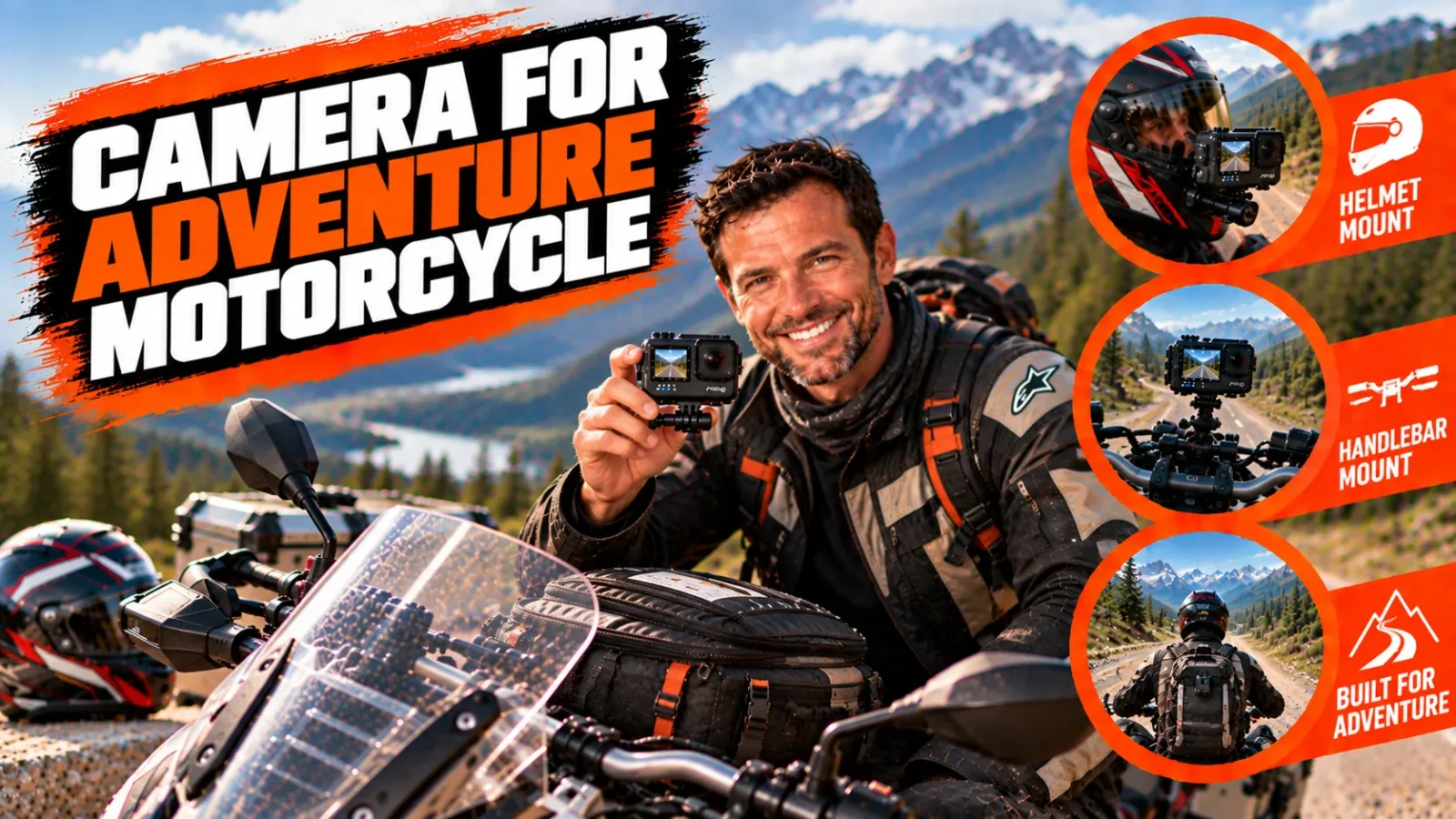
I’ve dropped a camera in a river crossing in Baja, watched one fog up completely on a cold pass in Colorado, and burned through way too many batteries chasing sunset footage in the desert. Adventure riding is brutal on gear, and cameras are no exception.
After years of strapping cameras to my helmet, chest, and handlebars across gravel, sand, and mud, I’ve got strong opinions about what actually holds up. This isn’t a list of specs copied off a manufacturer’s website — it’s what I’d actually buy again, and what I’d avoid.
Below are the 9 best cameras for adventure motorcycle riding I’ve used or thoroughly researched, broken down by what each one does best.
- The GoPro HERO13 Black is my top overall pick for durability, image quality, and mounting flexibility on ADV bikes.
- The DJI Osmo Action 5 Pro is the best choice if you ride in low light or unpredictable weather.
- The Insta360 X4 is worth it if you want 360-degree footage you can reframe after the ride.
- Budget riders should look at the GoPro HERO12 Black or Sena Prism Tube for solid performance without the premium price.
- Mounting matters as much as the camera itself — a bad mount ruins good footage every time.
1. GoPro HERO13 Black — Best Overall Action Camera
If I could only bring one camera on a multi-week ADV trip, it’s the GoPro HERO13 Black. It’s the camera I trust most when I’m crossing rivers, eating dust on fire roads, or getting rained on for six hours straight.
It shoots up to 5.3K at 60fps, has HyperSmooth 6.0 stabilization that makes washboard roads look almost smooth, and is waterproof to 10 meters without a case. That last part matters a lot when you’re dunking your front wheel in a creek crossing and don’t want to think about your camera.
The new magnetic lens mod system is a genuine upgrade for touring riders — you can swap in a Max Lens Mod 2.0 for ultra-wide POV shots or an anamorphic lens for cinematic footage. Battery life is still the weak point, so I always carry two or three spares.
Price sits around $399-$449 depending on the bundle. If you’re building out your setup, I’d pair it with one of the options from my breakdown of the best gopro camera for motorcycle helmet guide to get the mounting angle right.
Why It Works for Adventure Riding Specifically
ADV riding means constant vibration, temperature swings, and dust. The HERO13’s rugged shell and improved thermal management mean it doesn’t overheat as quickly as older models did on long, hot desert stretches.
2. DJI Osmo Action 5 Pro — Best for Low Light and Bad Weather
I switched to the DJI Osmo Action 5 Pro for a trip through the Pacific Northwest where I knew I’d be riding through fog, rain, and dim forest canopy most days. It didn’t disappoint.
Its 1/1.3-inch sensor is noticeably larger than most competitors, which translates to cleaner footage at dawn, dusk, and in shaded canyon sections where other action cams get grainy. It’s also waterproof to 20 meters without a housing, which is deeper than the GoPro.
Battery life is the real selling point here — DJI claims up to 240 minutes of recording on a single charge, and in my testing it genuinely outlasts the HERO13 by a solid margin in cold weather. That matters a lot on long ADV days where you can’t stop every hour to swap batteries.
It runs about $349 for the standard combo, which undercuts GoPro’s flagship while matching it in most areas that matter for touring riders.
3. Insta360 X4 — Best 360-Degree Camera
The Insta360 X4 changed how I think about capturing rides. Instead of committing to one angle before you even start riding, it records in every direction at once, and you pick your shot afterward in the app.
It shoots 8K 360-degree video, which sounds like overkill until you’re editing a video that reframes itself to follow your bike through a technical section without you ever having aimed the lens there. That flexibility is huge when you’re solo riding and can’t predict the best angle in advance.
Mounted on a selfie stick invisible in post, it also gives you that “drone-like” following shot that makes ADV footage look far more cinematic than a standard helmet cam ever could. It’s pricier at around $499, and the learning curve for editing 360 footage is real, but the results are worth it for content-focused riders.
Battery life is around 135 minutes of continuous 8K30 recording, so I bring backups for all-day rides just like with any action cam.
4. Insta360 Ace Pro 2 — Best for Vlogging and AI-Assisted Editing
For riders who want to talk to camera at rest stops and also capture solid riding footage, the Insta360 Ace Pro 2 is a smart pick. It has a flip-up touchscreen, which none of the traditional action cams offer, making it much easier to frame yourself for talking-head shots.
It co-developed its sensor with Leica, and the color science shows — skin tones and landscape shots both look more natural straight out of camera compared to GoPro’s default profile. It shoots 8K30 and 4K120 for slow-motion crash-avoidance clips (we’ve all had a close call worth reviewing).
What really sets it apart is the AI editing built into the companion app. It can auto-select highlights from a long ride and cut a rough edit in minutes, which is a lifesaver after a 10-hour riding day when you have zero energy left to sit and edit.
Priced around $399, it’s competitive with the HERO13 while offering a genuinely different feature set for content creators.
5. Sony RX0 II — Best Premium Compact Camera
The Sony RX0 II isn’t marketed as an “action camera,” but I’ve used it strapped to a handlebar mount for shots where I wanted DSLR-quality image without the bulk. It houses a 1-inch sensor, which is significantly larger than what you’ll find in a GoPro or DJI action cam.
That bigger sensor means better dynamic range and much cleaner low-light performance, which is noticeable when riding into golden-hour light on a mountain pass. It’s also waterproof to 10 meters and crushproof to 200kgf, so it survives being knocked around in a tank bag or pannier.
It’s not cheap — expect to pay around $700 — and it lacks the ultra-wide FOV and stabilization tricks of dedicated action cams. But if image quality is your top priority over convenience, it’s one of the best compact options out there for touring riders who also care about still photography.
6. DJI Osmo Pocket 3 — Best Gimbal-Stabilized Camera
When I want buttery-smooth handheld footage of my bike at camp or during a fuel stop, I reach for the DJI Osmo Pocket 3. Its mechanical 3-axis gimbal produces stabilization that no action camera can fully replicate, especially for slow panning or walking shots.
It has a 1-inch sensor, a rotating touchscreen, and shoots in a vertical format on the fly, which is genuinely useful if you’re posting to Instagram or TikTok alongside a YouTube channel. It’s not designed to be helmet-mounted since it’s not fully waterproof or rugged, but it earns its place in my tank bag every trip.
At around $519 for the Creator Combo, it’s an investment, but it fills a gap that helmet and chest cams simply can’t — cinematic B-roll of the bike, the campsite, and the scenery without needing a drone.
7. Insta360 GO 3S — Best Tiny Wearable Camera
The Insta360 GO 3S is genuinely tiny — about the size of a large gumdrop — and it clips onto a helmet, jacket collar, or chest mount with almost no wind noise or drag. I like using it as a secondary angle alongside a main helmet cam.
It shoots up to 4K30 and 2.7K60, with solid stabilization for its size, and comes with a magnetic pendant mount that’s genuinely fast to attach and remove at gas stops. It’s waterproof to 4 meters on its own, or deeper with the included Action Pod case.
Battery life is short on its own (around 45 minutes of continuous 4K), but the Action Pod extends that considerably while doubling as a mini tripod. At roughly $319, it’s a great second camera rather than a primary one for full-day ADV rides.
8. Sena Prism Tube — Best Budget Helmet Camera
Sena is better known for helmet communicators, but the Sena Prism Tube deserves attention as a budget-friendly, purpose-built motorcycle camera. It’s designed from the ground up to mount discreetly to a helmet and integrate with Sena’s mesh communication headsets.
It records in 2.7K and has a low-profile, tube-shaped design that creates noticeably less wind drag and noise than boxier action cams. For riders who already run a Sena communicator, the integration for voice-activated recording is a genuinely useful feature — you can start recording hands-free the moment something interesting happens on the trail.
At around $250, it undercuts GoPro and DJI significantly, though it won’t match their stabilization or dynamic range in tricky lighting. If you want a dedicated, low-hassle helmet setup without spending $400+, it’s one of the better values out there and worth comparing against other options in my best action camera for motorcycle helmets roundup.
9. GoPro HERO12 Black — Best Value Pick
If the HERO13 is slightly out of budget, the GoPro HERO12 Black is still an excellent choice and often sells for $50-$100 less. I used the HERO12 for over a year of ADV riding before upgrading, and it never let me down.
It shoots 5.3K30 and 4K120 for slow motion, has HyperSmooth 6.0 (the same stabilization tech as the HERO13), and is waterproof to 10 meters without a housing. The main differences from the HERO13 are the lack of the magnetic lens mod system and slightly shorter battery life.
For riders just getting into content creation who don’t need the absolute latest tech, this is genuinely one of the smartest buys in the action camera space right now. Prices typically run around $299-$349 depending on bundle and retailer.
How I Actually Choose a Camera for Adventure Riding
Specs on a spec sheet don’t tell the whole story. Here’s what I actually weigh before buying a new camera for a big trip.
Battery Life in Real Conditions
Manufacturer battery estimates are almost always optimistic. Cold weather, 4K/60fps recording, and screen-on time all drain batteries faster than advertised. I always plan for roughly 60-70% of the stated battery life on a real ride.
Durability and Weatherproofing
Adventure riding means dust storms, river crossings, and sudden downpours. Any camera on this list that isn’t rated for at least 10 meters of water resistance without a case gets left at home on my trips.
Mounting Flexibility
A great camera with a bad mount produces unwatchable, shaky footage. I run a combination of chin mounts, chest harnesses, and handlebar clamps depending on the shot I want, and I’d strongly recommend browsing the best go pro mounts for motorcycle helmets before committing to just one mounting style.
Adhesive vs. Bolt-On Mounts
For helmet cams specifically, adhesive mounts need to be applied correctly or they’ll fail at the worst possible moment — usually at highway speed. I always check out a proper guide like the best go pro adhesive mount setup for motorcycle helmet before slapping a mount onto a brand-new lid.
My Final Take
There’s no single “best” camera for every adventure rider — it really depends on whether you prioritize durability, image quality, editing flexibility, or budget. For most riders, though, I keep coming back to the GoPro HERO13 Black as the safest all-around choice.
If you ride in consistently dim or wet conditions, the DJI Osmo Action 5 Pro is genuinely better suited to that environment. And if you want footage that’s impossible to mess up in the moment, the Insta360 X4‘s 360-degree capture is worth the higher price and steeper learning curve.
Whatever you choose, spend as much thought on your mount as you do on the camera body itself. I’ve lost more good footage to a loose mount than to a bad camera, and that’s a mistake I don’t plan on repeating.
Frequently Asked Questions
Do I need a separate camera if I already have a GoPro?
Not necessarily. Many riders get by with just the best gopro camera for motorcycle helmet setups, but a dedicated body cam or 360 camera can add angles a helmet mount can’t capture.
What’s the most durable camera for dusty, wet adventure routes?
In my experience, the GoPro HERO13 Black and DJI Osmo Action 5 Pro are both rated for serious water and dust exposure without a housing, making them ideal for ADV riding.
Is a 360-degree camera worth it for motorcycle trips?
Yes, if you want flexibility in editing. The Insta360 X4 lets you reframe your shot after the ride, which is a huge advantage when you can’t predict what’s going to happen on the trail.
How should I mount my camera on an adventure bike?
It depends on the footage you want. I run a mix of helmet, chest, and handlebar mounts, and I’d recommend checking out the best go pro mounts for motorcycle helmets to find a setup that matches your riding style.

Related Articles

6 Best Rear View Cameras for Motorcycle: Riders Who Want Eyes in the Back of Their Head
I've tested the top rear view cameras for motorcycles so you don't have to. Here are my real-world picks for…
 Jake Miller
12 min read
Jake Miller
12 min read

8 Best Cameras for Riding Motorcycle in 2026 (Rider-Tested Picks)
I've mounted, crashed, and rain-soaked dozens of cameras on my helmet and bike. Here are the 8 best cameras for…
Jake Miller
9 min read

9 Best Cameras for Motorcycle Travel: My Tested Picks for Long-Haul Rides
I've tested action cams, 360 cameras, and mirrorless bodies on thousands of touring miles. Here are the 9 best cameras…
Jake Miller
12 min read