
8 Best Cameras for Motorcycle Pictures I’ve Actually Ridden With
 Jake Miller
10 min read
Jake Miller
10 min read
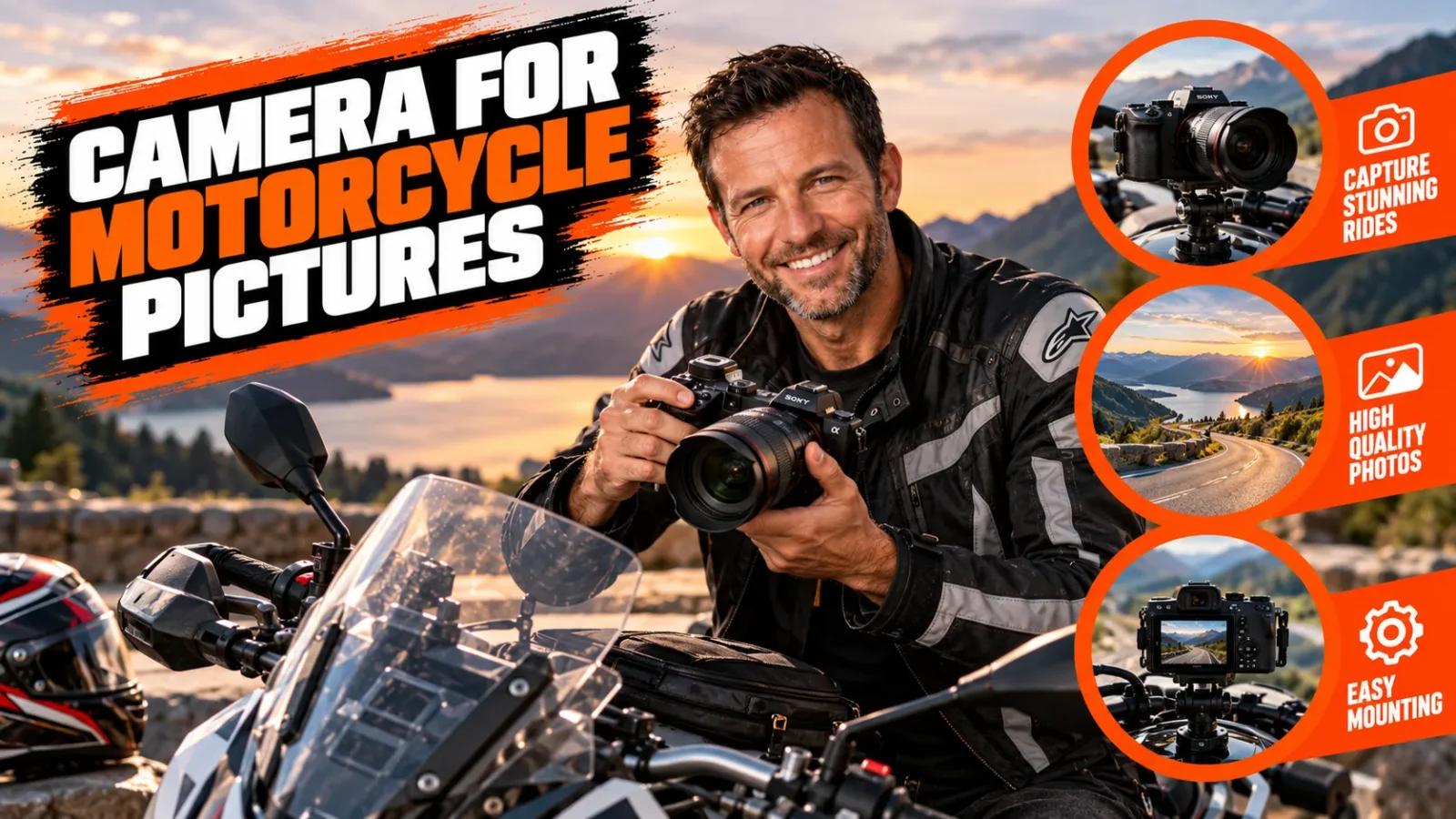
I’ve spent the better part of a decade chasing sunsets on two wheels, and I can tell you this much: the right camera changes everything about how you document a ride. I’ve hauled DSLRs in tank bags, mounted action cams to my chin bar, and stuffed compacts into jacket pockets on twisty backroads.
Through all of that trial and error, I’ve landed on a shortlist of cameras that actually earn their keep on a motorcycle. These aren’t theoretical picks pulled from spec sheets — I’ve either owned, borrowed, or ridden thousands of miles with every single one of these.
Whether you want cinematic helmet footage, crisp landscape shots at a scenic overlook, or a rugged little shooter that survives a drop in the gravel, I’ve got you covered below.
- For everyday riding and touring stills, my top pick is the Sony Alpha a6400 — small, fast, and packed with pro features.
- If you want rugged, mountable action footage plus solid stills, the GoPro HERO12 Black is still the gold standard.
- Budget-conscious riders should look at the Ricoh GR IIIx or an older GoPro for excellent image quality at a lower price.
- 360-degree riders should check out the Insta360 X4 for reframable footage that fixes bad camera angles after the fact.
- Pair any of these with a good GoPro mount for your helmet to get the most versatile shooting setup possible.
1. Sony Alpha a6400 — Best Overall Mirrorless Camera for Motorcycle Pictures
The Sony Alpha a6400 is the camera I reach for most when I’m touring and actually want gallery-worthy shots of my bike against a mountain backdrop. It’s a APS-C mirrorless body that weighs under a pound, so it doesn’t eat into my luggage weight budget.
What sold me on the a6400 is the autofocus. Sony’s real-time tracking locks onto my riding buddy’s bike mid-corner faster than any camera I’ve used in this price range, and that 0.02-second autofocus speed genuinely shows up in my keeper rate.
It shoots 24.2MP stills and 4K video at 30fps, with a flip-up screen that’s handy for vlogging at gas stops. I usually pair it with the compact Sony 16-50mm kit lens for pack size, but it also plays nicely with a 35mm prime for portraits of my bike.
Real-World Specs I Care About
Body-only pricing typically runs around $898, which feels fair for what you get. It’s not weather-sealed to the same degree as pro bodies, so I always carry a rain cover in my saddlebag just in case.
2. GoPro HERO12 Black — Best Action Camera for Helmet and Bike Mounts
I don’t think any motorcycle camera list is complete without the GoPro HERO12 Black. It’s the camera I trust most for anything that involves vibration, weather, or the possibility of getting knocked around at highway speed.
The HERO12 shoots 5.3K video at 60fps and 27MP stills, which is genuinely sharp enough for large prints if you’re shooting in good light. HyperSmooth 6.0 stabilization is the real headline feature for me — it makes footage from rough pavement look almost gimbal-smooth.
Battery life improved noticeably over the HERO11, and I’ve gotten close to two hours of continuous 4K recording on a single charge during longer rides. It’s rated waterproof to 33 feet without a housing, so rain doesn’t scare me anymore.
I’ve written a full breakdown of why I think this is the best GoPro camera for motorcycle helmets if you want more detail on mounting positions and settings I use.
Mounting Matters Just as Much as the Camera
I’ll be honest — a great action camera on a bad mount is a wasted purchase. I’ve had good luck combining the HERO12 with a proper GoPro mount for motorcycle helmets, and for chin-mount shots specifically, I lean on a reliable GoPro adhesive mount setup for motorcycle helmets so it doesn’t shift at speed.
3. DJI Osmo Action 4 — Best Alternative Action Camera for Low-Light Rides
I picked up the DJI Osmo Action 4 mainly to test it against my GoPro, and it ended up earning a permanent spot in my gear bag. The 1/1.3-inch sensor is noticeably larger than most action cams, which translates into better performance during dusk rides home.
DJI’s RockSteady 3.0 stabilization rivals HyperSmooth in my experience, and I actually find the touchscreen menu a bit more intuitive to navigate with gloves on. It’s waterproof to 18 meters without a case, and the dual batteries in the box mean I rarely run out of juice mid-ride.
Price-wise, it typically sells for around $349 for the standard combo, which undercuts GoPro’s flagship while matching most of its core capabilities. If you ride frequently at dawn or dusk, I genuinely think this camera has an edge.
4. Fujifilm X-T30 II — Best Camera for Cinematic Motorcycle Portraits
When I want my bike photos to look less like snapshots and more like something out of a magazine, I grab the Fujifilm X-T30 II. Fujifilm’s color science is genuinely a cheat code — the film simulations like Classic Chrome and Velvia make roadside shots pop without any editing.
It’s a 26.1MP APS-C body with a retro dial-based control layout that I find faster to operate than touchscreen-heavy menus once I’m used to it. The 4K/30p video is solid too, though I mostly use this camera for stills of my bike at scenic pull-offs.
At around $899 body-only, it’s priced similarly to the Sony a6400, so the choice really comes down to whether you prioritize autofocus speed (Sony) or color output straight out of camera (Fujifilm). I honestly own both for different occasions.
Lens Pairings I’ve Actually Used
My go-to combo is the Fujifilm 18-55mm f/2.8-4 kit lens for versatility, though I’ve swapped in a 35mm f/2 for tighter portrait-style shots of riders leaning into corners.
5. Insta360 X4 — Best 360-Degree Camera for Motorcycle Footage
The Insta360 X4 genuinely changed how I capture group rides. Because it shoots in full 360 degrees at up to 8K, I can mount it on a stick above my helmet and reframe the shot after the fact — meaning I never have to worry about aiming it correctly mid-ride.
This is a lifesaver on twisty roads where I don’t have a free hand to adjust angles. The Invisible Selfie Stick effect also makes it look like a drone is following me down the highway, which never fails to impress people scrolling through my feed.
It’s priced around $499, which feels steep until you realize it’s essentially replacing two or three cameras’ worth of angles in a single unit. Battery life caps out around 135 minutes in 8K mode, so I usually carry a spare battery on longer trips.
6. Sony RX100 VII — Best Premium Compact for Touring Riders
For riders who want DSLR-quality images without hauling interchangeable lenses, the Sony RX100 VII is the compact I recommend without hesitation. It fits in a jacket pocket, yet it packs a 1-inch, 20.1MP sensor and a 24-200mm equivalent zoom lens.
I’ve used this camera on multi-day tours specifically because I didn’t want to carry a full mirrorless kit through mountain passes. The autofocus borrows tech from Sony’s flagship cameras, so tracking a fellow rider pulling away from a stop light is no problem.
It’s not cheap — expect to pay around $1,298 — but I’ve found the image quality and zoom range genuinely replace a two-lens mirrorless setup for travel. If budget is tight, though, this is an easy one to skip in favor of cheaper options below.
7. Canon EOS R50 — Best Budget-Friendly Mirrorless Option
I recommended the Canon EOS R50 to a riding buddy who wanted to step up from his phone, and he hasn’t stopped thanking me. It’s Canon’s entry-level mirrorless body, but the 24.2MP sensor and Dual Pixel autofocus punch well above the roughly $679 price tag (body only).
The autofocus tracking for people and vehicles is shockingly capable for this price bracket — I’ve tested it tracking a rider approaching head-on at speed, and it held focus reliably. It’s lightweight too, which matters when it’s rattling around in a tank bag over rough roads.
My only gripe is the smaller battery life compared to Sony and Fujifilm competitors, so I always pack a spare for full-day rides. Still, for the price, I think it’s one of the smartest entry points into “real” camera ownership for new riders.
8. Ricoh GR IIIx — Best Pocketable Camera for Street-Style Motorcycle Shots
The Ricoh GR IIIx is my sleeper pick, and honestly the camera I carry most often just riding around town. It’s a fixed-lens compact with a 26.3MP APS-C sensor — genuinely large for something this pocketable — and a 40mm equivalent lens that’s perfect for environmental shots of my bike parked outside a diner.
There’s no zoom and no viewfinder, which took some adjustment, but the image quality rivals cameras twice its size. Startup time is nearly instant, which matters when you want to snap a candid shot before your riding buddy notices.
At around $1,099, it’s not the cheapest compact out there, but I’ve found nothing else this small that produces files this clean straight out of camera. It’s become my “always in the tank bag” option for spontaneous roadside photography.
How I Actually Choose a Camera Before a Ride
Before I pack for any trip, I ask myself what story I’m actually trying to tell. Group rides and canyon carving call for action cameras; scenic stops and bike portraits call for a mirrorless body or compact.
I also think hard about weight and weatherproofing. A camera that can’t survive a surprise rainstorm or a bit of road grime isn’t going to last long strapped to a motorcycle.
Weatherproofing and Durability
Action cameras like the GoPro HERO12 Black and DJI Osmo Action 4 win here easily — they’re built to be submerged, dropped, and vibrated without complaint. Mirrorless bodies need more babying, so I always pack a dry bag or rain cover regardless of the manufacturer’s weather-sealing claims.
Weight and Pack Size
Every extra pound matters on a long tour, especially if you’re running soft luggage instead of hard cases. This is exactly why compacts like the Ricoh GR IIIx and Sony RX100 VII earn a permanent spot in my travel kit — they deliver big-camera image quality without the bulk.
Getting the Most Out of Your Action Camera Setup
If you’re leaning toward an action camera for your rides, I’d strongly encourage reading up on the broader landscape before committing. I’ve put together a detailed comparison of the best action camera for motorcycle helmets that goes beyond just GoPro and DJI.
Mounting hardware genuinely makes or breaks your footage quality, in my experience. A shaky, poorly-positioned mount will ruin even the best camera’s stabilization tech.
I always test a new mount on a short local ride before trusting it on a multi-day tour. Nothing’s worse than reviewing footage and realizing your camera was tilted the entire time.
My Final Take
If I had to pick just one camera off this entire list, I’d probably grab the GoPro HERO12 Black for its sheer versatility — it handles action, stills, and weather abuse better than almost anything else here. But for riders serious about photography beyond just helmet footage, the Sony Alpha a6400 remains my top mirrorless recommendation.
Honestly, my own gear bag has evolved to include several of these cameras depending on the type of ride I’m planning. There’s no single “best” answer — just the right tool for the kind of story you want to tell from the saddle.
Whatever you choose, don’t skimp on the mounting setup. A great camera paired with a mediocre mount is how I ended up with hours of unusable, shaky footage early in my riding days — lessons I’d rather you skip entirely.
Frequently Asked Questions
What is the best all-around camera for motorcycle pictures?
For most riders, I recommend the Sony Alpha a6400 for static and touring shots paired with a GoPro HERO12 Black for riding footage and helmet mounts.
Can I use a GoPro for motorcycle photos, not just video?
Yes, modern GoPros like the HERO12 Black shoot 27MP stills with HDR, which is plenty sharp for social media and even prints. Check out my guide on the best GoPro camera for motorcycle helmets for mounting tips.
Do I need a weatherproof camera for motorcycle trips?
I always recommend weather sealing or a protective housing since rain, dust, and vibration are constant threats on a bike. Cameras like the DJI Osmo Action 4 and Fujifilm X-T30 II both handle rough conditions well.
What’s the best budget camera for motorcycle pictures?
The Ricoh GR IIIx and older GoPro models offer excellent image quality without breaking the bank, though I still think the HERO12 Black gives you the most versatility for the price.

Related Articles

6 Best Rear View Cameras for Motorcycle: Riders Who Want Eyes in the Back of Their Head
I've tested the top rear view cameras for motorcycles so you don't have to. Here are my real-world picks for…
Jake Miller
12 min read

8 Best Cameras for Riding Motorcycle in 2026 (Rider-Tested Picks)
I've mounted, crashed, and rain-soaked dozens of cameras on my helmet and bike. Here are the 8 best cameras for…
Jake Miller
9 min read

9 Best Cameras for Motorcycle Travel: My Tested Picks for Long-Haul Rides
I've tested action cams, 360 cameras, and mirrorless bodies on thousands of touring miles. Here are the 9 best cameras…
Jake Miller
12 min read