
8 Best Cameras for a Motorcycle Trip: What I Actually Trust on Long Rides
 Jake Miller
12 min read
Jake Miller
12 min read
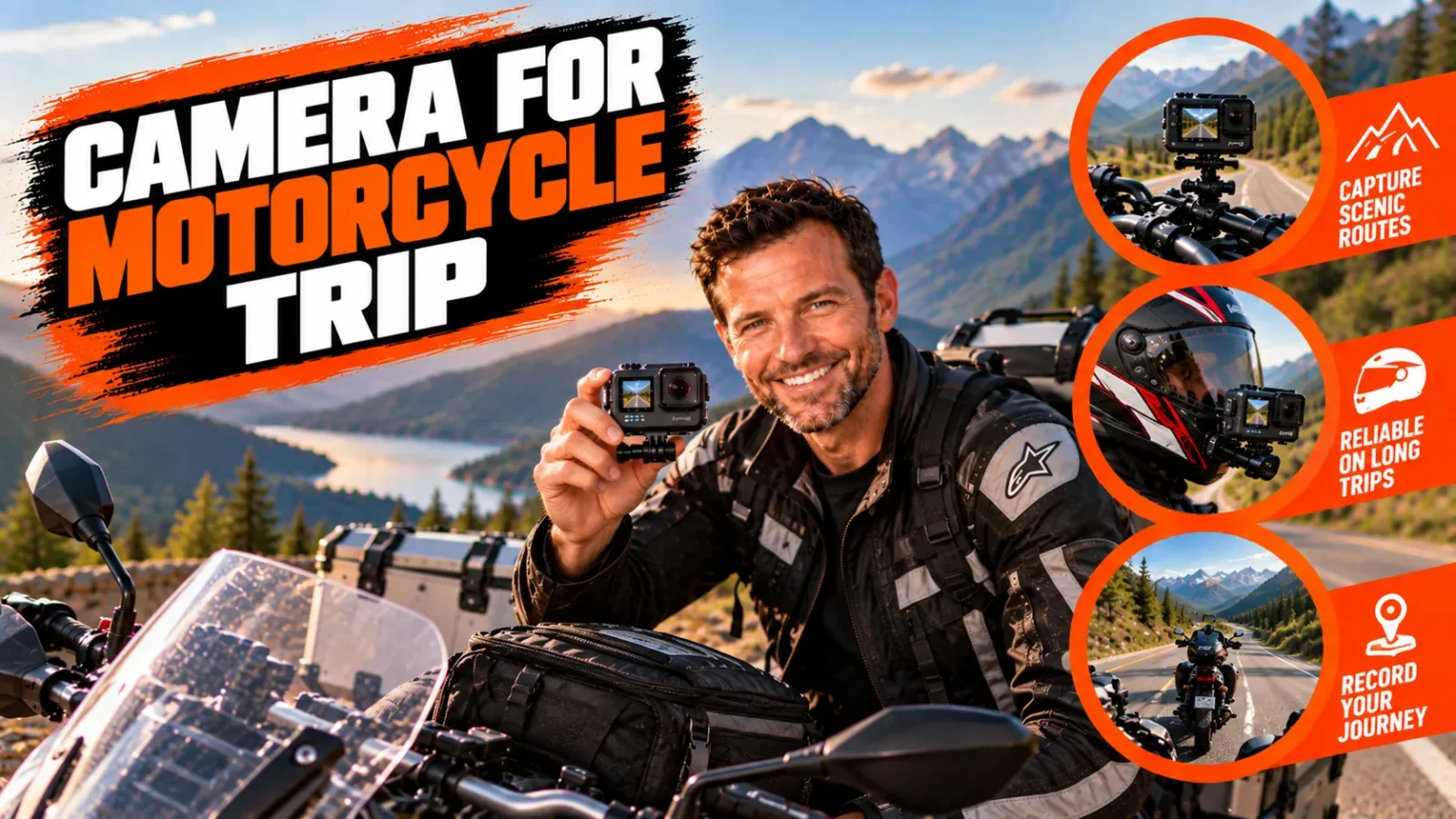
I’ve strapped a lot of cameras to my helmet, chest, and handlebars over the years, and honestly, most of them let me down at the worst possible moment — dead battery on a mountain pass, fogged lens in the rain, footage so shaky it’s unwatchable. Finding the best camera for motorcycle trip use isn’t about specs on a box; it’s about what survives an eight-hour riding day and still gives you footage worth showing your buddies.
Over the past few seasons of touring, commuting, and the occasional trackday, I’ve narrowed my picks down to the cameras that actually earn their spot on my bike. This list covers everything from pure action cams to 360-degree options and a couple of dedicated motorcycle dash cam systems for riders who want “set it and forget it” coverage.
- The GoPro HERO13 Black is my top all-around pick for footage quality, mounting flexibility, and reliability.
- The Insta360 X4 is the best choice if you want to reframe shots after the ride and skip fiddly aiming.
- For hands-free, always-on protection, a dedicated system like the INNOVV K5 doubles as a motorcycle dash cam and incident recorder.
- Battery life and mounting matter more than megapixels — plan your power and mount setup before you plan your route.
- Budget riders shouldn’t overlook the GoPro HERO12 Black, which still delivers excellent 5.3K footage at a lower price.
1. GoPro HERO13 Black — Best Overall Action Camera
The GoPro HERO13 Black is what I reach for on almost every trip, from weekend canyon runs to week-long tours. It shoots 5.3K60 video with HyperSmooth 6.0 stabilization, which genuinely tames vibration from the bars and helmet without needing a gimbal.
What sold me on this generation is the new magnetic quick-release mounting system. Swapping the HERO13 between a chin mount and a chest harness takes seconds, no tools required, which matters a lot when you’re packing up at a gas stop.
Battery life sits around 70-100 minutes of 4K recording depending on temperature, so I always carry a spare Enduro battery for longer riding days. It’s rated IP68 for up to 10 meters without a housing, so rain and road spray aren’t a concern.
Price runs around $399-$450 depending on bundle, which isn’t cheap, but the footage quality and the interchangeable lens options (including a genuine macro and anamorphic lens) make it worth it for riders who actually edit their videos afterward.
If you’re deciding between helmet and chest placement, I’ve written a full breakdown on the best GoPro camera for motorcycle helmet setups, including which mount styles hold up best at highway speeds.
2. Insta360 X4 — Best 360-Degree Camera for Full Coverage
The Insta360 X4 solves a problem I ran into constantly with traditional action cams: aiming. Mount this on your handlebar or a short pole and it captures everything in every direction, letting you pick the perfect angle in the app after the ride.
It shoots 8K30 360-degree video and 4K single-lens video, with the dual 1/2-inch sensors handling low light noticeably better than the previous X3 model. The “Me Mode” feature also lets you record like a normal, forward-facing action cam when you don’t need the full sphere.
Battery life is rated at about 135 minutes of 360 recording, which held up well on a full day of twisty backroads for me. It’s waterproof to 10 meters without a case and has an invisible selfie-stick effect, meaning you can mount it on a short pole and the stick vanishes from the final footage.
At roughly $500 for the standard bundle, it’s pricier than a standard GoPro, but the ability to reframe shaky, poorly-aimed footage into something usable has saved more than a few of my clips. It’s my go-to recommendation for riders who hate fussing with mount angles before every ride.
3. DJI Osmo Action 5 Pro — Best Low-Light & Battery Life
DJI’s Osmo Action 5 Pro has become my pick for early morning departures and dusk arrivals, situations where most action cameras start showing noisy, grainy footage. The larger 1/1.3-inch sensor handles low light dramatically better than most competitors in this price range.
It records 4K120 video with DJI’s RockSteady 3.0 and HorizonSteady stabilization, and I’ve found the horizon-lock feature particularly useful when the bike is leaned over mid-corner — the footage stays level even when the bike clearly isn’t.
Battery life is the real headline here: DJI rates it at up to 240 minutes of 1080p recording, and even in 4K I regularly got well over two hours per charge. For multi-day trips where charging opportunities are limited, that’s a genuine advantage.
It’s waterproof to 20 meters without a housing, has a front color screen for framing selfies, and costs around $349-$400 for the standard combo. If battery anxiety is your biggest gripe with action cameras, this is the one I’d point you toward.
4. Insta360 Ace Pro 2 — Best Image Quality
Co-engineered with Leica, the Insta360 Ace Pro 2 produces some of the best still-frame image quality I’ve pulled from any action camera on a bike. The 1/1.3-inch sensor and Leica-tuned color science give footage a noticeably richer, more natural look straight out of the camera.
It shoots 8K24 and 4K120 for slow motion, with AI-powered noise reduction that actually works in dim tunnels and shaded forest roads, two scenarios where I’ve watched cheaper cameras fall apart visually.
The flip-up touchscreen is genuinely useful for checking framing before you pull away from a scenic overlook, and the dual-battery fast charging system means you can top up quickly during a fuel stop rather than waiting around.
At around $450, it sits in the same price bracket as the GoPro HERO13 Black, and I’d recommend it specifically to riders who care more about final image quality than the widest possible feature set.
5. INNOVV K5 — Best Dedicated Motorcycle Dash Cam System
If you want a camera that’s simply always running, no charging, no remembering to hit record, the INNOVV K5 is the dedicated motorcycle camera system I’d point you toward. It wires directly into your bike’s electrical system with front and rear cameras built into small, weatherproof housings.
Both cameras record simultaneously in 2K resolution, giving you continuous front and rear coverage, which is invaluable if you’re ever in an incident and need footage to back up your side of the story. This is less about vlogging and more about protection and peace of mind.
Installation takes some wiring work (or a trip to a shop), but once it’s in, there’s nothing to remember before a ride. Footage loops onto a microSD card automatically, and there’s an optional GPS module to log speed, route, and location data alongside the video.
Pricing runs around $400-$500 for the full front-and-rear kit. It’s not the camera I’d use for cinematic trip videos, but for riders who want a permanent “always-on” safety net during commutes and long tours, it’s hard to beat.
6. GoPro HERO12 Black — Best Budget Pick
The GoPro HERO12 Black is my go-to recommendation whenever a friend asks for a solid camera without spending HERO13 money. It still shoots 5.3K30 and 4K60 video with HyperSmooth 6.0 stabilization, and honestly, the footage is close enough to the newer model that most viewers can’t tell the difference.
It’s fully compatible with the massive ecosystem of GoPro mounts already out there, including chin mounts, chest harnesses, and helmet mounts, since it uses the same standard folding-fingers mount design GoPro has used for years.
Battery life is a bit shorter than the HERO13, around 70 minutes in 4K, but at a street price often under $300, it’s an easy recommendation for riders building out their first setup. HDR video and improved low-light performance over older HERO models make it feel current, not outdated.
Because it shares GoPro’s mounting system, it’s worth reading up on the best action camera for motorcycle helmets if you’re choosing between GoPro and other brands at this price point — the mounting ecosystem matters as much as the sensor.
7. DJI Osmo Pocket 3 — Best for Vlogging Rest Stops
I don’t mount the DJI Osmo Pocket 3 to my bike, but I never leave it behind on a multi-day trip. Its 1-inch sensor and mechanical three-axis gimbal produce footage quality that action cameras simply can’t match once you’re off the bike, filming yourself at a scenic pullout or interviewing your riding buddies.
The 2-inch rotatable touchscreen makes it effortless to flip into selfie mode, and the gimbal keeps handheld footage buttery smooth even while walking around a bike at a rest stop. It shoots 4K120 for slow motion and has genuinely excellent low-light performance thanks to that larger sensor.
Battery life runs about 166 minutes of 1080p recording, and the whole unit fits in a jacket pocket, which is exactly the point. At around $519 for the Creator Combo, it’s pricier than most pocket cameras, but it fills the gap that action cameras leave when you want more cinematic, “vlog style” footage.
I pair mine with the action camera on my helmet — one captures the ride, the other captures the story around it. Together they make for a much more watchable trip video than either camera alone.
8. Insta360 GO 3S — Best Tiny, Lightweight Clip-on Camera
The Insta360 GO 3S is the camera I grab when I don’t want to think about mounting at all. This thumb-sized camera clips magnetically onto a jacket lapel, helmet strap, or chest mount, weighing so little you genuinely forget it’s there after a few miles.
It shoots 4K30 video and includes a small “Action Pod” case that doubles as a viewfinder, remote control, and extra battery, extending total shooting time to around 2.5 hours when combined. On its own, the camera body runs about 45 minutes, which is plenty for short scenic sections rather than a full day’s ride.
Waterproof to 4 meters without a case (and deeper with the optional dive case), it handles rain and road spray fine for typical touring conditions. The FlowState stabilization is surprisingly good for something this small, smoothing out the kind of micro-vibrations that plague chest mounts on rougher roads.
At around $319, it’s not the cheapest option, but for riders who want minimal bulk and don’t need marathon battery life, it’s genuinely one of the more fun cameras I’ve used on a bike. It also makes a great secondary angle alongside a primary helmet cam.
How I Actually Choose a Camera Before a Big Trip
Before every major ride, I run through the same mental checklist: battery life for the longest single riding day, weatherproofing for the season, and mount reliability at highway speeds. Footage quality matters, but it’s the last thing I check, not the first.
Mounting Matters More Than You’d Think
A great camera on a bad mount is worse than a mediocre camera on a rock-solid one. Vibration, wind buffeting, and vibration-induced loosening have cost me footage more often than a dead battery ever has.
I’ve tested a lot of hardware here, and my full comparison of the best GoPro mounts for motorcycle helmets covers which chin mounts, side mounts, and top mounts actually stay put above 70 mph.
For anyone gluing a mount directly to the shell, adhesive quality is non-negotiable — a mount that peels off at speed is a genuine safety hazard, not just a lost shot. I always recommend checking a dedicated guide on the best GoPro adhesive mount setup for motorcycle helmet before your first long trip, especially if your helmet has a textured or matte finish.
Power Planning for Multi-Day Rides
No camera on this list will survive a full riding day on a single charge if you’re recording continuously. I carry at least two spare batteries for whichever action cam I’m using, plus a small USB power bank tucked into a tank bag with a cable routed to the camera.
For the INNOVV K5 and similar wired systems, this isn’t a concern since they draw power directly from the bike. That’s honestly one of the biggest arguments in favor of a dedicated dash cam setup for daily commuters and touring riders who rack up serious mileage.
Weatherproofing and Temperature Swings
I’ve had cameras overheat and shut down on hot summer highway stretches, and I’ve had batteries drain unusually fast in cold mountain mornings. Most modern action cameras (GoPro HERO13 Black, DJI Osmo Action 5 Pro, Insta360 X4) are rated IP68 and handle both extremes reasonably well, but I still avoid leaving any camera baking in direct sun during long fuel stops.
My Final Take
If I could only pack one camera for a motorcycle trip, it’d be the GoPro HERO13 Black — the combination of stabilization, mount compatibility, and footage quality covers almost every scenario I run into. But for riders chasing better low-light performance or all-day battery life, the DJI Osmo Action 5 Pro and Insta360 X4 both earn their keep.
And if your priority is protection rather than highlight reels, a dedicated system like the INNOVV K5 gives you continuous front-and-rear coverage without lifting a finger. Whichever you choose, spend as much time dialing in your mount and power setup as you do picking the camera itself — that’s really where good trip footage comes from.
Frequently Asked Questions
What’s the best type of camera for a long motorcycle trip?
For most riders, a helmet or chest-mounted action camera like the GoPro HERO13 Black offers the best balance of footage quality, durability, and ease of mounting. If you want hands-free 360-degree reframing, an Insta360 X4 is worth the extra cost.
Do I need a 360 camera or a regular action camera for motorcycle trips?
A 360 camera like the Insta360 X4 is great if you want to reframe shots after the ride and capture both the road and yourself. A standard action camera is simpler, cheaper, and better on battery life for multi-day trips.
How long does a motorcycle camera battery actually last on the road?
Most action cameras run 60-90 minutes of continuous 4K recording per charge. For all-day touring, I pair mine with a USB power bank routed through a tank bag, or use a dedicated system like the INNOVV K5 wired to the bike’s battery.
Where’s the best place to mount a camera on a motorcycle?
Helmet mounts give the most immersive point-of-view footage, while chest mounts reduce head-bobble and helmet strain. Check out my breakdown of the best GoPro mounts for motorcycle helmets for specifics on hardware.

Related Articles

6 Best Rear View Cameras for Motorcycle: Riders Who Want Eyes in the Back of Their Head
I've tested the top rear view cameras for motorcycles so you don't have to. Here are my real-world picks for…
Jake Miller
12 min read

8 Best Cameras for Riding Motorcycle in 2026 (Rider-Tested Picks)
I've mounted, crashed, and rain-soaked dozens of cameras on my helmet and bike. Here are the 8 best cameras for…
Jake Miller
9 min read

9 Best Cameras for Motorcycle Travel: My Tested Picks for Long-Haul Rides
I've tested action cams, 360 cameras, and mirrorless bodies on thousands of touring miles. Here are the 9 best cameras…
Jake Miller
12 min read