
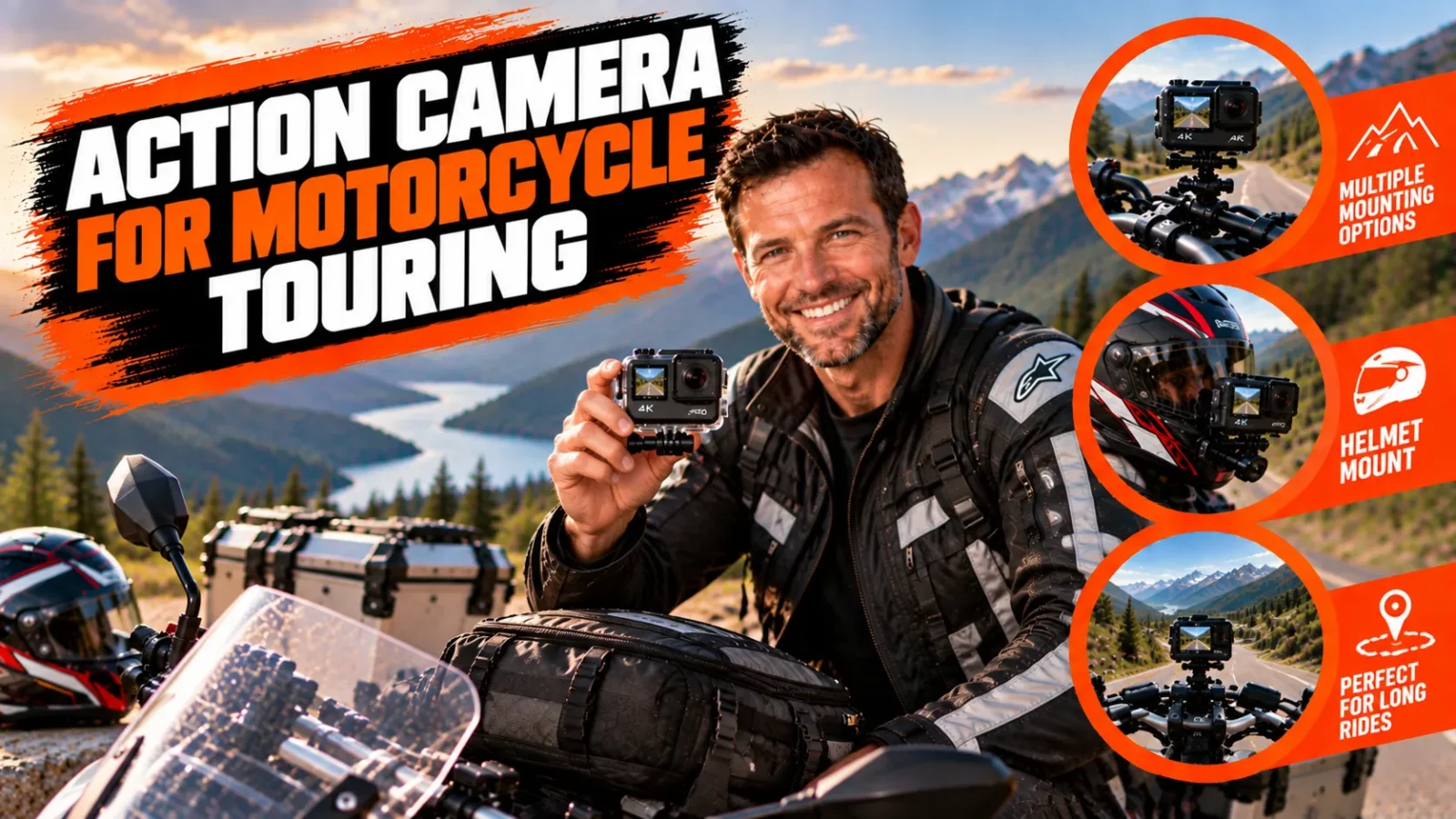
I’ve put a lot of cameras through their paces on long-distance rides — rain, dust, freezing mountain passes, and twelve-hour highway slogs included. When you’re touring, your action camera isn’t just capturing content; it’s documenting a trip you’ll want to relive for years.
The problem is that not every camera built for skateboarding or surfing holds up on a motorcycle tour. You need long battery life, weatherproofing that actually works, and stabilization that can handle vibration from your bars or helmet for hours at a time.
I’ve narrowed it down to the eight cameras I’d genuinely recommend to a fellow rider, based on real testing and years of strapping gear to my helmet and bike.
- My overall pick for touring is the GoPro HERO13 Black thanks to its stabilization and modular lens system.
- If battery life and low-light footage matter most, the DJI Osmo Action 5 Pro is the strongest choice right now.
- Want to reframe footage after the ride and never worry about aim? The Insta360 X4 is unmatched for 360-degree capture.
- On a tighter budget, the Akaso Brave 8 and older GoPro HERO12 Black both deliver surprisingly good results for touring riders.
- Whatever camera you pick, your mounting setup matters just as much — I’ll touch on that near the end.
1. GoPro HERO13 Black — Best Overall Action Camera for Touring
The GoPro HERO13 Black is what I reach for on most of my longer trips, and it’s the camera I recommend first to riders asking me where to start. It shoots 5.3K at 60fps, and the HyperSmooth 6.0 stabilization handles engine vibration and rough tarmac better than anything else I’ve tested.
What really sold me on the HERO13 for touring is the new interchangeable lens mount. I can swap in the Ultra Wide lens for sweeping mountain-pass shots, or the Macro lens for detail shots of my bike at rest stops, without buying a second camera.
Key specs and why they matter on tour
It’s waterproof to 10m without a housing, which covers you in most rainstorms you’ll ride through. Battery life sits around 70-100 minutes of 4K recording depending on settings, and GoPro’s Enduro battery is practically mandatory if you’re filming in cold mountain air.
Price typically runs $399-$450 depending on the bundle. If you’re deciding between GoPro generations, I break down the differences in more detail in my guide to the best GoPro camera for motorcycle helmets.
2. DJI Osmo Action 5 Pro — Best for Battery Life and Low-Light Riding
I didn’t expect to like a DJI action camera as much as I do, but the Osmo Action 5 Pro genuinely surprised me on a multi-day trip through the Rockies. The 1/1.3-inch sensor pulls in noticeably more light than most competitors, which matters a lot for early-morning starts or riding into dusk.
Battery life is where this camera really separates itself. DJI rates it for up to 240 minutes of 1080p recording, and even in 4K I consistently got well over 100 minutes per charge on the road.
Built tough for adventure riding
It’s waterproof to 20m without a case, which is more than double most competitors, and it survived a drop onto gravel during a fuel stop without a scratch on the housing. At around $349 for the Adventure Combo, it also undercuts GoPro’s flagship on price.
If you’re touring somewhere with unpredictable weather, this is genuinely one of the toughest options I’d trust on a helmet or chest mount.
3. Insta360 X4 — Best 360-Degree Camera for Touring
The Insta360 X4 works differently than a traditional action camera, and once I got used to it, I never wanted to go back on certain rides. It captures a full 360-degree sphere in 8K, which means you literally can’t miss the shot — you reframe and pick your angle afterward in the app.
This is a huge advantage for touring because you don’t have to fuss with aiming the lens perfectly before you set off. I’ve mounted it low on the tank and gotten usable footage of the road, my hands, the scenery, and my own riding posture all from one clip.
Where it shines and where it doesn’t
Battery life runs around 135 minutes at 5.7K, and it’s waterproof to 15m on its own. The invisible selfie-stick effect is genuinely fun for touring vlogs since it makes the camera appear to float beside your bike.
The tradeoff is that editing takes more effort than a standard GoPro clip, and the stick mount is a bit more finicky to secure at highway speeds. Expect to pay around $499 for the standard bundle.
4. Insta360 Ace Pro 2 — Best Flip Screen for Vlogging Riders
If you narrate your rides or do a lot of talking-head intros before hitting the road, the Insta360 Ace Pro 2 has a feature none of the others on this list offer: a flip-up 2.5-inch touchscreen. I use it constantly for checking framing before I clip the camera onto my chest mount.
It co-developed its sensor with Leica, and the color science genuinely stands out in daylight touring footage — skies and forests look richer straight out of the camera with less color grading needed.
Solid all-rounder specs
It shoots 8K at 24fps and 4K at up to 120fps for slow-motion highway pulls. Battery life is around 100 minutes of 4K60 footage, and it’s waterproof to 12m without a housing. Pricing sits around $449 for the standard kit.
For riders who post a lot of first-person commentary content, I think this is one of the most underrated cameras for touring right now.
5. GoPro HERO12 Black — Best Value Flagship
I still recommend the GoPro HERO12 Black to riders who want GoPro’s ecosystem and reliability but don’t need the absolute latest specs. It shares the same rugged, no-housing-needed waterproof design (10m) as its successor and delivers 5.3K60 footage that looks fantastic on a bike.
Since the HERO13 launched, prices on the HERO12 have dropped meaningfully, often landing around $299-$350, which makes it one of the better value buys in GoPro’s lineup right now.
Why I still pack this one sometimes
HyperSmooth 6.0 stabilization is present here too, so you’re not sacrificing the smooth, gimbal-like look GoPro is known for. Battery life is roughly the same as the HERO13 when paired with the Enduro battery, around 70-90 minutes of 4K footage.
It’s a smart pick if you’re new to helmet cameras and want proven hardware without paying flagship pricing. I go deeper on this comparison in my breakdown of the best action camera for motorcycle helmets.
6. Akaso Brave 8 — Best Budget Action Camera for Touring
Not everyone wants to spend $400+ on a camera, and I get it — the Akaso Brave 8 has become my go-to recommendation for riders on a tighter budget. It shoots 4K30 and features a front-facing touchscreen, which is a genuinely useful feature I don’t see enough on budget cameras.
Stabilization isn’t in the same league as GoPro or DJI, but for straight highway riding and scenic touring footage, it holds up well enough that most casual viewers won’t notice the difference.
What you’re getting for the price
It’s waterproof to 10m without a housing and typically retails for $130-$160, often bundled with extra batteries and mounting accessories. Battery life sits around 90 minutes per charge, which is respectable for the price point.
If you’re testing the waters with helmet or bike cameras before committing to a pricier setup, this is the one I’d suggest starting with.
7. Insta360 GO 3S — Best Ultra-Compact Camera for Touring
The Insta360 GO 3S is barely bigger than a large coin, and that tiny size makes it one of my favorite cameras for discreet touring footage. I clip the magnetic mount onto my jacket collar or helmet chin bar and basically forget it’s there.
It shoots up to 4K30 and includes an Action Pod accessory that turns it into a more traditional camera with a screen when you want to review footage at a fuel stop.
Great for minimalist setups
Battery life on the camera alone is short, around 45 minutes, but the Action Pod extends that to roughly 2.5 hours of combined use. It’s waterproof to 4m on its own or 10m with the optional dive case, and pricing starts around $399.
This is the camera I bring when I don’t want bulky gear on my helmet but still want quality footage throughout a multi-day tour.
8. DJI Osmo Action 4 — Best Rugged Budget Alternative
The DJI Osmo Action 4 is the previous generation of DJI’s flagship, and with the Action 5 Pro now out, prices on this one have become genuinely attractive for touring riders who don’t need the newest sensor. It still has that same large 1/1.3-inch sensor for strong low-light performance.
I’ve used it in near-freezing temps at altitude without any issues, and DJI’s cold-resistant battery genuinely performs better than most competitors when the temperature drops on mountain routes.
Reliable specs at a lower cost
It shoots 4K at 120fps for smooth slow-motion, is waterproof to 18m without a housing, and typically sells for around $279-$329 in the Adventure Combo. Battery life runs about 160 minutes at 1080p or roughly 100 minutes at 4K.
For riders who want DJI’s toughness and color science without paying flagship prices, this is a smart place to land.
Getting your mount right matters as much as the camera
Here’s something I learned the hard way: even the best camera on this list will give you shaky, useless footage if it’s mounted poorly. Vibration from the engine and wind buffeting at highway speed can ruin a shot faster than any camera spec can fix.
I’ve experimented with chin mounts, side mounts, and chest harnesses over the years, and each has tradeoffs depending on your helmet shape and riding style. My full comparison of the best GoPro mounts for motorcycle helmets covers which style works best for different helmet types.
Adhesive mounts vs. clip-on systems
For touring specifically, I lean toward a properly applied adhesive mount because it sits lower profile and creates less wind noise over long days in the saddle. If you’re unsure how to set one up correctly, I wrote a step-by-step guide on the best GoPro adhesive mount setup for motorcycle helmets that walks through surface prep and curing time, which matters more than people expect.
Skipping the curing time is probably the single most common mistake I see riders make — a mount that hasn’t fully bonded can peel off at speed, and that’s an expensive lesson to learn on the highway.
How I’d choose between these for my next tour
If I could only own one camera for touring, it would still be the GoPro HERO13 Black. The combination of stabilization, weatherproofing, and lens flexibility just covers the widest range of situations I run into on the road.
But I’d genuinely be happy with the DJI Osmo Action 5 Pro too, especially for trips where I know I’ll be riding early mornings or through unpredictable weather. Its battery life alone has saved me from missing footage more than once.
For riders just starting out, don’t feel like you need to spend flagship money right away. The Akaso Brave 8 or a discounted GoPro HERO12 Black will get you excellent footage while you figure out what you actually want from a touring camera setup.
Whatever you choose, pair it with a solid mount, charge your batteries the night before, and you’ll come home from your next tour with footage worth rewatching for years.
Frequently Asked Questions
Do I need a 360-degree camera for motorcycle touring?
Not necessarily, but a 360 camera like the Insta360 X4 is great if you want to reframe shots later or capture scenery in every direction without aiming the lens precisely, which is handy when you’re focused on riding.
How long do action camera batteries last on a full day of touring?
Most flagship cameras give you 60-90 minutes of continuous 4K recording per battery. For all-day touring, I always carry a power bank and use a hardwired mount, or rely on cameras like the DJI Osmo Action 5 Pro that sip power more efficiently.
What’s the best way to mount an action camera for touring?
It depends on your helmet and bike setup. I’ve written a full breakdown of the best GoPro mounts for motorcycle helmets and a separate guide on adhesive mount setups if you want a cleaner, lower-profile option.
Is a GoPro still worth it in 2024, or should I get an Insta360?
Both are excellent. I lean toward GoPro for simplicity and stabilization, while Insta360 wins if you want reframing flexibility or a discreet, tiny form factor. I cover the tradeoffs in my best GoPro for motorcycle helmets guide.

Related Articles

6 Best Rear View Cameras for Motorcycle: Riders Who Want Eyes in the Back of Their Head
I've tested the top rear view cameras for motorcycles so you don't have to. Here are my real-world picks for…
 Jake Miller
12 min read
Jake Miller
12 min read

8 Best Cameras for Riding Motorcycle in 2026 (Rider-Tested Picks)
I've mounted, crashed, and rain-soaked dozens of cameras on my helmet and bike. Here are the 8 best cameras for…
Jake Miller
9 min read

9 Best Cameras for Motorcycle Travel: My Tested Picks for Long-Haul Rides
I've tested action cams, 360 cameras, and mirrorless bodies on thousands of touring miles. Here are the 9 best cameras…
Jake Miller
12 min read