
9 Best Cameras for Motorcycle Videos That Actually Survive the Ride
 Jake Miller
11 min read
Jake Miller
11 min read
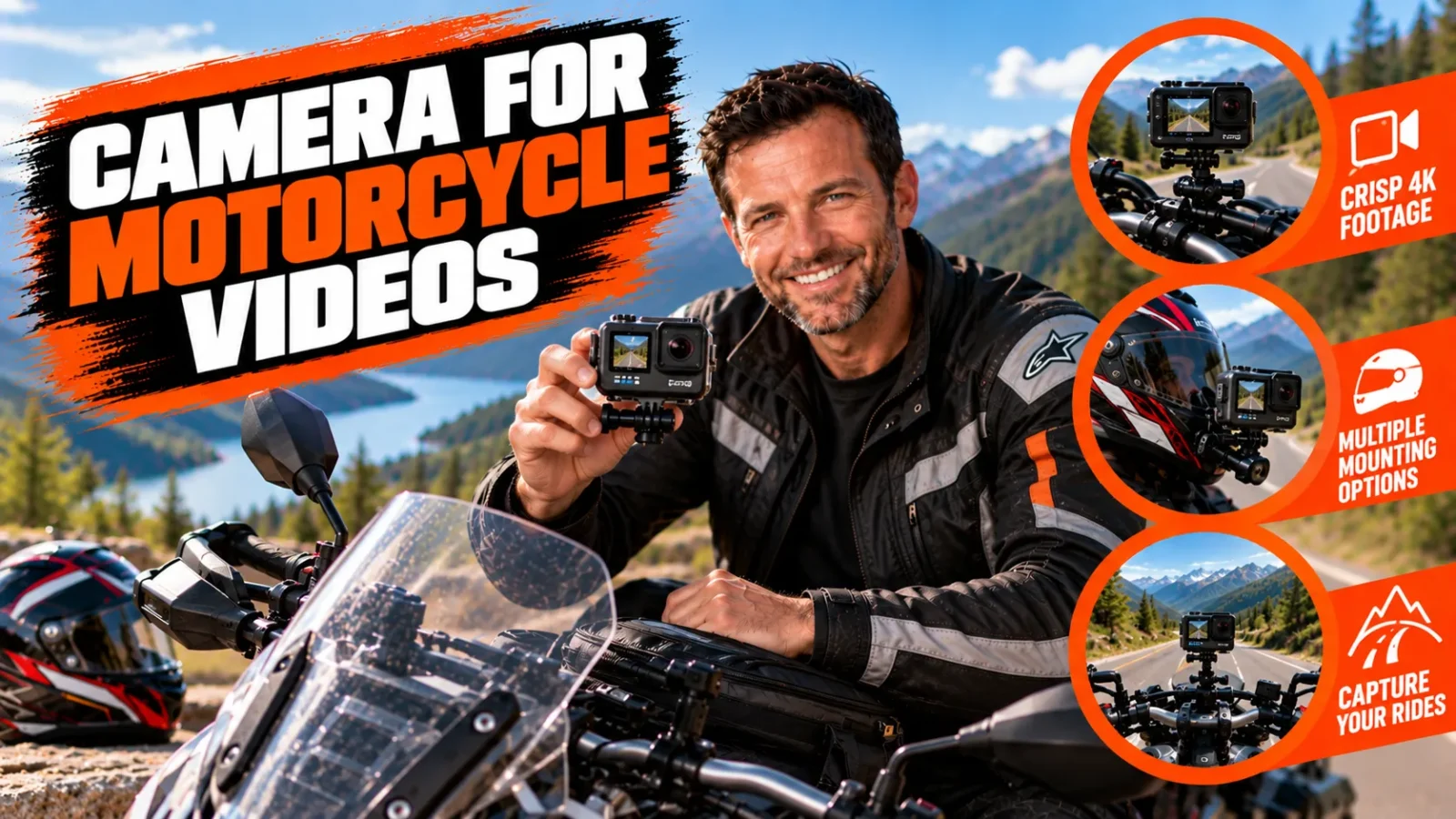
I’ve strapped a lot of cameras to my helmet, tank, and handlebars over the years. Some survived a full season of canyon runs. Some fogged up, died in the rain, or produced footage so shaky it looked like an earthquake simulator.
After all that trial and error (and a few cracked mounts), I’ve narrowed down the cameras that actually earn a permanent spot in my tank bag. This list covers everything from flagship action cams to tiny stealth options, so whether you’re filming a track day or a cross-country tour, you’ll find something here that fits.
- The GoPro HERO13 Black is my top overall pick thanks to HyperSmooth 6.0 stabilization and modular lens options.
- If you want to reframe your shot after the ride, the Insta360 X4‘s 360° capture is unmatched.
- For night rides, the DJI Osmo Action 5 Pro handles low light better than anything else I’ve tested.
- Budget riders shouldn’t overlook the Akaso Brave 8 or last-gen GoPro HERO12 Black.
- Whatever camera you pick, a secure, vibration-dampened mount matters just as much as the sensor inside.
1. GoPro HERO13 Black — Best Overall Camera for Motorcycle Videos
The GoPro HERO13 Black is the camera I reach for most often, and it’s not close. It shoots 5.3K at 60fps or 4K at 120fps, and its HyperSmooth 6.0 stabilization practically erases the vibration you get from a windscreen buzz or rough tarmac.
What sold me on this generation is the new magnetic mounting system. It clicks into place faster than the old buckle mounts, which matters when you’re trying to get moving before your riding buddies leave you behind.
GoPro also introduced interchangeable lenses this round, including an ultra-wide option that’s fantastic for tank-mounted shots where you want both your hands and the road in frame. At around $400 for the body, it’s not cheap, but the footage quality justifies it.
Why It Works for Riding
The HERO13’s touchscreen is responsive even with thin gloves on, which is a small detail that makes a real difference at a gas stop. Battery life sits around 70 minutes of 4K recording, so I always carry a spare for full-day rides.
If you’re still deciding between GoPro generations or competing brands, I go much deeper into helmet-specific picks in my breakdown of the best GoPro camera for motorcycle helmet use.
2. Insta360 X4 — Best for 360° Reframing
The Insta360 X4 changed how I think about motorcycle filming. It captures a full 360-degree sphere at up to 8K30fps, which means you literally cannot miss the shot because the camera is recording everything around it simultaneously.
I mount mine on a selfie-stick-style pole on my tank, and in post-production I reframe the footage to follow my bike, the scenery, or my helmet cam view. It’s genuinely freeing not to worry about aiming the camera correctly before a canyon run.
The invisible selfie stick effect is a bonus too. It makes it look like a drone is following you down the highway, which is a shot that used to require a second rider or expensive gear.
Battery and Durability Notes
Insta360 rates the X4 for IPX8 waterproofing down to 10 meters without a case, and I’ve ridden through genuine downpours with zero issues. Battery life runs about 135 minutes at 5.7K30, which comfortably covers most day rides.
My only gripe is file size. 360 footage eats storage fast, so budget for a 256GB or larger microSD card if you go this route.
3. DJI Osmo Action 5 Pro — Best Low-Light Performance
Night rides used to look like grainy garbage on most action cameras. The DJI Osmo Action 5 Pro fixed that for me with its 1/1.3-inch sensor, which is noticeably larger than what GoPro or Insta360 pack into their standard cams.
I’ve filmed evening commutes through poorly lit streets and the footage still looks usable, not muddy. DJI’s color science also renders skin tones and street lighting more naturally, in my experience, than competitors.
It records 4K at up to 120fps, has a genuinely excellent touchscreen on both the front and back, and the magnetic quick-release mount system is one of the fastest I’ve used. Pricing sits around $350 for the standard combo, which undercuts the GoPro flagship.
Battery Life That Actually Lasts
DJI claims up to 240 minutes of 1080p60 recording on a single charge, and even in 4K I’ve gotten well over two hours. For long-distance touring riders who hate swapping batteries at every stop, this is a legitimate selling point.
4. Insta360 Ace Pro 2 — Best Image Quality with a Leica Lens
Co-engineered with Leica, the Insta360 Ace Pro 2 is the sharpest-looking action camera I’ve personally tested on two wheels. It uses a 1/1.3-inch sensor and produces genuinely cinematic color straight out of camera, with minimal grading needed.
I noticed the biggest difference in dynamic range during golden-hour rides, when the sun is low and most action cams either blow out the sky or crush the shadows. The Ace Pro 2 handles that transition far more gracefully.
It also has a flip-up screen, which sounds minor until you’re trying to frame a selfie-style shot on your handlebar mount without guessing. At roughly $450, it’s premium-priced but competes directly with GoPro’s flagship.
Cooling and Overheating
One thing I appreciate: the Ace Pro 2’s built-in cooling fan means it doesn’t overheat during long 4K120 sessions the way older action cams did in direct summer sun on a black helmet.
5. Sony FDR-X3000 — Best for Ultra-Stable Highway Footage
The Sony FDR-X3000 has been around a while, but I still recommend it because Sony’s Balanced Optical SteadyShot stabilization remains some of the smoothest footage I’ve gotten on a naked bike with no windscreen to cut vibration.
It shoots 4K at 30fps, which isn’t class-leading anymore, but the stabilization more than compensates when your bike doesn’t have much damping between the bars and your camera mount.
Sony sells it bundled with a Live-View Remote you can strap to your wrist or bars, so you can start and stop recording without pulling over. That alone has saved me from missing shots at intersections more times than I can count.
Where It Falls Short
Battery life is mediocre at around 80 minutes, and the touchscreen (sold separately as a “Finder Kit”) isn’t included in the base package. Still, if stabilization is your top priority and you can find one on sale, it’s worth a look.
6. GoPro HERO12 Black — Best Value Pick
If the HERO13 is slightly outside your budget, the GoPro HERO12 Black is the smartest way to save money without sacrificing much. It still shoots 5.3K30 and 4K120, with the same HyperSmooth 6.0 stabilization found in the newer model.
I’ve used the HERO12 on multi-day tours, and honestly, unless you’re pixel-peeping side by side with the HERO13, you won’t notice a huge difference in everyday riding footage.
Prices typically drop to around $300, and since it uses the same mounting ecosystem as previous GoPros, you can reuse any mounts or accessories you already own. That backward compatibility is a real money-saver.
Great Entry Point for New Riders
If you’re just getting into filming your rides and want to test the waters before investing in a premium setup, the HERO12 gives you 90% of the flagship experience for noticeably less cash. Pair it with a solid GoPro mount for your motorcycle helmet and you’re set.
7. Insta360 GO 3S — Best Tiny, Stealth Camera
Sometimes I don’t want a bulky camera on my helmet, especially on longer tours where I care about aerodynamics and neck fatigue. The Insta360 GO 3S is roughly the size of a large gumdrop and clips onto gear, straps, or even a small magnetic mount on my jacket collar.
It shoots 4K30 and 2.7K60, which sounds modest, but for a camera this small, the image quality genuinely surprised me. It also has FlowState stabilization baked in, so shaky footage isn’t really an issue.
The Action Pod accessory doubles as a charging case and a more traditional viewfinder setup when you want to compose a shot rather than shoot blind. Pricing starts around $260 for the base kit.
Best Use Case
I like this one for point-of-view shots from unusual angles, like clipped to my glove or tank bag strap, where a full-size action cam would be too heavy or awkward to mount securely.
8. Akaso Brave 8 — Best Budget Camera for Motorcycle Videos
Not everyone wants to drop $350+ on a camera for weekend rides, and that’s where the Akaso Brave 8 earns its spot on this list. It shoots 4K30 with electronic image stabilization, and it’s waterproof to 10 meters without a housing.
Is the footage as sharp as a GoPro or DJI? No, and I won’t pretend otherwise. But for around $130, it’s a genuinely solid way to capture your rides without committing to a premium ecosystem right away.
It comes with a dual-screen design (front and rear), which is a feature you’d normally only find on cameras twice the price. That makes framing selfie-style shots on a handlebar mount much easier.
Who Should Buy This
I’d point beginner riders or anyone testing whether they even enjoy filming their rides toward the Brave 8 first. If you find yourself obsessed with getting better footage after a season, that’s when I’d upgrade to something like the HERO13 or Osmo Action 5 Pro.
9. DJI Action 4 — Best Wide Field of View Alternative
The DJI Action 4 is the previous-generation sibling to the Osmo Action 5 Pro, and I still think it’s worth mentioning because retailers frequently discount it now that the newer model is out. It has a wider field of view option than most competitors, which I love for chest-mounted shots that need to capture both hands on the bars.
It shares the same large 1/1.3-inch sensor as its successor, so low-light performance is still excellent for the category. Recording tops out at 4K120, plenty for smooth slow-motion highway clips.
At its current discounted price, often under $300, it’s genuinely one of the better value-to-performance ratios on this whole list.
Magnetic Mount Ecosystem
DJI’s magnetic mounting system carries over from the Action 4 to the Action 5 Pro, so if you ever upgrade later, your existing mounts stay useful. That’s a nice bit of future-proofing I don’t take for granted after years of GoPro’s mount changes.
How I Actually Choose a Camera for My Rides
Specs matter, but they’re not the whole story. I weigh four things every time I’m deciding what to strap to my helmet or tank: stabilization, low-light performance, battery life, and how easily I can mount it securely.
Stabilization Is Non-Negotiable
Motorcycles vibrate. Even smooth highways transmit engine buzz through your bars and helmet. Without solid electronic stabilization like GoPro’s HyperSmooth or DJI’s RockSteady, your footage ends up unwatchable no matter how sharp the sensor is.
Mounting Matters as Much as the Camera
I’ve learned the hard way that a great camera on a flimsy mount is worse than a mediocre camera on a rock-solid one. If you’re deciding between a chin mount, side mount, or top mount, I’d recommend reading through my comparison of the best action cameras for motorcycle helmets before you commit to hardware.
Adhesive versus strap mounts is its own debate too. I’ve had both fail and both work flawlessly, depending on helmet shell material and weather conditions. My full GoPro adhesive mount setup guide covers exactly how I prep the surface so it doesn’t peel off at highway speed.
Don’t Forget Audio
Wind noise ruins more motorcycle videos than bad footage does. I usually rely on my helmet’s Bluetooth intercom for voice audio and just let the camera’s onboard mic pick up ambient engine and road sound, then mix the two together in editing.
Final Thoughts on Picking Your Camera
If I had to recommend just one camera to a friend starting out, I’d say the GoPro HERO13 Black for most riders, or the Insta360 X4 if you love the flexibility of reframing shots after the fact.
Budget-conscious riders shouldn’t feel bad starting with the Akaso Brave 8 or a discounted GoPro HERO12 Black. Footage quality matters less than actually getting out and riding with a camera rolling in the first place.
Whatever you choose, pair it with a mount you trust completely. I’d rather have slightly softer footage from a secure setup than 5.3K footage I lost because my camera flew off at 70mph.
Frequently Asked Questions
Do I need a separate microphone for motorcycle videos?
Wind noise at highway speeds will drown out most built-in mics. I always recommend an external lav mic or a helmet-mounted Bluetooth intercom with audio recording if you want usable dialogue over 40 mph.
What’s the best mounting position for filming motorcycle rides?
I get the most cinematic footage from a chin mount or chest mount, but for stability and POV realism, a helmet top mount is hard to beat. Check out my guide on best GoPro mounts for motorcycle helmets for specifics.
Is a 360-degree camera worth it for motorcycle riding?
If you want the freedom to reframe your shot after the ride (or capture both your face and the road), yes. The Insta360 X4 is my go-to recommendation for riders who want maximum flexibility in editing.
Do I need an adhesive mount or a strap mount for my helmet?
It depends on your helmet shell and riding style. I break down the pros and cons of each in my GoPro adhesive mount setup guide.

Related Articles

6 Best Rear View Cameras for Motorcycle: Riders Who Want Eyes in the Back of Their Head
I've tested the top rear view cameras for motorcycles so you don't have to. Here are my real-world picks for…
Jake Miller
12 min read

8 Best Cameras for Riding Motorcycle in 2026 (Rider-Tested Picks)
I've mounted, crashed, and rain-soaked dozens of cameras on my helmet and bike. Here are the 8 best cameras for…
Jake Miller
9 min read

9 Best Cameras for Motorcycle Travel: My Tested Picks for Long-Haul Rides
I've tested action cams, 360 cameras, and mirrorless bodies on thousands of touring miles. Here are the 9 best cameras…
Jake Miller
12 min read