
9 Best Camera Mounts for Motorcycle Riders Who Actually Ride Hard
 Jake Miller
12 min read
Jake Miller
12 min read
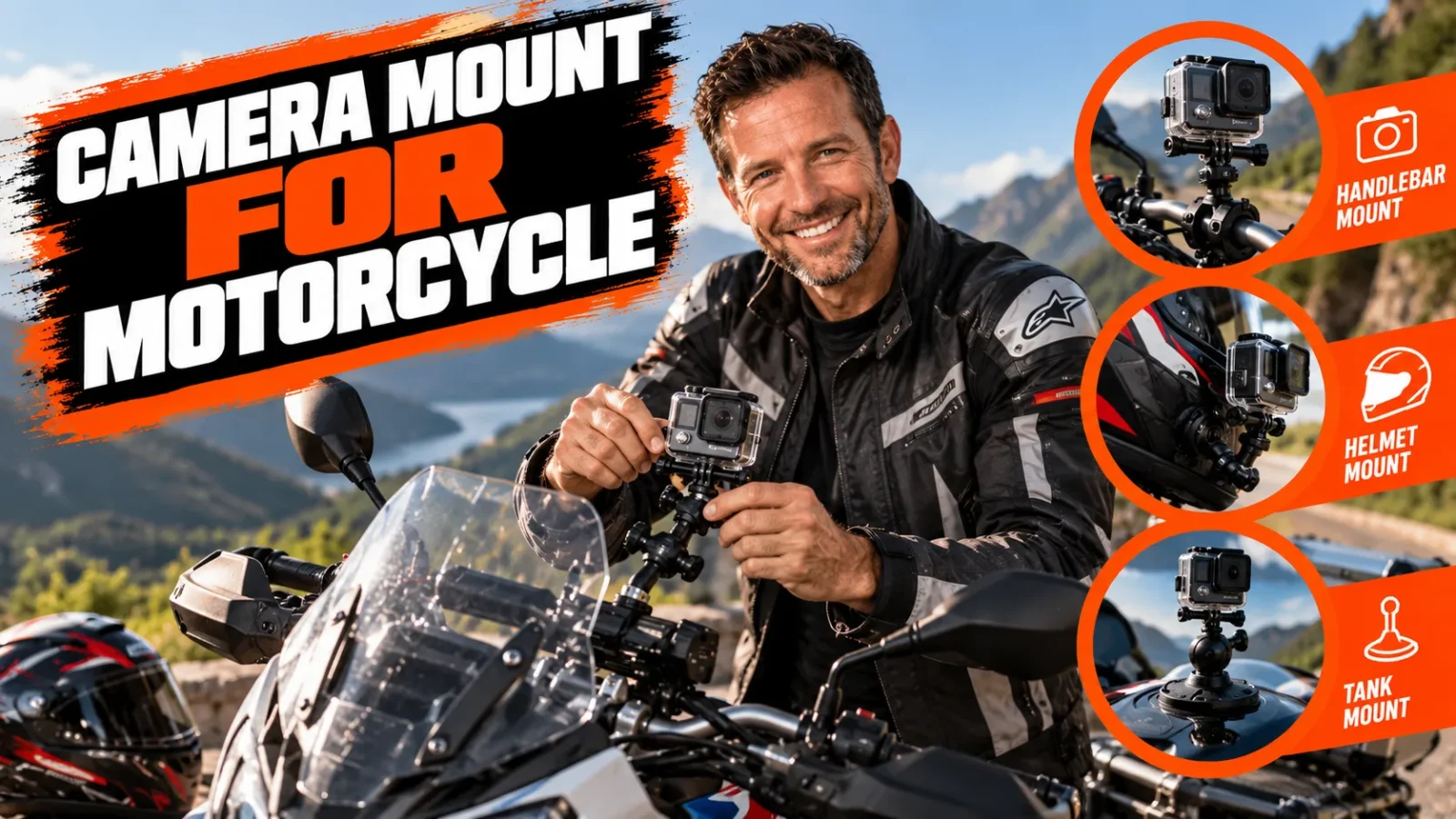
I’ve mounted cameras on more motorcycles than I care to admit, and I’ve also watched a $400 action camera go bouncing down the highway because I trusted a cheap suction mount. Lesson learned. Since then, I’ve made it my mission to only run gear that’s actually proven itself over thousands of miles.
This list isn’t theoretical. Every mount here has spent real time on my bars, my helmet, or my chest through rain, gravel, and a few embarrassing drops. If you’re trying to figure out the best camera mount for motorcycle riding, I’ve narrowed it down to the ones actually worth your money.
- My top overall pick is the RAM Mounts X-Grip Handlebar Mount because it’s vibration-resistant, universal, and nearly indestructible.
- For helmet footage, genuine GoPro adhesive mounts beat every third-party alternative I’ve tried in terms of holding strength.
- If your bike vibrates a lot, don’t skip a dedicated anti-vibration mount — it’s the difference between usable footage and unwatchable jello.
- 360-degree riders should look specifically at the Insta360 motorcycle mount bundle, since standard GoPro mounts aren’t built for that lens geometry.
- Mounting location matters as much as the mount itself — I’ll walk through where each option actually shines.
1. RAM Mounts X-Grip Handlebar Mount (RAM-B-231Z-A-UN7U) — Best Overall Camera Mount for Motorcycle Handlebars
If I had to recommend just one mount to a friend buying their first setup, it’s the RAM Mounts X-Grip Handlebar Mount. I’ve had one on my own bike’s bars for over two years, through rain, dust, and one memorable off-road detour, and it hasn’t loosened once.
The rubberized ball-and-socket base is what sets RAM apart. It absorbs handlebar vibration far better than the rigid plastic clamps you get bundled with budget cameras. That matters more than people realize — it’s the single biggest factor in whether your footage looks smooth or shaky.
It’s built from marine-grade composite, so it shrugs off UV exposure and road grime without cracking. It fits handlebars from roughly 0.5 to 1.25 inches in diameter, which covers the vast majority of cruisers, adventure bikes, and standards.
Why I Trust It
RAM has been making mounts for motorcycle cops, ambulance GPS units, and marine electronics for decades — this isn’t a company that just discovered action cameras. The 1-inch ball system is also compatible with a massive ecosystem of RAM arms and adapters, so you’re not locked into one configuration.
Price sits around $30-40, which is genuinely reasonable for something this durable. Pair it with a GoPro or Insta360 adapter (sold separately) and you’ve got one of the most bomb-proof handlebar setups on the market.
2. GoPro Curved + Flat Adhesive Mounts — Best Camera Mount for Motorcycle Helmets
For helmet-mounted footage, nothing has beaten genuine GoPro Curved and Flat Adhesive Mounts in my testing. I’ve tried a dozen third-party clones, and every single one eventually peeled at highway speed. The factory GoPro adhesive is a different formula entirely.
These mounts come in a two-pack (one curved, one flat) for around $13, which covers basically any helmet shell shape. The curved version matches the natural curvature of a full-face helmet, while the flat one works for visors or side panels.
I always let the adhesive cure for at least 24 hours before riding, and I clean the helmet surface with isopropyl alcohol first. Skip either step and you’re gambling with your camera falling off mid-ride.
Getting the Most Out of Helmet Mounts
If you’re still deciding which camera to actually put on that mount, I’ve written a full breakdown of the best GoPro camera for motorcycle helmet use, covering which models handle wind noise and vibration best. And if you want the exact adhesive placement process I use, check out my guide to the best GoPro adhesive mount setup for motorcycle helmets.
3. RAM Mounts Torque Series Handlebar/Rail Mount — Best for Vibration Control
When I moved from a smooth cruiser to a single-cylinder dual-sport, my footage went from cinematic to nauseating overnight. That’s when I discovered the RAM Mounts Torque Series mount, which is specifically engineered to dampen high-frequency engine vibration.
It uses a heavier-duty rubber base than the standard X-Grip, designed originally for off-road and racing applications where vibration is extreme. I run mine on the handlebar of my adventure bike, and it noticeably cuts the jitter compared to a standard clamp.
It’s priced around $35-45 depending on the base you pair it with, and it accepts the same 1-inch ball system as the rest of the RAM lineup. If your bike rattles your fillings loose at idle, this is the mount I’d send you toward.
4. GoPro Jaws: Flex Clamp — Best Versatile Clamp Mount
The GoPro Jaws: Flex Clamp is the mount I keep in my tank bag for whenever inspiration strikes mid-ride. It clamps onto anything from 0.25 to 1.5 inches thick — brake levers, mirror stems, frame rails, even a fence post if you’re filming a static shot.
The flexible gooseneck arm lets me angle the camera in ways a rigid mount simply can’t manage. I’ve used it to grab close-up shots of my front wheel clearing a rock garden and wide shots from a crash bar during a track day.
At around $30, it’s not the sturdiest option for constant highway vibration, but for creative, occasional shots, nothing beats its flexibility. I wouldn’t run it as my primary mount, but as a second camera angle, it’s fantastic.
5. GoPro Chesty (Performance Chest Mount) — Best for a Rider’s-Eye Perspective
The GoPro Chesty gives you a completely different look than helmet or bar footage — it shows your hands working the controls and captures a steadier frame since it’s anchored to your torso rather than your head.
I like using it on twisty backroad rides where I want viewers to see my body position through corners. It’s also great for adventure riding, since it survives falls better strapped to your chest than perched on your helmet.
It runs about $60 and adjusts to fit most body types and riding jackets, including armored gear. One tip from experience: tighten it more than feels comfortable at first, because it loosens slightly once you’re moving.
6. RAM Mounts Tough-Claw Base with Universal Camera Adapter — Best Clamp for Mirrors and Crash Bars
The RAM Tough-Claw is a different animal from the X-Grip — instead of gripping a round bar, its jaw clamps onto flat or irregular surfaces up to 1.5 inches wide. I use mine on my mirror stem when I want a mount that doesn’t crowd my handlebar controls.
It’s built from the same marine-grade nylon composite as RAM’s other products, so durability isn’t a concern. Combined with their universal action camera adapter (which mimics the GoPro three-prong buckle), it becomes compatible with basically any action camera on the market.
Expect to pay around $35-40 for the combo. If your handlebar real estate is already crowded with switches, phone mounts, and heated grip controls, this is the workaround I’d reach for.
7. Insta360 Motorcycle Mount Bundle — Best Camera Mount for 360-Degree Footage
If you’re shooting with an Insta360 X3 or X4, don’t try to force it onto a standard GoPro-style mount — the lens placement is different, and you’ll get your own mounting arm in the shot. Insta360’s official Motorcycle Mount Bundle is built specifically to avoid that problem.
It includes an invisible selfie-stick style extension arm that gets edited out automatically by Insta360’s app, plus a vibration-dampening handlebar clamp. I use this setup when I want that “flying camera” look that traditional action cams can’t replicate.
The bundle runs around $50-60 depending on which retailer you buy from. It’s a niche purchase, but if you already own a 360 camera, it’s the only mount I’d actually recommend for motorcycle use.
8. GoPro Anti-Vibration Mount — Best Accessory for Eliminating Jello Effect
This one technically isn’t a standalone mount — it’s a dampening accessory that sits between your camera and any standard GoPro mount — but I couldn’t leave it off this list. The GoPro Anti-Vibration Mount uses a rubber isolation system to filter out high-frequency shake before it ever reaches your footage.
I noticed the biggest improvement when using it on helmet mounts with high-revving sportbikes, where standard mounts just can’t keep up with the vibration frequency. It costs around $20 and works with GoPro’s electronic image stabilization for genuinely smooth results.
If you’ve already invested in a good mount and your footage is still shaky, this is the cheap fix I’d try before buying an entirely new setup. It’s one of the most underrated accessories in the whole category.
9. SP Connect Universal Handlebar Mount — Best for Phone-Based Setups
Not everyone wants to buy a dedicated action camera, and honestly, modern smartphones shoot excellent video. The SP Connect Universal Handlebar Mount is the best solution I’ve found for riders who want to use their phone as their primary camera.
It uses a quarter-turn locking system with a phone case or universal clamp, and the vibration dampening is surprisingly solid for the roughly $50 price point. I’ve used it on long highway stretches without the phone ever loosening or drifting out of frame.
The obvious downside is weatherproofing and battery life — phones aren’t built for six-hour rides in the rain the way action cameras are. I’d treat this as a backup solution rather than your primary motorcycle camera mount.
How I Actually Choose a Camera Mount
After going through more mounts than I’d like to admit, I’ve settled on a handful of criteria I check every single time before buying something new.
Vibration Resistance First
This is the number one thing that separates good footage from unwatchable footage. A mount that looks solid in a product photo can still transmit enough engine vibration to ruin every clip. I always look for rubber-dampened bases over rigid plastic ones.
Mounting Location Changes Everything
Helmet mounts give you that immersive point-of-view feel, handlebar mounts show the bike and road together, and chest mounts capture body position. I genuinely think the “best” location depends entirely on the story you’re trying to tell with your footage.
If you’re still weighing helmet placement against handlebar placement, my breakdown of the best GoPro mounts for motorcycle helmets goes into much more depth on the pros and cons of each helmet position specifically.
Weatherproofing and Material Quality
UV exposure eventually turns cheap plastic mounts brittle and yellow. I always check whether a mount is rated for outdoor/marine use, since that usually indicates better UV-resistant materials that will survive years of sun exposure rather than months.
Compatibility With Your Camera
Most mounts now use either the GoPro three-prong buckle system or RAM’s 1-inch ball system, and thankfully these have become close to industry standards. Before buying, I always double check that the mount’s adapter matches my specific camera model, especially with 360-degree cameras that have unusual mounting requirements.
A Quick Word on Camera Choice
A great mount is only half the equation — the camera sitting in it matters just as much. If you haven’t settled on a camera yet, I’d suggest reading through my comparison of the best action camera for motorcycle helmets before you commit to a mounting system, since some cameras pair better with certain mount types than others.
For example, cameras with built-in image stabilization tolerate slightly less rigid mounts, while cameras without it need every bit of vibration dampening you can throw at them. It’s worth figuring out your camera first, then building your mounting setup around it.
My Final Take
If you only take one thing from this list, let it be this: don’t cheap out on the mount. I’ve lost footage, and nearly lost an entire camera, by trusting a $10 no-name clamp on a fast-moving motorcycle.
My honest recommendation for most riders is to start with the RAM Mounts X-Grip Handlebar Mount for your primary angle, then add a GoPro adhesive helmet mount once you’re ready to capture that rider’s-eye view. Build from there based on the shots you actually want.
Whatever combination you land on, spend the extra ten minutes double-checking every screw and adhesive bond before you ride. Your footage — and your camera — will thank you.
Frequently Asked Questions
What is the most secure camera mount for a motorcycle helmet?
In my experience, GoPro’s genuine curved and flat adhesive mounts paired with the factory adhesive are the most secure option for helmets because the bond is chemically fused to the shell. For a deeper dive, check out our guide to the best GoPro adhesive mount setup for motorcycle helmets.
Should I mount my action camera on my helmet or my handlebars?
It depends on the footage you want. Helmet mounts capture where you’re looking and feel more immersive, while handlebar mounts like the RAM X-Grip show the bike, your hands, and the road in a steadier, more cinematic frame. I usually run both when I can.
Do I need an anti-vibration mount for motorcycle video?
If your bike has a parallel-twin, thumper, or high-revving engine, yes. Vibration causes the dreaded ‘jello effect’ in footage, and a dedicated anti-vibration mount or dampening puck fixes it almost completely.
Can I use a phone instead of an action camera on my motorcycle?
You can, especially with a rugged mount like the SP Connect system, but I’d only recommend it for short rides. Phones overheat, aren’t as waterproof, and lack the rugged housings that dedicated action cameras have.

Related Articles

6 Best Rear View Cameras for Motorcycle: Riders Who Want Eyes in the Back of Their Head
I've tested the top rear view cameras for motorcycles so you don't have to. Here are my real-world picks for…
Jake Miller
12 min read

8 Best Cameras for Riding Motorcycle in 2026 (Rider-Tested Picks)
I've mounted, crashed, and rain-soaked dozens of cameras on my helmet and bike. Here are the 8 best cameras for…
Jake Miller
9 min read

9 Best Cameras for Motorcycle Travel: My Tested Picks for Long-Haul Rides
I've tested action cams, 360 cameras, and mirrorless bodies on thousands of touring miles. Here are the 9 best cameras…
Jake Miller
12 min read