
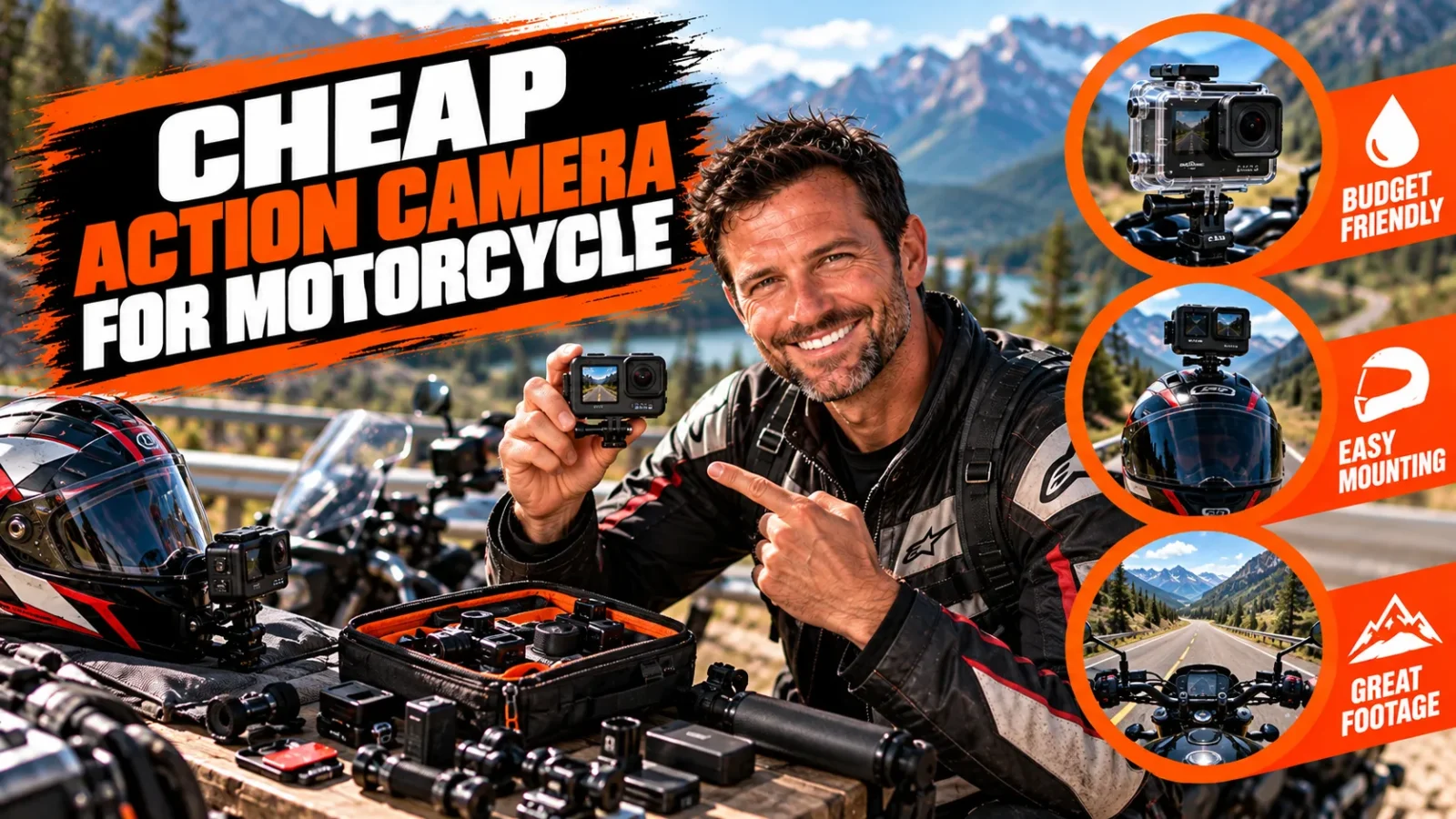
I’ve burned through more action cameras than I care to admit while chasing the perfect ride footage. Some died after one rainy commute. Others ate my battery in 20 minutes flat.
After years of strapping cameras to my helmet and tank bag, I’ve narrowed down the cheap options that actually hold up on two wheels. This isn’t a list of toys — every camera here can genuinely double as a crash-cam and a fun way to capture your rides.
I’m going to walk you through my top picks, what makes each one worth your money, and where they fall short. No fluff, just what I’d actually recommend to a riding buddy on a budget.
- My overall favorite budget pick is the Akaso Brave 7 LE — solid stabilization and battery life for under $100.
- If you want GoPro reliability without the flagship price, the GoPro Hero (2024) is the closest thing to a bargain from the brand itself.
- For dedicated crash-cam duty, the Crosstour CT9500 and SJCAM SJ8 Pro punch well above their price tags.
- Mounting matters as much as the camera — I always pair mine with a proper GoPro mount for motorcycle helmets.
- None of these will match a $400 flagship in low light, but for daily rides and casual clips, they’re more than good enough.
1. Akaso Brave 7 LE — Best Overall Cheap Action Camera
The Akaso Brave 7 LE is the camera I recommend most often when someone asks me where to start. It’s usually priced under $100, and it genuinely outperforms that price point in real-world riding conditions.
I’ve used mine on everything from short city commutes to full-day highway runs. The built-in electronic image stabilization (EIS) does a surprisingly good job smoothing out engine vibration and road chatter, which is the number one complaint I hear about cheap action cams.
It shoots 4K at 30fps and 2.7K at 30fps, with a removable lens cover that’s genuinely handy since lens scratches are the most common way I’ve killed cameras in the past. The dual screens (front and back) make framing your shot before a ride much easier too.
Why It Works for Motorcycle Riders
Battery life sits around 90 minutes of continuous 4K recording, which isn’t class-leading but is enough for most commutes. I always carry a spare battery anyway — it’s a $15 habit that’s saved a few of my longer rides.
It’s also waterproof to 10 meters without a case, which matters if you ride in the rain like I do more often than I’d like. For helmet mounting, it uses the standard GoPro-style mount system, so you’re not stuck with proprietary accessories.
2. GoPro Hero (2024) — Best Budget Pick From a Trusted Brand
If you want the GoPro name without the Hero 12 Black price tag, the entry-level GoPro Hero (2024) is your answer. GoPro stripped it down to the essentials — no touchscreen menus for advanced settings, no removable lens — but the core recording quality is still genuinely GoPro.
It records up to 4K60 and comes with HyperSmooth stabilization baked in, which in my experience is still one of the best stabilization systems in the budget-to-mid-range category. That alone makes a huge difference on rougher roads.
The price usually lands in the $199 range, which pushes the upper edge of “cheap,” but I’ve included it because the resale value and accessory ecosystem are unmatched. Every GoPro mount ever made will fit this camera.
The Trade-Off
You lose some of the manual controls found on pricier GoPros, and there’s no GPS overlay built in. For most riders just wanting reliable point-and-shoot footage, though, that’s not a dealbreaker.
If you’re deciding between this and other GoPro models, I’ve broken down the differences more thoroughly in my guide to the best GoPro cameras for motorcycle helmets.
3. SJCAM SJ8 Pro — Best for Advanced Features on a Budget
The SJCAM SJ8 Pro surprised me the first time I used it. For a camera that typically sells in the $130-$150 range, it packs a Sony IMX377 sensor and 4K30 recording that looks genuinely competitive with cameras twice its price.
It has a touchscreen on the back, which I actually use a lot for quick settings changes at gas stops. The interface isn’t quite as slick as GoPro’s, but it’s responsive enough that I don’t get frustrated fumbling with gloves on.
Built-in RAW image capture is a nice bonus if you like pulling still photos from your rides for social media. It also supports an external microphone, which none of the other cameras on this list offer at this price.
Durability on the Road
The SJ8 Pro is waterproof to 10 meters without a housing and has held up fine through a few unexpected drizzles on my commute. It uses a magnetic quick-release mount system that’s compatible with most standard motorcycle mounts, so swapping it between my helmet and tank bag takes seconds.
4. AKASO V50X — Best for Beginners
The AKASO V50X has been a staple budget pick for years, and it’s still one of the easiest cameras to recommend to someone buying their very first action cam. It typically runs around $90-$100.
It records 4K at 30fps with electronic stabilization, and the menu system is about as simple as it gets. I handed mine to a friend who’d never used an action camera before, and he had it recording within five minutes.
The included accessory kit is generous too — mounts, a remote control wristband, and a waterproof case are all in the box. For riders who don’t want to buy extras separately, that’s a real value add.
Where It Falls Short
Low-light footage is where the V50X shows its budget roots — night rides come out noticeably grainy. If most of your riding happens during the day, though, this is a non-issue.
5. Campark X30 — Best Ultra-Budget Option
When people ask me for the absolute cheapest camera that’s still worth buying, I point them to the Campark X30. It usually sells for under $70, making it one of the most affordable options I’d actually trust on a helmet.
It shoots 4K30 and 2.7K60, with a touchscreen and built-in stabilization that handles moderate vibration reasonably well. It’s not going to compete with the Brave 7 LE for smoothness, but for the price, I’ve been genuinely impressed.
The dual 1350mAh batteries included in the box are a nice touch — swapping one out gives you roughly 170 minutes of total recording time, which beats several pricier competitors on this list.
Best Use Case
I’d recommend the X30 for riders who mainly want a backup crash-cam rather than their primary content camera. It’s cheap enough to mount and forget about, which is exactly the point.
6. DJI Osmo Action 3 — Best Stabilization for the Price
The DJI Osmo Action 3 has dropped in price since the Osmo Action 4 and 5 Pro launched, and that makes it one of my favorite “sleeper” picks for budget-conscious riders. You can often find it for $200-$260, sometimes less during sales.
DJI’s RockSteady 3.0 stabilization is genuinely excellent — I’d argue it rivals GoPro’s HyperSmooth in a lot of riding scenarios, especially on rougher pavement. The dual-screen design also makes framing a helmet shot before you take off much easier.
Battery swapping is fast thanks to the magnetic quick-release battery compartment, and the camera is waterproof to 16 meters without a case. That’s deeper than most competitors on this list.
A Slightly Higher Investment
It sits at the top edge of “cheap” for this list, but given how often it goes on sale, I think it’s worth watching if your budget can stretch a little. The image quality difference over true entry-level cameras is noticeable, especially in changing light.
7. Insta360 GO 3 — Best Compact Pick for Minimalist Mounting
The Insta360 GO 3 is a different animal entirely — it’s a tiny thumb-sized camera that clips onto gear, straps, or a magnetic helmet mount. Pricing starts around $200 for the base 32GB storage version, which is affordable considering the tech packed inside.
I like using mine for POV clips that don’t need a bulky camera housing sticking off my helmet. It’s discreet, lightweight, and the FlowState stabilization is honestly excellent for something this small.
The Action Pod (included in the box) doubles as a charging case and a more traditional camera body if you want a viewfinder and physical controls for a specific ride.
Things to Consider
Battery life on the standalone camera is short — around 30-45 minutes — so it’s better suited to shorter rides or quick highlight clips rather than all-day recording. I treat it as a fun second camera rather than my only one.
8. Crosstour CT9500 — Best Dedicated Crash-Cam Option
The Crosstour CT9500 rounds out my list as a genuinely underrated pick for riders who mainly want documentation footage rather than cinematic clips. It typically retails for $60-$80.
It records native 4K30 without needing external interpolation tricks some cheap cameras use to fake higher resolutions. That matters if you ever need to zoom into footage to read a license plate after an incident.
Built-in Wi-Fi lets me pull footage straight to my phone at a gas station stop, which has been genuinely useful for quickly backing up clips before they get overwritten in a loop-recording cycle.
Setup Notes
I run mine in loop-recording mode, similar to how you’d use a car dash cam, so it’s always capturing the last several hours of riding automatically. It’s not flashy, but as a “just in case” camera, it’s one of the best values here.
How I Actually Choose a Budget Action Camera
Price is obviously the starting point, but I never buy a camera without checking stabilization quality first. Shaky footage from engine vibration ruins even the sharpest 4K video, and it’s the biggest difference between a good cheap camera and a bad one.
Battery life matters more on a motorcycle than almost any other use case. I’ve had rides get cut short on camera simply because I underestimated how much juice 4K recording eats through.
Weatherproofing is non-negotiable for me. Even if I’m not riding in a downpour, morning dew and splashback from other vehicles happen constantly, and I don’t want to replace a camera because of a light drizzle.
Mounting Matters as Much as the Camera Itself
I could have the best camera on this list, and it still wouldn’t matter if the mount fails mid-ride. I’ve had cheap adhesive mounts pop off at highway speed, and it’s a genuinely scary moment.
If you’re setting up your camera for the first time, I’d strongly recommend reading through my guide on the best action cameras for motorcycle helmets for placement tips specific to helmet shapes and shell materials.
For the actual hardware, I’ve tested a handful of options and detailed my findings in my breakdown of the best GoPro mounts for motorcycle helmets. A secure mount is honestly more important than squeezing out an extra few megapixels of resolution.
And if you’re going the adhesive route rather than a chin-mount or strap system, don’t skip surface prep. I wrote a full walkthrough on the best GoPro adhesive mount setup for motorcycle helmets after losing a camera to a poorly cleaned helmet shell.
Resolution vs. Frame Rate: What Actually Matters for Riding Footage
I get asked a lot whether 4K is necessary for motorcycle footage. Honestly, for most riders, 2.7K at 60fps looks smoother and more usable than 4K at 30fps, especially if you’re reviewing incident footage rather than making cinematic edits.
Higher frame rates handle motion blur better, which is exactly the kind of footage you get when you’re weaving through traffic or riding twisty backroads. I’d rather have smooth 1080p60 than choppy 4K30 any day.
Storage is another practical consideration. 4K footage eats through microSD cards fast, and I’ve had rides where I ran out of space halfway through a scenic route because I forgot to check available storage beforehand.
My Quick Checklist Before Buying
Before I recommend any budget camera to a fellow rider, I run through the same mental checklist every time.
- Stabilization quality — does it handle engine vibration without looking jittery?
- Battery runtime — can it realistically cover your typical ride length?
- Waterproof rating — does it survive rain without an extra housing?
- Mount compatibility — does it use the standard GoPro-style mount system?
- Storage speed — does it support fast enough microSD cards for 4K without dropped frames?
Final Thoughts From My Own Garage
None of the cameras on this list are going to outshoot a flagship GoPro or Insta360 X4 in perfect conditions. But that’s not really the point of a budget action camera.
What matters is that they’re reliable enough to trust on every ride, affordable enough that losing one to weather or a crash doesn’t hurt your wallet, and good enough to actually enjoy the footage afterward. Every camera here checks those boxes for me.
My personal daily setup right now is the Akaso Brave 7 LE mounted on my helmet chin bar, with a Crosstour CT9500 running loop-recording on my tank bag as a backup. It’s a setup that’s cost me less than a single flagship camera would, and it’s covered me on every ride so far.
Whatever you pick from this list, spend just as much thought on your mounting setup as you do on the camera itself. A great camera on a bad mount is worse than no camera at all.
Frequently Asked Questions
What is the best cheap action camera for motorcycle riding?
In my experience, the Akaso Brave 7 LE offers the best mix of stabilization, battery life, and price for everyday riders who want reliable footage without spending GoPro money.
Do I need a 4K action camera for motorcycle rides?
Not necessarily. 1080p or 2.7K footage is plenty for reviewing incidents or sharing clips online, and choosing a lower resolution often lets you grab a much cheaper camera without sacrificing stabilization quality.
Where should I mount a cheap action camera on my motorcycle?
I mount mine on my helmet’s chin bar or side using a solid adhesive base. Check out my guide on the best GoPro adhesive mount setup for motorcycle helmets for exact placement tips.
Are budget action cameras durable enough for daily riding?
Most of the cameras on this list are rated for drops, dust, and light rain, though I still recommend a protective case in heavy weather. None of them are as bulletproof as flagship GoPros, but they hold up fine for regular commuting and weekend rides.

Related Articles

6 Best Rear View Cameras for Motorcycle: Riders Who Want Eyes in the Back of Their Head
I've tested the top rear view cameras for motorcycles so you don't have to. Here are my real-world picks for…
 Jake Miller
12 min read
Jake Miller
12 min read

8 Best Cameras for Riding Motorcycle in 2026 (Rider-Tested Picks)
I've mounted, crashed, and rain-soaked dozens of cameras on my helmet and bike. Here are the 8 best cameras for…
Jake Miller
9 min read

9 Best Cameras for Motorcycle Travel: My Tested Picks for Long-Haul Rides
I've tested action cams, 360 cameras, and mirrorless bodies on thousands of touring miles. Here are the 9 best cameras…
Jake Miller
12 min read